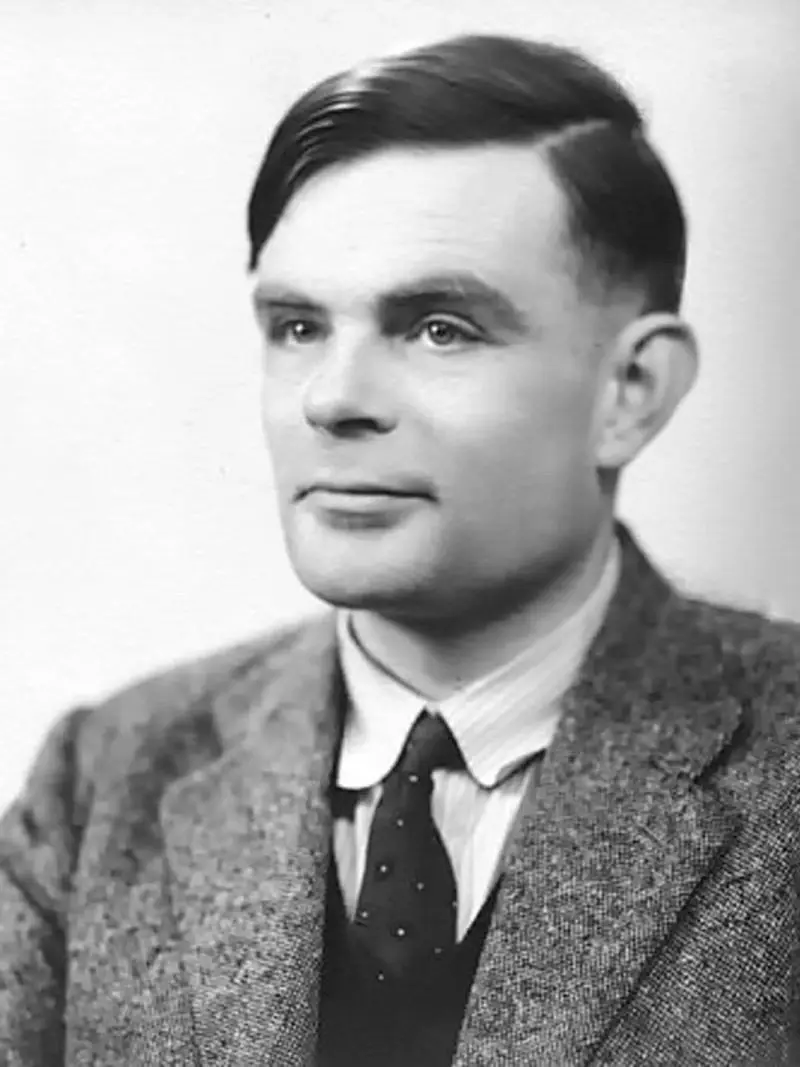
Alan Turing
“The English mathematician who imagined the universal computer in 1936, led the breaking of the German navy's Enigma at Bletchley Park, and asked whether machines can think.”
Alan Mathison Turing (1912–1954) was the English mathematician who gave the world the idea of the computer before anyone had built one. In a paper he wrote at Cambridge at 23, 'On Computable Numbers' (1936), he imagined a machine that reads and writes symbols on an endless paper tape by following a table of rules, and he showed that a single 'universal' machine, given the right table, can do the work of any other: in today's words, one computer that can run any program. With the same idea he proved that no mechanical method can settle every question in mathematics, answering a famous problem set by David Hilbert. In the Second World War he was the leading mind among Britain's codebreakers at Bletchley Park; after it he designed one of the first electronic computers, wrote the first programming manual and asked whether machines can think.
He was born on 23 June 1912 in a nursing home in Maida Vale, London, while his father served in the Indian Civil Service, and grew up with foster families in England. At Sherborne School his teachers despaired of his English, his Latin and his messy work. At sixteen he found a friend who shared his passion for science, Christopher Morcom, whose sudden death in February 1930 left him determined to do the work they would have done together. At King's College, Cambridge, he graduated with distinction in 1934 and was elected a Fellow at 22; in 1935 Max Newman's lectures introduced him to Hilbert's 'decision problem', which led to his paper and then to Princeton, where he took a doctorate under the logician Alonzo Church in 1938.
Already working part-time for the Government Code and Cypher School, he went to Bletchley Park the day after Britain declared war in September 1939. Building on the work of Polish mathematicians, he designed with Gordon Welchman the 'bombe', an electro-mechanical machine that tested Enigma settings at high speed; the first was installed in March 1940, and more than two hundred followed. His section, Hut 8, broke the German navy's Enigma, the cipher of the U-boats hunting the Atlantic convoys, and his statistical methods also helped against Hitler's teleprinter cipher. In October 1941 he and three colleagues wrote directly to Winston Churchill asking for more staff, and Churchill ordered 'Action This Day'. All of this stayed secret for thirty years.
After the war he designed the Automatic Computing Engine (ACE) for the National Physical Laboratory, the first complete design of an electronic stored-program computer, but slow progress there sent him in 1948 to the University of Manchester, which had just run the first working one. There he wrote its programming manual, and in 'Computing Machinery and Intelligence' (1950) he proposed the 'imitation game', now called the Turing test, as a fair way to ask whether a machine can think. From 1951 he used the computer to model how patterns such as spots and stripes form in living things. In 1952 he was convicted of 'gross indecency' for a relationship with a man; he accepted a year of oestrogen injections instead of prison and lost his security clearance. On 7 June 1954 he died at his home in Wilmslow, Cheshire, of cyanide poisoning, aged 41. The inquest found suicide; his mother believed it was an accident, and some historians still question the verdict.
Recognition came late. Computer science's most famous prize, often compared to a Nobel, is the A. M. Turing Award. In 2009 Prime Minister Gordon Brown publicly apologised for the way Britain had treated him, in 2013 Queen Elizabeth II granted him a royal pardon, and the Policing and Crime Act 2017 extended pardons to other men convicted of the same abolished offences. Since 23 June 2021, his birthday, his face from the 1951 portrait on this page has been on the Bank of England's £50 note. Every computer, phone and AI system today is a universal machine in his sense, and the question of his 1950 paper is argued over again in the age of chatbots.
What happened
- 1912
Alan Mathison Turing is born in a nursing home in Warrington Crescent, London, the second son of Julius Turing of the Indian Civil Service and Ethel Sara Turing. While their parents are in India, he and his brother John grow up with foster families in England.
Warrington Crescent, Maida Vale, London: born on 23 June 1912 in Warrington Lodge, then a nursing home, now the Colonnade Hotel, where a blue plaque marks his birthplace- 1926
He starts at Sherborne School in Dorset in the middle of the General Strike, cycling some 60 miles to get there. His teachers despair of his English, his Latin and his messy work.
- 1928
In the sixth form he meets Christopher Morcom, a year older and as passionate about science and astronomy as he is. They work side by side in the laboratories and talk about mathematics when they should be doing French.
- 1930
- 12:00 p.m.
A week after the two boys heard a concert in the Big Schoolroom, Morcom dies at noon in a London nursing home, of tuberculous peritonitis. Turing writes that he must now do alone the work they would have done together.
- 1931
With a scholarship won in December 1930, he comes up to King's College, Cambridge, to read mathematics. King's, the college of John Maynard Keynes, becomes his first true home.
King's College, Cambridge: undergraduate from October 1931, Fellow from March 1935; here he wrote 'On Computable Numbers' (1936)- 1935
A year after graduating with distinction, he is elected a Fellow of King's at 22, for a dissertation in probability theory. The same year Max Newman's lectures introduce him to Hilbert's open question: is there a definite method to decide whether any mathematical statement can be proved?
King's College, Cambridge: undergraduate from October 1931, Fellow from March 1935; here he wrote 'On Computable Numbers' (1936)- 1936
After showing his answer to Newman in April, he sends 'On Computable Numbers' to the London Mathematical Society. It defines what a machine can compute, describes one universal machine able to do the work of any other, and proves that Hilbert's question has the answer no. Hearing that Alonzo Church in Princeton has reached the same result another way, he adds an appendix in August; the paper is read on 12 November and printed at the end of the year.
King's College, Cambridge: undergraduate from October 1931, Fellow from March 1935; here he wrote 'On Computable Numbers' (1936)Having crossed the Atlantic on the liner Berengaria, he enrols as a graduate student at Princeton, to work under Church. There he also builds a cipher machine that multiplies binary numbers with electric relays, and his paper comes to the attention of John von Neumann.
- 1938
Princeton grants him his Ph.D. for 'Systems of Logic Based on Ordinals'. He turns down von Neumann's offer of a post and returns to King's, where he joins Wittgenstein's classes and starts working part-time for the Government Code and Cypher School on the German Enigma.
- 1939
The day after Britain declares war on Germany, he takes up full-time work at Bletchley Park, the codebreakers' new headquarters, and lodges at the Crown Inn in the village of Shenley Brook End nearby.
Bletchley Park, Buckinghamshire: Britain's wartime codebreaking centre, where he worked from September 1939, designed the bombe and led Hut 8 against naval Enigma- 1940
He travels to France to meet the Polish codebreakers who had first broken Enigma and passed their methods to Britain in July 1939. Their insights help him design the British bombe.
His Naval Enigma section moves into Hut 8. The German navy's Enigma, with more rotors and stricter procedures, is thought unbreakable; Turing takes it on because, he says, no one else is doing anything about it.
Bletchley Park, Buckinghamshire: Britain's wartime codebreaking centre, where he worked from September 1939, designed the bombe and led Hut 8 against naval EnigmaThe first bombe, designed by Turing with Gordon Welchman and built by the British Tabulating Machine Company at Letchworth, is installed in Hut 1. Named 'Victory', it tests possible Enigma settings against a guessed piece of a message; eventually more than two hundred are built.
Bletchley Park, Buckinghamshire: Britain's wartime codebreaking centre, where he worked from September 1939, designed the bombe and led Hut 8 against naval Enigma- 1941
With papers captured from German ships, from the Krebs off Norway in February onward, and his statistical method 'Banburismus', Hut 8 breaks the U-boats' Enigma key. From the second half of the year the Admiralty can track the U-boat wolf packs hunting the Atlantic convoys.
Bletchley Park, Buckinghamshire: Britain's wartime codebreaking centre, where he worked from September 1939, designed the bombe and led Hut 8 against naval EnigmaShort of staff, Turing, Welchman, Hugh Alexander and Stuart Milner-Barry write directly to the Prime Minister. Winston Churchill writes 'Action This Day' on their letter and orders that they have all they want, with extreme priority.
Bletchley Park, Buckinghamshire: Britain's wartime codebreaking centre, where he worked from September 1939, designed the bombe and led Hut 8 against naval Enigma- 1942
The U-boats switch to a new four-rotor Enigma, and Hut 8 goes blind on the Atlantic until December, when captured material and new tricks restore the break. In November the chess champion Hugh Alexander takes over Hut 8.
Bletchley Park, Buckinghamshire: Britain's wartime codebreaking centre, where he worked from September 1939, designed the bombe and led Hut 8 against naval EnigmaHe lands in New York for four months of secret liaison with the Americans: he inspects the US Navy's codebreakers in Washington and its bombe factory in Dayton, Ohio, and the speech-scrambling system at Bell Laboratories. He sails home in March 1943, reading about electronics on the way.
- 1945
The war over, he joins the National Physical Laboratory at Teddington to design an electronic computer, a real universal machine. He is made an OBE for his secret war work.
- 1946
The NPL accepts his report 'Proposed Electronic Calculator', the plan of the Automatic Computing Engine (ACE): the first complete design of a stored-program computer, able to switch from arithmetic to codebreaking or chess. Little is built while he stays.
A serious long-distance runner by now, he comes second in a three-mile race at the NPL on Boxing Day. In 1947 he finishes fifth in the AAA Marathon, and only an injury stops him being considered for the 1948 Olympics.
- 1948
Frustrated at the NPL, he moves to the University of Manchester as deputy director of its computing laboratory, where on 21 June the 'Baby' of Frederic Williams and Tom Kilburn had become the first computer to run a program stored in its memory. His job is to make the machine usable.
Coupland Building, University of Manchester: his office and the Manchester computers, from October 1948 until his death- 1949
Interviewed by The Times about the Manchester 'electronic brain', he calls what it can do 'only a foretaste of what is to come'.
Coupland Building, University of Manchester: his office and the Manchester computers, from October 1948 until his death- 1950
He buys his first house, at 43 Adlington Road in Wilmslow, a village south of Manchester, and keeps running the lanes around it.
43 Adlington Road, Wilmslow, Cheshire: the house he bought in 1950, where he was arrested in 1952 and died on 7 June 1954The philosophy journal Mind publishes 'Computing Machinery and Intelligence'. Instead of asking 'Can machines think?', he proposes the imitation game: if a judge exchanging typed messages cannot tell a machine from a person, we should grant that it thinks.
Coupland Building, University of Manchester: his office and the Manchester computers, from October 1948 until his death- 1951
The Ferranti Mark 1, the factory-built version of the Manchester computer and the first computer put on the market, comes into operation. Turing's programming manual is its guide, and he becomes one of the first scientists to use a computer for his own research.
Coupland Building, University of Manchester: his office and the Manchester computers, from October 1948 until his deathElected a Fellow of the Royal Society for his work of 1936, he sits for formal portraits by Elliott & Fry; one of them is now the face on the £50 note.
He sends the Royal Society 'The Chemical Basis of Morphogenesis', which shows how two chemicals reacting and spreading through tissue can make spots, stripes and spirals from an even start; it is published on 14 August 1952 and becomes a founding paper of mathematical biology.
Coupland Building, University of Manchester: his office and the Manchester computers, from October 1948 until his death- 1952
After a burglary at his house he tells the police that the burglar was an acquaintance of Arnold Murray, a young Manchester man, and openly admits their relationship, then a crime. Both are charged.
43 Adlington Road, Wilmslow, Cheshire: the house he bought in 1950, where he was arrested in 1952 and died on 7 June 1954Tried for gross indecency, he pleads guilty but says he sees nothing wrong in what he did. To avoid prison he accepts a year of probation with oestrogen injections meant to suppress his desire; he loses his security clearance and his secret work for GCHQ.
- 1953
The University of Manchester creates a readership in the theory of computing for him. He works on plant patterns, the Fibonacci numbers in sunflower heads, and new ideas in quantum physics.
Coupland Building, University of Manchester: his office and the Manchester computers, from October 1948 until his death- 1954
He dies at his home in Wilmslow of cyanide poisoning, aged 41, and is found by his cleaner the next morning, a half-eaten apple by his bed. The inquest finds suicide; his mother believes he swallowed cyanide by accident after one of his chemistry experiments, and the question has never been settled.
43 Adlington Road, Wilmslow, Cheshire: the house he bought in 1950, where he was arrested in 1952 and died on 7 June 1954