ENIAC, the first general-purpose electronic computer
“ENIAC, built for the US Army at the University of Pennsylvania and unveiled in February 1946, was the first general-purpose electronic computer: 18,000 vacuum tubes and 30 tons filling a whole room.”
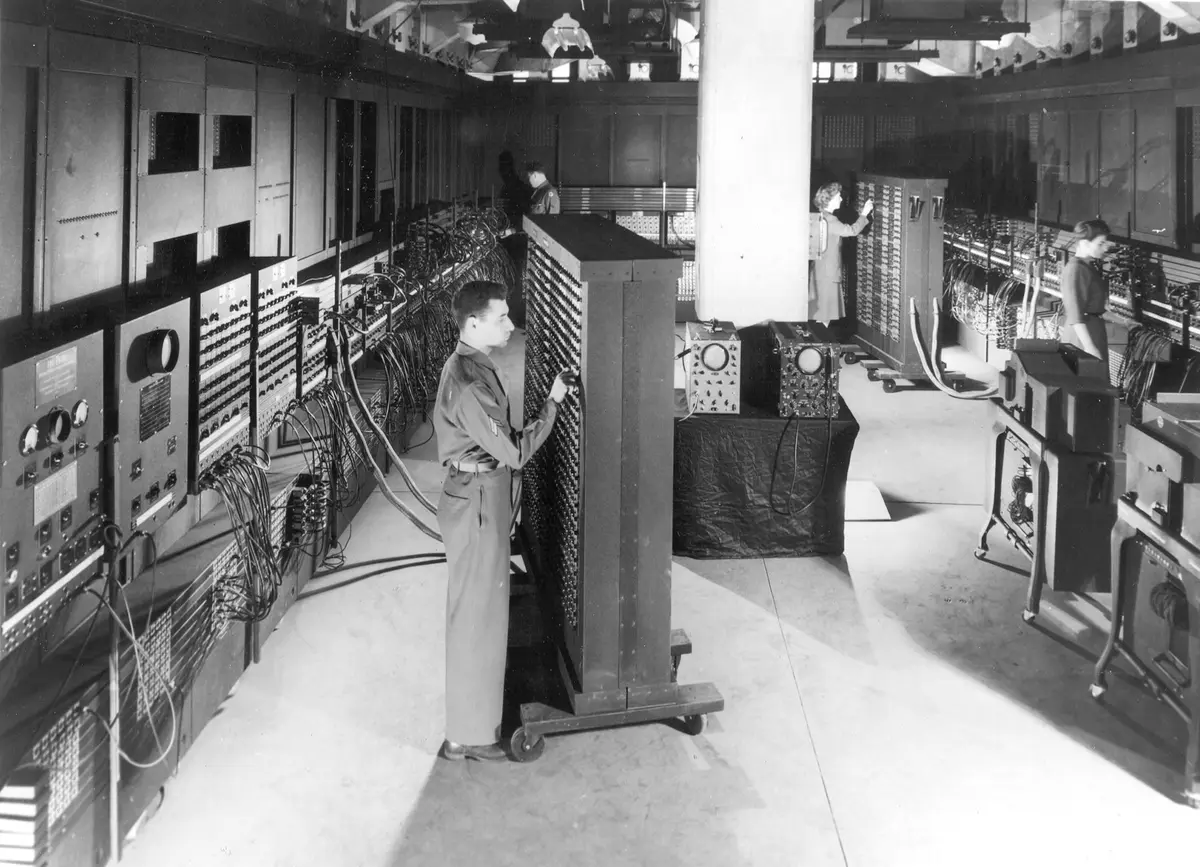
ENIAC, the Electronic Numerical Integrator and Computer, was the first electronic computer that could be set up to do any kind of calculation. It was built from 1943 to 1945 at the Moore School of Electrical Engineering of the University of Pennsylvania in Philadelphia, paid for by the US Army, and shown to the world in February 1946. It filled a room of about 30 by 50 feet: forty black panels standing in a U along three walls, nearly 18,000 vacuum tubes, some 30 tons, drawing about 150 to 174 kilowatts of electricity. It could do 5,000 additions a second. A shell's 60-second flight took a skilled person with a desk calculator about 20 hours to work out; ENIAC did it in 30 seconds, faster than the shell itself flew.
It was built for the war. The Army's Ballistic Research Laboratory at Aberdeen Proving Ground in Maryland had to compute a 'firing table' for every new gun and shell, so that gunners knew how to aim, and its rooms of human 'computers', most of them young women with mathematics degrees, could not keep up even with the help of two mechanical differential analyzers, one at Aberdeen and one at the Moore School. In August 1942 the physicist John Mauchly wrote a short memo proposing to do the arithmetic with vacuum tubes, which switch thousands of times faster than any mechanical part. Lieutenant Herman Goldstine, the Army mathematician in charge of the computing team in Philadelphia, took the idea to his superiors, and a contract was signed on 5 June 1943: $61,700 at first, about $487,000 in the end. J. Presper Eckert, then only 24, was the chief engineer; he made the machine reliable by running its tubes far below their rated power.
ENIAC had no stored program. To set it up for a new problem, people plugged hundreds of cables and turned thousands of switches, a job that took days. That work fell to six women chosen from the human computers: Kathleen McNulty, Jean Jennings, Betty Snyder, Marlyn Wescoff, Frances Bilas and Ruth Lichterman, who learned the machine from its wiring diagrams. The war ended before ENIAC was finished. Its first real job, run from 10 December 1945, was a secret calculation for Los Alamos on whether a hydrogen bomb could work. On 15 February 1946 it was on the front page of The New York Times and formally dedicated at Penn, but the six programmers were not named. ENIAC then moved to Aberdeen, ran again from August 1947, and served the Army, weather forecasters and atomic scientists until it was switched off at 11:45 p.m. on 2 October 1955.
Its ideas mattered even more than its calculations. While it was still being built, its team and the mathematician John von Neumann planned a better machine, the EDVAC, that would keep its instructions in memory instead of in cables; von Neumann's 'First Draft of a Report on the EDVAC' of June 1945 and the Moore School Lectures of summer 1946 spread that 'stored-program' design to Britain and across the United States, the design nearly all later computers follow. ENIAC itself was converted in 1948 to read its program from its switch tables. Eckert and Mauchly left Penn in 1946 to start their own company, which went on to build UNIVAC, the first American commercial computer, in 1951.
Whether ENIAC was the first computer depends on the words used. Britain's Colossus machines at Bletchley Park were electronic, but they were built for one task, breaking German codes, and kept secret until the 1970s; Konrad Zuse's programmable machines in Germany were not electronic; the machine John Atanasoff and Clifford Berry built at Iowa State in 1939 to 1942 was electronic but could not be programmed. Eckert and Mauchly's patent on ENIAC, granted in 1964, was struck down in 1973 in the case Honeywell v. Sperry Rand, when a federal judge ruled that they had derived the electronic computer from Atanasoff, whom Mauchly had visited in 1941. ENIAC remains the first electronic computer that could be set to any problem, the machine that proved a computer of thousands of tubes could work, and the start of the computer industry. Pieces of it survive at Penn, at the Army's artillery museum at Fort Sill and at the Computer History Museum in California.
What happened
- 1942
John Mauchly, a physicist teaching at the Moore School, writes a short memorandum on doing calculations at electronic speed with vacuum tubes, and circulates it to colleagues including the young engineer J. Presper Eckert.
Moore School Building, University of Pennsylvania, 33rd and Walnut Streets, Philadelphia: ENIAC was designed and built here in 1943–45, ran its first problems and was unveiled in February 1946; four of its panels are on show on the ground floor todayCaptain Paul Gillon, in charge of the Army's ballistic computations, and Lieutenant Herman Goldstine inspect the Ballistic Research Laboratory's computing unit at the Moore School; Goldstine is put in charge of it, its differential analyzer and its human computers.
Moore School Building, University of Pennsylvania, 33rd and Walnut Streets, Philadelphia: ENIAC was designed and built here in 1943–45, ran its first problems and was unveiled in February 1946; four of its panels are on show on the ground floor today- 1943
After Goldstine and Professor John Brainerd bring the plan to Gillon, the Moore School's proposal for an electronic computer is presented at Aberdeen and submitted to the Chief of Ordnance.
Aberdeen Proving Ground, Maryland: the Army's Ballistic Research Laboratory, which ordered ENIAC for its firing tables; ENIAC ran here in Building 328 from 1947 until 2 October 1955The Army and the University of Pennsylvania sign the contract for 'research and development of an electronic numerical integrator and computer', $61,700 for six months; work had begun on 31 May. Brainerd supervises 'Project PX', Eckert is chief engineer, Mauchly principal consultant and Goldstine the Army's resident supervisor.
Moore School Building, University of Pennsylvania, 33rd and Walnut Streets, Philadelphia: ENIAC was designed and built here in 1943–45, ran its first problems and was unveiled in February 1946; four of its panels are on show on the ground floor today- 1944
The first two units, the cycling unit that sets the machine's pulse and one accumulator, are working; ENIAC is put together unit by unit.
Moore School Building, University of Pennsylvania, 33rd and Walnut Streets, Philadelphia: ENIAC was designed and built here in 1943–45, ran its first problems and was unveiled in February 1946; four of its panels are on show on the ground floor todayIn the first week of August Goldstine meets the mathematician John von Neumann on the platform of the Aberdeen railway station and tells him about ENIAC; days later von Neumann sees the machine and becomes a frequent visitor to the Moore School.
Aberdeen Proving Ground, Maryland: the Army's Ballistic Research Laboratory, which ordered ENIAC for its firing tables; ENIAC ran here in Building 328 from 1947 until 2 October 1955At a meeting at Aberdeen attended by von Neumann, the laboratory's board recommends funding a better machine that will store its instructions in memory, the EDVAC; the Army approves $105,600 for it in October.
Aberdeen Proving Ground, Maryland: the Army's Ballistic Research Laboratory, which ordered ENIAC for its firing tables; ENIAC ran here in Building 328 from 1947 until 2 October 1955- 1945
Von Neumann's 'First Draft of a Report on the EDVAC' is dated: it sets out the stored-program design. Widely copied, it gives him the credit and later costs Eckert and Mauchly patent rights on the ideas.
Moore School Building, University of Pennsylvania, 33rd and Walnut Streets, Philadelphia: ENIAC was designed and built here in 1943–45, ran its first problems and was unveiled in February 1946; four of its panels are on show on the ground floor todayWith the function tables and initiating unit added in September and the divider and square-rooter in October, the last units are in place; final assembly runs through the autumn, after the war has ended.
Moore School Building, University of Pennsylvania, 33rd and Walnut Streets, Philadelphia: ENIAC was designed and built here in 1943–45, ran its first problems and was unveiled in February 1946; four of its panels are on show on the ground floor todayThe Applied Mathematics Panel of the National Defense Research Committee distributes the Moore School's restricted 'Description of the ENIAC', the first written account of the machine.
Moore School Building, University of Pennsylvania, 33rd and Walnut Streets, Philadelphia: ENIAC was designed and built here in 1943–45, ran its first problems and was unveiled in February 1946; four of its panels are on show on the ground floor todayENIAC starts its first real job: a secret problem from Los Alamos, programmed with Stanley Frankel and Nicholas Metropolis, on whether a hydrogen bomb could be ignited. The six women programmers set it up on the machine without being told what it is for.
Los Alamos, New Mexico: the laboratory whose secret hydrogen-bomb problem was ENIAC's first real job, from 10 December 1945- 1946
Reporters are shown ENIAC at the Moore School and addressed by General Gladeon Barnes, Eckert, Mauchly, Brainerd and Goldstine; Arthur Burks runs the demonstration, among it 5,000 additions in one second. The story is held back for two weeks.
Moore School Building, University of Pennsylvania, 33rd and Walnut Streets, Philadelphia: ENIAC was designed and built here in 1943–45, ran its first problems and was unveiled in February 1946; four of its panels are on show on the ground floor todayThe War Department releases the news of ENIAC, a machine 'expected to revolutionize the mathematics of engineering', with the Army's photographs.
Moore School Building, University of Pennsylvania, 33rd and Walnut Streets, Philadelphia: ENIAC was designed and built here in 1943–45, ran its first problems and was unveiled in February 1946; four of its panels are on show on the ground floor todayENIAC is on the front page of The New York Times. That evening it is formally dedicated at a dinner in Penn's Houston Hall: General Barnes presses a button that starts the machine, and the guests walk to the Moore School to watch it calculate. The six women who programmed the demonstration are not introduced.
Houston Hall, University of Pennsylvania: the dedication dinner of 15 February 1946, where General Barnes pressed the button that started ENIACThe Army formally accepts ENIAC.
Moore School Building, University of Pennsylvania, 33rd and Walnut Streets, Philadelphia: ENIAC was designed and built here in 1943–45, ran its first problems and was unveiled in February 1946; four of its panels are on show on the ground floor todayThe Moore School Lectures, 48 talks on 'Theory and Techniques for the Design of Electronic Digital Computers', run through July and August; Eckert and Mauchly, who have left Penn to found their own company, lecture to 28 official students from both sides of the Atlantic, spreading the stored-program design.
Moore School Building, University of Pennsylvania, 33rd and Walnut Streets, Philadelphia: ENIAC was designed and built here in 1943–45, ran its first problems and was unveiled in February 1946; four of its panels are on show on the ground floor today- 1947
Dismantled at the Moore School over the winter, ENIAC's first units arrive at Aberdeen Proving Ground.
Aberdeen Proving Ground, Maryland: the Army's Ballistic Research Laboratory, which ordered ENIAC for its firing tables; ENIAC ran here in Building 328 from 1947 until 2 October 1955Eckert and Mauchly file their patent application for the 'Electronic Numerical Integrator and Computer'; it will be granted only in 1964.
ENIAC runs again in Building 328 of the Ballistic Research Laboratory at Aberdeen, 'the largest collection of interconnected electronic circuitry then in existence'.
Aberdeen Proving Ground, Maryland: the Army's Ballistic Research Laboratory, which ordered ENIAC for its firing tables; ENIAC ran here in Building 328 from 1947 until 2 October 1955- 1948
On von Neumann's suggestion, ENIAC is converted to read a fixed set of instructions from its function tables, so that the cables stay in place and a new problem no longer means days of rewiring.
Aberdeen Proving Ground, Maryland: the Army's Ballistic Research Laboratory, which ordered ENIAC for its firing tables; ENIAC ran here in Building 328 from 1947 until 2 October 1955 - 1953
A 100-word magnetic-core memory built by Burroughs is added to ENIAC, the first such memory in service; it works three days after it arrives.
Aberdeen Proving Ground, Maryland: the Army's Ballistic Research Laboratory, which ordered ENIAC for its firing tables; ENIAC ran here in Building 328 from 1947 until 2 October 1955- 1955
- 11:45 p.m.
Outrun by the newer EDVAC and ORDVAC and costly to run, ENIAC is switched off for good after more than 80,000 hours of work since 1948.
Aberdeen Proving Ground, Maryland: the Army's Ballistic Research Laboratory, which ordered ENIAC for its firing tables; ENIAC ran here in Building 328 from 1947 until 2 October 1955