The transistor is invented at Bell Labs
“In December 1947 Bardeen and Brattain made the first transistor at Bell Labs; with Shockley's junction design it replaced the vacuum tube and became the building block of every chip.”
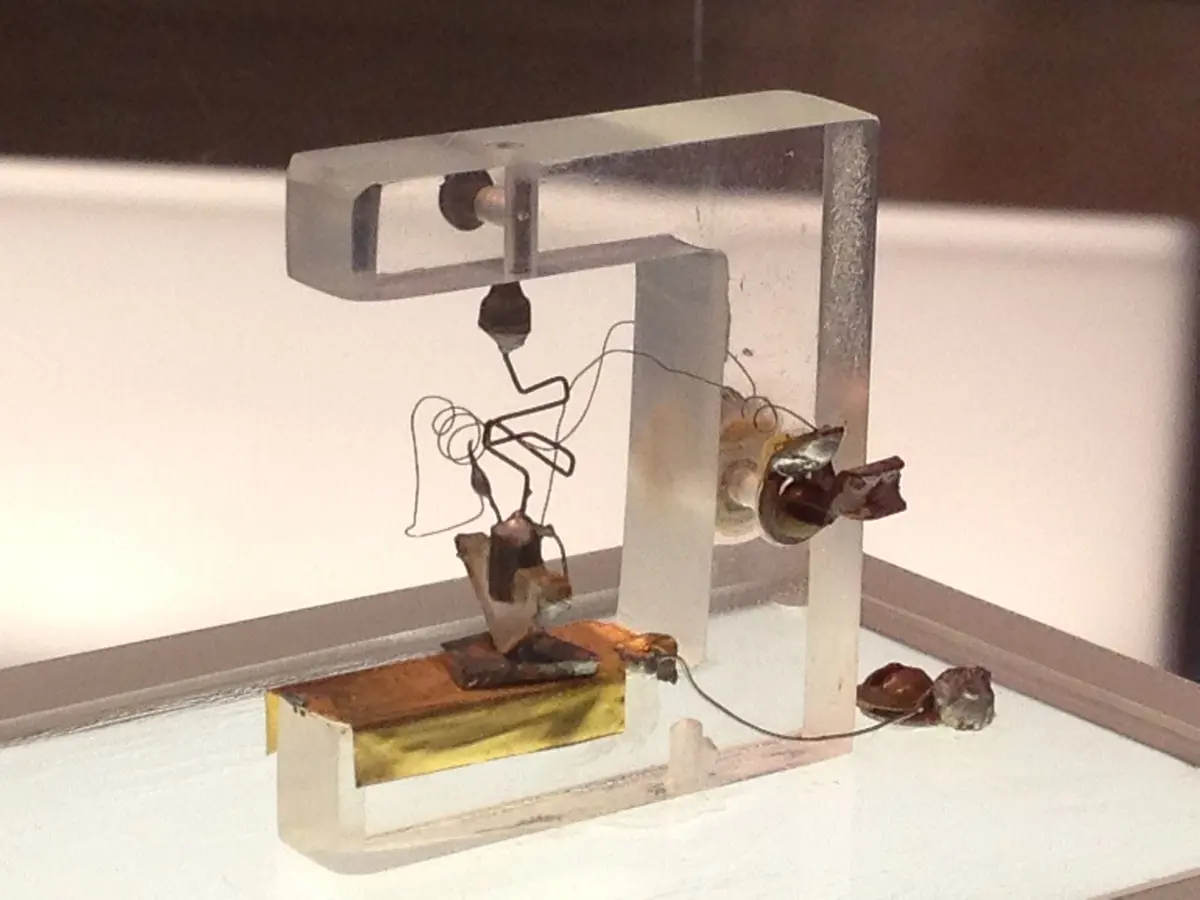
The transistor is a small solid device that amplifies and switches electric currents, doing the work of the vacuum tube without a glass bulb, a vacuum or a glowing filament. The first one was made at Bell Telephone Laboratories, the research arm of the American telephone company AT&T, in Murray Hill, New Jersey. On 16 December 1947 the physicists John Bardeen and Walter Brattain pressed two gold contacts, a fraction of a millimetre apart on the tip of a plastic wedge, onto a slab of germanium, and a signal fed into one contact came out of the other up to a hundred times stronger. A week later, on 23 December, they showed their laboratory's leaders how it made speech louder.
Bell Labs had been looking for exactly this. The telephone network depended on bulky, hot, fragile vacuum tubes to amplify calls and on millions of clanking mechanical relays to switch them. In 1945 the laboratory's executive Mervin Kelly set up a solid-state physics group under the physicist William Shockley and the chemist Stanley Morgan to find a solid replacement. Wartime radar work had taught engineers to purify germanium and silicon, and quantum physics explained how these semiconductors carry current. Shockley's own design, which tried to control the current with an electric field from outside, did not work; Bardeen worked out that electrons trapped at the surface were blocking the field, and the experiments he and Brattain made on that surface led, in a 'miracle month' from 17 November 1947, to the point-contact transistor.
Shockley, angry that the patent would name only Bardeen and Brattain, worked alone and on 23 January 1948 conceived a better design: the junction transistor, a sandwich of three layers of germanium in which the current flows through the solid, not along its surface. Bell Labs showed the 'transistor' to the press in New York on 30 June 1948; The New York Times gave it a few paragraphs on page 46, but engineers understood at once. (In Paris, Herbert Mataré and Heinrich Welker built a similar device on their own that summer.) Making transistors reliably took years: Gordon Teal and Morgan Sparks grew the pure crystals that made Shockley's sandwich real by 1951, Western Electric opened the first production line that October, and AT&T licensed the patents to any company for $25,000.
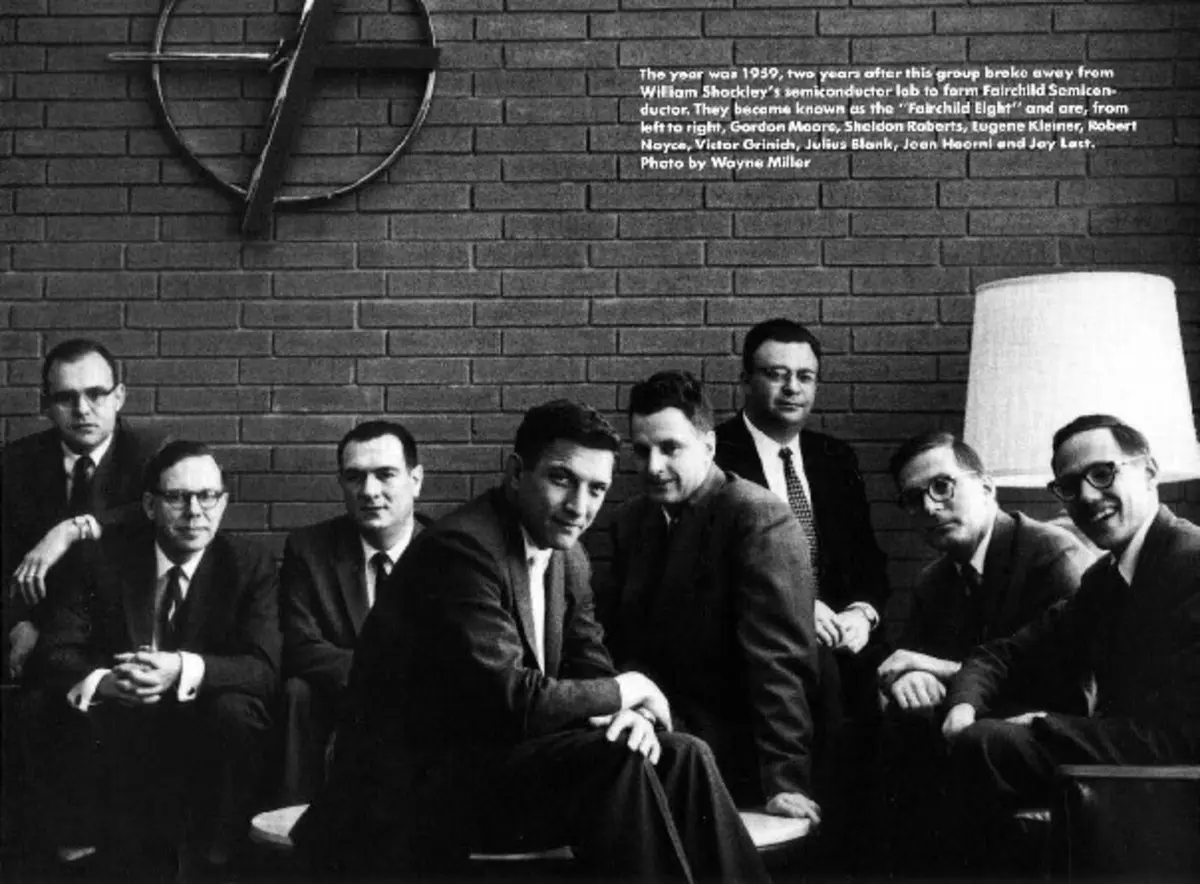
Transistors went first into hearing aids in 1952, then into the Regency TR-1, the first transistor radio, in 1954, the year Texas Instruments began selling transistors made of silicon. In 1956 Shockley, Bardeen and Brattain shared the Nobel Prize in Physics, though by then they no longer worked together: Bardeen had moved to the University of Illinois (he would win a second physics Nobel in 1972), and Shockley had founded his own laboratory in Mountain View, California, the first silicon company in what became Silicon Valley. In 1957 eight of his young staff left to found Fairchild Semiconductor.
The transistor made electronics small, cheap, cool and long-lived enough to go everywhere: into pocket radios, hearing aids, telephone exchanges, military equipment and computers. Packed many to a chip on the integrated circuits that followed from 1958, it became the basic building block of every computer chip, and every phone and laptop today runs on it. The story of Bell Labs also became the model for how industrial research can turn basic physics into an industry.
What happened
- 1945
With the war ending, Bell Labs' executive Mervin Kelly sets up a solid-state physics group under William Shockley and the chemist Stanley Morgan, to find a solid replacement for the vacuum tubes and mechanical switches of the telephone network. Walter Brattain and Gerald Pearson join, and the theorist John Bardeen is hired.
Bell Telephone Laboratories, Murray Hill, New Jersey: the solid-state group's laboratories, where the transistor was made in Building 1, Room 1E455Shockley conceives a 'field-effect' amplifier: an electric field applied from outside should control the current in a thin layer of germanium or silicon. It does not work as intended.
Bell Telephone Laboratories, Murray Hill, New Jersey: the solid-state group's laboratories, where the transistor was made in Building 1, Room 1E455- 1946
Bardeen explains the failure: electrons trapped in 'surface states' block the outside field from reaching into the material. He and Brattain begin a long series of experiments on the semiconductor's surface.
Bell Telephone Laboratories, Murray Hill, New Jersey: the solid-state group's laboratories, where the transistor was made in Building 1, Room 1E455 - 1947
To get rid of condensation, Brattain plunges his experiment into water and sees the largest effect yet: the start of the 'miracle month'. On 21 November Bardeen suggests pushing a metal point into the semiconductor through a drop of liquid, and the device amplifies a little.
Bell Telephone Laboratories, Murray Hill, New Jersey: the solid-state group's laboratories, where the transistor was made in Building 1, Room 1E455Brattain wraps gold foil round a plastic triangle, slits it at the tip with a razor and presses it onto a slab of germanium: a signal fed into one gold contact comes out of the other up to a hundred times stronger. The point-contact transistor works.
Bell Telephone Laboratories, Murray Hill, New Jersey: the solid-state group's laboratories, where the transistor was made in Building 1, Room 1E455Bardeen and Brattain show the device to Bell Labs' leaders, switching it in and out of a circuit so that they can hear speech amplified; Brattain records it in his notebook the next day. Shockley calls it a magnificent Christmas present.
Bell Telephone Laboratories, Murray Hill, New Jersey: the solid-state group's laboratories, where the transistor was made in Building 1, Room 1E455- 1948
Shockley, resentful that he will not be named on the patent, conceives the junction transistor at his kitchen table: a sandwich of three layers of germanium in which the current flows through the solid, not along its surface. He tells no one.
John Shive makes a transistor with its two contacts on opposite faces of a thin sliver of germanium, proving that current carriers can flow through the bulk of the crystal. When the result is presented to the group, Shockley reveals his junction design.
Bell Telephone Laboratories, Murray Hill, New Jersey: the solid-state group's laboratories, where the transistor was made in Building 1, Room 1E455A ballot among Bell Labs staff gives the device its name: 'transistor', suggested by the engineer John R. Pierce, from the transfer of signals through a varistor, a kind of resistor.
Bell Labs files the patent on Bardeen and Brattain's 'three-electrode circuit element', replacing an application of 26 February; it is granted on 3 October 1950 as US 2,524,035. Shockley's name is not on it.
Shockley files his own patent on the junction transistor, in his name alone; it is granted on 25 September 1951 as US 2,569,347.
In the auditorium at 463 West Street, New York, Ralph Bown presents the transistor to the press with a 100-to-1 model; reporters hear speech amplified through telephone receivers, see a television picture restored by a transistor amplifier and listen to a portable radio whose tubes have all been replaced by transistors. The New York Times of 1 July gives it a few paragraphs on page 46.
Bell Labs' West Street building, 463 West Street, Manhattan (now Westbeth): the transistor was first shown to the press in its auditorium on 30 June 1948The Physical Review publishes Bardeen and Brattain's letter 'The Transistor, A Semi-Conductor Triode', with companion letters by Brattain and Bardeen and by Shockley and Pearson.
The trade journal Electronics puts the three men on its cover and explains 'The Transistor - A Crystal Triode' to engineers.
- 1951
Bell Labs announces the junction transistor at a press conference featuring Shockley. Gordon Teal's large single crystals of germanium and Morgan Sparks's method of adding impurities while the crystal grows (the first n-p-n structures in April 1950) have made Shockley's sandwich real, and it now beats the point-contact device.
Bell Telephone Laboratories, Murray Hill, New Jersey: the solid-state group's laboratories, where the transistor was made in Building 1, Room 1E455Bell Labs holds its first transistor symposium at Murray Hill, for some 300 engineers and the armed services.
Bell Telephone Laboratories, Murray Hill, New Jersey: the solid-state group's laboratories, where the transistor was made in Building 1, Room 1E455Western Electric, AT&T's manufacturing arm, opens the first commercial transistor production line, at its plant in Allentown, Pennsylvania.
Allentown, Pennsylvania: Western Electric's plant, where the first commercial transistor production line opened on 1 October 1951- 1952
The first consumer product with a transistor goes on sale late in the year: Sonotone's hearing aid at $229.50, with one transistor and two vacuum tubes. AT&T has offered hearing-aid makers free licences in honour of Alexander Graham Bell.
Companies that have paid AT&T's $25,000 licence fee, among them Texas Instruments and the future Sony, spend more than a week at Murray Hill and Western Electric's Allentown plant learning to make transistors; the proceedings become the industry's 'cookbook'.
Bell Telephone Laboratories, Murray Hill, New Jersey: the solid-state group's laboratories, where the transistor was made in Building 1, Room 1E455- 1953
Raytheon begins selling the CK722 junction transistor, cheap enough for hobbyists; by 1954 almost all hearing aids use only transistors.
- 1954
At a radio engineers' conference in Dayton, Ohio, Gordon Teal, now at Texas Instruments, announces that TI is making silicon transistors, which work at temperatures germanium cannot stand.
The Regency TR-1 is launched at $49.95: the first transistor radio, built by an Indianapolis firm with four germanium transistors from Texas Instruments. More than 100,000 are sold.
- 1956
Shockley, who has left Bell Labs, and the businessman Arnold Beckman announce the Shockley Semiconductor Laboratory at 391 San Antonio Road, Mountain View; among its young recruits are Robert Noyce and Gordon Moore.
Shockley Semiconductor Laboratory, 391 San Antonio Road, Mountain View, California (1956)Shockley, Bardeen and Brattain are awarded the Nobel Prize in Physics 'for their researches on semiconductors and their discovery of the transistor effect'; each hears the news in a different place.
In Stockholm the three receive their prizes from King Gustaf VI Adolf; that night, after years apart, they sit together at dinner.
Konserthuset, Stockholm: the Nobel Prize ceremony of 10 December 1956