The telephone
“In 1876 Alexander Graham Bell patented the telephone and spoke its first sentence, 'Mr. Watson—come here—I want to see you'; by 1878 the first telephone exchange was open.”
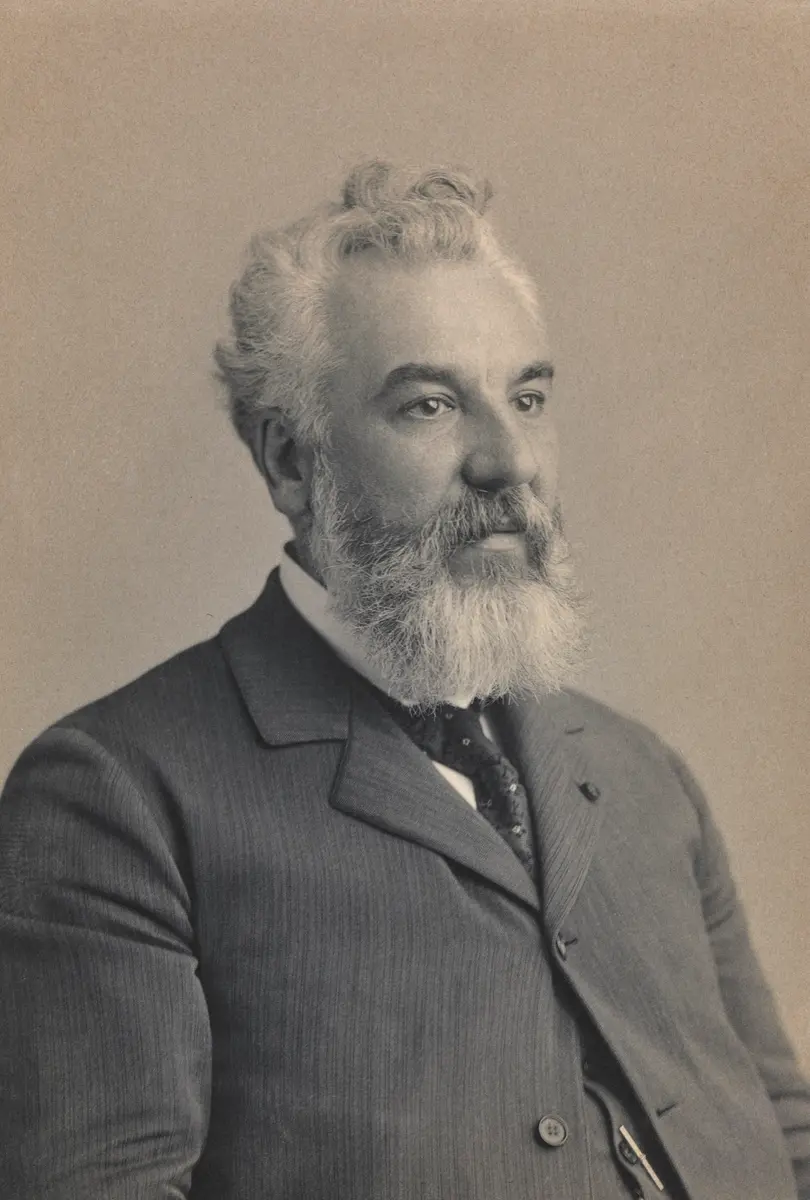
The telephone was invented between 1874 and 1876 by Alexander Graham Bell, a Scottish-born teacher of the deaf working in Boston, with his young assistant Thomas Watson. Speech ran in Bell's family: his father had devised 'Visible Speech' to help deaf people learn to talk, and Bell trained teachers of the deaf and taught at Boston University. Like several inventors of the time he was trying to build a 'harmonic telegraph' that would send many telegraph messages over one wire at once on tuned steel reeds, paid for by two fathers of his pupils, the patent lawyer Gardiner Greene Hubbard and the leather merchant Thomas Sanders. In the summer of 1874, at his parents' house on Tutela Heights near Brantford, Ontario, Bell saw a bigger idea: an electric current that rose and fell exactly as the air does when someone speaks could carry the voice itself.
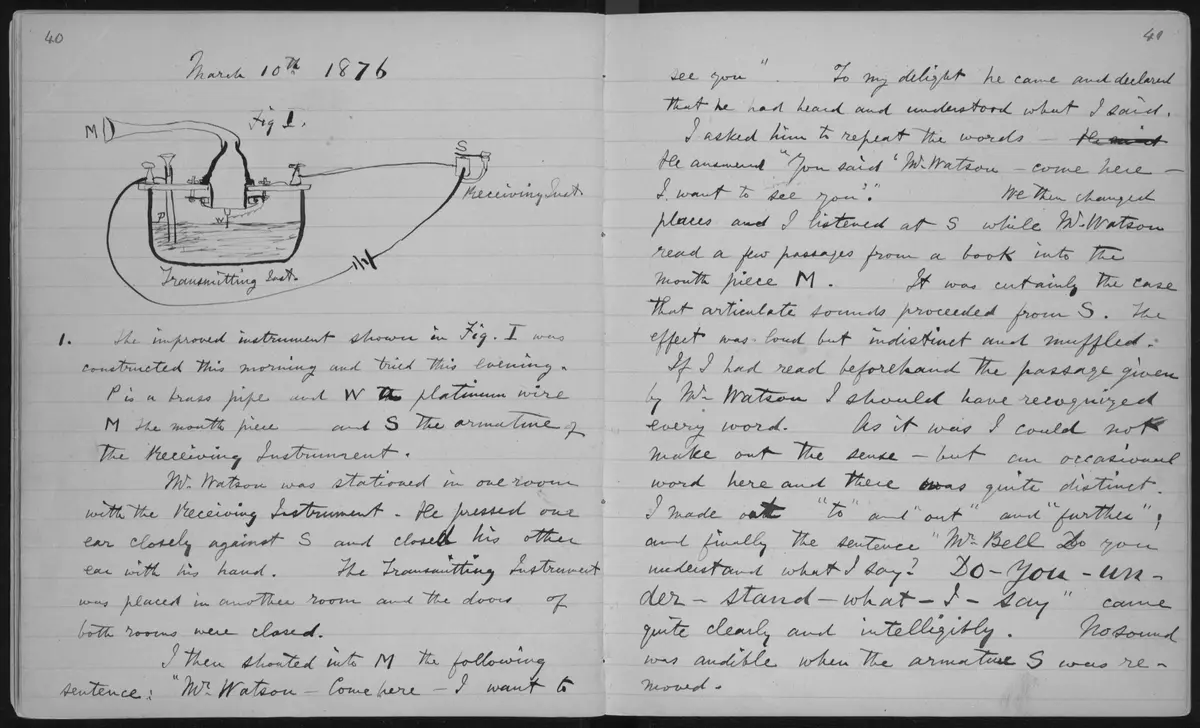
On June 2, 1875, in the attic of Charles Williams's electrical shop at 109 Court Street, Boston, a stuck reed that Watson plucked sent its twang down the wire to Bell's receiver in another room, and Bell knew the idea could work; the next day Watson built the first telephone to his directions. On February 14, 1876 Hubbard filed Bell's patent application in Washington, and a few hours later the lawyer of Elisha Gray, an inventor allied with the telegraph giant Western Union, filed a caveat, a notice of a planned invention, for a telephone of his own. Patent 174,465, modestly titled 'Improvement in Telegraphy', was granted on March 7. Three days later, at his rooms at 5 Exeter Place, Bell spoke into a new transmitter in which a wire dipped into a liquid, and Watson, listening in another room, heard: 'Mr. Watson—come here—I want to see you.' Bell wrote the words into his laboratory notebook under that day's date.
Then the telephone went public. On June 25, 1876 Bell showed it to the judges of the Centennial Exhibition in Philadelphia, among them Emperor Pedro II of Brazil and the Scottish physicist Sir William Thomson, who called it perhaps the greatest marvel yet achieved by the electric telegraph. In August, over telegraph wires in Ontario, voices and songs sent from Brantford were heard eight miles away in Paris; on October 9 Bell and Watson held the first two-way conversation between two towns, Boston and Cambridgeport, and a Boston newspaper printed both men's notes side by side. Bell's lectures in Salem in the winter of 1877 filled the hall. On July 9, 1877 Hubbard, Sanders, Bell and Watson formed the Bell Telephone Company, which leased telephones in pairs; two days later Bell married Hubbard's daughter Mabel, his former pupil, deaf since childhood. On January 28, 1878 the first commercial telephone exchange opened in New Haven, Connecticut, with 21 telephones on eight lines, so that any subscriber could be connected to any other.
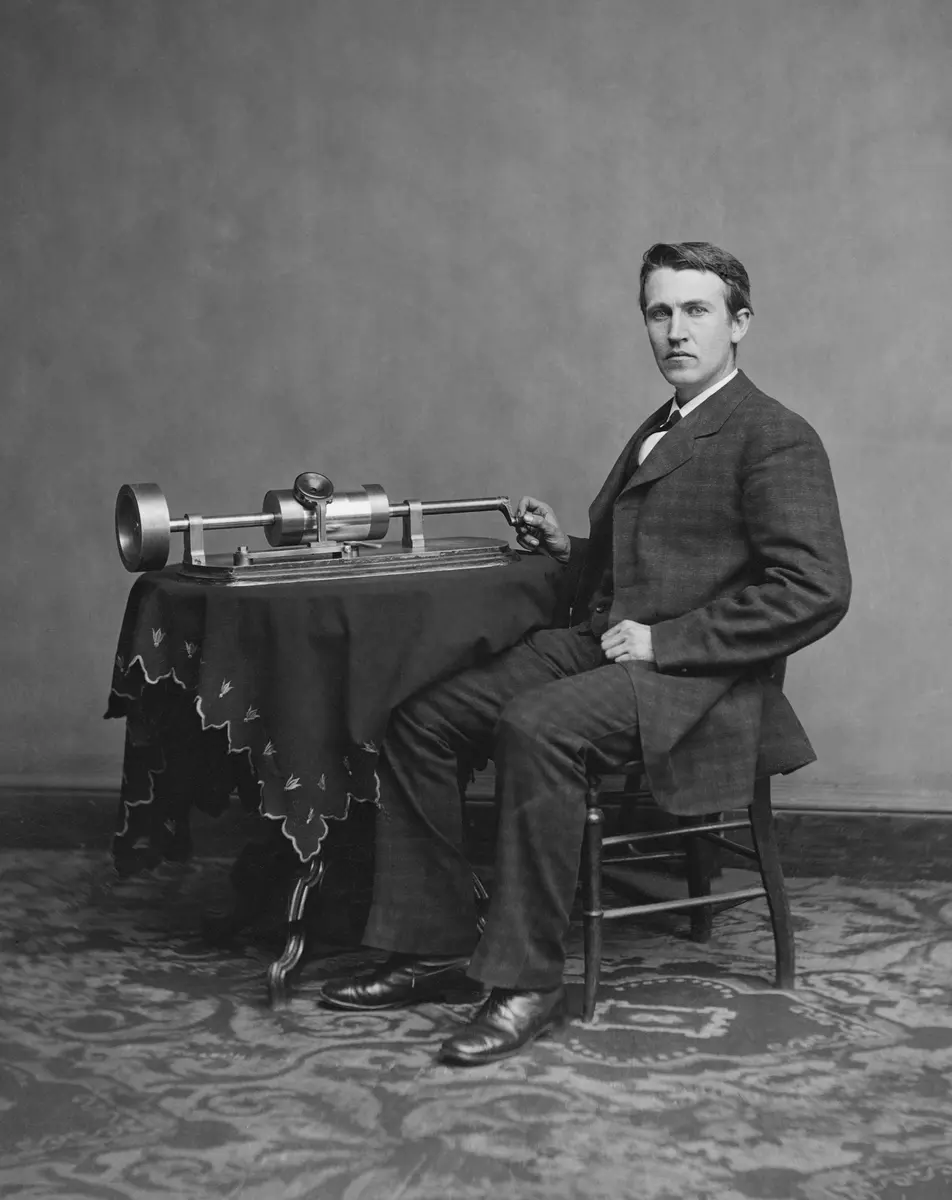
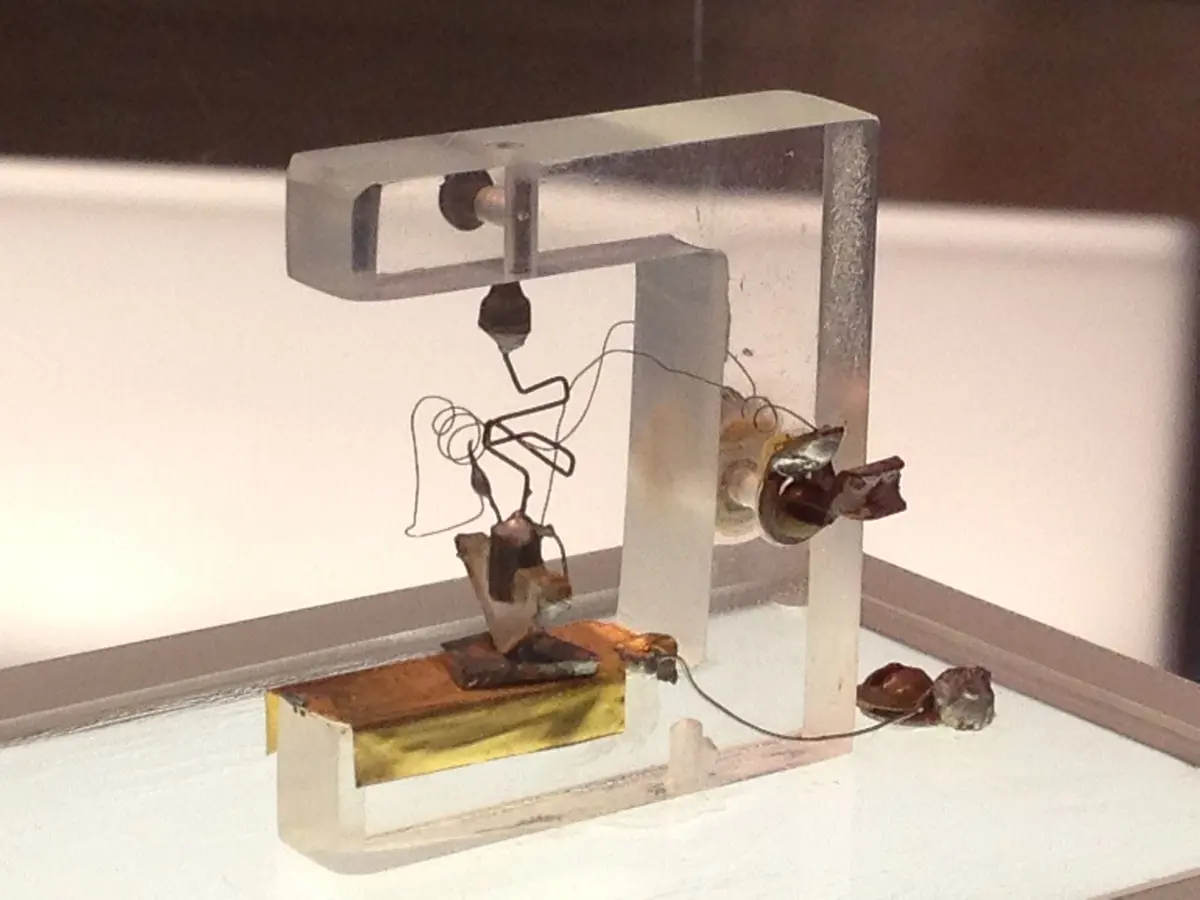
The telephone was the first machine to carry the human voice itself, not a code, over a wire. Thomas Edison's carbon transmitter, ready by the end of 1877, made it louder, and Western Union sold telephones of its own until, in November 1879, it settled with the Bell company and accepted Bell's patents. By the end of 1880 there were almost 48,000 Bell telephones in the United States, and the Bell company, which defended its patents in more than 600 lawsuits, grew into the American Telephone and Telegraph Company, AT&T, whose Bell Labs later invented the transistor. Bell had seen it coming: on the day of the first sentence he wrote to his father that one day wires would be 'laid on to houses just like water or gas', and friends would talk to each other without leaving home.
Who invented the telephone is still argued. Antonio Meucci in New York and Philipp Reis in Germany had built instruments that sent sound by wire years earlier, and in 2002 the US House of Representatives honoured Meucci's work; Gray's caveat described a similar method, and some writers believe Bell saw it at the Patent Office before he made his first sentence work. Historians still weigh these claims, but Bell was the first to patent the principle, to make clear speech travel over a wire, and to build a business on it. Every phone call since, from the New Haven exchange to today's mobile networks, still starts by turning the voice into a changing electrical signal and back again.
What happened
- 1874
At his parents' house on Tutela Heights above the Grand River, near Brantford, Bell works out the principle of the telephone: an electric current that varies in strength exactly as the air varies in density while a sound is made could carry any sound, even speech. That November he sets it out in a letter to his father.
Bell Homestead, Tutela Heights, Brantford, Ontario: Bell's parents' house, where he worked out the idea of the telephone in July 1874- 1875
Thomas Watson, a young mechanic at Charles Williams's electrical shop at 109 Court Street, Boston, where Bell rents attic space for his night-time experiments, starts working with him on the harmonic telegraph.
109 Court Street, Boston: Charles Williams's electrical shop, where Bell and Watson worked in the attic and heard the plucked reed on June 2, 1875Bell signs a written agreement with Gardiner Greene Hubbard and Thomas Sanders, fathers of two of his deaf pupils: they pay for his experiments and share equally in the profits of his telegraph inventions.
In Washington Bell explains his idea to Joseph Henry, the head of the Smithsonian Institution, who calls it 'the germ of a great invention'; when Bell says he lacks the knowledge of electricity, Henry answers: 'Get it!'
Bell receives US Patent 161,739 for his harmonic telegraph, which sends several messages at once along one wire by tuned steel reeds.
The Patent Office Building, Washington: Bell's application was filed on February 14, 1876 and Patent 174,465 granted on March 7In the hot attic at Court Street one of Watson's transmitter reeds sticks; when he plucks it, Bell, in another room, hears its twang in his receiver. The plucked reed has made exactly the undulating current Bell had imagined, and he knows that a voice could do the same.
109 Court Street, Boston: Charles Williams's electrical shop, where Bell and Watson worked in the attic and heard the plucked reed on June 2, 1875Watson builds the first telephone to Bell's directions, a drumhead of gold-beater's skin over a receiver, and runs a wire from the attic down to the shop floor. That evening Watson hears Bell's voice and almost catches the words, but Bell cannot hear him.
109 Court Street, Boston: Charles Williams's electrical shop, where Bell and Watson worked in the attic and heard the plucked reed on June 2, 1875In Brantford again, Bell improves the telephones, putting a thin iron disc on the membrane at the suggestion of his parents' doctor; that month he starts on the specification for a telephone patent.
Bell Homestead, Tutela Heights, Brantford, Ontario: Bell's parents' house, where he worked out the idea of the telephone in July 1874- 1876
In New York Bell hands his specification to George Brown, the Toronto newspaper owner who has taken the British rights and sails for Britain the next day; Brown soon doubts the invention and decides 'to go no further in the business', while Hubbard waits for word before filing in America.
Hubbard, tired of waiting, files Bell's application at the Patent Office in Washington; a few hours later the lawyer of Elisha Gray files a caveat, a notice of a planned invention, describing a telephone by a similar method. Who reached the office first, and what Bell later learned of Gray's papers, has been argued ever since.
The Patent Office Building, Washington: Bell's application was filed on February 14, 1876 and Patent 174,465 granted on March 7The Patent Office grants Bell US Patent 174,465, 'Improvement in Telegraphy', for transmitting 'vocal or other sounds' by an undulating current: one of the most valuable patents ever issued, and one of the most contested.
The Patent Office Building, Washington: Bell's application was filed on February 14, 1876 and Patent 174,465 granted on March 7In his rooms at 5 Exeter Place, Boston, Bell tries a new transmitter in which a platinum wire fixed to the membrane dips into a liquid. He shouts into it 'Mr. Watson—Come here—I want to see you', and Watson, at the receiver in another room with the doors closed, comes and says he heard and understood: the first sentence ever sent by telephone. The same day Bell writes to his father that wires will one day be laid on to houses 'just like water or gas'.
At the Centennial Exhibition in Philadelphia Bell demonstrates the telephone to the judges, among them Emperor Pedro II of Brazil and Sir William Thomson, who reports it 'the greatest marvel hitherto achieved by electric telegraph'. The telephone wins one of the exhibition's awards.
Centennial Exhibition, Fairmount Park, Philadelphia: Bell showed the telephone to the judges on June 25, 1876Using the Dominion Telegraph Company's line and stovepipe wire run to his father's house, Bell has voices sent from Wallace Ellis's general store in Mount Pleasant to Tutela Heights, four miles away.
Mount Pleasant, Ontario: on August 3, 1876 voices went from Wallace Ellis's store here to the Bell house four miles awayThe longest test yet: over eight miles of telegraph wire from Brantford to Paris, Ontario, where Bell and others in Robert White's boot and shoe store hear voices, music and singing. The line carries sound one way only.
Paris, Ontario: on August 10, 1876 listeners in Robert White's shoe store heard voices and songs sent from Brantford, eight miles awayBell in Boston and Watson in Cambridgeport hold the first two-way telephone conversation between two towns, over two miles of the Walworth Manufacturing Company's private telegraph line; both write down what they said and heard, and the Boston Advertiser prints the two records side by side.
Cambridgeport, Massachusetts: the Walworth Manufacturing Company's factory, end of the line for the first two-way conversation between two towns, October 9, 1876A telephone conversation is held between Boston and Salem, sixteen miles, over railroad telegraph wires, with large box telephones like the one now in the Smithsonian.
- 1877
Bell gives his first public lecture and demonstration of the telephone before the Essex Institute in Lyceum Hall, Salem, the town where he lodged and had done some of his experiments.
Lyceum Hall, Salem: Bell's lectures and demonstrations of February and March 1877In Lyceum Hall again, before an overflow crowd, Bell in Salem talks by telephone with a party of scientists in Boston; Frank Leslie's Illustrated Newspaper prints the scene.
Lyceum Hall, Salem: Bell's lectures and demonstrations of February and March 1877The first outdoor line for regular telephone use is put up between Charles Williams's shop at 109 Court Street and his house in Somerville.
109 Court Street, Boston: Charles Williams's electrical shop, where Bell and Watson worked in the attic and heard the plucked reed on June 2, 1875Hubbard, Sanders, Bell and Watson form the Bell Telephone Company, with Hubbard as trustee, to lease telephones.
Bell marries Mabel Hubbard, his former pupil, deaf since an illness at five, at her parents' home in Cambridge; in August they leave for a year in Britain, where he tries to interest British investors.
By the end of 1877 Thomas Edison, at Menlo Park, has a stronger transmitter in which the voice presses on a small button of carbon and so varies the current; Western Union markets telephones with it against the Bell company.
Menlo Park, New Jersey: Edison's laboratory, where he devised the carbon transmitter in 1877- 1878
Bell demonstrates the telephone to Queen Victoria.
In the Boardman Building in New Haven, Connecticut, George Coy's District Telephone Company opens the world's first commercial telephone exchange, with eight lines and 21 telephones: an operator at a home-made switchboard can connect any subscriber to any other, for $1.50 a month.
741 Chapel Street, New Haven: the Boardman Building, where the world's first commercial telephone exchange opened on January 28, 1878