The first telegraph message
“On May 24, 1844, Samuel Morse sent “What hath God wrought?” by electric telegraph from the Capitol in Washington to Baltimore, opening the age of instant long-distance messages.”
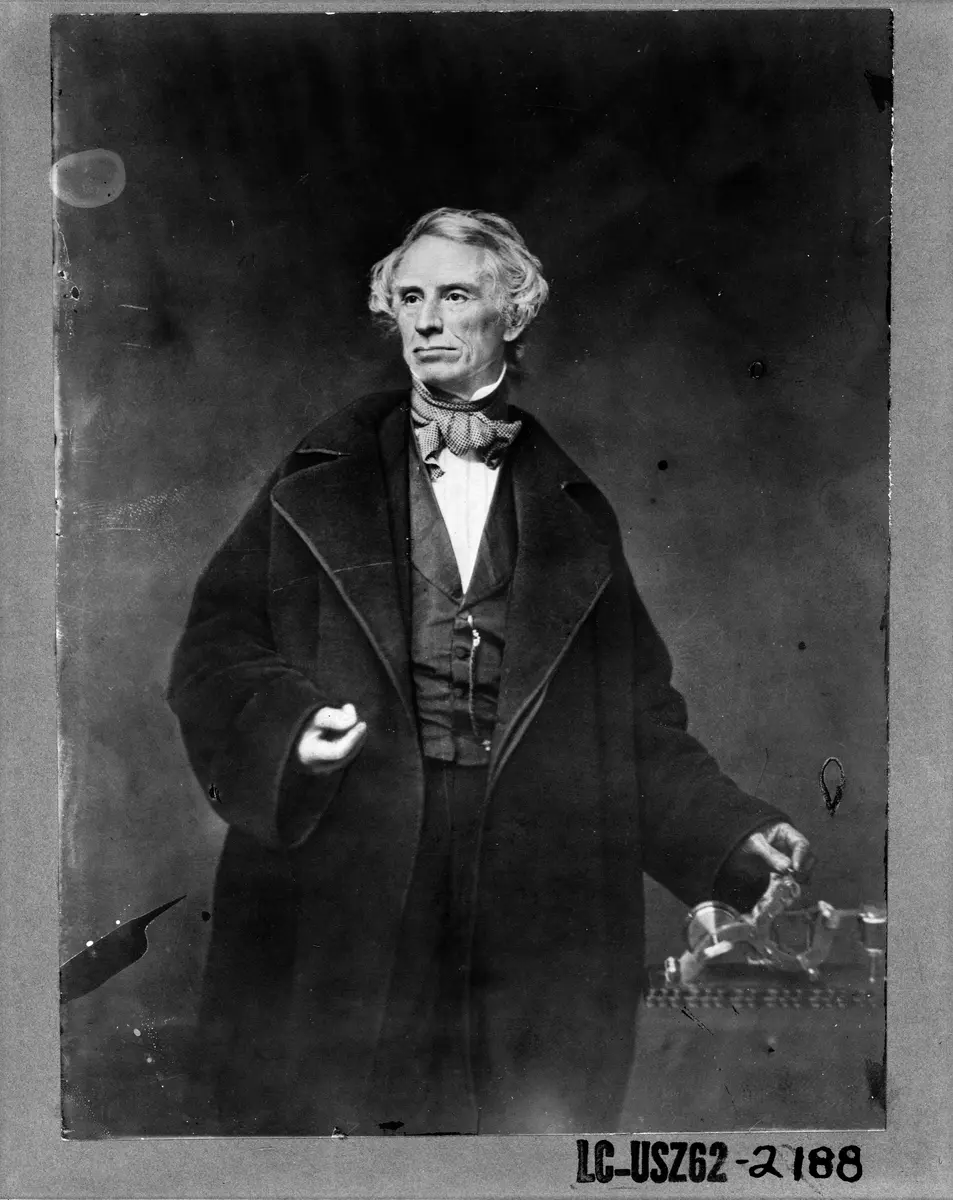
On the morning of Friday, May 24, 1844, Samuel Morse sat at his instrument in the Supreme Court's chamber in the United States Capitol and sent four words chosen from the Bible (Numbers 23:23) by Annie Ellsworth, the teenage daughter of his friend the Commissioner of Patents: “What hath God wrought?” Forty miles away, at a Baltimore depot of the Baltimore and Ohio Railroad, his partner Alfred Vail watched an electromagnet press the message into a moving strip of paper as dots and dashes, and sent it straight back. It opened the first long telegraph line in the United States, built with $30,000 voted by Congress, and news could now pass between two American cities faster than any horse, train or ship could carry it.
Morse was a well-known portrait painter, not a scientist. Sailing home from France on the packet ship Sully in October 1832, after hearing fellow passengers talk about electromagnetism, he sketched a telegraph that would write its signals on paper. Making it work took twelve years. Leonard Gale, a chemistry professor at the university in New York where Morse taught painting, showed him Joseph Henry's work on electromagnets and how to push a signal through miles of wire. Alfred Vail joined in 1837 and built better instruments at his family's ironworks at Speedwell, New Jersey, where the two gave a public demonstration in January 1838. By then they had replaced a dictionary of numbered words with a simple code of dots, dashes and spaces for every letter: Morse code.
Money was the hard part. Morse received his American patent in 1840, but Congress only voted the $30,000 on March 3, 1843. The wires were first laid underground in lead pipe; when the insulation failed, they were strung on poles along the railway between the two cities. The line proved itself at once. On May 1, 1844, with the wires only part of the way, Vail sent the Whig party's choice of Henry Clay for president back to Washington, and in the last week of May the Democratic convention in Baltimore heard Washington's reaction to its nomination of James K. Polk before the result had even been announced in the hall.
Private companies took over from there. By 1846 the line ran on to Philadelphia and New York; by 1850 about 12,000 miles of wire belonged to some twenty American companies; newspapers formed the Associated Press in 1848 to share the cost of telegraphing news; Western Union, formed in 1856, reached California in October 1861; and after a cable of 1858 that failed within a month, a lasting one crossed the Atlantic in 1866. In Britain, William Cooke and Charles Wheatstone had patented a needle telegraph in 1837, but Morse's simpler single-wire system and code were taken up widely: in 1858 ten European governments jointly awarded him 400,000 francs for the invention.
With the electric telegraph, a message no longer needed a messenger. Newspapers, armies, businesses and governments could act within minutes on news from hundreds, then thousands, of miles away, and the wires began the line of networks that leads to today's internet. Morse code outlived the paper tape: operators soon learned to read it by ear, and it was later sent by radio. The strip of paper Morse sent on May 24, 1844 is kept in his papers at the Library of Congress.
What happened
- 1832
Sailing home from Le Havre to New York on the packet ship Sully, the painter Samuel Morse hears fellow passengers, among them the Boston doctor Charles T. Jackson, talk about electromagnetism, and fills his sketchbook with a telegraph that writes its signals on paper and a code of dots and dashes.
- 1836
Morse shows the recording telegraph he built the previous autumn to Leonard Gale, professor of chemistry at the University of the City of New York, where Morse teaches painting. Gale points him to Joseph Henry's electromagnets and helps him plan relays that renew a weakening signal along the wire.
Washington Square East, New York: the site of the University Building, where Morse taught and he and Gale first sent signals through miles of wire- 1837
Alfred Vail, whose family owns the Speedwell ironworks in New Jersey, sees a demonstration and becomes a partner with Morse and Gale (their agreement is dated September 23). On September 28 Morse files a caveat for a patent; his prototypes of that year draw a wavy line on paper.
Washington Square East, New York: the site of the University Building, where Morse taught and he and Gale first sent signals through miles of wireIn Gale's lecture room at the university, a message passes through ten miles of wire wound on reels.
Washington Square East, New York: the site of the University Building, where Morse taught and he and Gale first sent signals through miles of wire- 1838
On the second floor of the Factory Building at Speedwell, Morristown, Vail and Morse give the first public demonstration of the telegraph; the message reads 'A patient waiter is no loser'. That month Morse drops his dictionary of numbered words for a code of dots and dashes for each letter.
The Factory Building at Speedwell, Morristown, New Jersey: Vail and Morse's first public demonstration, January 1838Back in New York, Morse demonstrates the telegraph to friends in his university studio; for the artist and soldier Thomas S. Cummings the tape reads 'Attention the Universe, by kingdoms right wheel'.
Washington Square East, New York: the site of the University Building, where Morse taught and he and Gale first sent signals through miles of wireAfter showing it to the Franklin Institute in Philadelphia on February 8 and to the House Committee on Commerce, Morse demonstrates the telegraph to President Martin Van Buren and his cabinet in Washington.
A bill for $30,000 to build a fifty-mile line, introduced in April by Congressman F. O. J. Smith, now Morse's partner, is never acted on. Morse sails to Europe to seek patents; only France grants one, and in England Cooke and Wheatstone had patented their needle telegraph the year before.
- 1840
Morse receives US Patent 1,647 for his 'American Electro-Magnetic Telegraph': the circuit, the type and port-rule, the register and the system of signs.
- 1842
Morse sends signals through two miles of cable laid under New York harbour between the Battery and Governor's Island.
- 1843
In the last hours of the session the Senate passes the bill, already voted by the House, and President Tyler signs it: $30,000 to test Morse's telegraph on a line between Washington and Baltimore.
- 1844
The wire laid underground in lead pipe, with a machine designed by Ezra Cornell, has failed: Vail writes from Washington that the pipe is defective and that Gale has resigned. By March they are stringing the wire on posts instead.
With wires going up on poles beside the railway since April 1, Vail moves the instruments into the Capitol and talks to Morse there from ten miles down the line.
The Old Supreme Court Chamber in the US Capitol, Washington: Morse's end of the line, where he sent “What hath God wrought?” on May 24, 1844From the Junction, 22 miles out, Vail sends Washington the Whig convention's nominations of Henry Clay and Theodore Frelinghuysen, the first public news sent over the line, as Vail's son later noted.
Annapolis Junction, Maryland, on the railway's Washington branch: Vail telegraphed the Whig nominations from here on May 1, 1844At the railway depot in Baltimore, where he set up the instruments two days earlier, Vail's register embosses the message and he sends it straight back; four tapes are made that day. In the afternoon he moves the instruments to the 'lower depot' and puts them up there.
Mount Clare, the Baltimore and Ohio Railroad's first depot on West Pratt Street, Baltimore: where Vail received the first message (today the railroad museum)- 8:45 a.m.
In the Supreme Court chamber of the Capitol, Morse sends the words Annie Ellsworth has chosen from the Book of Numbers: “What hath God wrought?” The line to Baltimore is open.
The Old Supreme Court Chamber in the US Capitol, Washington: Morse's end of the line, where he sent “What hath God wrought?” on May 24, 1844 Vail sends the words again 'from the lower depot at Baltimore'; Morse signs the strip and keeps it as a souvenir.
The Democratic convention opens in Baltimore and Vail and Morse telegraph its proceedings. When it nominates James K. Polk on the ninth ballot, the news reaches the crowd outside the telegraph room at the Capitol and both houses of Congress, and Washington's reaction is back at the convention before the result is officially announced.
The Old Supreme Court Chamber in the US Capitol, Washington: Morse's end of the line, where he sent “What hath God wrought?” on May 24, 1844Morse reports to the Treasury that the experiment voted by Congress has succeeded: forty miles of line connecting the Capitol with the railroad depot in Pratt Street, Baltimore, its use 'fully proved'.