Volta's battery
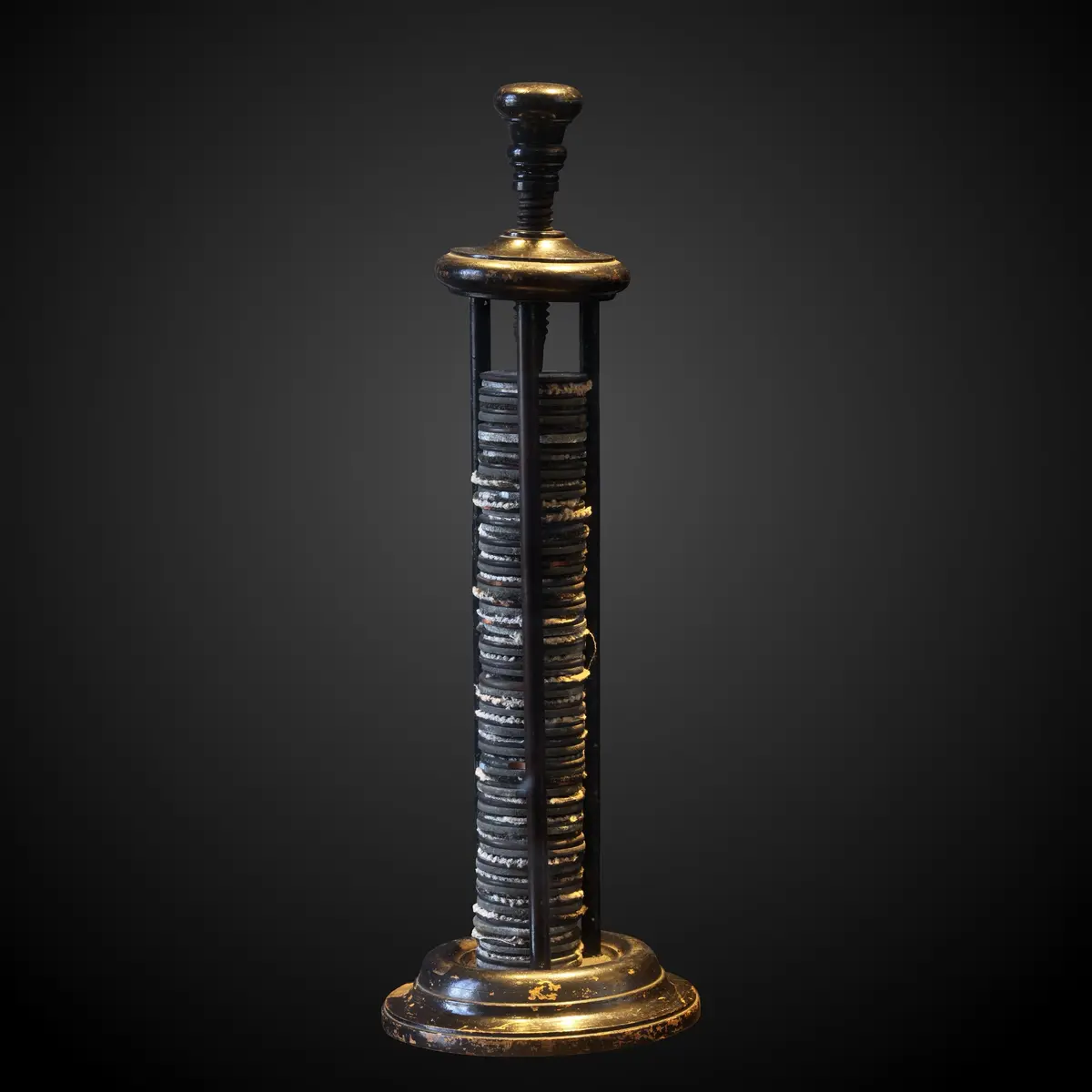
“In 1800 Alessandro Volta stacked pairs of zinc and silver or copper discs with brine-soaked card into the first battery, the first steady electric current; the volt is named after him.”
In 1800 the Italian physicist Alessandro Volta announced the first electric battery. It was a simple column, or 'pile': discs of two different metals, silver or copper and zinc, stacked in pairs, with a disc of card or cloth soaked in salt water between each pair. Joined from top to bottom by a wire, the pile gave a steady flow of electricity, a current that kept running instead of vanishing in a single spark like the charge of the Leyden jars used until then. Volta described it in a long letter in French to Sir Joseph Banks, President of the Royal Society in London, dated at Como on 20 March 1800. It was read to the Society on 26 June and printed in its Philosophical Transactions with an engraving of the pile and of a 'crown of cups', the same idea built from a row of cups of brine. Volta called his device an 'artificial electric organ', because it worked like the organ with which the torpedo fish gives its shocks.
The pile came out of an argument. In 1791 Luigi Galvani, an anatomist in Bologna, published experiments in which the legs of dead frogs twitched when an arc of two metals touched their nerves and muscles; he concluded that animals carry their own 'animal electricity'. Volta, professor of physics at the University of Pavia, repeated the experiments from 1792 and decided that the two metals made the electricity and the frog only showed it; he could feel the effect of two metals on his own tongue. To prove it he needed electricity with no animal in it. Around 1799, at Como, he found that stacking many pairs of metals with wet layers between them added up the tiny effect of each pair into a current anyone could feel.
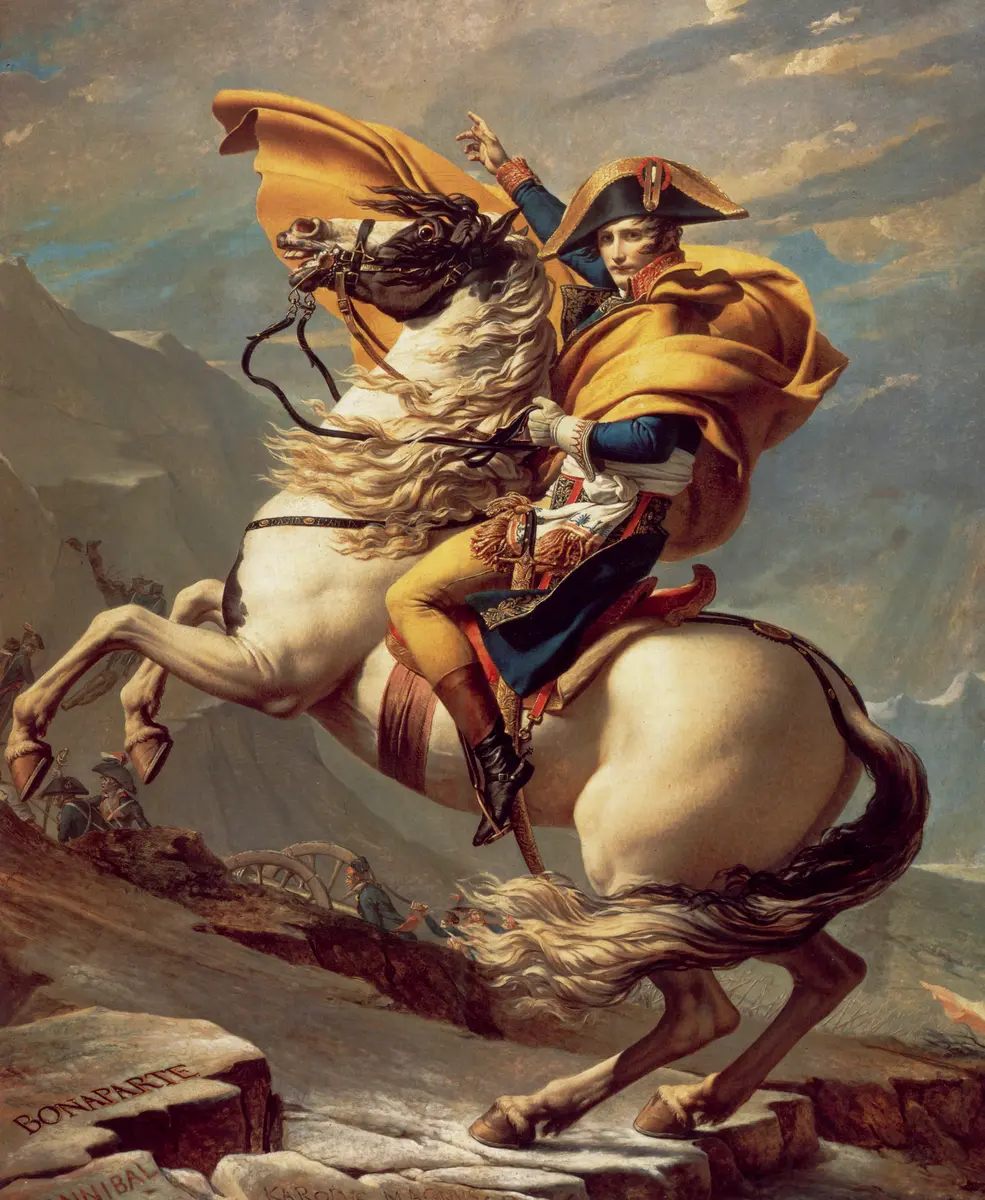
The news ran ahead of the printed paper. At the end of April 1800 Banks let the London surgeon Anthony Carlisle read the first pages; Carlisle and his friend William Nicholson built a pile of silver half crowns, zinc and wet pasteboard, and on 2 May they saw its current split water into bubbles of hydrogen and oxygen. Electrolysis, the use of electricity to break up chemical compounds, was born within six weeks of Volta's letter. In Paris in 1801 Volta showed his experiments to the Institut national with the First Consul, Napoleon Bonaparte, attending; the Institut gave him its gold medal, the government 6,000 francs, and Napoleon later made him a senator and a count. In London Humphry Davy built ever bigger batteries at the Royal Institution, and in 1807 used them to pull two new metals, potassium and sodium, out of potash and soda.
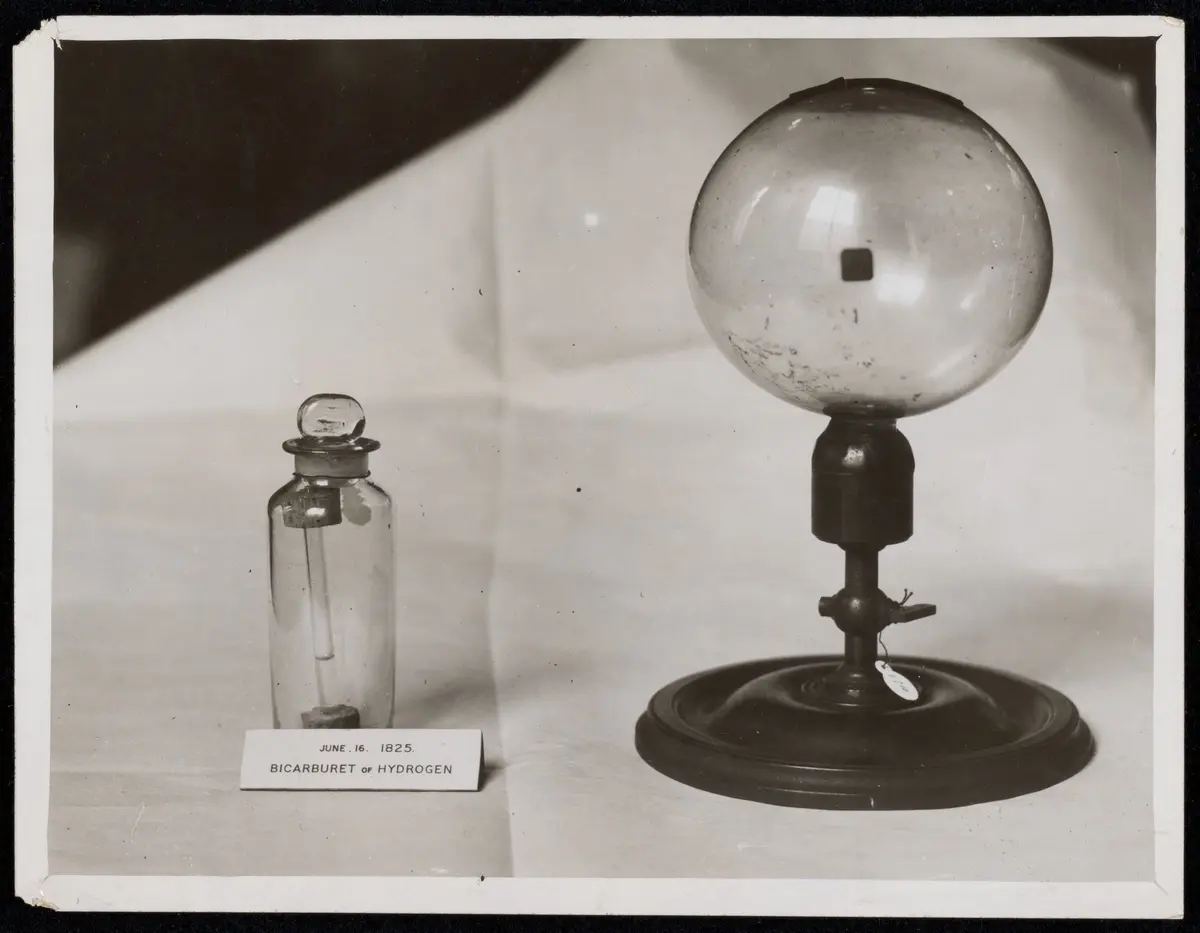
Volta's pile was the first steady, reliable source of electricity, and every battery since works the same way: two different materials with a conducting liquid or paste between them, cells stacked to give more force. For decades batteries were the main source of current, and with them scientists founded electrochemistry and discovered electromagnetism, the road to the electric telegraph, the motor and the dynamo. Volta gave one of his piles to Davy's young assistant, Michael Faraday, in Milan in 1814; it is still at the Royal Institution. In 1881 the unit of electric potential, the volt, was named after him.
What happened
- 1791
In Bologna, Luigi Galvani publishes his Commentary on the Effects of Electricity on Muscular Motion: the legs of dead frogs twitch when an arc of two metals joins their nerves and muscles. He concludes that animals carry their own 'animal electricity'.
Palazzo Poggi, Bologna: home of the city's Institute of Sciences, whose academy Galvani joined in 1765 and presided in 1772; Bologna is where he made the frog experiments he published in 1791 - 1792
Volta, professor of physics at Pavia, repeats Galvani's experiments and begins to test metals alone, even feeling the current of two metals on his tongue. He argues that the metals make the electricity and the frog only shows it: 'metallic electricity'.
University of Pavia, Strada Nuova: Volta's chair of experimental physics and his physics cabinet, now in the University History Museum - 1794
The Royal Society, which elected Volta a Fellow in 1791, awards him its Copley Medal.
- 1796
With a 'doubler', an instrument that magnifies weak charges, Volta makes the electricity of two touching metals show on an instrument, with no frog and no tongue.
University of Pavia, Strada Nuova: Volta's chair of experimental physics and his physics cabinet, now in the University History Museum - 1797
Galvani restates his case with the torpedo, a fish that gives electric shocks. Around this time Volta reads William Nicholson's paper on the torpedo's electric organ, built of many thin columns, in which Nicholson imagined a machine to imitate it.
- 1799
At Como, Volta stacks pairs of silver or copper and zinc discs with wet card between them into a column, and finds that the pile gives shocks and a steady current that renews itself; he also builds the 'crown of cups' on the same principle. Tradition places the work at his villa at Camnago, outside the town.
Volta's family house, Via Alessandro Volta 62, Como: born and died here; his letter of 20 March 1800 is dated at Como - 1800
Volta writes from Como to Sir Joseph Banks, President of the Royal Society, in French, describing his 'new instrument' of good conductors of different kinds, which imitates a weakly charged Leyden battery but recharges itself; the first four pages reach London first, and the rest of the memoir arrives long after.
Volta's family house, Via Alessandro Volta 62, Como: born and died here; his letter of 20 March 1800 is dated at ComoAt the end of April Banks lets the surgeon Anthony Carlisle read the first four pages. Carlisle reads them with his friend William Nicholson and at once builds an instrument to Volta's directions.
Soho Square, London: Nicholson and Carlisle's first pile and the splitting of water, 30 April to 2 May 1800Carlisle's first pile is ready: 17 silver half crowns, as many pieces of zinc and pieces of pasteboard soaked in salt water. It gives shocks, and their instruments show the silver end negative and the zinc end positive.
Soho Square, London: Nicholson and Carlisle's first pile and the splitting of water, 30 April to 2 May 1800Nicholson and Carlisle put a tube of New River water, with a brass wire in each end, across a pile of 36 half crowns. A stream of tiny bubbles of hydrogen rises from one wire while the other tarnishes as oxygen attacks it: the current splits water, the first electrolysis.
Soho Square, London: Nicholson and Carlisle's first pile and the splitting of water, 30 April to 2 May 1800Volta's letter is read to the Royal Society at Somerset House. It is printed in the Philosophical Transactions for 1800 as 'On the Electricity excited by the mere Contact of conducting Substances of different kinds', pages 403 to 431, with Plate XVII showing the pile and the crown of cups.
Somerset House, Strand, London: the Royal Society's home from 1780 to 1857, where Volta's paper was read on 26 June 1800Nicholson describes the pile and their experiments in the July issue of his Journal of Natural Philosophy, Chemistry and the Arts, noting that it has already been 'a subject of great attention among philosophers for near two months'.
- 1801
From Paris the Geneva physicist Marc-Auguste Pictet reports that Volta, travelling with his Pavia colleague Luigi Brugnatelli, is showing experiments that prove galvanism and common electricity are the same, and that the Institut national has named a commission to examine them.
The Louvre, Paris: seat of the Institut national until 1805, where Volta showed his experiments in November 1801 with Bonaparte presentVolta presents his work to the Institut national, then housed in the Louvre, with the First Consul, Napoleon Bonaparte, a member of the Institut, attending.
The Louvre, Paris: seat of the Institut national until 1805, where Volta showed his experiments in November 1801 with Bonaparte presentThe Institut's commission of twelve, among them Laplace, Coulomb and Monge, reports on Volta's experiments and proposes, at the request of one of the members, that the Institut's gold medal be given to him. The French government adds a gift of 6,000 francs, and Napoleon later makes him a senator (1809) and a count (1810).
The Louvre, Paris: seat of the Institut national until 1805, where Volta showed his experiments in November 1801 with Bonaparte present- 1807
Although Britain and France are at war, the Institut de France gives Humphry Davy a prize for his lecture of 1806 'On Some Chemical Agencies of Electricity', the work he did with the Royal Institution's batteries.
Davy reads his Bakerian Lecture to the Royal Society: with the Royal Institution's batteries of 24, 100 and 150 pairs of plates he has decomposed potash and soda, and drawn from them globules of new metals like quicksilver that burst into flame. He names them potassium and sodium.
The Royal Institution, 21 Albemarle Street, London: Davy's great batteries and the isolation of potassium and sodium in 1807