Michael Faraday
“The bookbinder's apprentice who became the great experimenter of electricity: he built the first electric motor and in 1831 discovered electromagnetic induction, the principle of every generator.”
Michael Faraday was the English experimenter who did more than anyone to turn electricity and magnetism into the forces that run the modern world. With almost no schooling and no mathematics, he built the first electric motor (1821), discovered electromagnetic induction (1831), the principle behind every generator and transformer, and found the laws of electrolysis, giving chemistry the words electrode, anode, cathode and ion. He also isolated benzene, showed that magnetism can act on light, and pictured the space around magnets and currents as filled with 'lines of force'. James Clerk Maxwell later turned that picture into the mathematics of the electromagnetic field, and said freely that the ideas were Faraday's.
He was born on 22 September 1791 at Newington Butts, then a village just south of London, the son of a blacksmith from the north of England who was often too ill to work. The family belonged to the Sandemanians, a small and strict Christian church whose faith shaped his whole life and his belief that the forces of nature are one. He learned little more than reading, writing and arithmetic at school. At thirteen he became errand boy to George Riebau, a bookseller in Blandford Street, and from 1805 to 1812 his apprentice bookbinder, reading the science books that passed through his hands. In 1812 a customer's tickets took him to Humphry Davy's last lectures at the Royal Institution. He wrote up and bound his notes and sent them to Davy, and in 1813, when Davy's laboratory assistant was dismissed for brawling, Davy gave him the job. Months later he left with Davy on an eighteen-month tour of Europe, half assistant and half servant, and met Ampère in Paris and Volta in Milan: the tour was his university.
The Royal Institution in Albemarle Street, Mayfair, became his home and workplace. In September 1821, following the Danish physicist Ørsted's discovery that a current makes a magnetic force, he made a wire carrying a current turn steadily round a magnet in a bath of mercury: the first electric motor. Through the 1820s he worked mostly as a chemist, liquefying chlorine and, in 1825, isolating benzene from the oily residue of compressed lamp gas; that year he became Director of the Laboratory. On 29 August 1831, with two coils wound on an iron ring, he saw that switching a current on or off in one coil makes a brief current flow in the other. Within weeks he made a current by moving a magnet in a coil and a steady one by spinning a copper disc between a magnet's poles, the first dynamo. In the 1830s he showed that electricity from batteries, machines, magnets and fish is all the same thing, found the laws that tie chemical change to the quantity of electricity, and in 1836 built a shielding enclosure, so large it had to stand in the lecture theatre, now called a Faraday cage. Overwork broke his health in 1839, but in 1845 he found that a magnet turns the plane of polarised light passing through heavy glass (the Faraday effect), discovered diamagnetism, and came to see the space around bodies, not the bodies themselves, as the seat of electric and magnetic force: the beginning of field theory.
Faraday was also the great public face of science in Victorian London. He started the Friday Evening Discourses and the Christmas Lectures for young people at the Royal Institution in the mid-1820s, gave nineteen series of the Christmas Lectures himself, and his last, 'The Chemical History of a Candle' (1860–61), is still in print. He advised Trinity House on lighthouses and served the Admiralty as scientific adviser, and in 1855 shamed London with a letter to The Times about the filth of the Thames. He refused most honours: he twice declined the presidency of the Royal Society and said he would stay plain Mr Faraday. In 1858 Queen Victoria gave him a house at Hampton Court, where he died on 25 August 1867, and he was buried as a Sandemanian in Highgate Cemetery. His basement laboratory is preserved at the Royal Institution, the farad, the unit of electric capacitance, carries his name, and almost all the world's electricity is still made by his principle of induction.
What happened
- 1791
Michael Faraday is born at Newington Butts, then a village south of London, the third child of James Faraday, a blacksmith from the north of England who has moved there that year to find work, and Margaret Hastwell. The family belongs to the Sandemanians, a small Christian church.
Newington Butts, Elephant and Castle: Faraday was born in the then village on 22 September 1791; the steel Faraday Memorial now stands at the junction- 1804
At thirteen, after a day school that taught him little more than reading, writing and arithmetic, he starts work as errand boy for George Riebau, a bookseller and bookbinder in Blandford Street, delivering newspapers.
Blandford Street, Marylebone: George Riebau's shop, where Faraday was errand boy from 1804 and apprentice bookbinder from 1805 to 1812 - 1805
Riebau takes him on as an apprentice bookbinder for seven years. He reads the books he binds, among them the article on electricity in the Encyclopaedia Britannica and Jane Marcet's Conversations on Chemistry, and builds a little electrostatic machine and a weak battery of his own.
Blandford Street, Marylebone: George Riebau's shop, where Faraday was errand boy from 1804 and apprentice bookbinder from 1805 to 1812 - 1810
He begins to attend the silversmith John Tatum's science lectures near Blackfriars Bridge, a shilling a time; by September 1811 he has heard thirteen and written them up in four bound, illustrated and indexed notebooks.
- 1812
His notebooks impress a customer of the shop, who gives him tickets to Humphry Davy's last four chemistry lectures at the Royal Institution. Faraday writes up his notes, binds them as a fifth volume, and hopes to leave trade for science.
His apprenticeship ends and he works as a journeyman bookbinder. He has already written to Sir Joseph Banks, President of the Royal Society, who never answered; now he sends Davy his bound notes, and Davy sees him but advises him to keep to his trade.
- 1813
When Davy's laboratory assistant is dismissed for brawling, Davy remembers the young bookbinder and gives him the post of chemical assistant at the Royal Institution.
The Royal Institution, 21 Albemarle Street, Mayfair: his laboratory, lecture theatre and home from 1813 until the late 1850s, where he made all his great discoveriesHe leaves with Davy and Lady Davy on a tour of the continent as assistant, secretary and, to Lady Davy, a servant. In Paris he meets Ampère; they go on to Genoa, Florence, Rome and Naples, and in Milan in June 1814 Volta gives him one of his piles. The eighteen months are his university.
- 1815
Back in London, he is re-engaged at the Royal Institution as assistant in the laboratory; his first paper, on caustic lime from Tuscany, follows in 1816.
The Royal Institution, 21 Albemarle Street, Mayfair: his laboratory, lecture theatre and home from 1813 until the late 1850s, where he made all his great discoveries- 1821
He marries Sarah Barnard, whom he met at the Sandemanian church; they will have no children. The Royal Institution makes him Superintendent of the House and gives the couple rooms in the building.
The Royal Institution, 21 Albemarle Street, Mayfair: his laboratory, lecture theatre and home from 1813 until the late 1850s, where he made all his great discoveriesFollowing Ørsted's discovery of the magnetic force round a current, he makes a wire carrying a current circle steadily round the pole of a magnet in a bath of mercury, and a pole circle round a wire: electrical energy turned into motion, the first electric motor. His paper is dated 11 September and published in the October Quarterly Journal of Science.
The Royal Institution, 21 Albemarle Street, Mayfair: his laboratory, lecture theatre and home from 1813 until the late 1850s, where he made all his great discoveries- 1823
He liquefies chlorine under pressure, the first time a gas thought to be 'permanent' is made liquid.
- 1824
He is elected a Fellow of the Royal Society, with Charles Babbage among his supporters and against the opposition of Davy, now its President.
- 1825
He becomes Director of the Laboratory of the Royal Institution in place of the ailing Davy, and starts its Friday Evening Discourses and Christmas Lectures for young people.
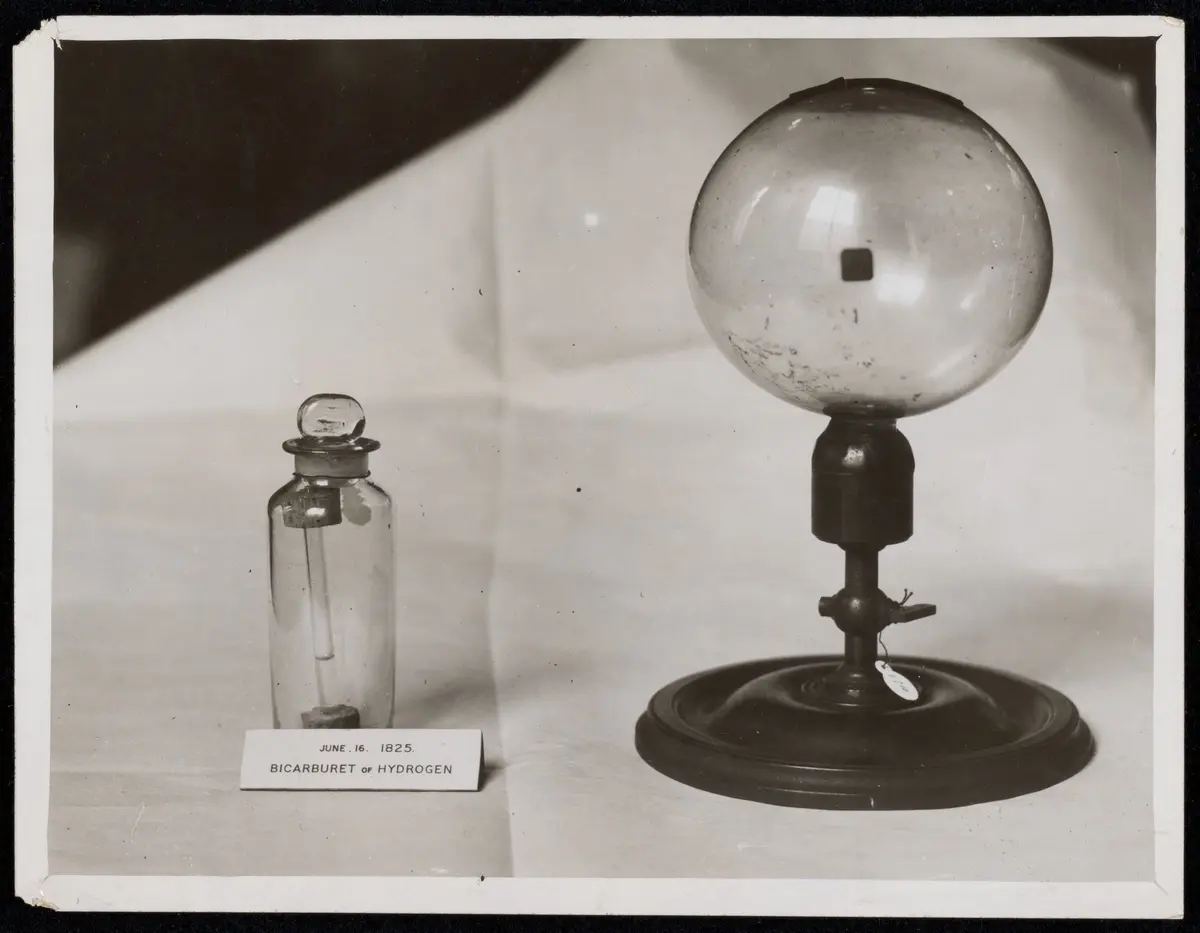
The Royal Institution, 21 Albemarle Street, Mayfair: his laboratory, lecture theatre and home from 1813 until the late 1850s, where he made all his great discoveriesHe reports to the Royal Society 'a new compound of carbon and hydrogen', which he calls bicarburet of hydrogen and we call benzene, separated from the oily liquid left in cylinders of compressed lamp gas made from whale or fish oil.
The Royal Institution, 21 Albemarle Street, Mayfair: his laboratory, lecture theatre and home from 1813 until the late 1850s, where he made all his great discoveries- 1827
He gives his first series of Christmas Lectures, on chemistry, the second series ever held; he will give nineteen. He also publishes Chemical Manipulation, the only book he wrote as a book.
The Royal Institution, 21 Albemarle Street, Mayfair: his laboratory, lecture theatre and home from 1813 until the late 1850s, where he made all his great discoveries - 1831
In the basement laboratory he winds two coils of wire on opposite sides of an iron ring. Closing the battery circuit in one coil makes the galvanometer needle on the other jump, and opening it makes it jump the other way: a changing current induces a current. It is electromagnetic induction, and the ring is the first transformer.
The Royal Institution, 21 Albemarle Street, Mayfair: his laboratory, lecture theatre and home from 1813 until the late 1850s, where he made all his great discoveriesHe reads the first series of his Experimental Researches in Electricity to the Royal Society. That autumn he has made a current by pushing a bar magnet in and out of a coil, and a steady one by turning a copper disc between the poles of a magnet: the first generator and the first dynamo.
- 1833
The Fullerian Professorship of Chemistry is created at the Royal Institution for him.
The Royal Institution, 21 Albemarle Street, Mayfair: his laboratory, lecture theatre and home from 1813 until the late 1850s, where he made all his great discoveries- 1834
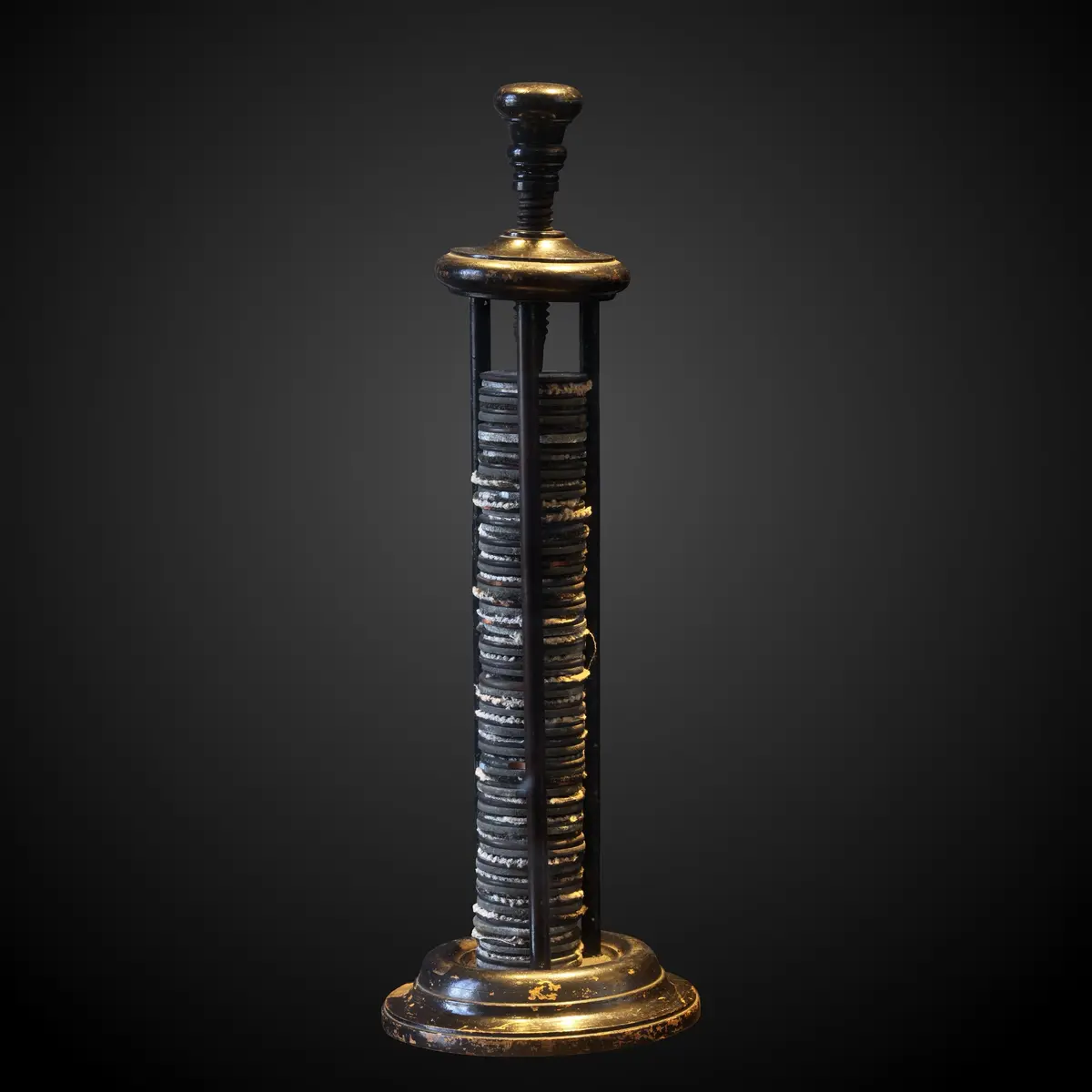
The Royal Society hears the Seventh Series of his Researches. Having shown that electricity from every source is one and the same, he states the laws of electrolysis (the chemical change is proportional to the quantity of electricity) and, after talking it over with the Cambridge scholar William Whewell, proposes the words electrode, anode, cathode, electrolyte and ion.
- 1836
He builds an enclosure that shields what is inside it from electric forces, so large that the only place it fits is the Royal Institution's lecture theatre: the Faraday cage. That year he also becomes scientific adviser to Trinity House, which runs the lighthouses.
The Royal Institution, 21 Albemarle Street, Mayfair: his laboratory, lecture theatre and home from 1813 until the late 1850s, where he made all his great discoveries - 1839
At Henry Talbot's request he announces Talbot's photography at a Friday Evening Discourse, the first public word of the new art in Britain. Later that year, after eight years of relentless work, his health breaks down; he does little research for six years.
The Royal Institution, 21 Albemarle Street, Mayfair: his laboratory, lecture theatre and home from 1813 until the late 1850s, where he made all his great discoveries- 1845
Prompted by a letter from the young William Thomson, he passes polarised light through a block of heavy glass between the poles of a strong electromagnet and sees its plane of polarisation turn: magnetism acts on light, the Faraday effect. Soon after he finds that all matter responds to magnetism, and names the substances pushed away by it diamagnetic.
The Royal Institution, 21 Albemarle Street, Mayfair: his laboratory, lecture theatre and home from 1813 until the late 1850s, where he made all his great discoveries- 1846
When a speaker flees before his Friday Discourse, Faraday fills the hour with 'Thoughts on Ray Vibrations', suggesting that light may be a vibration of the lines of electric and magnetic force: the idea Maxwell later built on.
- 1848
He first gives the Christmas Lectures on the chemical history of a candle.
The Royal Institution, 21 Albemarle Street, Mayfair: his laboratory, lecture theatre and home from 1813 until the late 1850s, where he made all his great discoveries - 1851
He fixes iron filings on waxed paper over magnets and pastes the patterns into his notebook, to show his lines of force; by now he sees space itself, not matter, as the seat of electric and magnetic force.
The Royal Institution, 21 Albemarle Street, Mayfair: his laboratory, lecture theatre and home from 1813 until the late 1850s, where he made all his great discoveries - 1855
He writes to The Times about the filthy state of the Thames; on 21 July Punch shows him handing his card to a filthy Father Thames.
He opens his Christmas Lectures on the distinctive properties of the common metals before an audience that includes Prince Albert, the Prince of Wales and Prince Alfred.
The Royal Institution, 21 Albemarle Street, Mayfair: his laboratory, lecture theatre and home from 1813 until the late 1850s, where he made all his great discoveries- 1857
He declines the presidency of the Royal Society, as he does a second time; he says he will remain plain Mr Faraday to the end.
- 1858
Queen Victoria gives him the use of a house on Hampton Court Green, where he and Sarah spend more and more of their time as his memory fails.
Faraday House, Hampton Court: the grace-and-favour house Queen Victoria gave him in 1858, where he died on 25 August 1867 - 1860
Called on at short notice, he gives his nineteenth and last series of Christmas Lectures, The Chemical History of a Candle, published by William Crookes in 1861.
The Royal Institution, 21 Albemarle Street, Mayfair: his laboratory, lecture theatre and home from 1813 until the late 1850s, where he made all his great discoveries- 1867
He dies at his house at Hampton Court, aged 75, and is buried in the Sandemanian plot of Highgate Cemetery.
Highgate Cemetery, north London: buried in the Sandemanian plot