The first photograph
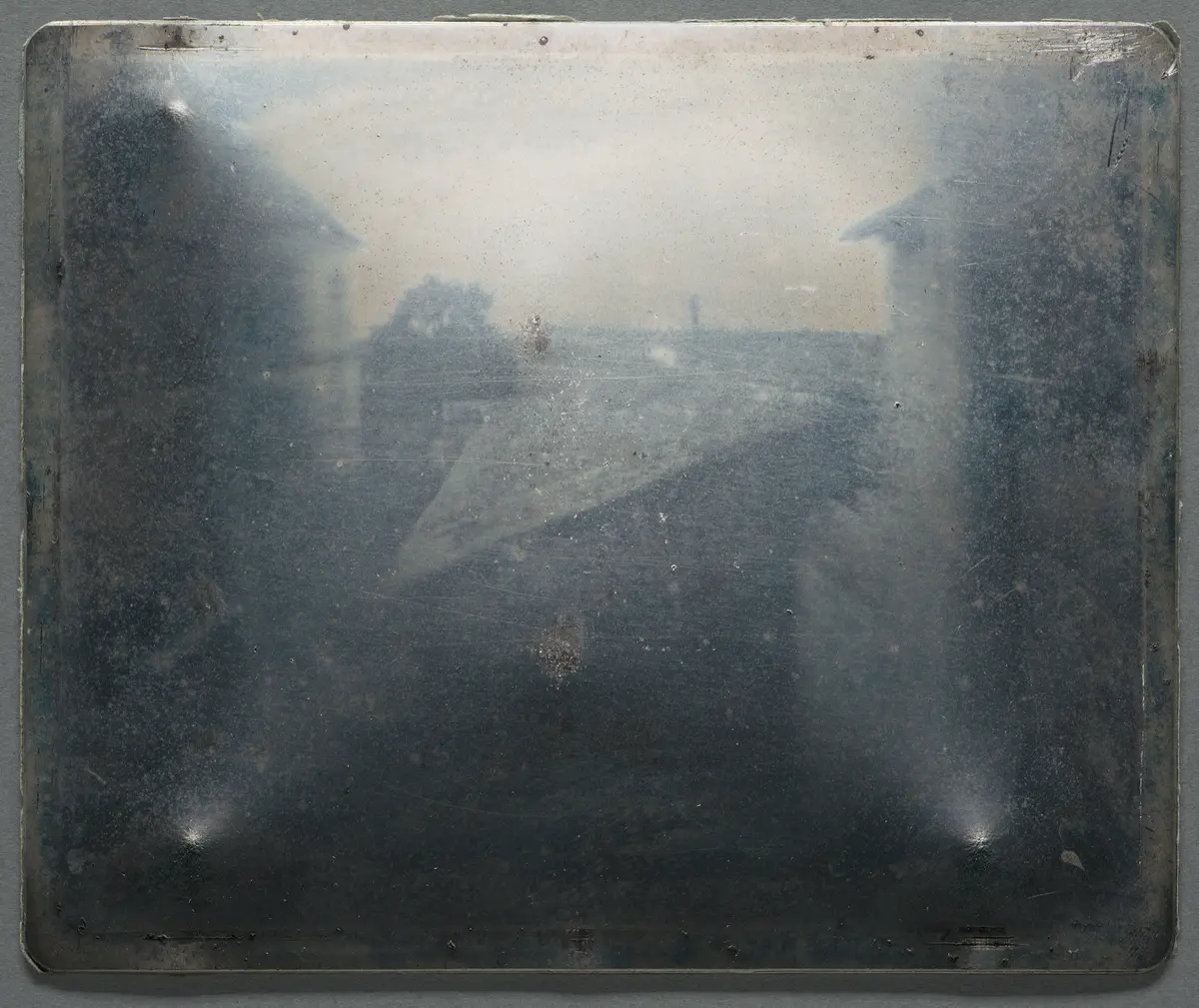
“Nicéphore Niépce's view from his window at Le Gras, fixed on a pewter plate in 1826 or 1827 after hours or days of exposure, is the oldest surviving camera photograph.”
The oldest photograph made with a camera that still exists is a small, dim picture on a pewter plate, about 17 by 20 centimetres. It shows the courtyard, outbuildings and trees seen from an upstairs workroom window at Le Gras, the country house of the inventor Nicéphore Niépce in the village of Saint-Loup-de-Varennes, near Chalon-sur-Saône in Burgundy. Niépce made it in 1826 or 1827; the Harry Ransom Center in Austin, Texas, which owns it, now dates it 1827. He coated the polished plate with bitumen of Judea, a natural asphalt that hardens in light, put it in a camera obscura facing the window and left it there for many hours, perhaps several days. Then he washed it with oil of lavender and white petroleum, which dissolved the bitumen the light had not hardened. What stayed on the plate was a picture that would not fade.
Niépce, born in Chalon in 1765, came from a well-off family, served in Napoleon's army and then lived on his estate as a gentleman inventor; with his brother Claude he had built an early internal-combustion engine, the Pyréolophore, in 1807. When lithography became a fashion in France in 1813, Niépce, who could not draw well, looked for a way to let light copy pictures for him. From 1816 he caught camera views on paper coated with silver chloride, but could fix them only in part. With bitumen he copied an engraving onto glass in 1822, and later more pictures onto metal: a man leading a horse in 1825, and in 1826 a portrait of Cardinal d'Amboise that an engraver etched and printed. He called the process heliography, 'sun writing'. The view from the window is his only camera picture known to survive.
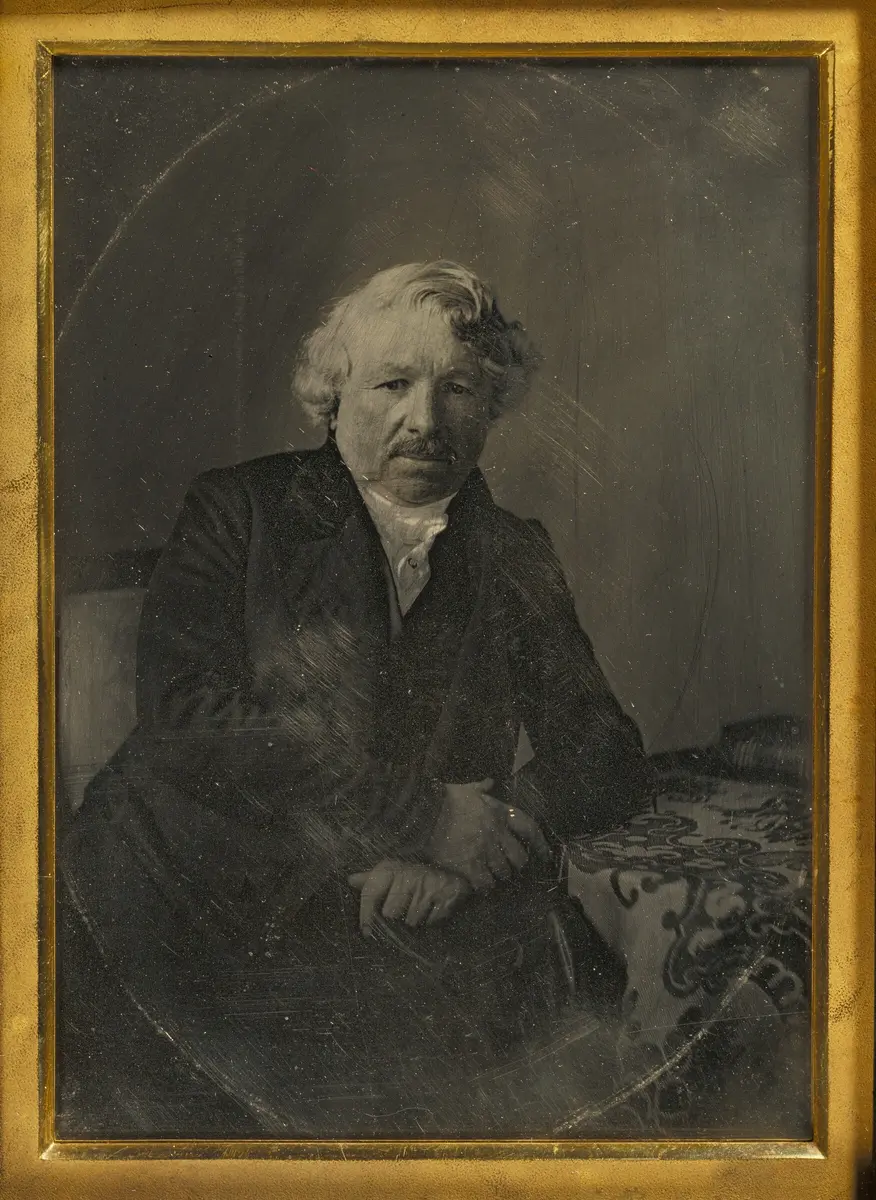
In 1827 Niépce visited England, where his brother lay ill. At Kew the botanical painter Francis Bauer saw what the plates meant and helped him offer a paper to the Royal Society, which turned it down because Niépce kept his method secret; he left the plates with Bauer. His exposures were still far too long, and in 1829 he became the partner of Louis Daguerre, the Paris painter who ran the Diorama. Niépce died in 1833. Daguerre went on alone and found a quicker way: a silver-coated copper plate, made sensitive with iodine fumes, exposed for minutes and developed with mercury vapour. On 7 January 1839 the astronomer François Arago announced the daguerreotype to the Académie des sciences in Paris. The French state bought the process for life pensions to Daguerre and to Niépce's son Isidore, and on 19 August 1839 Arago explained it in public, as France's gift to the world. In England Henry Talbot rushed out his own process on paper: from his negatives, the oldest surviving one made in 1835, any number of prints could be made.
Within months photography spread around the world, and the camera became the way people recorded faces, cities, wars and science. Niépce's own part was nearly forgotten. His plates were shown in England in 1839 to prove that he had come first, then passed through private hands; the view from Le Gras was last shown in 1905 and lost until the photo-historian Helmut Gernsheim tracked it down in 1952. The retouched copy made for him that year by Kodak's laboratory at Harrow became the famous image in the books. The University of Texas acquired Gernsheim's collection in 1963; the Getty Conservation Institute studied the plate in 2002 and built it a new airtight case, and since 2003 it has been on permanent display at the Harry Ransom Center. It is the first picture in the long line that ends in the camera in every pocket.
What happened
- 1816
At Le Gras, Niépce turns from copying engravings to the camera: he records the view from his workroom window on paper made sensitive with silver chloride, but can fix it only in part. He calls these fleeting camera pictures points de vue.
Le Gras, Saint-Loup-de-Varennes: Niépce's family house, where he worked from 1816 and made the view from his workroom window in 1826 or 1827; now the Maison de Nicéphore Niépce- 1822
With bitumen of Judea, an asphalt that hardens in light, Niépce copies an engraving of Pope Pius VII onto glass: the first lasting result of what he will call heliography, 'sun writing'. The copy was destroyed some years later when he tried to reproduce it.
Le Gras, Saint-Loup-de-Varennes: Niépce's family house, where he worked from 1816 and made the view from his workroom window in 1826 or 1827; now the Maison de Nicéphore Niépce - 1825
Niépce copies a 17th-century engraving of a man leading a horse, by Dirk Stoop, by heliography. Dated 1825, it is the oldest of his pictures known to survive; it was sold at Sotheby's in Paris in March 2002 and kept in France for the national library.
Le Gras, Saint-Loup-de-Varennes: Niépce's family house, where he worked from 1816 and made the view from his workroom window in 1826 or 1827; now the Maison de Nicéphore Niépce - 1826
Through a Paris optician, Niépce learns that Louis Daguerre, the painter of the Diorama, is also trying to fix the images of the camera; their first contact dates from this month.
Niépce copies an engraved portrait of Cardinal Georges d'Amboise onto a metal plate; the Paris engraver Augustin-François Lemaître etches it and pulls prints. It is the first photomechanical reproduction, the printing of pictures made by light.
Le Gras, Saint-Loup-de-Varennes: Niépce's family house, where he worked from 1816 and made the view from his workroom window in 1826 or 1827; now the Maison de Nicéphore Niépce- 1827
Niépce sets a camera obscura at his upstairs workroom window, facing the courtyard and outbuildings, with a polished pewter plate coated in bitumen dissolved in oil of lavender. After at least eight hours, perhaps several days, he washes the plate with oil of lavender and white petroleum, and a picture remains that will not fade: the oldest surviving camera photograph. The Ransom Center dates it 1827; many accounts say 1826.
Le Gras, Saint-Loup-de-Varennes: Niépce's family house, where he worked from 1816 and made the view from his workroom window in 1826 or 1827; now the Maison de Nicéphore NiépceNiépce travels to England to visit his ailing brother Claude. At Kew he meets Francis Bauer, botanical painter at the Royal Botanic Gardens, who sees the importance of the heliographs and urges him to present them to the Royal Society.
Royal Botanic Gardens, Kew: where Niépce showed his heliographs to the botanical painter Francis Bauer in 1827, and left them with himNiépce writes his 'Notice sur l'héliographie' for the Royal Society, calling his plates 'the first uncertain step in a completely new direction'. The Society refuses them because he will not reveal his method. He leaves the paper and his plates, the view from Le Gras among them, with Bauer, who labels them 1827.
Royal Botanic Gardens, Kew: where Niépce showed his heliographs to the botanical painter Francis Bauer in 1827, and left them with him- 1829
At Chalon-sur-Saône, Niépce and Daguerre sign a ten-year partnership to perfect heliography and profit from it: the profits are to be shared equally, Niépce as the inventor, Daguerre for his improvements.
Chalon-sur-Saône: Niépce's home town, where he and Daguerre signed their partnership on 14 December 1829; the Musée Nicéphore Niépce keeps his cameras- 1833
Niépce dies, aged 68, before the invention succeeds, and is buried at Saint-Loup-de-Varennes. His son Isidore takes his place in the partnership with Daguerre.
Le Gras, Saint-Loup-de-Varennes: Niépce's family house, where he worked from 1816 and made the view from his workroom window in 1826 or 1827; now the Maison de Nicéphore Niépce- 1835
In the 'brilliant summer' of 1835, Henry Talbot sets small cameras with sensitised paper around Lacock Abbey in Wiltshire. His negative of a window in the south gallery is the oldest photographic negative known to survive; from a negative, any number of prints could be made.
Lacock Abbey, Wiltshire: Henry Talbot's home, where he made the oldest surviving negative in August 1835- 1837
Daguerre, working on alone with silver-coated plates, signs a final agreement with Isidore Niépce, who accepts that Daguerre has shown him a new process: it will bear Daguerre's name alone.
- 1838
Daguerre photographs the Boulevard du Temple in Paris: the traffic vanishes in the long exposure, but a man having his boots polished stands still long enough to be recorded. This year he begins showing his plates to artists and scientists in search of investors.
Boulevard du Temple, Paris: Daguerre's view of about 1838, with the first people ever photographed - 1839
François Arago, astronomer and deputy, announces Daguerre's discovery to the Académie des sciences in Paris and describes its astonishing detail, without revealing how it is done.
Institut de France, Paris: Arago announced the daguerreotype to the Académie des sciences here on 7 January 1839 and revealed it on 19 AugustSpurred by the news from Paris, Henry Talbot claims his own invention: Michael Faraday shows his photogenic drawings of 1835 at the Royal Institution in London, and on 31 January Talbot's 'Some Account of the Art of Photogenic Drawing' is read to the Royal Society.
Daguerre's Diorama burns down, and with it his laboratory, his written records and most of his early plates.
The government asks parliament to buy the process for the nation, with life pensions of 6,000 francs a year for Daguerre and 4,000 for Isidore Niépce. Arago reports for the Chamber of Deputies on 3 July and Gay-Lussac for the Chamber of Peers on 30 July, and the bill becomes law.
At a joint session of the Académie des sciences and the Académie des beaux-arts at the Institut de France, Arago explains the daguerreotype step by step while the crowd spills into the courtyard. France gives the process to everyone, 'a gift to the whole world', and within months Paris is gripped by 'daguerreotypomania'.
Institut de France, Paris: Arago announced the daguerreotype to the Académie des sciences here on 7 January 1839 and revealed it on 19 August