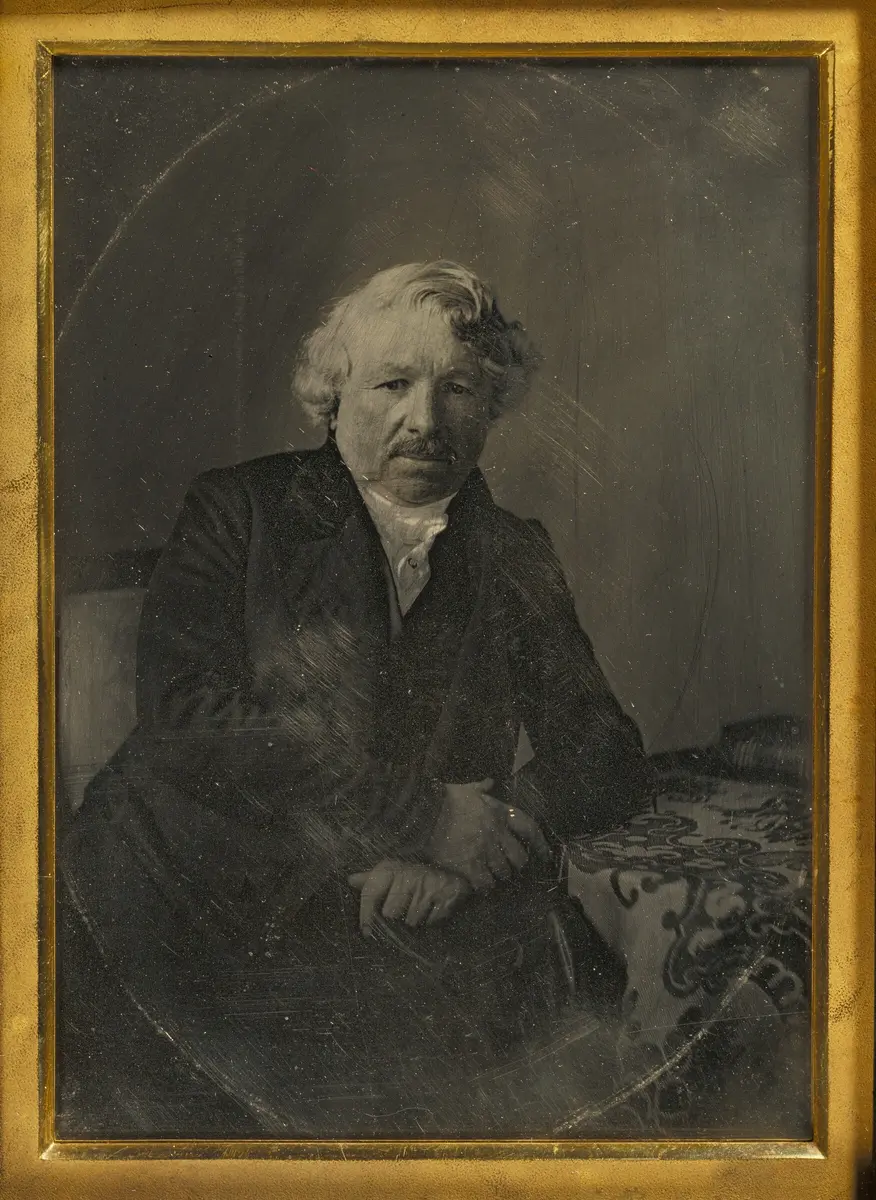
Louis Daguerre
“The French painter and Diorama showman who invented the daguerreotype, the first practical photograph, given to the world by France in 1839.”
Louis Daguerre was a French painter and showman who gave the world its first practical way of taking photographs. His process, the daguerreotype, made a sharp, one-of-a-kind picture on a polished silver-coated copper plate. When it was announced in Paris in January 1839 and given away to the public that August, it started a craze that spread around the world within months, and it made Daguerre's name the word for photography itself for a generation.
He was born on 18 November 1787 at Cormeilles-en-Parisis, a village north-west of Paris, and trained as a draughtsman, then as a painter of stage scenery for the Paris Opéra and of giant panoramas with Pierre Prévost. By 1816 he was designing sets for the Ambigu-Comique theatre, and from 1820 to 1822 he shared the post of chief designer at the Opéra, where his scenery for 'Aladin, or the Wonderful Lamp' was shown under the new gas lighting. In July 1822, with the painter Charles-Marie Bouton, he opened the Diorama near the Château-d'Eau in Paris: huge pictures painted on both sides of translucent cloth that seemed to change from day to night, or from calm to storm, as the light behind and in front of them was moved. A second Diorama opened in Regent's Park, London, in 1823. It made him famous and rich.
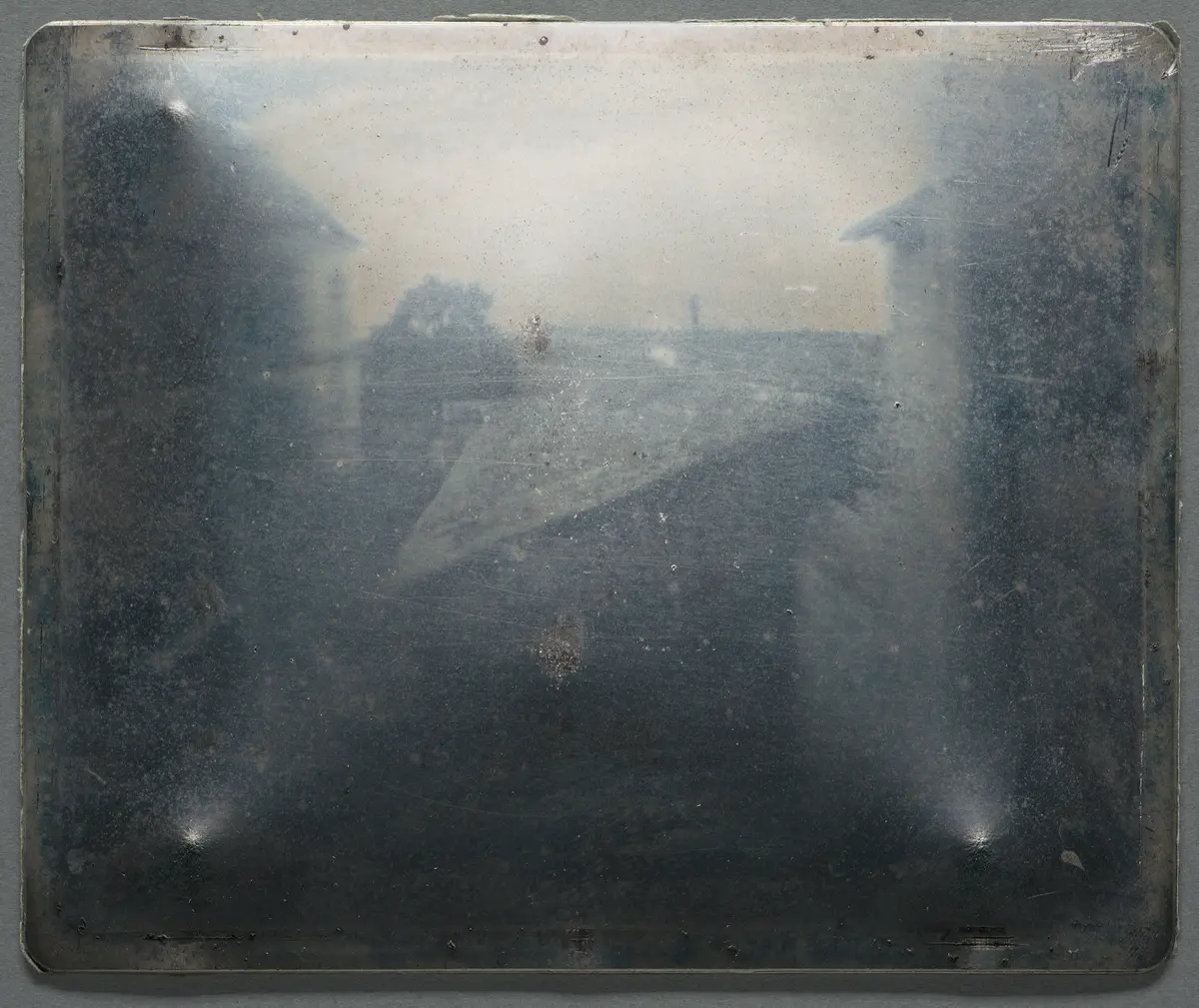
Like many painters he used the camera obscura, and he wanted to fix the image it threw. In 1826 he learned that Nicéphore Niépce, a gentleman inventor in Burgundy, had already made lasting pictures with light, and in December 1829 the two became partners. Niépce died in 1833 with the problem unsolved. Daguerre went on alone and found the method that worked: a silver plate made sensitive with iodine vapour, exposed in the camera for minutes instead of hours, its invisible 'latent' image brought out with mercury vapour and fixed with salt water. His still life of 1837 and his view of the Boulevard du Temple of 1838, with the first people ever photographed, show how far he had come. The story of Niépce's first photograph and of the invention as a whole is told in 'The first photograph'; this entry follows Daguerre.
Daguerre could not sell the secret by subscription, so the physicist François Arago took up his cause. Arago announced the invention to the Académie des sciences on 7 January 1839; on 8 March, while Daguerre was visiting the American painter Samuel Morse to see his telegraph, the Diorama burned down with his laboratory and notes. That summer the French state bought the process in exchange for a life pension of 6,000 francs for Daguerre and 4,000 for Niépce's son Isidore, and on 19 August 1839 Arago explained it step by step to a packed joint session of the Académies. Daguerre's manual sold out at once. In England, where Henry Talbot claimed his own process on paper in January 1839, Daguerre had taken out a patent, so the gift to the world stopped at the Channel.
Daguerre retired to Bry-sur-Marne, east of Paris, where in 1842 he painted a last diorama, an illusion of a deep Gothic choir, behind the altar of the village church; it is the only one of his dioramas that survives. He died there on 10 July 1851, aged 63, and the town gave him a monument in its cemetery. Fewer than twenty-five photographs securely by his hand survive, but his process filled the world with portraits in the 1840s, and his Diorama, with its moving light and darkened hall, is often counted among the ancestors of the cinema.
What happened
- 1787
Louis Jacques Mandé Daguerre is born at Cormeilles-en-Parisis, a village north-west of Paris, and is baptised in its church of Saint-Martin three days later.
Cormeilles-en-Parisis, north-west of Paris: born here on 18 November 1787 and baptised in the church of Saint-Martin three days later; a plaque marks his birth house in the rue Gabriel-Péri- 1816
After training as a draughtsman, painting scenery at the Opéra under Degotti during the Empire and helping Pierre Prévost paint his giant panoramas, Daguerre becomes a designer of stage sets at the Ambigu-Comique theatre on the Boulevard Saint-Martin, where he works until 1822.
- 1820
He becomes joint chief designer at the Paris Opéra with Pierre-Luc-Charles Cicéri, a post the two share until 1822.
- 1822
'Aladin, ou la Lampe merveilleuse' opens at the Opéra with sets by Cicéri and Daguerre, staged under the Opéra's new gas lighting, which was ready only at the end of January.
Daguerre and the painter Charles-Marie Bouton open the Diorama on the rue Sanson, by the Château-d'Eau in Paris. The audience sits in a dark hall that turns from one huge painting to the next; light moved behind and in front of the translucent canvas makes each scene change, from day to night or calm to storm.
Site of the Diorama, rue Sanson by the Château-d'Eau (today the rue Léon-Jouhaux, by the Place de la République): his theatre, home and laboratory from 1822 until the fire of 8 March 1839, and where he perfected the daguerreotypeThe Diorama company issues shares of 1,000 francs, signed by Daguerre and Bouton, each entitled to a 250th of the profits; the show is a hit and makes him wealthy.
- 1823
A second Diorama, built to the same plan, opens behind the new terraces of Park Square in Regent's Park, London, showing two Paris-painted views at a time.
- 1826
Through a Paris optician, Daguerre learns that Nicéphore Niépce in Burgundy has already fixed images made by light, and the two begin a cautious correspondence; Daguerre himself has been trying to capture the image of the camera obscura since the mid-1820s.
- 1829
At Chalon-sur-Saône, Daguerre and Niépce sign a ten-year partnership to perfect Niépce's 'heliography' and share the profits equally.
- 1833
Niépce dies with the process still slow and uncertain. Daguerre carries on alone, with Niépce's son Isidore as his partner, and turns to plates of polished silver made sensitive with iodine, whose faint image he learns to bring out with mercury vapour.
- 1837
Daguerre makes a still life of plaster casts in his studio, the oldest daguerreotype known to survive. Sure of his method, he makes a new agreement with Isidore Niépce and plans to sell it the next year, to one buyer for 200,000 francs or to a hundred subscribers at 1,000 each; the scheme fails.
- 1838
He photographs the Boulevard du Temple from a window in Paris, the view with the first people ever caught by a camera, and shows his plates to artists and scientists in search of investors. In the last days of the year he meets the astronomer and deputy François Arago, who proposes that the state should buy the secret.
- 1839
Arago announces Daguerre's invention to the Académie des sciences and describes the astonishing detail of the plates, but keeps the method secret.
Institut de France, Paris: Arago announced the invention to the Académie des sciences here on 7 January 1839 and explained it to the joint session of the Académies on 19 August 1839In London Henry Talbot, stung by the news from Paris, has his paper 'Some Account of the Art of Photogenic Drawing' read to the Royal Society: a rival process on paper, quite different from Daguerre's, which leads in time to the negative.
- 12:00 p.m.
A few days after showing his plates to the American painter Samuel Morse, Daguerre goes at noon to see Morse's telegraph and stays more than an hour. Meanwhile the Diorama, with his house, his paintings, his notes and most of his early plates, burns to the ground.
Site of the Diorama, rue Sanson by the Château-d'Eau (today the rue Léon-Jouhaux, by the Place de la République): his theatre, home and laboratory from 1822 until the fire of 8 March 1839, and where he perfected the daguerreotype Daguerre and Isidore Niépce sign a provisional agreement with the Minister of the Interior, Tanneguy Duchâtel: their secret in exchange for life pensions of 6,000 francs for Daguerre and 4,000 for Niépce, Daguerre's larger because he must also reveal the Diorama's methods and all future improvements. He is made an Officer of the Legion of Honour, and the bill goes to parliament the next day.
The Chamber of Deputies passes the pension bill without debate, 237 votes to 3, while Arago shows daguerreotypes to a crowd in a nearby hall.
At Isidore Niépce's urging, an application is sent to London for a patent covering England and its colonies. Granted in August, it means that Britain alone has to pay licence fees for what France gives to the world.
After the Peers approve it on 2 August, 92 votes to 4, King Louis-Philippe signs the law that buys the process for the nation.
At a joint session of the Académie des sciences and the Académie des beaux-arts at the Institut de France, with a crowd spilling into the courtyard, Arago explains the daguerreotype step by step. Daguerre does not speak: that morning he had pleaded a violent sore throat and, Arago adds, a little shyness. His manual, published by Alphonse Giroux, who also sells the cameras, sells out at once.
Institut de France, Paris: Arago announced the invention to the Académie des sciences here on 7 January 1839 and explained it to the joint session of the Académies on 19 August 1839- 1842
Retired to Bry-sur-Marne, where he had bought a large house opposite the church in 1839, Daguerre paints a last diorama for the village church: behind the altar, whose choir was opened up to take it, a deep Gothic choir appears in changing daylight. He gives it to the town.
Church of Saint-Gervais-et-Saint-Protais, Bry-sur-Marne: his last diorama, painted in 1842 behind the altar, the only one that survives; he lived in the large house opposite - 1844
He publishes a 'new way of preparing the sensitive coating' of the plates and sits for the daguerreotypist E. Thiesson, the Legion of Honour on his coat.
- 1848
The New York photographer Charles R. Meade comes to Bry to meet the founder of his trade and makes several daguerreotypes of him, among the very few ever made of Daguerre.
- 1851
Daguerre dies at Bry-sur-Marne, aged 63. He is buried in the village cemetery; on 10 August the town council grants his grave free and for ever, and raises a monument over it.
Cemetery of Bry-sur-Marne: he died in the village on 10 July 1851 and is buried here under a monument from the town