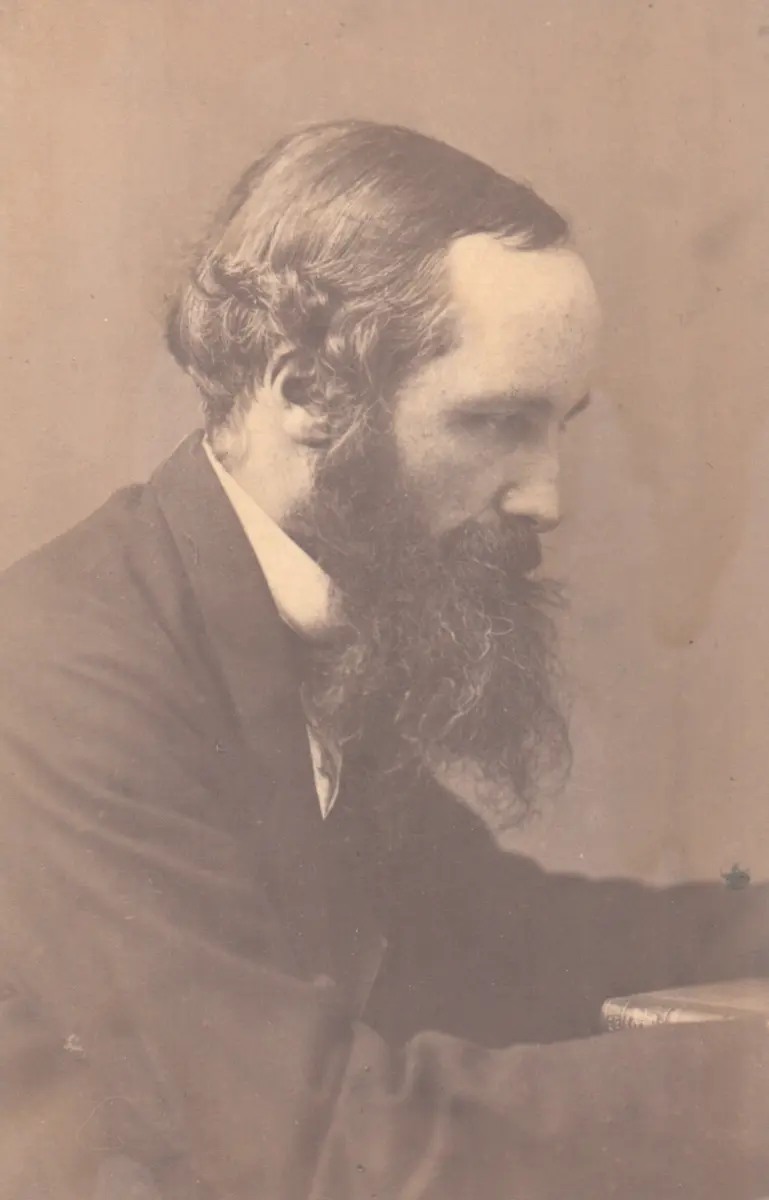
James Clerk Maxwell
“The Scottish physicist who showed that light is an electromagnetic wave: his equations (1864–73) joined electricity, magnetism and light, and foretold the radio waves found after his death.”
James Clerk Maxwell was the Scottish physicist who showed that electricity, magnetism and light are one thing. In a small set of equations he described how electric and magnetic fields produce each other and move through space as a wave, and he calculated that this wave travels at the speed of light. His conclusion, that light itself is an electromagnetic wave, joined three sciences into one, predicted invisible waves that nobody had yet seen, and opened the way to radio, radar, television and every wireless device. Physicists put him beside Newton and Einstein; in 1931 Einstein called the change Maxwell made in our idea of physical reality the deepest and most fruitful since Newton.
He was born in Edinburgh in 1831 into a family of Scottish lawyers and landowners, and grew up at Glenlair, the family's country house in Galloway, a child who always wanted to know 'how it doos'. His mother died when he was eight. At the Edinburgh Academy the other boys called him 'Dafty', yet at fourteen he had a paper on drawing oval curves read to the Royal Society of Edinburgh. He studied at the universities of Edinburgh and Cambridge, finished Second Wrangler in 1854, and at twenty-five became professor of natural philosophy at Marischal College in Aberdeen, where he married Katherine Mary Dewar, the principal's daughter.
His range was astonishing. He proved that Saturn's rings cannot be solid or liquid and must be made of countless small separate bodies. He put the study of colour vision on a measured footing and, on 17 May 1861 at the Royal Institution, showed a colour picture of a tartan ribbon made from three photographs taken by Thomas Sutton through red, green and blue filters: the first colour photograph made by the three-colour method that cameras and screens still use. His statistical law for the speeds of molecules in a gas (1859–60), now the Maxwell distribution, helped found statistical physics, and his imaginary 'demon' of 1867 is still a famous puzzle about heat and information.
The great work on the field was done at King's College London (1860–65) and at Glenlair: 'On Physical Lines of Force' (1861–62), 'A Dynamical Theory of the Electromagnetic Field', read to the Royal Society on 8 December 1864, and the Treatise on Electricity and Magnetism (1873), which gave the field equations their full form. He built his theory on Michael Faraday's picture of lines of force, which he turned into mathematics. In 1871 Cambridge made him its first Professor of Experimental Physics, and he planned the Cavendish Laboratory, opened in 1874, where much of the physics of the following decades was done.
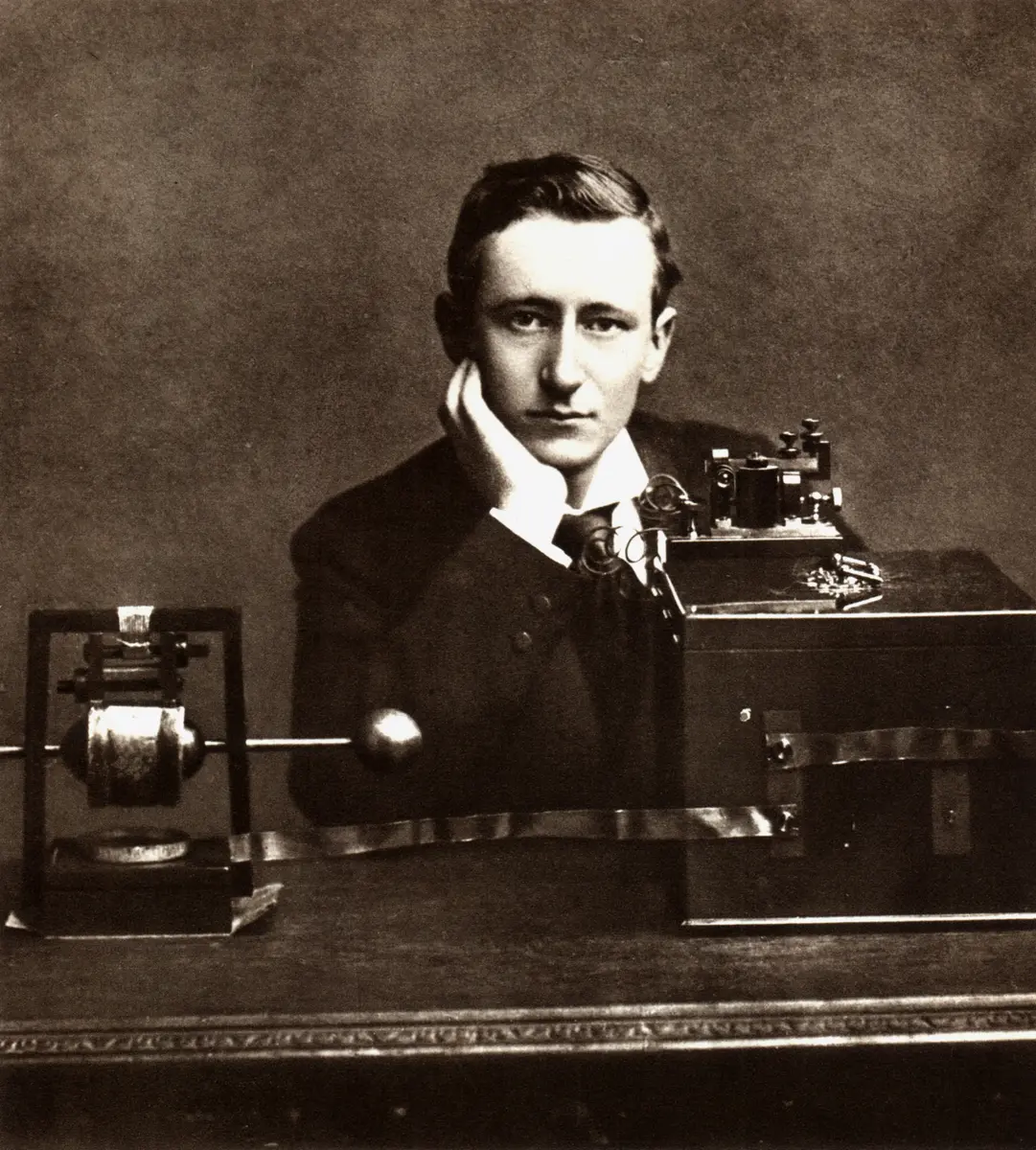
He died of abdominal cancer in Cambridge on 5 November 1879, aged 48, the age at which the same disease had killed his mother, and he is buried in the churchyard at Parton near Glenlair. He did not live to see his waves found. In 1886–88 Heinrich Hertz, working at Karlsruhe, made and detected electromagnetic waves in his laboratory, and within a few years Guglielmo Marconi was using them to send messages. Maxwell's equations are still the basis of electrical engineering, and Einstein said that his own special theory of relativity grew out of them.
What happened
- 1831
James Clerk Maxwell is born at 14 India Street in Edinburgh's New Town, the only child of John Clerk Maxwell, a lawyer who owns the Middlebie estate in Galloway, and Frances Cay, who is nearly forty.
14 India Street, Edinburgh: Maxwell was born here on 13 June 1831; today the James Clerk Maxwell Foundation's house and museum- 1833
The family settles at Glenlair, the new house on the Middlebie estate near Corsock in Galloway. The boy grows up in the country, forever asking 'Show me how it doos' about doors, locks, streams and bell-wires.
Glenlair, near Corsock in Galloway: the family's country house, his childhood home and later his own, where he wrote much of the Treatise and enlarged the house in 1868 - 1839
His mother dies of abdominal cancer at Glenlair; he is eight. A home tutor is tried and fails, and his aunt Jane Cay helps to rescue him.
Glenlair, near Corsock in Galloway: the family's country house, his childhood home and later his own, where he wrote much of the Treatise and enlarged the house in 1868- 1841
He arrives at 31 Heriot Row in Edinburgh, the house of his aunt Isabella Wedderburn, to attend the Edinburgh Academy. The other boys nickname him 'Dafty'; there he meets his lifelong friends Lewis Campbell and P. G. Tait.
- 1846
At fourteen, his first paper, 'On the description of oval curves, and those having a plurality of foci', a new way of drawing ovals with pins and string, is read to the Royal Society of Edinburgh by Professor James Forbes.
- 1847
At sixteen he enters the University of Edinburgh, taking mathematics with Kelland, natural philosophy with Forbes, who lets him use the class apparatus, and logic with Sir William Hamilton; he publishes two more papers.
- 1850
He goes up to Cambridge, to Peterhouse, and after one term moves to Trinity College, where a fellowship is more likely. His tutor is William Hopkins, the famous coach of wranglers.
- 1854
He finishes the Mathematical Tripos as Second Wrangler, behind Edward Routh, and is bracketed equal with Routh for the Smith's Prize.
- 1855
Elected a fellow of Trinity, he reads 'On Faraday's lines of force' to the Cambridge Philosophical Society (in two parts, 1855 and 1856), his first step towards putting Michael Faraday's picture of electricity and magnetism into mathematics.
His paper on experiments in colour, made with spinning tops carrying adjustable sectors of coloured paper, is read to the Royal Society of Edinburgh; in it he sets out the three-colour method for making colour pictures.
Cambridge announces the subject of the Adams Prize: the motion and stability of Saturn's rings. Maxwell decides to compete.
- 1856
His father dies at Glenlair, shortly before Maxwell is to return to Cambridge; before the end of the month he learns he has been appointed professor of natural philosophy at Marischal College, Aberdeen.
Glenlair, near Corsock in Galloway: the family's country house, his childhood home and later his own, where he wrote much of the Treatise and enlarged the house in 1868At twenty-five he takes up the chair at Marischal College in Aberdeen. In the same year he is elected a Fellow of the Royal Society of Edinburgh.
- 1857
His essay on Saturn's rings wins the Adams Prize. He shows that a solid ring or a fluid ring could not last, so the rings must be made of countless separate particles; the Astronomer Royal, George Airy, calls it one of the most remarkable applications of mathematics to physics he has seen. The essay is printed in 1859.
- 1858
He marries Katherine Mary Dewar, daughter of the principal of Marischal College, at Old Machar in Aberdeen. They have no children; she later helps in his experiments on colour and on gases.
- 1859
At the British Association meeting in Aberdeen he reads 'Illustrations of the Dynamical Theory of Gases', with his statistical law for the speeds of molecules in a gas. Printed in the Philosophical Magazine in January 1860, it begins the statistical physics later carried on by Ludwig Boltzmann.
- 1860
Marischal College merges with King's College into the University of Aberdeen and his post disappears. He loses the Edinburgh chair to his friend Tait, and is appointed professor of natural philosophy at King's College London. The Royal Society gives him its Rumford Medal for his work on colour.
King's College London, on the Strand: Maxwell was professor of natural philosophy here from 1860 to 1865, the years of his electromagnetic papersAt Glenlair he falls dangerously ill with smallpox, probably caught at a horse fair; Katherine nurses him alone.
Glenlair, near Corsock in Galloway: the family's country house, his childhood home and later his own, where he wrote much of the Treatise and enlarged the house in 1868- 1861
He is elected a Fellow of the Royal Society, shortly before his thirtieth birthday.
In his first lecture at the Royal Institution, 'On the Theory of the three Primary Colours', he projects a colour image of a tartan ribbon made from three photographs that Thomas Sutton took through red, green and blue filters; Faraday is in the audience. In 1960 Kodak researchers showed that the 'red' plate had in fact recorded ultraviolet light.
- 1862
In 'On Physical Lines of Force' (Philosophical Magazine, 1861–62) he models the space around magnets as a medium of spinning cells and finds that waves in it would travel at almost exactly the measured speed of light: 'we can scarcely avoid the inference that light consists in the transverse undulations of the same medium which is the cause of electric and magnetic phenomena.'
- 1864
'A Dynamical Theory of the Electromagnetic Field' is read to the Royal Society in London. Without any mechanical model, it sets out the equations of the field and concludes that light is an electromagnetic wave. It is printed in the Philosophical Transactions in 1865.
- 1865
In the spring he resigns from King's College and retires to Glenlair, to write and to enlarge the house; he goes on travelling to Cambridge as an examiner for the Tripos.
Glenlair, near Corsock in Galloway: the family's country house, his childhood home and later his own, where he wrote much of the Treatise and enlarged the house in 1868A scratch on the head from a branch while riding a strange horse at Glenlair leads to erysipelas, which brings him very low; Katherine nurses him again.
Glenlair, near Corsock in Galloway: the family's country house, his childhood home and later his own, where he wrote much of the Treatise and enlarged the house in 1868- 1866
He gives the Royal Society's Bakerian Lecture, 'On the Viscosity or Internal Friction of Air and Other Gases', with measurements he and Katherine made in the garret of their London house; they confirm his prediction that a gas's viscosity does not depend on its pressure.
- 1867
In a letter to Tait he imagines a tiny being who sorts fast and slow molecules between two boxes, making heat flow from cold to hot without work. Kelvin will name it 'Maxwell's demon'.
- 1868
His paper 'On Governors' gives the first mathematical treatment of feedback control in machines, the beginning of control theory. The same year he and the architect James Barbour enlarge Glenlair.
Glenlair, near Corsock in Galloway: the family's country house, his childhood home and later his own, where he wrote much of the Treatise and enlarged the house in 1868 - 1871
The University of Cambridge founds a chair of experimental physics; its Chancellor, the Duke of Devonshire, has offered to build and equip a physics laboratory. Maxwell, at first reluctant, accepts and becomes the first Cavendish Professor.
The old Cavendish Laboratory, Free School Lane, Cambridge: planned by Maxwell as first Cavendish Professor and opened in 1874; he died in Cambridge on 5 November 1879He gives his inaugural lecture as Professor of Experimental Physics at Cambridge and begins his annual courses of lectures.
The old Cavendish Laboratory, Free School Lane, Cambridge: planned by Maxwell as first Cavendish Professor and opened in 1874; he died in Cambridge on 5 November 1879- 1873
The Clarendon Press in Oxford publishes his Treatise on Electricity and Magnetism in two volumes, written largely at Glenlair; in it the equations of the electromagnetic field take their complete form.
- 1874
The Cavendish Laboratory in Free School Lane, which he has planned, is formally opened. From now until his death he also edits the unpublished electrical researches of Henry Cavendish, which appear in 1879.
The old Cavendish Laboratory, Free School Lane, Cambridge: planned by Maxwell as first Cavendish Professor and opened in 1874; he died in Cambridge on 5 November 1879- 1877
In the spring he begins to suffer from painful indigestion, which he keeps to himself for about two years.
- 1878
He gives the Rede Lecture at Cambridge on a new invention, the telephone.
- 1879
In his last term he keeps lecturing although his health is clearly failing; his student Ambrose Fleming later remembers the lectures as an inspiration.
After a summer at Glenlair, where a doctor tells him he has about a month to live, he returns with Katherine to Cambridge, so weak he can hardly walk from the train.
The old Cavendish Laboratory, Free School Lane, Cambridge: planned by Maxwell as first Cavendish Professor and opened in 1874; he died in Cambridge on 5 November 1879He dies of abdominal cancer in Cambridge, aged 48, the age at which his mother died of the same disease. His Cambridge doctor, Dr Paget, says no man ever met death more consciously or more calmly. After a service in Trinity College Chapel he is buried at Parton, near Glenlair.
The old Cavendish Laboratory, Free School Lane, Cambridge: planned by Maxwell as first Cavendish Professor and opened in 1874; he died in Cambridge on 5 November 1879