The integrated circuit (microchip)
“In 1958–59 Jack Kilby at Texas Instruments and Robert Noyce at Fairchild each found how to build a whole electronic circuit in one piece of semiconductor: the microchip.”
An integrated circuit, or microchip, is a complete electronic circuit made inside one small piece of semiconductor: its transistors, resistors and capacitors, and the connections between them, are formed together instead of being made one by one and soldered by hand. In the 1950s the transistor had replaced the vacuum tube, but a missile or a computer still needed thousands of separate parts and every soldered joint could fail, a problem Bell Labs' Jack Morton called 'the tyranny of numbers'. The armed services paid for many rival answers: standard snap-together modules, thin films, 'molecular electronics'. In 1952 the British radar engineer Geoffrey Dummer had imagined electronics built 'in a solid block with no connecting wires', but no one had made one that worked.
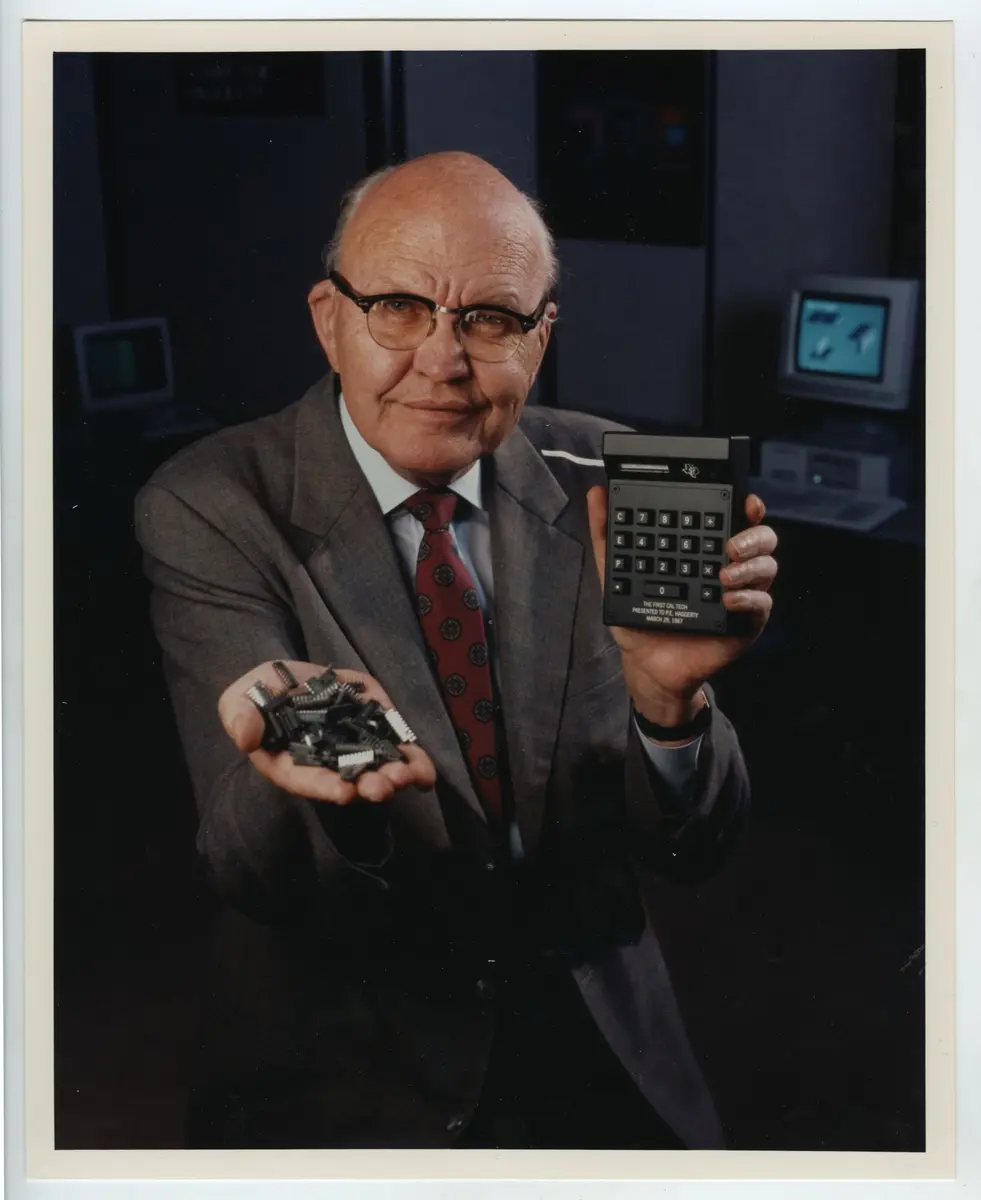
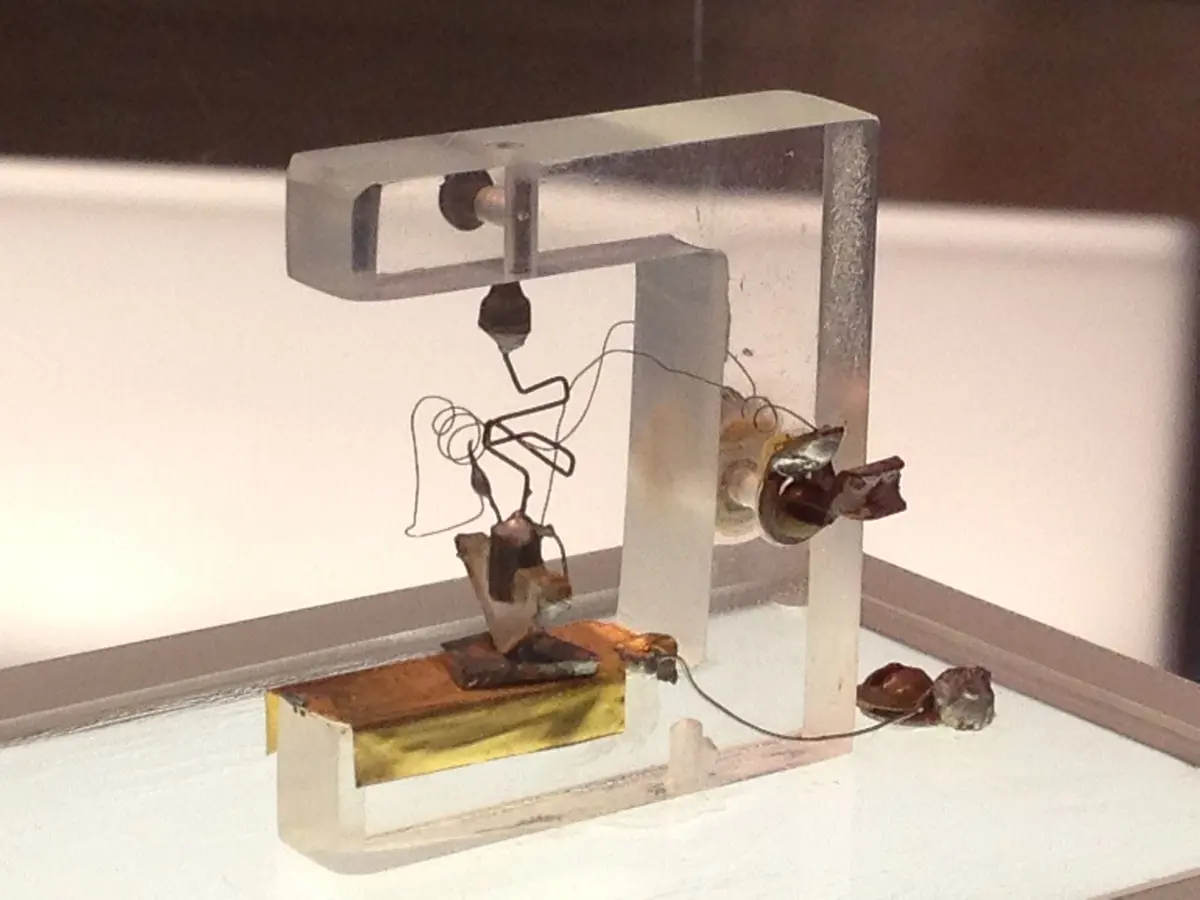
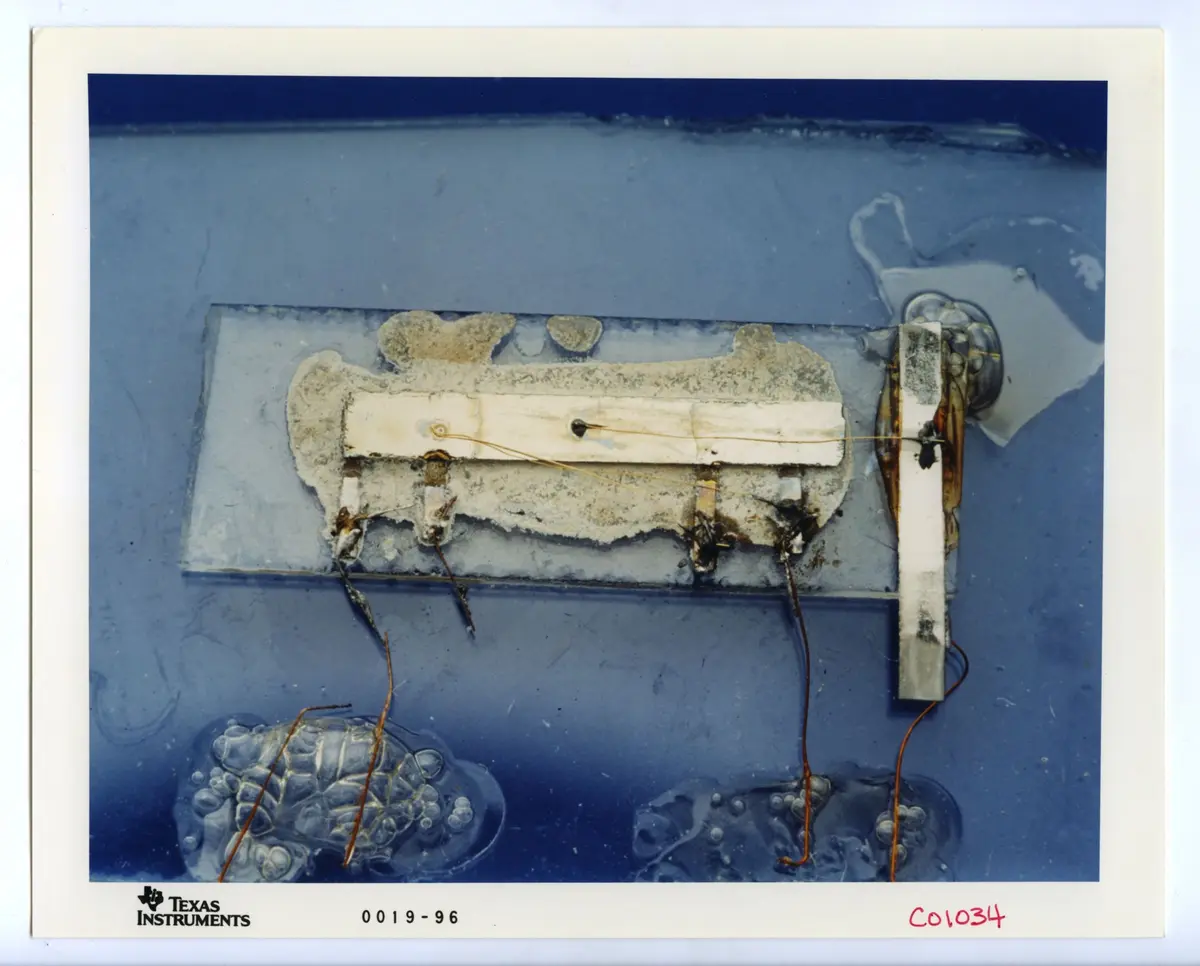
Jack Kilby, an engineer from Kansas who had made parts for hearing aids at Centralab in Milwaukee, joined Texas Instruments in Dallas in May 1958 to work on miniaturization. As a newcomer he had no holiday, so he worked through the July shutdown, and on July 24 he wrote in his notebook that resistors, capacitors, transistors and diodes could all be made in a single slice of semiconductor. On September 12, 1958 he showed TI's managers the result: a sliver of germanium about 11 millimetres long, glued to a glass slide and wired with fine gold threads. When he switched it on, it produced a steady wave of about 1.3 megahertz. A flip-flop, the basic memory element of a computer, followed a week later. TI applied for a patent on February 6, 1959 and showed its 'solid circuits' at the radio engineers' show in New York in March.
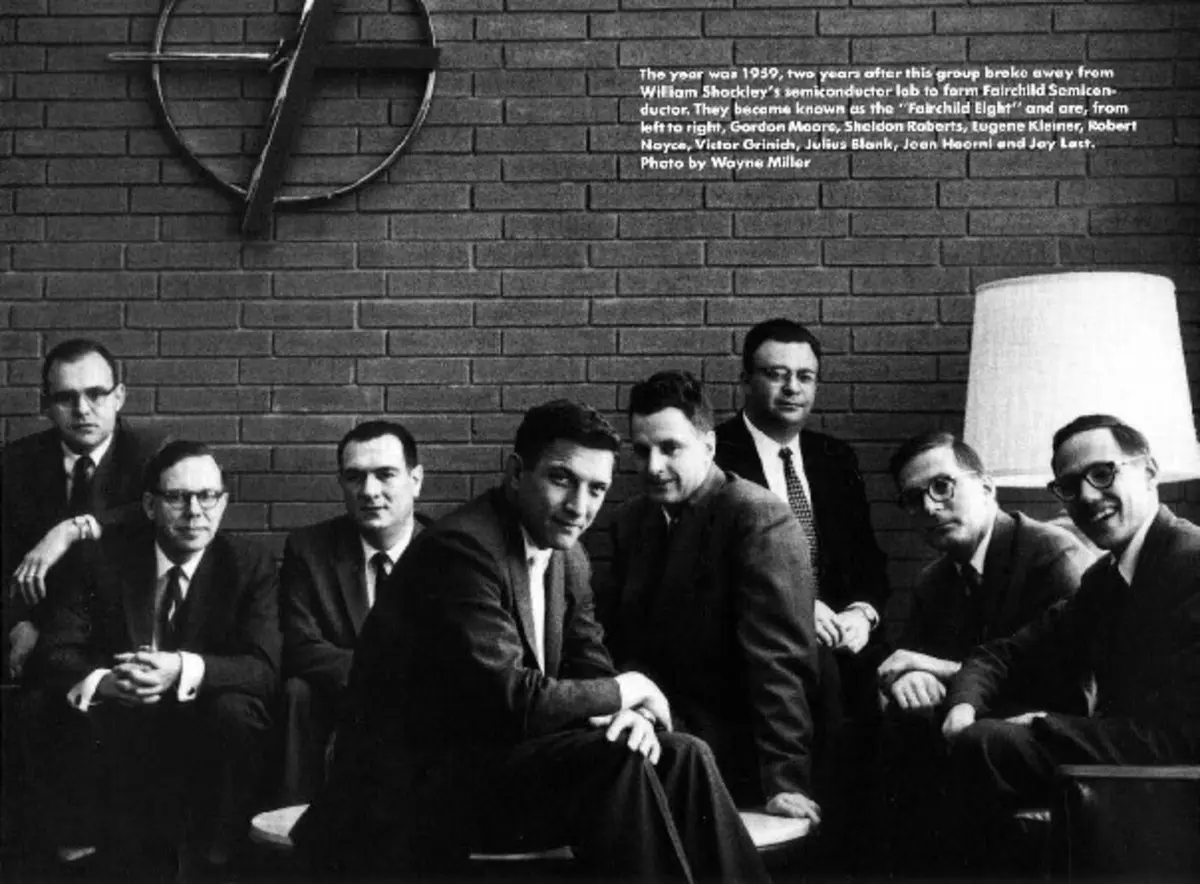
Kilby's parts were still joined by hand-bonded 'flying wires', which could not be made in quantity. The answer came from Fairchild Semiconductor in Palo Alto, California, where Jean Hoerni had found how to make flat, 'planar' transistors sealed under a layer of glassy silicon dioxide. On January 23, 1959 Robert Noyce wrote that many devices could be made in one piece of silicon and joined by metal lines laid on top of that oxide; he filed his patent in July. Jay Last's team made the first working planar chips in 1960, Fairchild sold them as 'Micrologic' from March 1961, and TI answered with its own planar Series 51 that October. The two firms fought over the patents for years, until in September 1966 they agreed to license each other; in 1969–70 the courts sided with Noyce, but today both men are honoured as co-inventors.
The first chips cost far more than the separate parts they replaced, so the first big buyers were those who needed small, light and reliable electronics at any price. In 1961 TI built the US Air Force a demonstration computer of 587 chips that did the work of 8,500 ordinary parts in less than a hundredth of the space. In 1962 MIT chose Fairchild-type chips for the Apollo Guidance Computer that would steer astronauts to the Moon, and TI won the order for the Minuteman II missile's custom circuits; by 1965 the missile was the largest buyer of all. Their orders taught the factories to make chips in volume, and the price fell year after year.
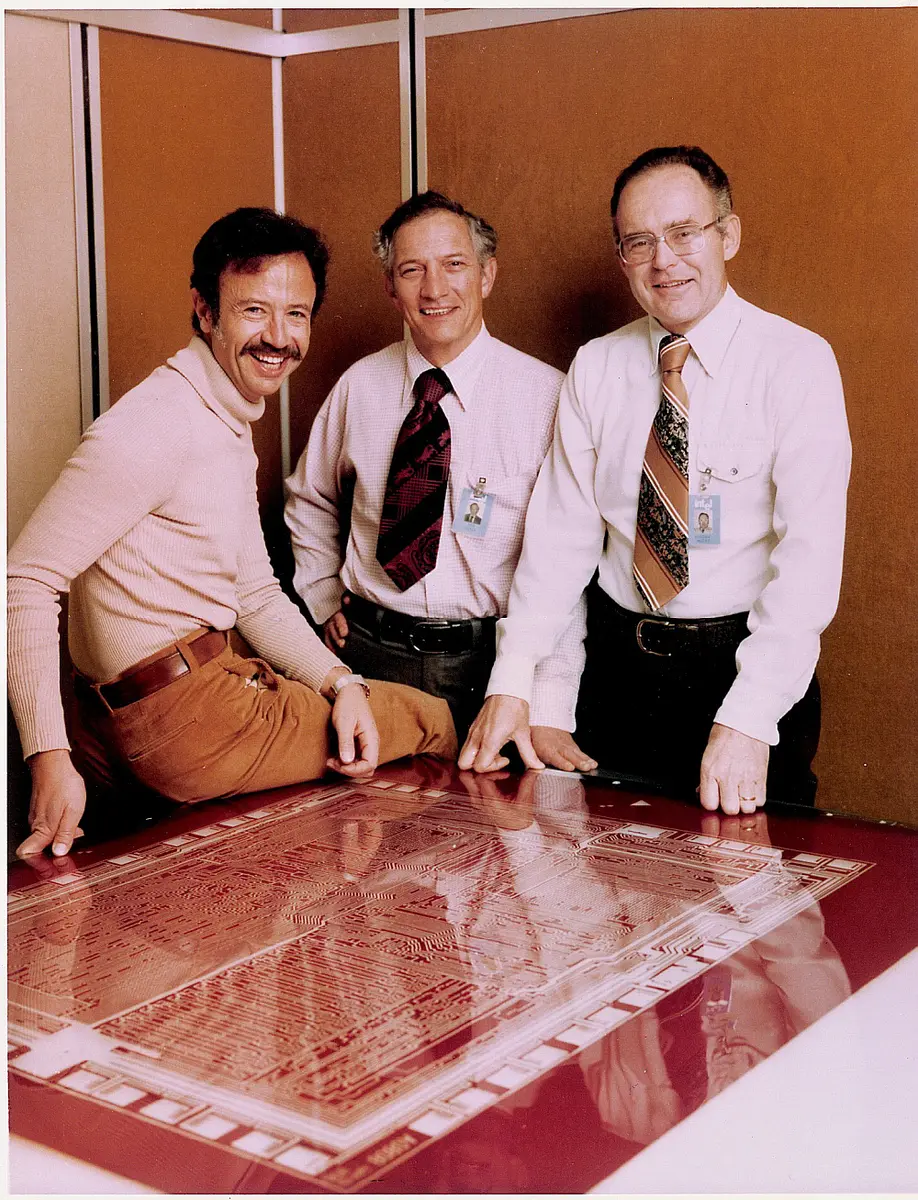
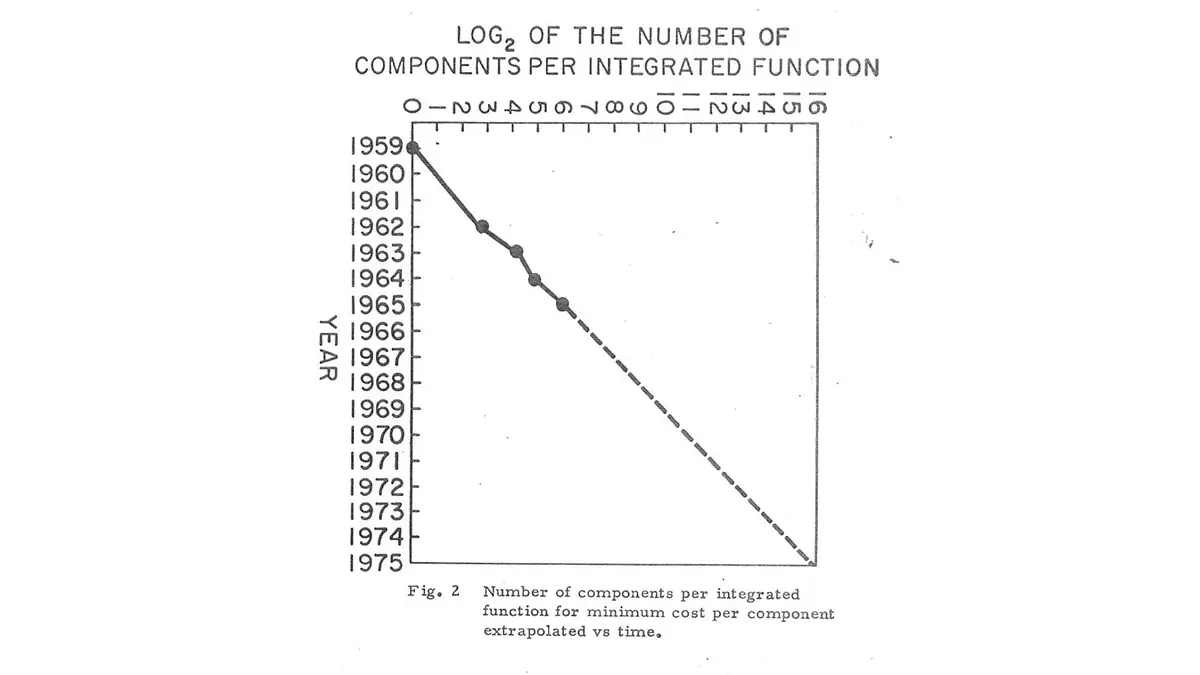
Almost every electronic device today, from phones and cars to the computers that run the internet, is built on integrated circuits made by Noyce's planar method, now with billions of transistors on one chip. In 1965 Fairchild's Gordon Moore predicted that the number of parts on a chip would keep doubling, and Noyce and Moore went on to found Intel. Kilby shared the 2000 Nobel Prize in Physics for his part in the invention; Noyce had died in 1990, and Kilby said that had he lived they would surely have shared it.
What happened
- 1958
Jack Kilby, an engineer from Centralab in Milwaukee, starts work at Texas Instruments in Dallas, the only company that offers to let him work on miniaturising electronics more or less full time.
Texas Instruments' Expressway site (north campus), 13500 North Central Expressway, Dallas: the Semiconductor-Components Building opened here in June 1958, and Kilby built the first integrated circuit in its laboratoryTI opens its new Semiconductor-Components Building on the Expressway site; Walter Brattain, co-inventor of the transistor, and Mark Shepherd cut the ribbon as Patrick Haggerty looks on.
Texas Instruments' Expressway site (north campus), 13500 North Central Expressway, Dallas: the Semiconductor-Components Building opened here in June 1958, and Kilby built the first integrated circuit in its laboratoryWorking through TI's two-week summer shutdown because he is too new to have a holiday, Kilby writes in his notebook that resistors, capacitors, transistors and diodes could all be made in a single slice of semiconductor, and sketches a flip-flop built that way.
Texas Instruments' Expressway site (north campus), 13500 North Central Expressway, Dallas: the Semiconductor-Components Building opened here in June 1958, and Kilby built the first integrated circuit in its laboratoryTo prove the idea, Kilby shows his supervisor Willis Adcock a circuit built from separate pieces of silicon, with resistors cut from silicon bars and capacitors from diffused wafers: every element can be made of semiconductor.
Texas Instruments' Expressway site (north campus), 13500 North Central Expressway, Dallas: the Semiconductor-Components Building opened here in June 1958, and Kilby built the first integrated circuit in its laboratoryKilby demonstrates the first integrated circuit: a phase-shift oscillator formed in one bar of germanium, mounted on a glass slide and joined with gold wires. With 10 volts applied it oscillates at about 1.3 megahertz, watched by Willis Adcock, Mark Shepherd and others.
Texas Instruments' Expressway site (north campus), 13500 North Central Expressway, Dallas: the Semiconductor-Components Building opened here in June 1958, and Kilby built the first integrated circuit in its laboratoryThree more germanium units, cut from wafers prepared for the 2N623 transistor, are tested; one works as a flip-flop, the first digital integrated circuit, again before Adcock and Shepherd.
Texas Instruments' Expressway site (north campus), 13500 North Central Expressway, Dallas: the Semiconductor-Components Building opened here in June 1958, and Kilby built the first integrated circuit in its laboratory- 1959
At Fairchild in Palo Alto, Robert Noyce writes in his notebook that many devices could be made in one piece of silicon and connected as part of the manufacturing process, with metal lines on top of the insulating oxide; no one witnesses the entry.
844 East Charleston Road, Palo Alto: Fairchild Semiconductor's first building, where Hoerni made the planar transistor, Noyce conceived the planar chip and Last's team built itTexas Instruments files Kilby's patent application, 'Miniaturized Electronic Circuits'.
Texas Instruments' Expressway site (north campus), 13500 North Central Expressway, Dallas: the Semiconductor-Components Building opened here in June 1958, and Kilby built the first integrated circuit in its laboratoryJean Hoerni demonstrates a working planar transistor at Fairchild: its junctions stay protected under a layer of silicon dioxide, and it proves more reliable than any transistor before it.
844 East Charleston Road, Palo Alto: Fairchild Semiconductor's first building, where Hoerni made the planar transistor, Noyce conceived the planar chip and Last's team built itAt a press conference in New York, Texas Instruments announces its 'semiconductor solid circuits', each about the size of a match head; the development models then go on show at the Institute of Radio Engineers' convention at the Coliseum.
New York Coliseum, Columbus Circle: TI's solid circuits went on show at the radio engineers' (IRE) annual show here in March 1959Hoerni files his patent on the planar process.
844 East Charleston Road, Palo Alto: Fairchild Semiconductor's first building, where Hoerni made the planar transistor, Noyce conceived the planar chip and Last's team built itFairchild files Noyce's patent, 'Semiconductor Device-and-Lead Structure': a whole circuit in one piece of silicon, wired by metal strips on the oxide.
844 East Charleston Road, Palo Alto: Fairchild Semiconductor's first building, where Hoerni made the planar transistor, Noyce conceived the planar chip and Last's team built it- 1960
TI introduces its first integrated circuit for sale, the Type 502 binary flip-flop, at $450 each; still wired by hand with gold 'flying wires', only a few dozen are shipped for evaluation.
Texas Instruments' Expressway site (north campus), 13500 North Central Expressway, Dallas: the Semiconductor-Components Building opened here in June 1958, and Kilby built the first integrated circuit in its laboratoryJay Last's team at Fairchild produces the first working monolithic planar chips, a flip-flop whose parts are separated by channels etched through the silicon and filled with epoxy.
844 East Charleston Road, Palo Alto: Fairchild Semiconductor's first building, where Hoerni made the planar transistor, Noyce conceived the planar chip and Last's team built itFairchild's chips work with the method that will become standard: the components inside the silicon are isolated from one another by p-n junctions instead of cuts.
844 East Charleston Road, Palo Alto: Fairchild Semiconductor's first building, where Hoerni made the planar transistor, Noyce conceived the planar chip and Last's team built it- 1961
Fairchild announces the first planar integrated circuit for sale, the Micrologic type F flip-flop, at a press conference at the IRE show in New York and in a photograph in LIFE magazine.
Noyce's patent 2,981,877 is granted, more than three years before Kilby's.
844 East Charleston Road, Palo Alto: Fairchild Semiconductor's first building, where Hoerni made the planar transistor, Noyce conceived the planar chip and Last's team built itIn Dayton, Ohio, Texas Instruments launches its planar Series 51 solid circuits and, with the Air Force's Aeronautical Systems Division, demonstrates a computer of 587 integrated circuits: 6.3 cubic inches and 10 ounces, against 1,000 cubic inches and 480 ounces for the same machine built from 8,500 ordinary parts.
Wright-Patterson Air Force Base, near Dayton, Ohio: the Air Force and TI demonstrated the first computer built of integrated circuits on October 19, 1961- 1962
In the autumn MIT's Instrumentation Laboratory decides to build the Apollo Guidance Computer from a single kind of chip, a three-input NOR gate of the Fairchild Micrologic type; by the summer of 1963 Apollo prototypes are taking 60 percent of all the microcircuits made in the United States.
MIT, Cambridge, Massachusetts: its Instrumentation Laboratory designed the Apollo Guidance Computer and chose integrated circuits for it in 1962TI announces a contract for Solid Circuit networks for the Air Force's Minuteman missile programme; working with North American Aviation's Autonetics division, it designs 22 custom circuits for the Minuteman II guidance computer.
Texas Instruments' Expressway site (north campus), 13500 North Central Expressway, Dallas: the Semiconductor-Components Building opened here in June 1958, and Kilby built the first integrated circuit in its laboratory- 1963
NASA's Explorer 18, the first Interplanetary Monitoring Platform, is launched from Cape Canaveral; TI's Series 51 circuits in its optical aspect computer are the first integrated circuits in orbit.
Cape Canaveral, Florida: Explorer 18 (IMP-A) carried TI's Series 51 chips into orbit on November 27, 1963, the first integrated circuits in space- 1964
Kilby's patent 3,138,743, 'Miniaturized Electronic Circuits', is granted; TI announces four integrated-circuit patents that day.
Texas Instruments' Expressway site (north campus), 13500 North Central Expressway, Dallas: the Semiconductor-Components Building opened here in June 1958, and Kilby built the first integrated circuit in its laboratory- 1965
The Minuteman II programme overtakes Apollo as the largest single buyer of integrated circuits; each missile carries more than 2,000 TI circuits.
- 1966
Texas Instruments and Fairchild announce a ten-year cross-licence: TI may use Fairchild's planar patents and Fairchild TI's integrated-circuit patents, everywhere except Japan.
Texas Instruments' Expressway site (north campus), 13500 North Central Expressway, Dallas: the Semiconductor-Components Building opened here in June 1958, and Kilby built the first integrated circuit in its laboratory