Moore's Law
“In 1965 Gordon Moore predicted that the number of components on a chip would double every year; in 1975 he slowed it to every two years, and the industry kept the pace for half a century.”
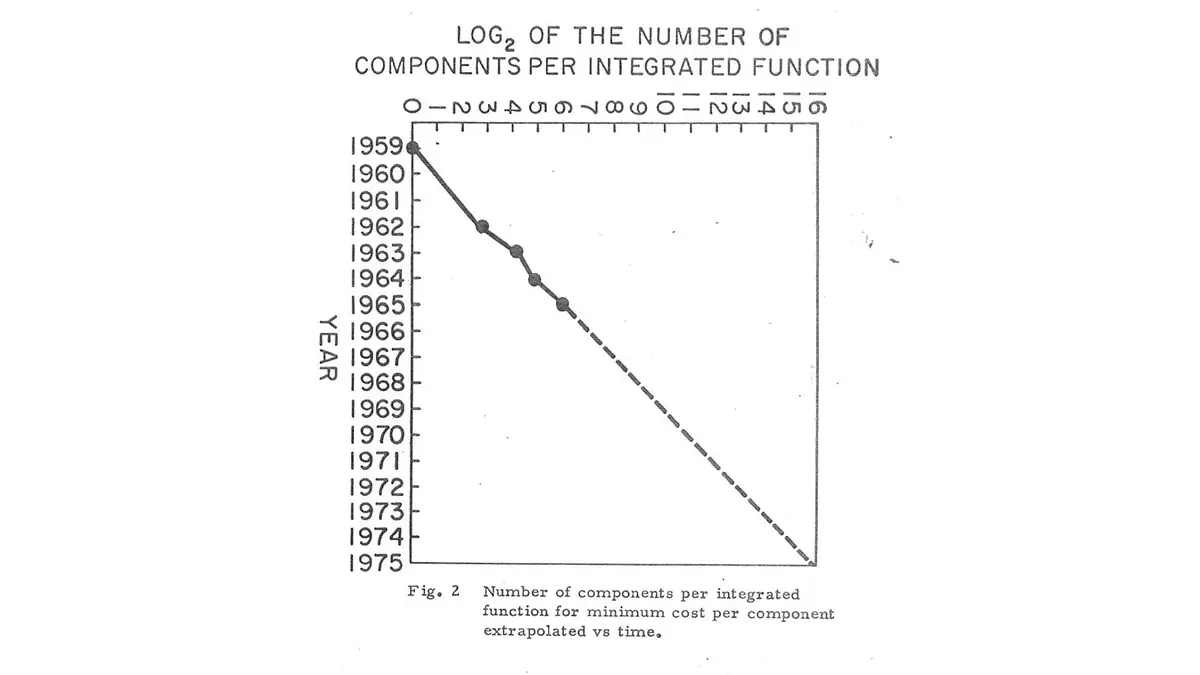
Moore's law is the prediction, made by the chemist Gordon Moore in April 1965, that the number of components that can be built into one silicon chip would keep doubling every year. Moore ran the research and development laboratories of Fairchild Semiconductor in Palo Alto, California, the company where the planar integrated circuit had been made a few years before. For its 35th anniversary issue, the trade magazine Electronics asked experts to look ten years ahead, and on 19 April 1965 it printed his article 'Cramming more components onto integrated circuits'. Moore had plotted the number of components (transistors, resistors and diodes) on the chips that could be made at the lowest cost per component, from a single transistor in 1959 to about 64 in 1965, and found that the number had roughly doubled each year. Drawing a straight line through those five points, he guessed it would go on doubling for a decade, to about 65,000 components on one chip by 1975.
His reasoning was about money. Putting more components on a chip makes each one cheaper, until the chips become so complex that too many fail; the cheapest size moves up every year as the factories improve. Moore wrote to persuade customers that integrated circuits would make electronics cheap and everywhere, and he listed what they would bring: 'home computers — or at least terminals connected to a central computer', automatic controls for cars, personal portable communications equipment and electronic wristwatches. A cartoon in the article showed a department store selling 'Handy Home Computers' between the notions and the cosmetics.
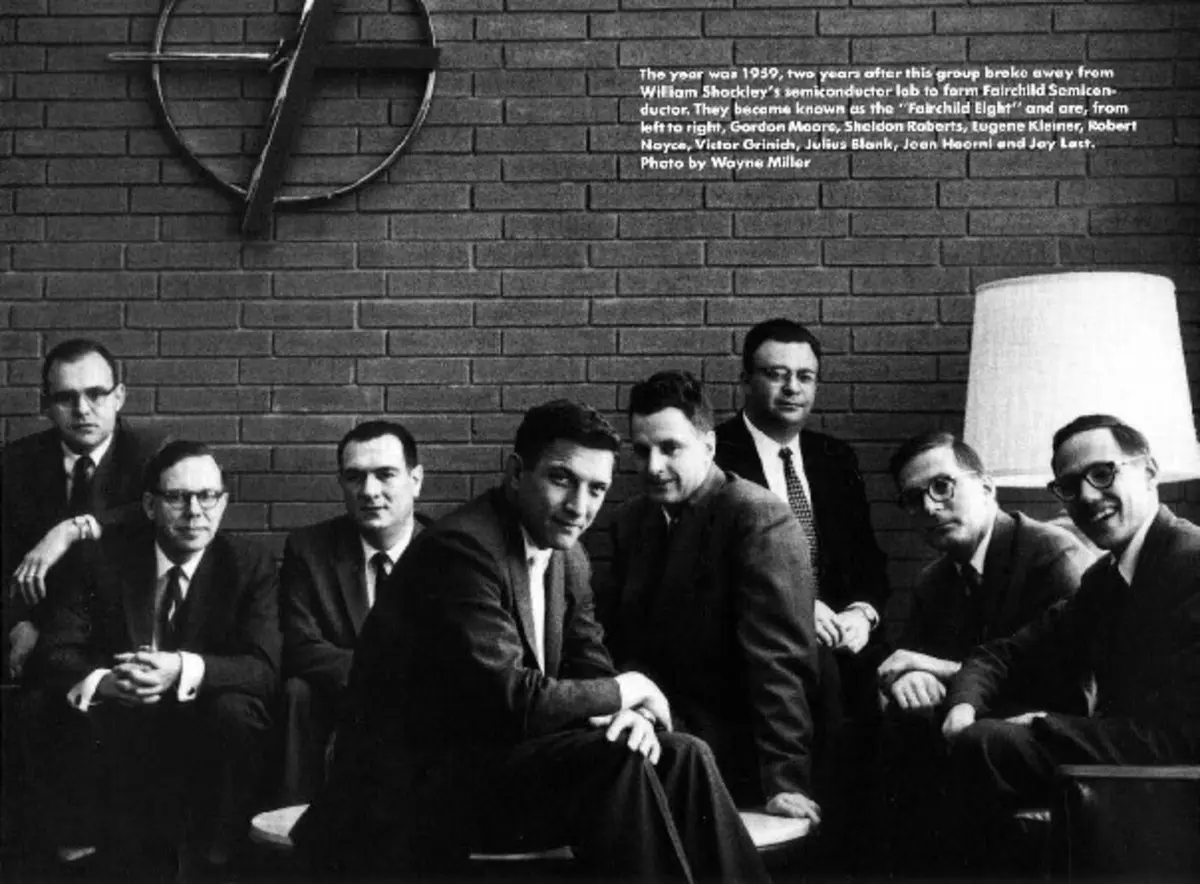
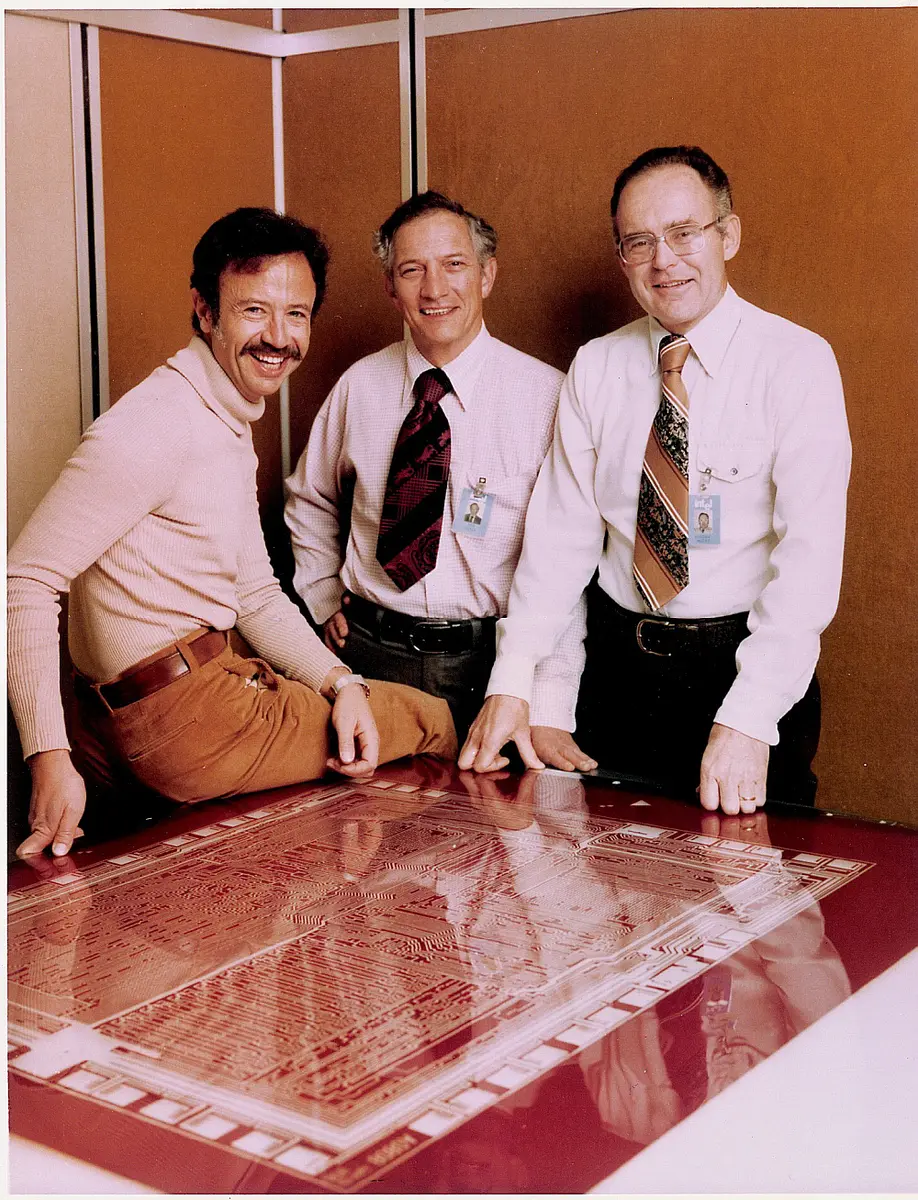
The prediction held. Fairchild chips of 1966 and 1967 carried about 125 and 264 components. In 1968 Moore and Robert Noyce left Fairchild and founded Intel, betting that chips could replace the magnetic core memories of computers; Intel's 1103 memory chip did that from 1970. At the International Electron Devices Meeting in Washington in December 1975, Moore, by then running Intel, showed that the newest memory chip held about the 65,000 components he had forecast. But because there was little room left for cleverer circuit designs, he expected the pace to slow to 'a doubling every two years, rather than every year'. Around this time the Caltech professor Carver Mead began calling it Moore's law; when the name was first used is not known. The figure often quoted, a doubling every 18 months, was Intel's David House talking about computer performance, not Moore.
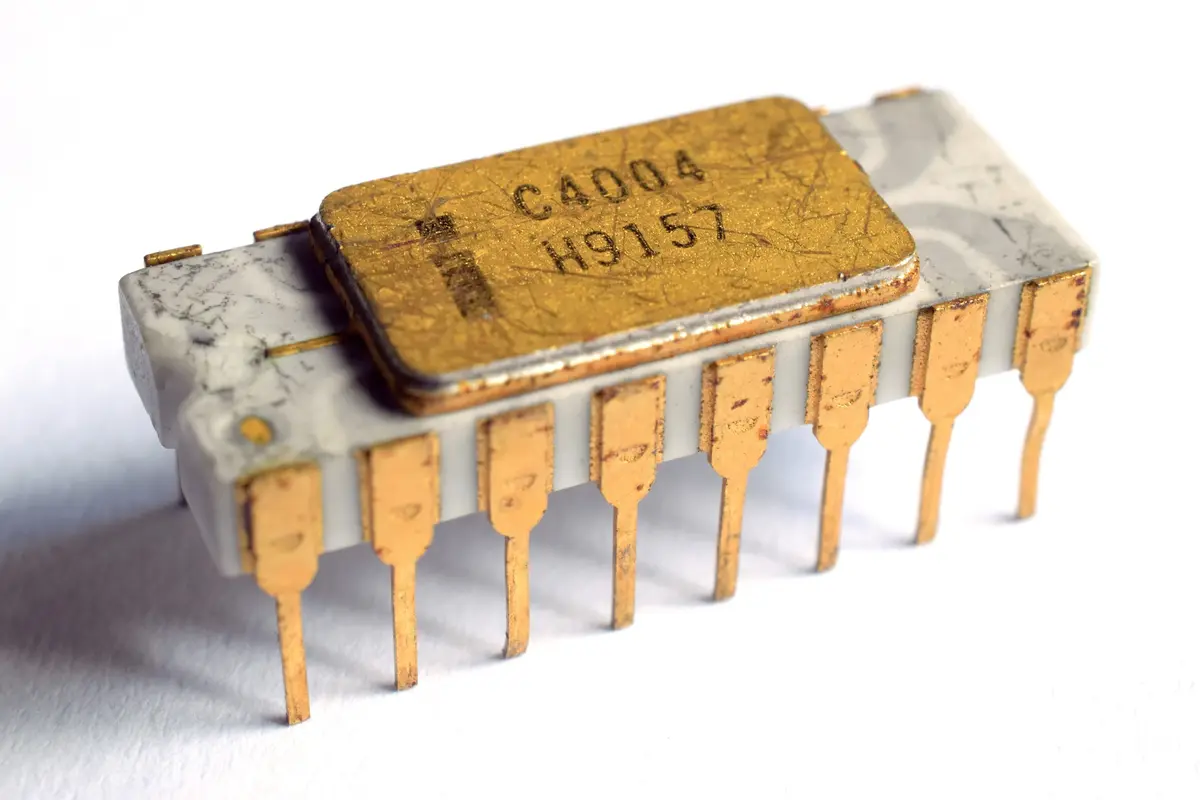
Moore always said it was 'not a law in any real respect' but an observation and a projection. It became a target the whole industry aimed at. From 1991 American chipmakers wrote a shared roadmap of what each supplier had to deliver to stay on the curve, an effort Moore helped to start; in 1998 it became the International Technology Roadmap for Semiconductors, with Europe, Japan, Taiwan and South Korea, and in 2016 it was recast under a new name as simple shrinking became harder and costlier. By 2020 the largest microprocessors held tens of billions of transistors, against about 2,300 on Intel's first microprocessor in 1971.
Moore's law is why computing became cheap: the same steady doubling made possible personal computers, the internet, smartphones and the huge calculations behind today's artificial intelligence. It also shaped how the technology business thinks, expecting every product to be faster and cheaper a year or two later. Moore lived to see the pace slow; in 2015 he said he saw his law 'dying here in the next decade or so'. He died on 24 March 2023, aged 94.
What happened
- 1965
Electronics, McGraw-Hill's fortnightly from New York, publishes 'Cramming more components onto integrated circuits' by Gordon Moore, director of Fairchild Semiconductor's research laboratories, in its 35th-anniversary issue. The number of components on a chip at the lowest cost has doubled about every year since 1959; Moore expects that to go on, to 65,000 by 1975, and foresees home computers, controls for cars and personal portable communications.
McGraw-Hill Building, 330 West 42nd Street, New York: the publisher of Electronics, which printed the article on 19 April 1965- 1966
Fairchild's 9300 TTL universal shift register carries about 125 components (85 transistors and 40 resistors), roughly double the best of 1965: the first year of the forecast is on the line.
Palo Alto: Fairchild Semiconductor's research and development laboratories, which Moore directed and where he drew his graph in 1965 - 1967
Fairchild's 4500 Micromatrix, a 32-gate logic array, carries about 264 components (200 transistors and 64 resistors): the doubling holds again.
Palo Alto: Fairchild Semiconductor's research and development laboratories, which Moore directed and where he drew his graph in 1965 - 1968
Moore asks Harry Sello to photograph seven Fairchild chips, from a single planar transistor of 1960 to the 264-component array of 1967, to show the growth he had predicted.
Palo Alto: Fairchild Semiconductor's research and development laboratories, which Moore directed and where he drew his graph in 1965In the summer Moore and Robert Noyce leave Fairchild and found Intel in Mountain View, betting that silicon memory chips can take computer memory from magnetic cores; their first hire is Andy Grove from Moore's laboratory.
- 1970
Intel's 1103, a 1,024-bit dynamic memory chip priced at about a cent per bit, begins to replace magnetic cores as computers' main memory; memory chips become the densest chips and the main road of the law.
- 1975
At the International Electron Devices Meeting in Washington (1–3 December), Moore, now Intel's president, presents 'Progress in Digital Integrated Electronics': complexity has doubled every year since 1959 and a 16,384-bit memory chip has about reached his 65,000 components; but with circuit cleverness near its limit he expects 'a doubling every two years, rather than every year, by the end of the decade'.
Washington, D.C.: the International Electron Devices Meeting of 1–3 December 1975, where Moore slowed his forecast to a doubling every two years