Intel's first microprocessor
“Intel's 4004, announced on 15 November 1971 and born from a Japanese calculator order, put a computer's whole processor on one chip: the first microprocessor anyone could buy.”
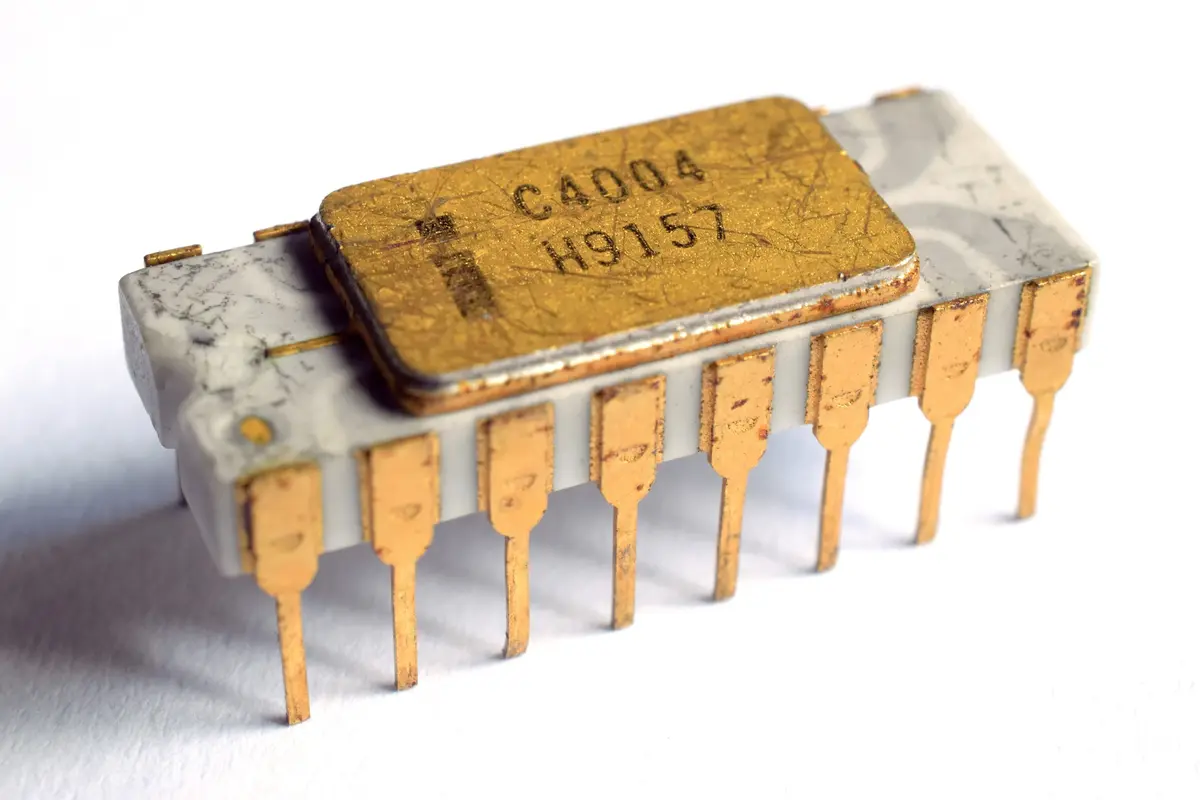
On 15 November 1971 Intel, a three-year-old maker of memory chips in Santa Clara, California, announced in the trade paper Electronic News 'a micro-programmable computer on a chip'. The 4004 was a sliver of silicon about 3 by 4 millimetres in a 16-pin package, holding some 2,300 transistors drawn with lines 10 microns wide. It was a complete central processing unit, the part of a computer that fetches instructions from memory and carries them out: it knew 45 instructions, worked on 4 bits at a time and ran about 92,000 instructions a second. With three companion chips, the 4001 for the program, the 4002 for data and the 4003 for input and output, it made the MCS-4, a small computer built from just four kinds of chip.
It began with a calculator. In April 1969 the Japanese firm Busicom (Nippon Calculating Machine Corporation) agreed with Intel, founded the year before by Robert Noyce and Gordon Moore, to make chips for a new family of printing calculators. In June three Busicom engineers, among them the young Masatoshi Shima, arrived in Mountain View with a design of eight complex custom chips (Intel's own history says twelve). Ted Hoff, the Intel engineer looking after them, feared it was too complex to build cheaply. Over the summer he proposed something simpler: one general-purpose processor that would do the calculator's work by following a program stored in memory. With Stanley Mazor he turned the idea into a plan of four chips, and in October 1969 Busicom chose it.
Then the project stood still until Federico Faggin arrived from Fairchild in April 1970. At Fairchild he had developed the silicon-gate process in 1968, and he used it, with new tricks of his own such as the buried contact, to fit a whole processor on one chip, while Shima checked the logic beside him. In about nine months he designed all four chips. The first 4004 wafers, just after Christmas 1970, were dead because a layer had been left out; the next batch, in the second half of January 1971, worked, and Faggin tested it alone until three in the morning. He had signed the chip with his initials, F.F. By April Busicom's calculator was running on the new chips.
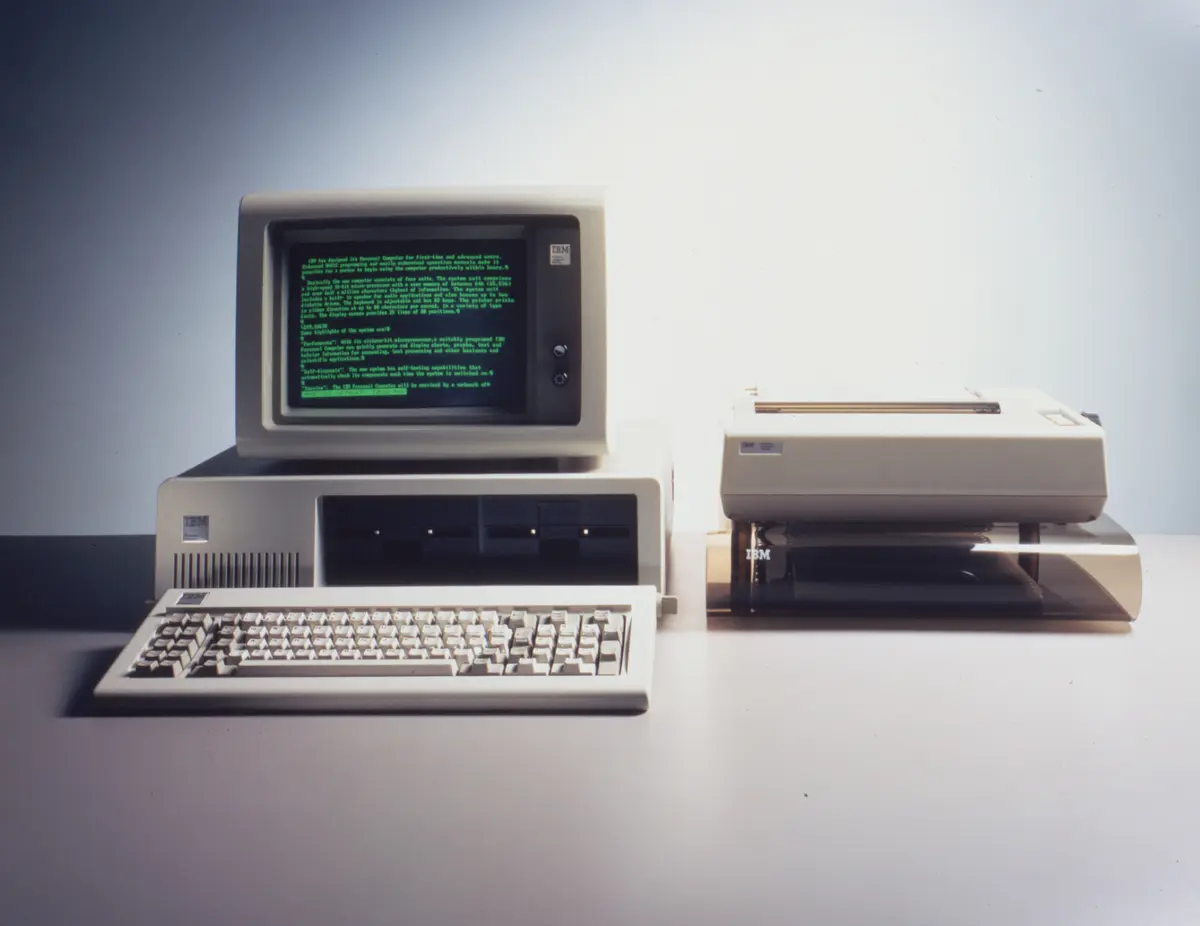
Busicom owned the design, but as calculator prices fell it wanted cheaper chips, and in May 1971 Intel won back the right to sell them for everything except calculators by returning Busicom's $60,000. The November launch turned Intel from a memory company into the microprocessor company: the 8-bit 8008 followed in 1972 and the 8080, designed by Faggin and Shima, in 1974; the 8080 ran the Altair 8800, the 1975 hobby kit that started the personal computer, and in 1981 IBM chose Intel's 8088 for its PC. Others had similar ideas, among them a secret chip set for the F-14 fighter's air-data computer and a one-chip calculator from Texas Instruments, but the 4004 was the first processor on a chip that anyone could buy. Its deeper lesson, as Shima put it, was that software could replace wired logic: the idea now inside every phone, car and washing machine.
What happened
- 1969
Busicom (Nippon Calculating Machine Corporation) of Japan and Intel conclude a provisional agreement for Intel to develop a family of large-scale integrated chips for Busicom's new calculators; Ted Hoff sits in on the April meetings.
Three Busicom engineers, the project manager Masuda, the senior designer Takayama and the young Masatoshi Shima, arrive at Intel with their design: eight kinds of chip for a decimal calculator computer. They work in Intel's small building at 365 Middlefield Road.
365 Middlefield Road, Mountain View: Intel's first home, where Busicom's engineers worked beside Hoff and Mazor in 1969Hoff, who looks after the visitors, finds their chips too complex to make cheaply. Over July and August he works out a simpler plan: a 4-bit general-purpose processor with 16 registers and a small stack, doing the calculator's work by a program in read-only memory. At the end of August he explains it to the Busicom engineers.
365 Middlefield Road, Mountain View: Intel's first home, where Busicom's engineers worked beside Hoff and Mazor in 1969Stanley Mazor, who joined Hoff's group at the start of September, helps turn the idea into a specification of four chips, and Intel formally proposes the design to Busicom in a letter of 16 September.
365 Middlefield Road, Mountain View: Intel's first home, where Busicom's engineers worked beside Hoff and Mazor in 1969After weeks of evaluation by Shima in California and by Busicom in Tokyo, Busicom tells Intel that it adopts Intel's design.
- 1970
Busicom and Intel sign the formal agreement for the chip set. Busicom holds the rights; Intel promises its reasonable best effort.
Federico Faggin, who had developed silicon-gate technology at Fairchild, joins Intel to lead the project. He finds an architecture and a specification but no logic or circuit design, and the work six months behind the schedule promised to Busicom.
365 Middlefield Road, Mountain View: Intel's first home, where Busicom's engineers worked beside Hoff and Mazor in 1969Shima arrives from Japan to check the finished logic and finds none. He stays to help: Faggin designs the four chips in overlapping turns, starting with the 4001, and Shima checks the logic and works on the test programs.
365 Middlefield Road, Mountain View: Intel's first home, where Busicom's engineers worked beside Hoff and Mazor in 1969The first chip of the set, the 4001 read-only memory, comes out and works first time, and the last design, the 4004's, goes to mask-making.
365 Middlefield Road, Mountain View: Intel's first home, where Busicom's engineers worked beside Hoff and Mazor in 1969Just after Christmas the first 4004 wafers arrive. Every chip is dead: under the microscope Faggin sees that the buried-contact layer was left out in manufacture. Three weeks are lost.
- 1971
In the second half of January a new batch comes out at about 6:30 in the evening. This time the 4004 shows signs of life; Faggin tests its main blocks alone in the empty lab until about three in the morning, then goes home to tell his wife Elvia that it works.
After two small faults are fixed with a new set of masks, Faggin ships the first fully working 4004s to Shima in Japan.
Busicom's printing calculator works on the new chips: one 4004, two 4002s, four 4001s and three 4003s, with its functions set by program.
With calculator prices falling, Busicom asks for cheaper chips. Pressed by the design team, Robert Noyce agrees, and in return Intel wins the right to sell the chips for everything except calculators by giving back Busicom's $60,000.
Intel announces the MCS-4 in Electronic News: 'Announcing a new era of integrated electronics', a micro-programmable computer on a chip, in stock at its new headquarters at 3065 Bowers Avenue, Santa Clara.
3065 Bowers Avenue, Santa Clara: Intel's new headquarters of 1971, where the 4004 was first made, and the address on the launch advert