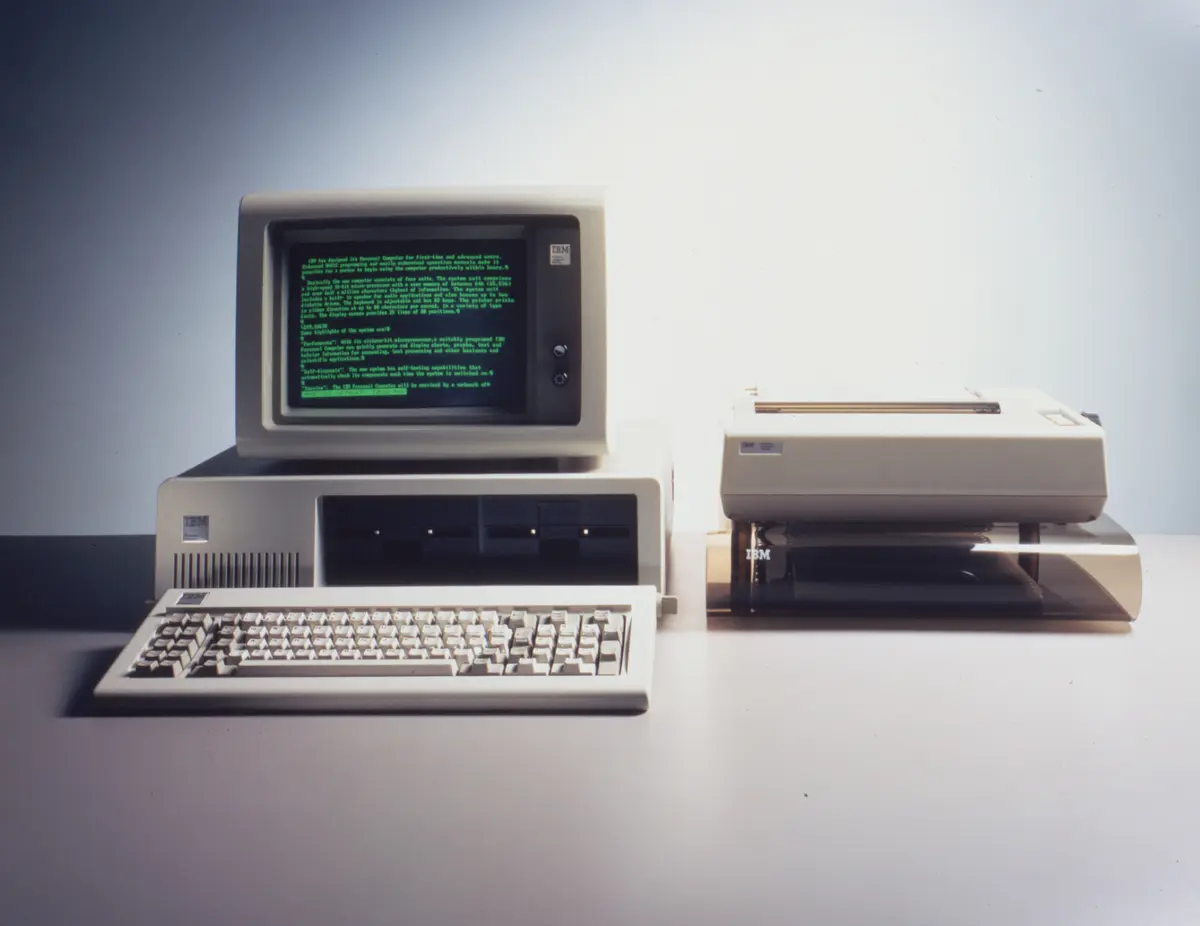
The IBM PC
“In August 1981 IBM launched its Personal Computer, built from other firms' parts with Microsoft's DOS; its open design became the 'IBM-compatible' standard that clone makers soon took over.”
The IBM Personal Computer, model 5150, was the desktop computer that IBM, then the world's biggest computer company, announced at the Waldorf-Astoria hotel in New York on August 12, 1981. It was a beige box with an Intel 8088 processor, 16 kilobytes of memory and a keyboard on a coiled cable. The basic unit cost $1,565; with colour graphics, two diskette drives and a printer, a business system cost about $4,500. Personal computers from smaller firms such as Apple had been on sale for years, but the IBM name told companies that a personal computer was a serious business tool. Within a year more than 750 programs had been written for it, and at the peak IBM was selling one machine every minute of the business day.
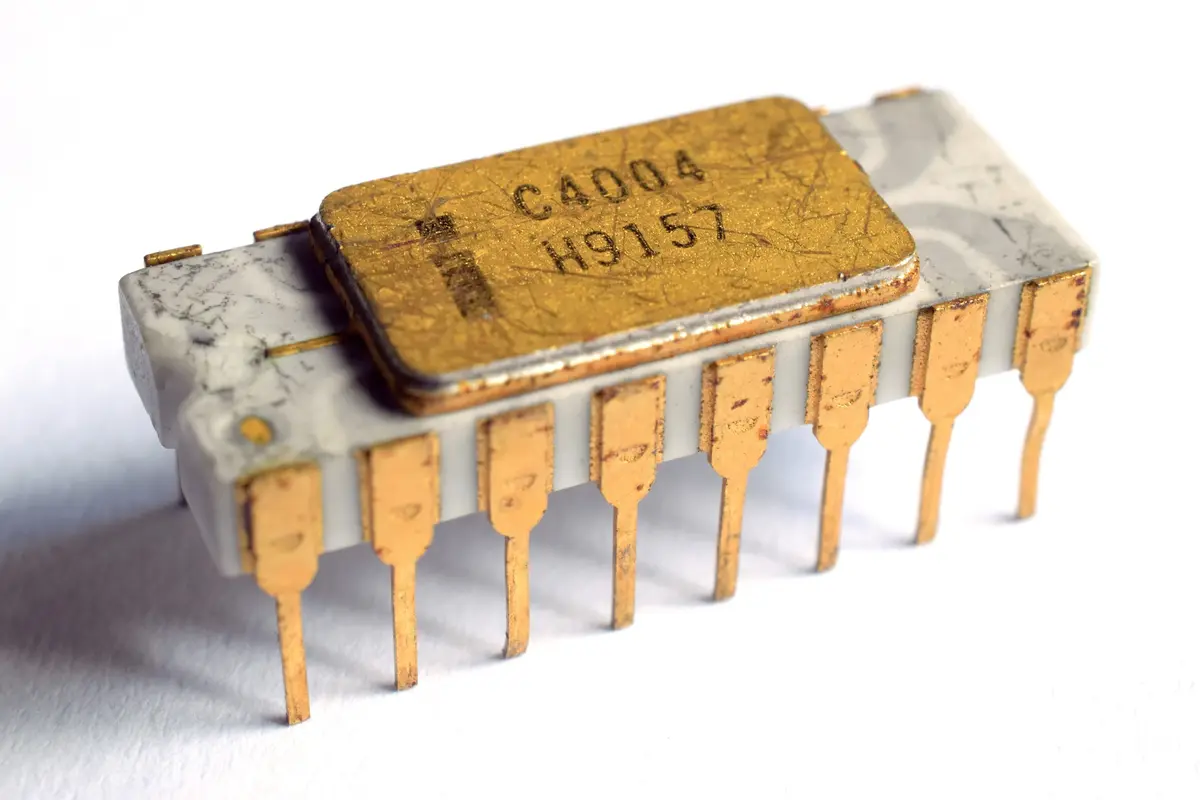
IBM built it in a hurry and against its own habits. In July 1980 Bill Lowe, director of IBM's laboratory in Boca Raton, Florida, promised IBM's leaders a personal computer within a year, when a new IBM product normally took four or five. A small team led by Don Estridge, code-named Chess, worked outside the usual rules: it bought tested parts from other firms instead of making them, took the processor from Intel, the printer from Epson and the operating system from Microsoft. After talks with Digital Research about its CP/M system broke down, Microsoft bought an operating system called 86-DOS from Seattle Computer Products, adapted it, and licensed it to IBM as PC DOS while keeping the right to sell it to others as MS-DOS. IBM also published a Technical Reference manual with the circuit diagrams and the full listing of the BIOS, the machine's built-in start-up code, so that other firms could write programs and make add-on cards. It sold the PC through ComputerLand and Sears as well as its own salesmen, and advertised it with a campaign built on Charlie Chaplin's character, the Little Tramp.
The open design made the IBM PC the standard, and then let others take it. Programs such as the Lotus 1-2-3 spreadsheet (January 1983) made it the machine of the office, and Time named the computer its 'Machine of the Year' for 1982. Columbia Data Products and then Compaq, a Houston start-up whose Portable went on sale in March 1983, rewrote the BIOS in 'clean rooms', without looking at IBM's code, and sold 'IBM compatibles' that ran the same software: since IBM had used parts anyone could buy, and Microsoft could license DOS to anyone, the BIOS was the only piece they had to recreate. IBM answered with the XT (1983) and the AT (1984), but Compaq beat it to Intel's next chip, the 386, in 1986. Estridge, who had made the open design, died in an air crash in August 1985. In April 1987 IBM launched the Personal System/2 with a new, closed expansion bus, the Micro Channel, partly to stop the clones; the clone makers set up a rival standard of their own instead, and the market stayed with them.
IBM's share of the market it had created fell from about 80 percent in 1982–83 to about 20 percent a decade later, and in 2005 it sold its PC business to the Chinese firm Lenovo for $1.75 billion. The lasting winners were its suppliers: Microsoft, whose DOS, and later Windows, became the software of the PC world, and Intel, whose processors grew out of the 8086 family that the 8088 belonged to. 'PC' became the general word for a personal computer, and today's Windows desktops and laptops stand at the end of a long line of compatible machines that began with the 5150.
What happened
- 1980
Bill Lowe, director of IBM's laboratory in Boca Raton, tells IBM's top executives his team can build a personal computer within a year. Frank Cary, IBM's chief executive, backs him; told to come back with a plan, Lowe has a task force of twelve write it, and the project, code-named Chess, goes to Don Estridge, who sets its rules: tested parts from other firms, one model, an open design and sales through outside shops.
IBM's laboratory and plant at Boca Raton, Florida, on Yamato Road: Lowe's lab, where Estridge's team designed the PC in 1980–81 and IBM built it; today the Boca Raton Innovation CampusAn IBM team visits Digital Research in Pacific Grove, California, to license CP/M-86 for the new machine. Dorothy McEwen and the company's lawyer negotiate a non-disclosure agreement in the morning; Gary Kildall returns from a business flight as planned, but the two sides cannot agree on money: IBM wants to buy the system outright, Digital Research wants a royalty on each copy.
Digital Research, 801 Lighthouse Avenue, Pacific Grove, California: IBM's team came here in August 1980 to license CP/M-86 and left without a dealIBM signs a contract with Microsoft, which is already writing the PC's BASIC, to supply the operating system as well, although Microsoft has none yet.
Microsoft licenses 86-DOS, written by Tim Paterson at Seattle Computer Products for Intel's 16-bit chips, for a flat fee of $25,000; the seller does not know for sure that the customer is IBM.
- 1981
After 40 days on the system board and four months to a working prototype, the engineers in Boca Raton are virtually finished, and the manufacturing team takes over, assembling tested parts from outside suppliers.
IBM's laboratory and plant at Boca Raton, Florida, on Yamato Road: Lowe's lab, where Estridge's team designed the PC in 1980–81 and IBM built it; today the Boca Raton Innovation CampusPC DOS 1.0 is complete, a month before the launch. Seeing the value of owning the system and licensing it to the makers of IBM-PC clones, Microsoft buys all rights to 86-DOS for another $50,000; IBM gets a non-exclusive licence, and Microsoft keeps the right to sell the system to others as MS-DOS.
IBM publishes the PC's Technical Reference manual, with circuit diagrams and the complete listing of the BIOS, the start-up code in the machine's read-only memory, so that other companies can write programs and build cards for its five expansion slots.
At a press conference in the Waldorf-Astoria's ballroom in New York, Don Estridge announces the IBM Personal Computer, 'as little as $1,565' for a system unit with 16 kilobytes of memory, to be sold through ComputerLand, Sears and IBM's own Product Centers; a business system with colour graphics, two diskette drives and a printer costs about $4,500.
The Waldorf-Astoria, Park Avenue, New York: Don Estridge announced the IBM Personal Computer at a press conference in its ballroom on August 12, 1981The month IBM's press release set for the first deliveries. The response to the announcement has been overwhelming: one dealer has taken $1,000 deposits from 22 customers for machines he could not promise a delivery date for.
- 1982
Byte, the leading computer magazine, puts the IBM PC on its cover with an in-depth review; its editor marvels that the whole project took about 13 months, built from outside vendors' parts by a team that included hobbyists and was left alone in Boca Raton.
Three senior engineers from Texas Instruments, Rod Canion, James Harris and William Murto, found Compaq in Houston to make a portable computer that runs IBM PC software, sketched first on a restaurant placemat.
Houston, Texas: Compaq was founded here in February 1982 and built the Compaq Portable, the first big-selling IBM-compatibleCompaq announces the Compaq Portable, a 28-pound IBM-compatible whose BIOS was rewritten in a 'clean room' so as not to copy IBM's; it goes on sale in March 1983 for $2,995 and sells 53,000 in its first year.
Houston, Texas: Compaq was founded here in February 1982 and built the Compaq Portable, the first big-selling IBM-compatible- 1983
Time names not a person but 'The Computer' its Machine of the Year for 1982: personal computer sales doubled in 1981, the year IBM joined the market, and are expected to double again.
Lotus Development releases 1-2-3, a spreadsheet, chart maker and database in one, written for the IBM PC; it becomes the PC's 'killer app', the program businesses buy the machine to run.
IBM announces the PC XT, with a hard disk and room to grow, and PC DOS 2.0, which Microsoft rewrote to handle hard disks and folders within folders.
IBM makes its PC business a division of its own, the Entry Systems Division, responsible for low-cost personal computers worldwide, with Don Estridge as its president.
IBM's laboratory and plant at Boca Raton, Florida, on Yamato Road: Lowe's lab, where Estridge's team designed the PC in 1980–81 and IBM built it; today the Boca Raton Innovation Campus- 1984
IBM introduces the Personal Computer AT, built on Intel's faster 80286 processor, with a 1.2 MB diskette drive and DOS 3.0.
- 1985
- 6:05 p.m.
Delta Air Lines Flight 191 is caught by a microburst on its approach to Dallas–Fort Worth and crashes; among the 134 people killed aboard are Don Estridge, 48, and his wife Mary Ann. The PC division he led until earlier that year, begun with a team of 14, has grown to about 10,000 employees, and more than a million PCs have been sold.
Dallas–Fort Worth International Airport: Delta Air Lines Flight 191 crashed on its approach on August 2, 1985, killing Don Estridge and his wife - 1987
IBM announces the Personal System/2, whose better models use a new, proprietary expansion bus, the Micro Channel, meant in part to stop the clones. The clone makers do not follow: their cheaper machines keep the old open design, and a year later nine of them announce a rival standard of their own.