Jack Kilby
“The Texas Instruments engineer who built the first integrated circuit in 1958, led the team that made the first handheld calculator, and won the 2000 Nobel Prize in Physics.”
Jack St. Clair Kilby was the American electrical engineer who built the first integrated circuit, the microchip, at Texas Instruments (TI) in Dallas in 1958. He also led the small team that made the first handheld electronic calculator, co-invented the thermal printer used in early portable terminals, and took out more than sixty US patents. Tall, quiet and modest, he spoke in few words and liked to say that he solved problems rather than pursued theories. In 2000, more than forty years after his first chip, he received the Nobel Prize in Physics.
He was born in Jefferson City, Missouri, on 8 November 1923, but grew up in Kansas, first in Salina and then in Great Bend, where his father ran a power company with customers across the western part of the state. When an ice storm brought down the lines, his father kept in touch with customers through radio amateurs, and young Jack became a licensed 'ham' himself. He hoped to study at the Massachusetts Institute of Technology but missed its entrance standard by three points, so in 1941 he began electrical engineering at the University of Illinois. In 1943 he went into the Army; he trained as a radio operator and served with the Office of Strategic Services (OSS) on the border of India and Burma and then in China, keeping the radios of the agents behind Japanese lines working. He finished his degree in 1947.
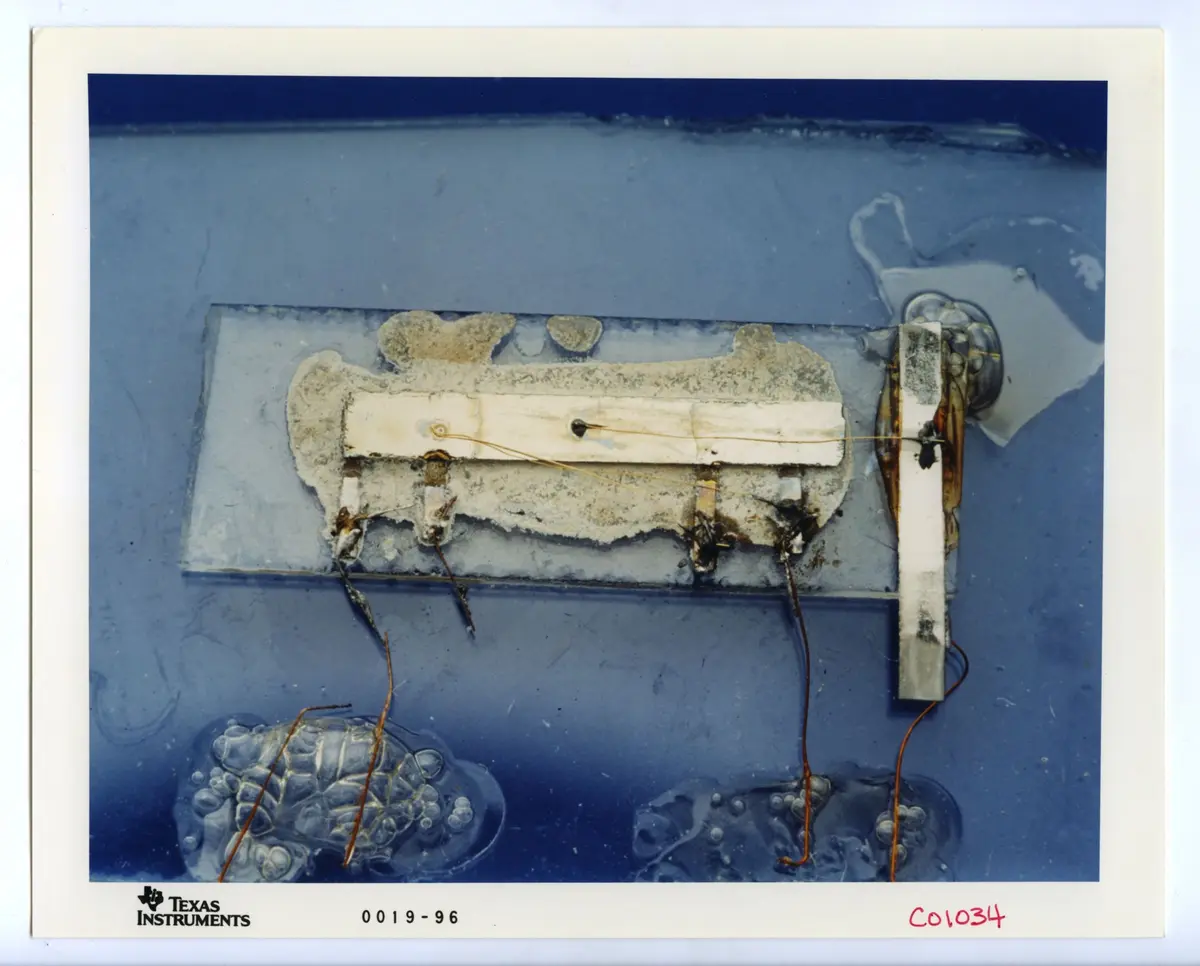
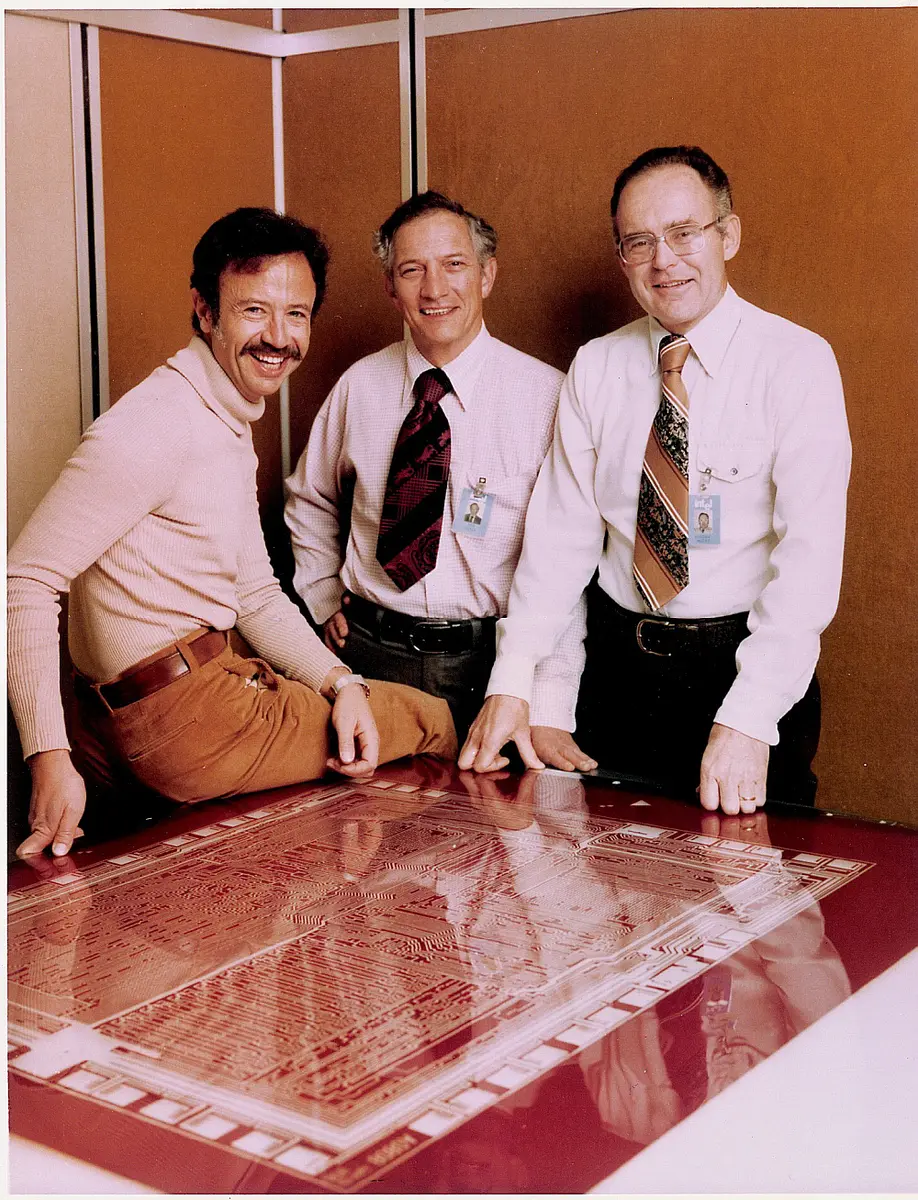
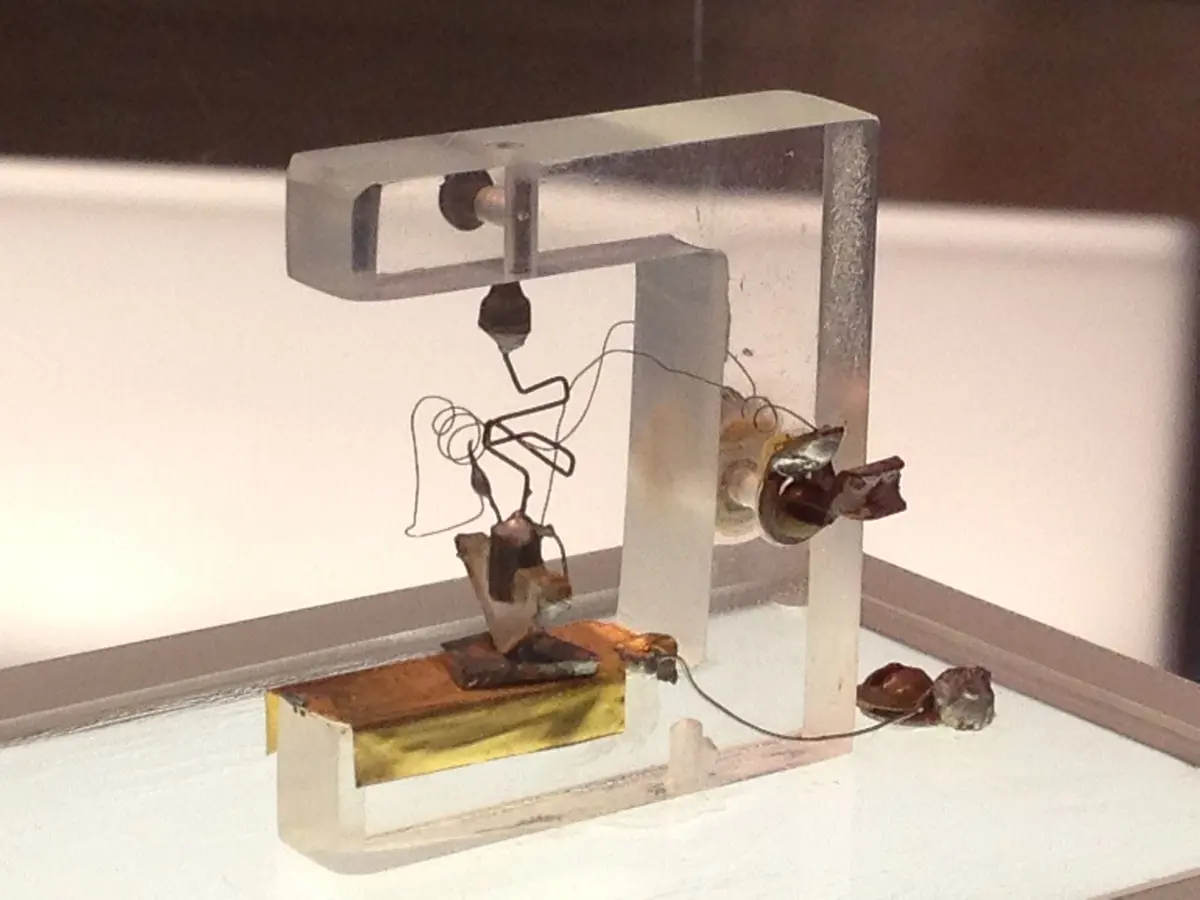
For eleven years he worked at Centralab, a maker of radio and television parts in Milwaukee, Wisconsin, where he printed whole circuits on small ceramic plates, studied for a master's degree at night, and after Bell Labs licensed the transistor in 1952 built some of the first transistor amplifiers for hearing aids. In May 1958 he moved to TI, the only company that would let him work on making electronics smaller. That summer, too new to have a holiday, he had the idea of making every part of a circuit in one piece of semiconductor, and on 12 September 1958 he showed a working one. At Fairchild in California, Robert Noyce reached the same goal independently a few months later, in a form that factories could make in quantity; the two firms fought over the patents for years, and today both men are honoured as co-inventors. Kilby went on to lead the teams that built the first military systems and the first computer made of chips.
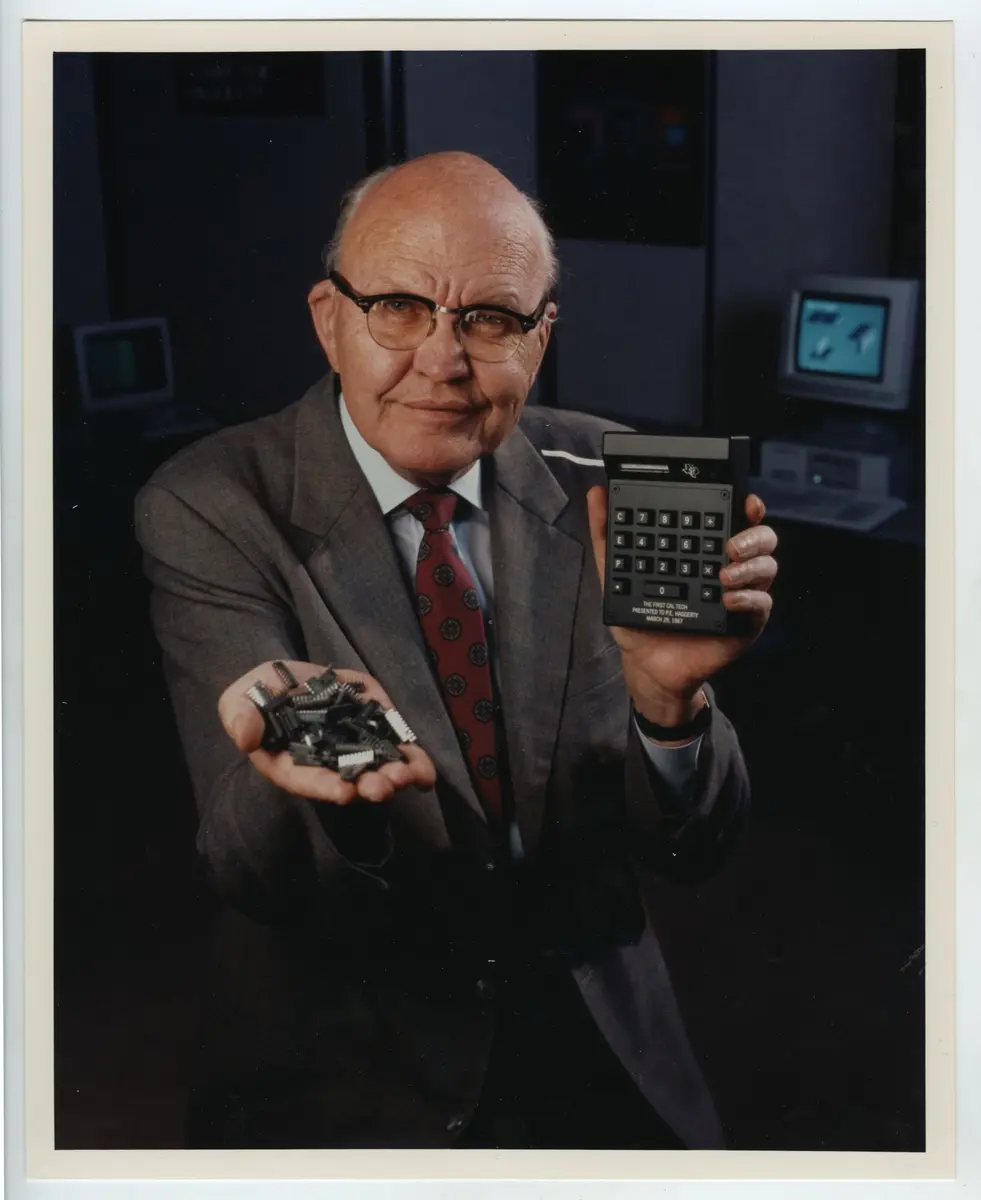
In the mid-1960s TI's president, Pat Haggerty, wanted a consumer product to prove what chips could do. Kilby proposed a pocket calculator and divided the work: Jerry Merryman designed the logic, James Van Tassel the keyboard, and Kilby the output and power supply, including a small thermal printer. The prototype, called Cal Tech, was handed to Haggerty on 29 March 1967 and now belongs to the Smithsonian; Canon sold the first product based on it, the Pocketronic, in 1970. That year Kilby left his post at TI to work as an independent inventor, first on consumer products and then on a way to make electricity from sunlight with silicon. He taught at Texas A&M University from 1978 and officially retired from TI in 1983, but stayed close to the company.
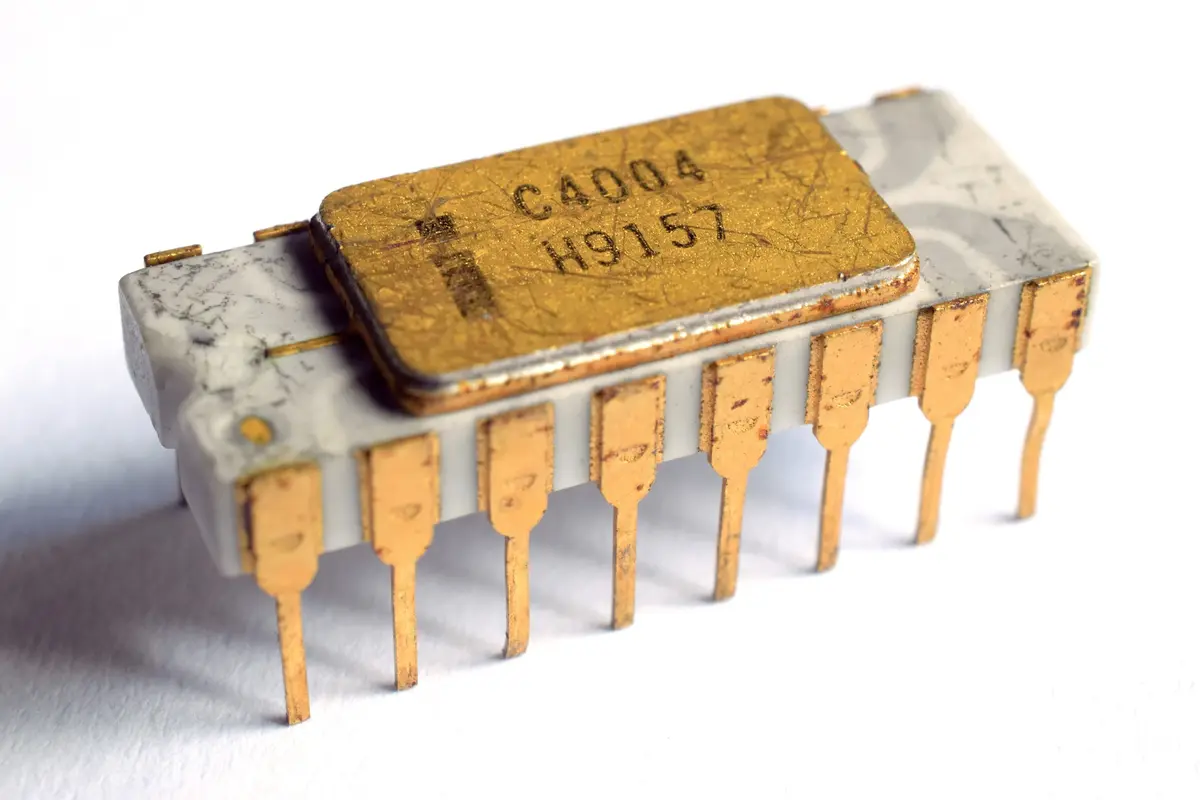
Honours came late but in great number: the National Medal of Science, the National Inventors Hall of Fame, the IEEE Medal of Honor, the first Draper Prize (shared with Noyce), the National Medal of Technology, the Kyoto Prize and finally the Nobel Prize, shared with Zhores Alferov and Herbert Kroemer. In his Nobel autobiography he wrote that if Noyce, who died in 1990, had still been living, they would surely have shared it. A keen photographer and woodworker, he lived in Dallas until his death on 20 June 2005. Every phone and computer today runs on his idea of putting a whole circuit on one small chip.
What happened
- 1923
Jack St. Clair Kilby is born in Jefferson City, Missouri, the son of Hubert St. Clair Kilby, an electrical engineer with a utility company.
Jefferson City, Missouri: born here on 8 November 1923; the family left for Kansas when he was about four- 1928
When Jack is about four, his father takes a new job and the family moves to Salina, Kansas. 'I was born there, but left before it made much of an impression,' Kilby later said of Missouri.
- 1935
By the middle of the 1930s the family lives in Great Bend, Kansas, where his father's company, which serves customers across the western third of the state, has moved its offices. Jack, a Boy Scout, often travels with his father around the company's lines.
Great Bend, Kansas: the family home from the early 1930s, where his father's power company had its offices; he graduated from Great Bend High School in 1941 - 1941
Kilby graduates from Great Bend High School. In his last years there an ice storm brought down his father's lines and his father kept in touch with customers through radio amateurs; Jack became a licensed 'ham' himself. He applies only to MIT, but after a summer course scores 497 on the entrance test, against a minimum of 500.
Great Bend, Kansas: the family home from the early 1930s, where his father's power company had its offices; he graduated from Great Bend High School in 1941With about a week to spare, he enrols in electrical engineering at the University of Illinois in Urbana-Champaign, where his parents had studied, and joins the Acacia fraternity.
University of Illinois, Urbana-Champaign: electrical engineering 1941-43 and 1946-47, BS 1947Five days after Pearl Harbor, Kilby volunteers for the Army Reserve.
University of Illinois, Urbana-Champaign: electrical engineering 1941-43 and 1946-47, BS 1947- 1943
Called to active duty after two years at Illinois, he trains at the Signal Corps' radio operators' school and then joins the Office of Strategic Services (OSS), the wartime intelligence service.
- 1944
In India, close to the Burmese border, Kilby keeps the radios working that link the OSS to its agents and their irregular forces behind Japanese lines in Burma; he spends a little time in Myitkyina in Burma.
- 1945
When the Burma campaign ends, his unit moves to China, where he spends the last six months of the war doing the same work.
Kilby receives his honourable discharge, on Christmas Eve, and goes back to Illinois a few weeks later on the GI Bill.
- 1947
He graduates from the University of Illinois with a Bachelor of Science in electrical engineering. His courses were mostly in electric power, but he also took vacuum-tube electronics, just before Bell Labs announced the transistor.
University of Illinois, Urbana-Champaign: electrical engineering 1941-43 and 1946-47, BS 1947After writing some thirty letters, he joins Centralab, the components division of Globe-Union in Milwaukee, to design circuits printed by silk screen on small ceramic plates for television sets and hearing aids.
Centralab, a division of Globe-Union, East Keefe Avenue, Milwaukee: his workplace from 1947 to 1958- 1948
He marries Barbara Annegers of Galesburg, Illinois. They will have two daughters, Ann and Janet.
- 1950
Studying at night in courses that University of Wisconsin teachers give in Milwaukee, he receives a master's degree in electrical engineering from the university in Madison.
Centralab, a division of Globe-Union, East Keefe Avenue, Milwaukee: his workplace from 1947 to 1958 - 1952
Centralab pays Bell Labs $25,000 for a licence to make transistors, and Kilby and the chief engineer Robert Wolff attend Bell's symposium. Back in Milwaukee he works on transistor products, among them small amplifiers for hearing aids.
Centralab, a division of Globe-Union, East Keefe Avenue, Milwaukee: his workplace from 1947 to 1958 - 1958
Kilby joins Texas Instruments in Dallas, in Willis Adcock's research group, because TI is the only company that will let him work on making electronic circuits smaller almost full time.
Texas Instruments, North Central Expressway, Dallas: his laboratory from May 1958, where he built the first integrated circuit; he lived in Dallas until his death in 2005Alone in the laboratory during TI's summer shutdown, as a newcomer without holiday, he writes in his notebook that resistors, capacitors and transistors could all be made in one piece of semiconductor (the integrated circuit entry tells the story).
Texas Instruments, North Central Expressway, Dallas: his laboratory from May 1958, where he built the first integrated circuit; he lived in Dallas until his death in 2005Kilby shows TI's managers the first working integrated circuit, a sliver of germanium that produces a steady wave on the oscilloscope.
Texas Instruments, North Central Expressway, Dallas: his laboratory from May 1958, where he built the first integrated circuit; he lived in Dallas until his death in 2005- 1959
TI applies for his patent 'Miniaturized Electronic Circuits'. A few months later Robert Noyce at Fairchild files his own patent for a chip made in silicon with flat metal connections, the form that industry will mass-produce; the two firms fight over priority for years.
Texas Instruments, North Central Expressway, Dallas: his laboratory from May 1958, where he built the first integrated circuit; he lived in Dallas until his death in 2005- 1961
TI and the US Air Force show the first computer built from integrated circuits; Kilby had led the team that built it, as he did the first military systems that used chips.
- 1964
Kilby's integrated-circuit patent, 3,138,743, is granted.
- 1965
TI's president Pat Haggerty, looking for a consumer product to show what chips can do, suggests ideas to Kilby, among them a pocket calculator. Kilby takes it on as the secret 'Project Cal Tech', with Jerry Merryman designing the logic, James Van Tassel the keyboard, and himself the output and power supply.
TI files the first application for a thermal printer by Kilby, Earl Alexander and Stephen Emmons: rows of tiny semiconductor heaters that mark heat-sensitive paper. The patent is granted on 17 February 1970.
- 1966
The IEEE makes Kilby a Fellow and gives him its David Sarnoff Award; the Franklin Institute gives him its Stuart Ballantine Medal.
- 1967
The first Cal Tech, a battery calculator weighing about three pounds that adds, subtracts, multiplies and divides and prints its answers on a paper strip, is presented to Haggerty.
Texas Instruments, North Central Expressway, Dallas: his laboratory from May 1958, where he built the first integrated circuit; he lived in Dallas until his death in 2005Kilby, Merryman and Van Tassel apply for a patent on the 'miniature electronic calculator'.
- 1970
Canon brings out the Pocketronic in Japan, the first calculator based on the Cal Tech, with TI's chips and thermal printer; it reaches the United States in 1971, and TI sells calculators under its own name from 1972.
Kilby takes a leave of absence from TI to work as an independent inventor and consultant, first on consumer products and telephone accessories. A serious photographer with a Hasselblad and his own darkroom, he photographs Dallas buildings in the same year.
President Richard Nixon presents Kilby with the National Medal of Science (for 1969) at the White House, for his work on the production and use of integrated circuits.
- 1974
The calculator patent, 3,819,921, is granted to Kilby, Merryman and Van Tassel.
- 1975
The National Academy of Engineering gives him its Vladimir K. Zworykin Award.
- 1977
TI files a patent by Kilby, William McKee and Wilbur Porter on making small drops of silicon in free fall, part of his scheme for producing electricity from sunlight. TI acquired the rights and Kilby consulted on the solar project for years, until TI dropped it in the early 1980s.
- 1978
He becomes Distinguished Professor of Electrical Engineering at Texas A&M University, a post he holds until 1984. 'I really didn't do much professing,' he wrote.
- 1982
Kilby is inducted into the National Inventors Hall of Fame, beside Edison, Ford and the Wright brothers.
- 1983
Kilby officially retires from TI, but stays closely involved with the company for the rest of his life.
- 1986
The IEEE awards him its Medal of Honor for semiconductor integrated-circuit technology.
- 1988
The University of Illinois gives him an honorary Doctor of Science.
University of Illinois, Urbana-Champaign: electrical engineering 1941-43 and 1946-47, BS 1947- 1990
He receives the National Medal of Technology at the White House.
At the State Department in Washington, President George H. W. Bush presents the first Charles Stark Draper Prize of the National Academy of Engineering to Kilby and Robert Noyce together.
- 1993
The Inamori Foundation awards him the Kyoto Prize in Advanced Technology for the monolithic integrated circuit and its first uses, including the prototype calculator.
- 1997
TI opens its new research centre in Dallas and names it the Kilby Center.
Texas Instruments, North Central Expressway, Dallas: his laboratory from May 1958, where he built the first integrated circuit; he lived in Dallas until his death in 2005 - 1998
Barton County, Kansas, proclaims a 'Jack Kilby Day' in honour of Great Bend's most famous pupil.
Great Bend, Kansas: the family home from the early 1930s, where his father's power company had its offices; he graduated from Great Bend High School in 1941- 2000
The Royal Swedish Academy of Sciences awards Kilby half of the Nobel Prize in Physics 'for his part in the invention of the integrated circuit'; the other half goes to Zhores Alferov and Herbert Kroemer. Woken early by the news, he starts his pot of coffee.
He gives his Nobel lecture, 'Turning Potential into Realities: The Invention of the Integrated Circuit', to about 800 people at Stockholm University.
King Carl XVI Gustaf of Sweden presents him with the Nobel Prize at the Stockholm Concert Hall. In his autobiography Kilby writes that had Robert Noyce still been living, they would surely have shared it.
- 2005
Jack Kilby dies in Dallas, aged 81, after a brief illness with cancer.
Texas Instruments, North Central Expressway, Dallas: his laboratory from May 1958, where he built the first integrated circuit; he lived in Dallas until his death in 2005