ARPANET, the internet's ancestor
“In 1969 the Pentagon's research agency ARPA linked four computers by packet switching; the first message, 'lo', went from UCLA to SRI, and its 1983 switch to TCP/IP made it the core of the internet.”
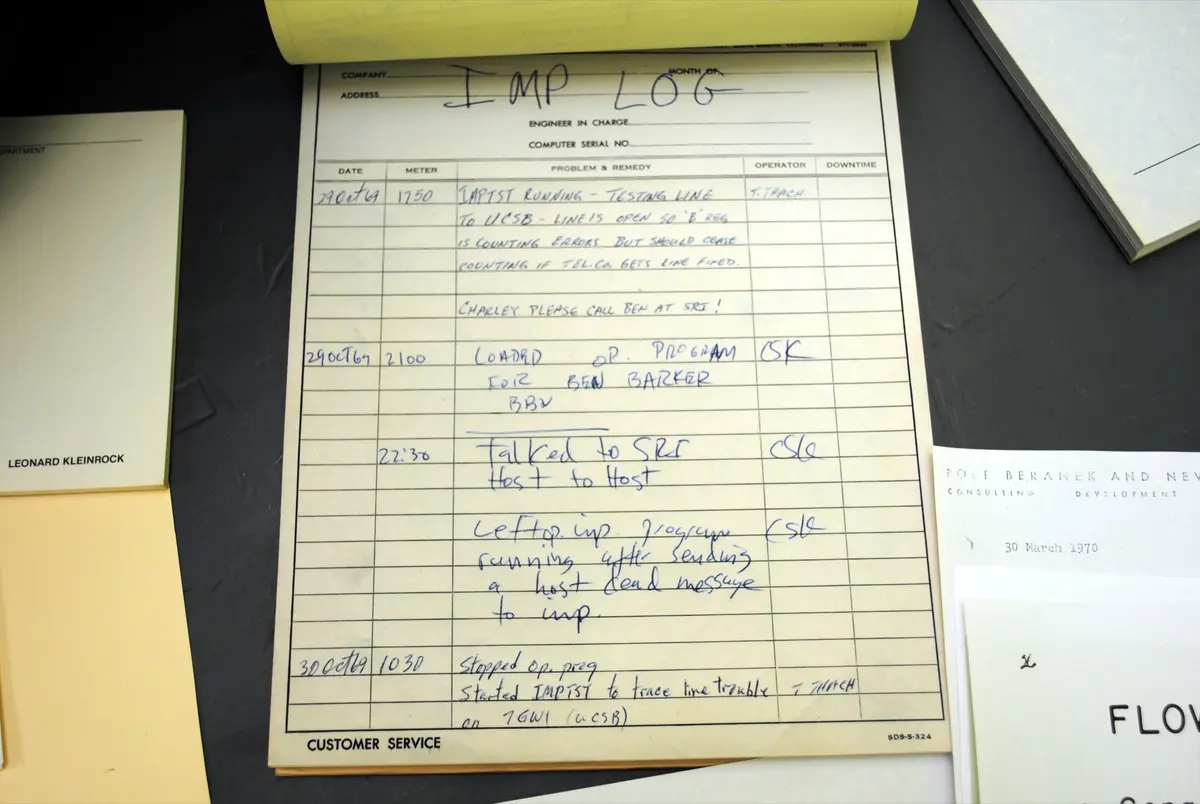
ARPANET was the computer network that the US Defense Department's Advanced Research Projects Agency (ARPA) built from 1969 to link the computers of the universities and laboratories it paid for. It was the first large network to send data in 'packets': a message was cut into small blocks that travelled on their own through a chain of switching computers and were put back together at the end. On October 29, 1969, at 10:30 in the evening, Charley Kline, a programmer in Leonard Kleinrock's laboratory at UCLA, tried to log in to a computer at the Stanford Research Institute (SRI) in Menlo Park. The letters L and O arrived, then SRI's machine crashed, so the first message was 'lo'; the full login worked about an hour later. By December 1969 four computers were joined: UCLA, SRI, the University of California at Santa Barbara and the University of Utah.
ARPA had been created in 1958 as the American answer to Sputnik, and in the 1960s it paid for much of the country's computer research. Computers were then huge, expensive and all different. In 1962 J. C. R. Licklider, the first head of ARPA's computer office, wrote of a 'Galactic Network' that would let anyone use programs and data anywhere. In 1966 Bob Taylor of the same office had three terminals in his room at the Pentagon, each for a different distant computer, and asked ARPA's director, Charles Herzfeld, for money to join them; within twenty minutes he had a million dollars. Taylor brought in Larry Roberts from MIT to plan the network. Roberts used packet switching, worked out separately by Kleinrock at MIT, Paul Baran at the RAND Corporation and Donald Davies at Britain's National Physical Laboratory, whose team gave the 'packet' its name. Baran had wanted networks that could survive a nuclear attack, but the ARPANET was built to share computers.
The Cambridge firm Bolt Beranek and Newman (BBN) built the switches, called Interface Message Processors (IMPs): small Honeywell computers that passed packets to each other over leased telephone lines at 50,000 bits a second, the ancestors of today's routers. Young researchers at the connected sites wrote the rules for the big host computers and shared their drafts as 'Requests for Comments', a series begun by Steve Crocker of UCLA in April 1969 that is still used for the internet's standards. The network grew by about one site a month. In late 1971 Ray Tomlinson at BBN sent the first email between two computers on it and chose the @ sign for addresses; within a year email was most of the traffic. In October 1972 Bob Kahn showed the ARPANET to the public at a conference in Washington, where visitors used programs on computers across the country.
Other packet networks followed, by radio and by satellite, and they could not talk to the ARPANET. In 1973 and 1974 Kahn and Vint Cerf designed a common language for joining networks, the Transmission Control Protocol, later split into TCP and IP. On November 22, 1977, data travelled from a van in the San Francisco Bay Area across three different networks, by way of London, to Los Angeles. On January 1, 1983, every computer on the ARPANET had to switch to TCP/IP: the 'flag day' often called the birth of the internet. That year the military sites moved to a network of their own, MILNET. From 1985 the National Science Foundation's NSFNET grew around TCP/IP, and the ARPANET itself was switched off in 1990.
The ARPANET still shapes daily life. The internet moves packets through routers that descend from the IMPs, speaks TCP/IP, keeps Tomlinson's @ and still publishes its rules as open Requests for Comments. Because it was built by researchers to share machines, not by a telephone company to sell calls, it was designed as a general network on which anyone could build new uses, which is how the World Wide Web could later be added on top. It also shows what public money for basic research, given with a free hand, can start: when ARPA offered to hand the network over in the early 1970s, AT&T turned it down.
What happened
- 1966
Bob Taylor of ARPA's computer office in the Pentagon has three terminals for three distant computers, in Santa Monica, at Berkeley and at MIT, and wants them joined. He asks ARPA's director, Charles Herzfeld, for money and within about twenty minutes gets a million dollars, taken from the missile-defence budget.
The Pentagon, Arlington, Virginia: ARPA's computer office, where Taylor's three terminals started the project in 1966Taylor, now head of the office, brings in Larry Roberts from MIT's Lincoln Laboratory as its chief scientist, to plan and run the network.
The Pentagon, Arlington, Virginia: ARPA's computer office, where Taylor's three terminals started the project in 1966- 1967
Roberts gathers the researchers ARPA pays for at the University of Michigan in Ann Arbor. Wesley Clark suggests putting a small computer, an 'Interface Message Processor', in front of each big host to run the network for it.
Roberts presents the plan for the ARPA network at an ACM symposium in Gatlinburg, Tennessee. There Roger Scantlebury tells him of Donald Davies's packet network at Britain's National Physical Laboratory and of Paul Baran's work at RAND; ARPA takes the word 'packet' and raises the planned line speed from 2.4 to 50 kilobits a second.
- 1968
ARPA mails its request for quotations for the IMPs to 140 possible bidders. Twelve proposals come back; IBM and AT&T do not bid.
- 1969
Bolt Beranek and Newman of Cambridge, Massachusetts, chosen the week before Christmas, starts work on its contract of about a million dollars. Frank Heart's team, with Bob Kahn on the design, turns Honeywell DDP-516 minicomputers into IMPs.
Bolt Beranek and Newman, 50 Moulton Street, Cambridge, Massachusetts: the IMPs were built and the network run from here; the first network email (1971)Steve Crocker of UCLA sends out 'Host Software', Request for Comments 1, the first of the open working notes in which the sites agree how their computers will talk.
UCLA, Boelter Hall room 3420: Kleinrock's laboratory, the ARPANET's first node (September 2, 1969) and the sending end of the first message; now the Kleinrock Internet Heritage SiteOn a Saturday, BBN's first IMP arrives at Kleinrock's laboratory, room 3420 of Boelter Hall at UCLA.
UCLA, Boelter Hall room 3420: Kleinrock's laboratory, the ARPANET's first node (September 2, 1969) and the sending end of the first message; now the Kleinrock Internet Heritage SiteThe day after Labor Day the IMP is joined by a 15-foot cable to UCLA's SDS Sigma 7 computer, and bits move between them: the first node of the network.
UCLA, Boelter Hall room 3420: Kleinrock's laboratory, the ARPANET's first node (September 2, 1969) and the sending end of the first message; now the Kleinrock Internet Heritage SiteEarly in the month the second IMP reaches SRI in Menlo Park, home of Doug Engelbart's 'Augmentation of Human Intellect' project, and the first 50-kilobit line joins UCLA and SRI. Later in October SRI connects its SDS 940 computer.
SRI (Stanford Research Institute), Menlo Park: the second node (October 1969), Engelbart's laboratory and the Network Information Center; the receiving end of 'lo'- 10:30 p.m.
Charley Kline at UCLA, with Kleinrock, starts to log in to Bill Duvall's computer at SRI, the two talking by telephone. 'L' and 'o' arrive, then the SRI system crashes: the first message is 'lo'. The IMP log records 'Talked to SRI Host to Host'; the full login works about an hour later.
UCLA, Boelter Hall room 3420: Kleinrock's laboratory, the ARPANET's first node (September 2, 1969) and the sending end of the first message; now the Kleinrock Internet Heritage Site The third IMP is connected at the University of California, Santa Barbara, with an IBM 360/75 as its host; Glen Culler and Burton Fried work on showing mathematics on screens across the network.
University of California, Santa Barbara: the third node (November 1969)The fourth IMP joins the University of Utah and its DEC PDP-10, where researchers study 3-D graphics over the network. The four-node ARPANET is complete, and further deliveries wait while it is tested.
University of Utah, Salt Lake City: the fourth node (December 1969)- 1970
The Network Working Group under Steve Crocker finishes the first host-to-host protocol, the Network Control Protocol (NCP). As the sites put it in during 1971 and 1972, users can start to build applications.
- 1971
Late in the year Ray Tomlinson at BBN lets a mail program deliver to another computer and sends the first email between two machines on the ARPANET, standing side by side. He picks the @ sign to show that a user is 'at' another host.
Bolt Beranek and Newman, 50 Moulton Street, Cambridge, Massachusetts: the IMPs were built and the network run from here; the first network email (1971) - 1972
The first International Conference on Computer Communication opens at the Washington Hilton (October 24-26). In a demonstration room organised by Bob Kahn, visitors use terminals from many makers to run programs on computers across the country, and the psychiatrist program ELIZA at MIT chats with the 'paranoid' program PARRY at Stanford.
Washington Hilton, Connecticut Avenue, Washington: the first public demonstration of the ARPANET at the ICCC, October 24-26, 1972- 1973
Kahn, now at ARPA, and Vint Cerf of Stanford give the first written design of their Transmission Control Protocol, for joining different networks, to the International Network Working Group meeting at the University of Sussex in England.
- 1974
Cerf and Kahn publish 'A Protocol for Packet Network Intercommunication' in the IEEE Transactions on Communications. ARPA soon pays Stanford, BBN and University College London to build working versions.
- 1975
ARPA hands the running of the ARPANET, now an everyday tool, to the Defense Communications Agency; BBN stays on as its operator.
- 1977
A packet-radio van driving in the San Francisco Bay Area sends data through SRI, across the ARPANET and by satellite to London and back, to USC's Information Sciences Institute in Los Angeles: the first transmission across three different networks with TCP.
SRI (Stanford Research Institute), Menlo Park: the second node (October 1969), Engelbart's laboratory and the Network Information Center; the receiving end of 'lo'- 1981
Jon Postel publishes RFC 801, the plan to move every ARPANET host from NCP to TCP/IP, with 'a complete switch over' by January 1, 1983.
- 1983
Flag day: the ARPANET switches from NCP to TCP/IP all at once, and hosts that have not converted are left with makeshift links. The network becomes the core of the TCP/IP internet; later that year its military sites split off as MILNET.