Fusion ignition at the National Ignition Facility
“On December 5, 2022, NIF's lasers delivered 2.05 MJ to a fusion target and got 3.15 MJ out, the first time a lab fusion shot beat its laser energy (target gain 1.5, not wall-plug: the laser drew about 300 MJ).”
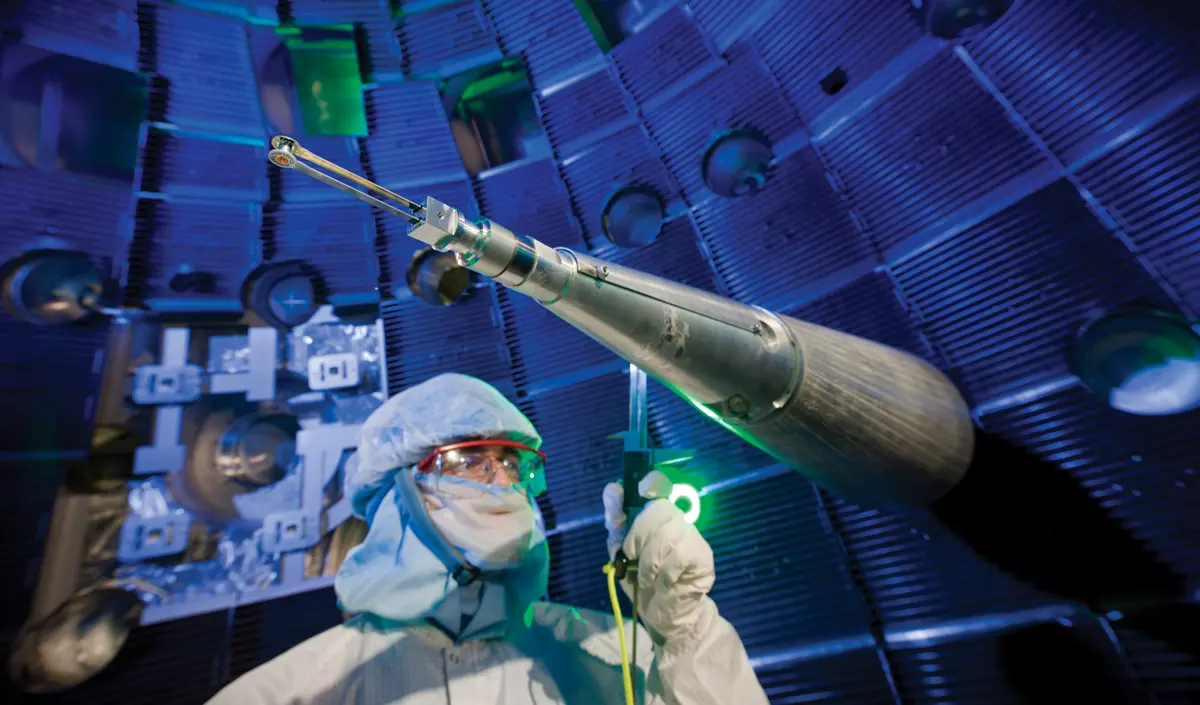
For about sixty years, scientists have tried to make a small piece of the Sun on Earth: to fuse two light atoms into one and get out more energy than they put in. At the National Ignition Facility (NIF), a building the size of three football fields at Lawrence Livermore National Laboratory in California, 192 laser beams are fired in a pulse lasting billionths of a second into a gold cylinder about as big as a pencil eraser. The cylinder holds a capsule the size of a peppercorn, filled with two heavy forms of hydrogen, deuterium and tritium. The lasers turn the inside of the cylinder into a bath of X-rays, the X-rays blow off the capsule's surface, and the rest implodes at more than 400 kilometres a second. If the squeeze is tight and round enough, the fuel fuses and heats itself further. That self-heating is called ignition.
NIF was built to prove that this could be done. Its ground was broken on May 29, 1997; the project then ran years late and, according to Physics Today, its price rose from $1.2 billion to $3.5 billion before the Department of Energy declared it complete on March 31, 2009. The first shot of all 192 beams came on February 26, 2009, and the facility was dedicated on May 29, 2009. Its main job was always to help look after the American nuclear weapons stockpile without explosive tests, but ignition was the big prize. A campaign to reach it by 2012 ended about ten times short of what was needed, and for nearly a decade the progress was slow. On August 8, 2021, a shot produced about 1.35 million joules (megajoules, MJ) of fusion energy from 1.92 MJ of laser light, close to the line but not over it.
The line was crossed in the early morning of December 5, 2022. At 1:03 a.m. Pacific time the lasers delivered 2.05 MJ to the target, and the fusion that followed gave out 3.15 MJ (a later, more careful analysis in Physical Review Letters gives 3.1 MJ), a target gain of about 1.5. The Department of Energy and the National Nuclear Security Administration announced it in Washington on December 13. It was the first time a laboratory fusion experiment had produced more energy than the laser energy that reached the target, which the laboratory calls scientific breakeven.
Read the numbers carefully, because the headlines often did not. The gain is measured against the laser light that hit the target, not against the electricity the laser drew from the grid. LLNL's director, Kim Budil, said the laser needed about 300 MJ from the wall to make that 2.05 MJ pulse, so the whole facility used roughly a hundred times more energy than the fusion gave back. NIF was built for science, not for power, and it can fire about once a day. A power plant would need lasers many times more efficient, firing several times a second, and millions of cheap fuel capsules.
Since then NIF has repeated ignition again and again. LLNL counts eleven ignition shots by June 20, 2026, and the record is 8.6 MJ from 2.08 MJ of laser light on April 7, 2025, a target gain of 4.13. The achievement showed that the physics works, gave weapons scientists a new tool, and gave the fusion-energy field a proof it had never had. It did not make electricity, and a working power plant is still a project of decades.
What happened
- 1997
The ground is broken for the National Ignition Facility at Livermore, in a ceremony with Lab Director Bruce Tarter, Energy Secretary Federico Peña and Congresswoman Ellen Tauscher; the plan is a laser of 192 beams that will cost about a billion dollars.
The National Ignition Facility building, LLNL: the laser, the target chamber and the control room where the shots of August 8, 2021 and December 5, 2022 were fired- 1999
A crane lifts the 10-metre target chamber, with holes for all 192 beams, from the yard and sets it down in the Target Bay; the move takes about 30 minutes. By then it had become clear that the project was far behind schedule and over budget, and a new management team was brought in that year.
The National Ignition Facility building, LLNL: the laser, the target chamber and the control room where the shots of August 8, 2021 and December 5, 2022 were fired- 2009
The last of NIF's 6,206 line replaceable units, a camera, is installed, nearly eight years after the first one, a flashlamp, on September 26, 2001.
The National Ignition Facility building, LLNL: the laser, the target chamber and the control room where the shots of August 8, 2021 and December 5, 2022 were firedJust before 2 a.m. the control room fires the first full-system shot: all 192 beams converge at once at the centre of the target chamber. LLNL calls it the unofficial end of construction.
The National Ignition Facility building, LLNL: the laser, the target chamber and the control room where the shots of August 8, 2021 and December 5, 2022 were fired- 3:15 a.m.
At 3:15 a.m. NIF becomes the first laser in the world to pass the megajoule, delivering 1.098 MJ of ultraviolet light to the centre of the chamber, still below the 1.8 MJ it was designed for.
The National Ignition Facility building, LLNL: the laser, the target chamber and the control room where the shots of August 8, 2021 and December 5, 2022 were fired The Department of Energy announces that the National Nuclear Security Administration has certified the project complete, after 12 years of construction and a cost that Physics Today puts at $3.5 billion, nearly three times the first estimate.
The National Ignition Facility building, LLNL: the laser, the target chamber and the control room where the shots of August 8, 2021 and December 5, 2022 were firedNIF is dedicated before thousands of guests, among them Governor Arnold Schwarzenegger, exactly twelve years after the ground was broken.
The National Ignition Facility building, LLNL: the laser, the target chamber and the control room where the shots of August 8, 2021 and December 5, 2022 were fired- 2010
The first integrated ignition experiment is fired, with a full cryogenic fuel target, opening the National Ignition Campaign, whose goal is ignition by the end of 2012.
The National Ignition Facility building, LLNL: the laser, the target chamber and the control room where the shots of August 8, 2021 and December 5, 2022 were fired- 2012
The ignition campaign is suspended without ignition: after two years the capsules reach about a tenth of what ignition needs, and the facility turns mainly to weapons-physics and materials research while the physics is worked out.
The National Ignition Facility building, LLNL: the laser, the target chamber and the control room where the shots of August 8, 2021 and December 5, 2022 were fired- 2014
A team led by Omar Hurricane reports in Nature that, with a gentler 'high-foot' way of shaping the laser pulse, the fusion energy made in the fuel exceeds the energy put into the fuel, a step towards ignition, though still far below the laser energy fired.
The National Ignition Facility building, LLNL: the laser, the target chamber and the control room where the shots of August 8, 2021 and December 5, 2022 were fired- 2021
A NIF shot produces about 1.35 MJ of fusion energy from 1.92 MJ of laser light, the first experiment to pass the Lawson criterion for ignition and to give a capsule gain of about six, though still short of target gain 1 (0.72). Repeat shots of the design came in lower (Hurricane: the best about half of August's performance, as reported by Physics World, not checked at the source).
The National Ignition Facility building, LLNL: the laser, the target chamber and the control room where the shots of August 8, 2021 and December 5, 2022 were fired- 2022
- 1:03 a.m.
At 1:03 a.m. the lasers deliver 2.05 MJ to the target and the fusion gives out 3.15 MJ, a target gain of about 1.5. The team sees the first neutron counts that morning and spends the following week checking them. The laser drew about 300 MJ from the grid to make the 2.05 MJ pulse.
The National Ignition Facility building, LLNL: the laser, the target chamber and the control room where the shots of August 8, 2021 and December 5, 2022 were fired - 10:00 a.m.
At 10:00 a.m. Eastern, Energy Secretary Jennifer Granholm, NNSA Administrator Jill Hruby, the president's science adviser Arati Prabhakar and LLNL's director Kim Budil announce the result in Washington; a panel of NIF scientists, among them Annie Kritcher, explains it afterwards, and Budil warns that a power plant is a matter of decades.
The James Forrestal Building, Washington: the headquarters of the Department of Energy, where the ignition was announced on December 13, 2022 - 2023
The laser again delivers 2.05 MJ and this time the yield is 3.88 MJ, showing that ignition can be repeated and improved.
The National Ignition Facility building, LLNL: the laser, the target chamber and the control room where the shots of August 8, 2021 and December 5, 2022 were fired- 2024
A shot gives an estimated 5.2 MJ from 2.2 MJ of laser energy, more than double the input.
The National Ignition Facility building, LLNL: the laser, the target chamber and the control room where the shots of August 8, 2021 and December 5, 2022 were fired- 2025
The eighth ignition experiment sets the records: 8.6 MJ of fusion energy (plus or minus 0.45 MJ) from 2.08 MJ of laser light in a pulse of 456 terawatts, a target gain of 4.13.
The National Ignition Facility building, LLNL: the laser, the target chamber and the control room where the shots of August 8, 2021 and December 5, 2022 were firedA team led by Los Alamos National Laboratory achieves ignition on NIF, with a yield of 2.4 MJ and a burning plasma, the first ignition not run by LLNL.
Los Alamos National Laboratory, New Mexico: its team led the ignition experiment of June 22, 2025, working with LLNL on NIF- 2026
Ignition is achieved for the eleventh time: a yield of 7.9 MJ (plus or minus 0.4 MJ) and a target gain of about 3.8.
The National Ignition Facility building, LLNL: the laser, the target chamber and the control room where the shots of August 8, 2021 and December 5, 2022 were fired