Harrison's H4 solves longitude
“In 1761-64 Harrison's watch H4 crossed the Atlantic twice and lost only seconds; in 1765 the Board of Longitude agreed it met the 1714 test, but Harrison got his full reward only by a vote of Parliament in 1773.”
A ship's north-south position, its latitude, is easy to find from the height of the Sun or a star. East-west position, longitude, is not. The Earth turns 15 degrees every hour, so a navigator who knows the exact time at home and the local time on board can work out how far east or west he has come, but only if he has a clock that still tells home time after weeks at sea, through heat, cold and the pitching of a ship. Pendulum clocks could not do this. In 1714 Parliament offered £20,000 for a method that found longitude to within half a degree, which means a clock that is wrong by no more than about two minutes after a six-week voyage to the West Indies, or about three seconds a day. A Board of Longitude was set up to judge the claims.
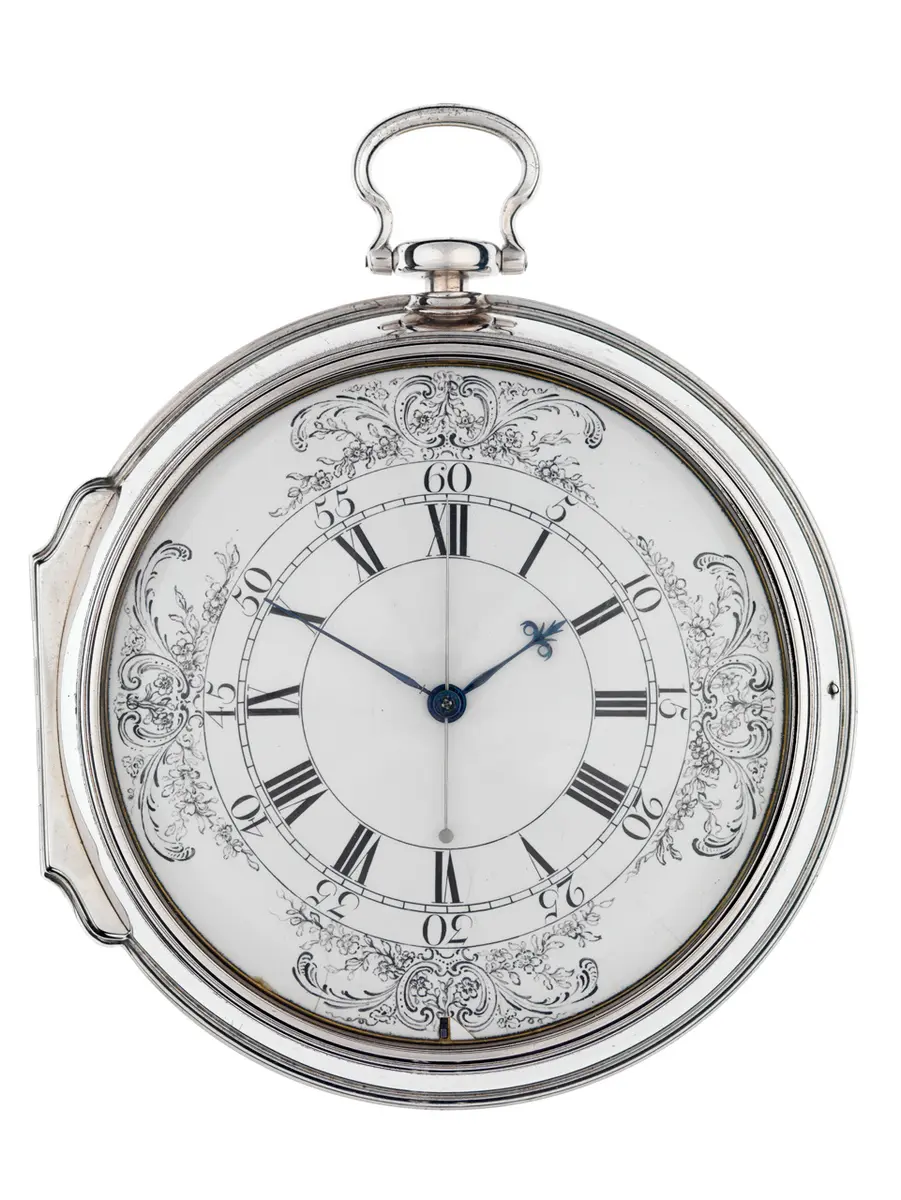
John Harrison, a self-taught carpenter and clockmaker from Barrow upon Humber in Lincolnshire, spent most of his life on the problem. His first sea clock, H1, was finished in 1735 and tried on a voyage to Lisbon in 1736. H2 followed in 1739, and H3, begun in 1740, took him nearly nineteen years. All three were large brass machines with heavy swinging balances. Then, in the early 1750s, he saw what a watch with a fast, heavy balance could do. H4, finished in 1759 with his son William, looks like an oversized pocket watch, 12 cm across, but its balance beats five times a second. It was the one that worked.
In November 1761 William Harrison took H4 aboard HMS Deptford from Portsmouth to Jamaica. Nine days out, the watch put the ship well west of where the officers' dead reckoning placed it, William said Madeira would appear next morning, and it did. At Jamaica the watch was found to be only five seconds slow, an error of about one mile of longitude. The Board still held back. It said the test might have been luck, that the longitude of Jamaica was not certain enough, and that the watch's rate had not been checked well; it paid £2,500 and ordered a second voyage. In 1764 William took H4 to Barbados in HMS Tartar, where the astronomer Nevil Maskelyne, who favoured a rival method based on the Moon, observed the longitude from Jupiter's moons. The watch was out by under 40 seconds of time, about ten miles, and on 9 February 1765 the Board was unanimously of the opinion that it had kept its time "considerably within" the Act's limit.
Even so the money came slowly. The Board and a new Act of 1765 demanded that Harrison first explain H4 on oath and hand over the watch, and promised the second half of the prize only after other makers had built watches as good. Harrison took H4 to pieces before a committee in August 1765, was paid half the prize that October, and saw H4 locked in a box and tested for ten months at Greenwich by Maskelyne, whose report was harsh. Harrison, who was nearly eighty, went over the Board's head: his second watch, H5, was tested in 1772 in King George III's own observatory at Kew, and the King backed a petition to the House of Commons. In 1773 Parliament voted him a further £8,750. It was not the prize, which the Board never certified, but it ended the dispute.
H4 itself became a pattern, not a product. The Board paid the London watchmaker Larcum Kendall to copy it, and the copy, K1, finished in 1769, went with Captain Cook on his second and third voyages. The lunar-distance method that Maskelyne championed, helped by his Nautical Almanac, which he began to publish in 1766, did not need an expensive instrument. Marine chronometers were very costly at first and only spread widely once makers simplified Harrison's designs, at the start of the 1800s. Yet the principle was proved in 1761-65: a good enough clock carried on board could tell a ship where it was.
What happened
- 1759
H4 is finished. John Harrison, then in his mid-sixties, and his son William have turned the idea of a fast, heavy watch balance into a 12 cm silver watch with a balance that beats five times a second; the movement is signed 'John Harrison & Son' and dated 1759. The year is the museum's date for the watch; Harrison began work on it in 1755.
Red Lion Square, Holborn, London, where Harrison lived and worked and where H4 was kept in 1766 - 1761
William Harrison, with Harrison's third timekeeper, goes down to Portsmouth to wait for a ship, his father meaning to follow with H4. The ship first named for the trial is sent on other duty, and the Deptford is not available until October.
Portsmouth, where H4 was rated and where the Deptford and the Tartar sailed fromThe Commissioners of Longitude meet and ask the Council of the Royal Society to say what would make a fair trial of Harrison's timekeepers. The Society's reply, with a plan to check the watch by the eclipses of Jupiter's moons, is read to the Board in October.
The Admiralty in Whitehall, where the Commissioners of Longitude metThe Board decides how the trial is to be run. Harrison's son is to take the watch to Portsmouth and sail in the Deptford to Jamaica. The case gets three more locks, with the keys held by William Harrison, Governor Lyttelton of Jamaica, the captain and the first lieutenant, so the watch cannot be touched unless they are all there. Mr Robertson, master of the Royal Academy at Portsmouth, is to find the true time there by the Sun, and John Robison is to find it at Jamaica on the ship's arrival.
The Admiralty in Whitehall, where the Commissioners of Longitude metAt Portsmouth the Navy's commissioner, Richard Hughes, writes to the Admiralty's secretary that observations of the Sun at equal heights, which fix the true time and so the watch's rate, have been spoiled by cloudy, wet weather. Gould reports that William Harrison finally rated the watch at 2.4 seconds a day slow, from only nine days of sights.
Portsmouth, where H4 was rated and where the Deptford and the Tartar sailed fromThe Deptford sails from Spithead with a convoy, with William Harrison and H4 aboard, and calls at Portland and Plymouth before setting out for Madeira.
Portsmouth, where H4 was rated and where the Deptford and the Tartar sailed fromOn the ninth day out of sight of land the officers' dead reckoning puts the Deptford at 13 degrees 50' west, but H4 says 15 degrees 19' west. Captain Digges offers to bet five to one against William Harrison, who says Madeira will be in sight next day if it is marked correctly on the chart. Porto Santo is sighted at 6 in the morning. The crew, whose beer has run out, are relieved. The date is inferred from the ship's log entries of 7 and 9 December.
Funchal, Madeira, the first landfall of both voyages- 1762
The Deptford reaches Jamaica. Allowing for the rate William had measured at Portsmouth, H4 is found to be only five seconds slow, an error of about one and a quarter minutes of longitude, or about a mile, if the longitude of Kingston is right. On the way the watch had also named the other islands before they were seen.
Port Royal, Jamaica, where the Deptford came in on 19 January 1762William Harrison goes home in the sloop Merlin, through very rough weather in which H4 had to be moved to the poop as the only dry place. On Gould's figures its total error in the five months was still only 1 minute 53.5 seconds, or 28.5 minutes of longitude.
Portsmouth, where H4 was rated and where the Deptford and the Tartar sailed fromAt the Admiralty William Harrison tells the Board he is satisfied with the observations made at Portsmouth and Jamaica. The Board sends copies of them to three gentlemen, Matthew Raper, John Howe and Gael Morris, to examine their accuracy, and has the instruments, made by John Bird, examined by Bird with Dr Bliss and Mr Shepherd. It asks the Navy Board to pay Harrison £300 to make up the £500 granted.
The Admiralty in Whitehall, where the Commissioners of Longitude metThe Board says the trial has not been 'sufficient to determine the Longitude at sea'. It resolves that Harrison, or someone in his place, shall go to the West Indies again, and gives him £2,500 as a reward for the invention, £1,500 at once and £1,000 on his return from the new trial, to be deducted from any later reward. The watch is to become public property. Harrison agrees to let it be tried at Greenwich first, after four or five months of changes.
The Admiralty in Whitehall, where the Commissioners of Longitude met- 1763
After meetings on 4 and 9 August the Board settles the second trial. The astronomer who will check the longitude by Jupiter's moons is first meant to go to Jamaica, and is instead sent to Barbados, with Harrison's consent, because of the fevers at Jamaica (Gould says Maskelyne's health); Maskelyne and Charles Green are the observers. Maskelyne sails in September in the Princess Louisa.
The Admiralty in Whitehall, where the Commissioners of Longitude metMaskelyne and Green settle at Bridgetown and begin their log of observations, which will run to August 1764. They are to find the longitude of Barbados from the eclipses of Jupiter's moons, to be compared with observations made at Portsmouth.
Bridgetown, Barbados, where H4 was tried against Jupiter's moons in 1764- 1764
The Tartar, Captain Sir John Lindsay, leaves Portsmouth with William Harrison and H4. William has sent the Admiralty a sealed declaration of the rate he expects, and on the way he again names the landfalls at Madeira and Barbados.
Portsmouth, where H4 was rated and where the Deptford and the Tartar sailed fromThe Tartar reaches Barbados. Maskelyne writes in his book that Mr Harrison arrived with his time-keeper in the Tartar. The two men have already quarrelled: William thinks Maskelyne, who favours the lunar method, is a rival and cannot be trusted as observer, and Captain Lindsay agrees.
Bridgetown, Barbados, where H4 was tried against Jupiter's moons in 1764Early in the morning Harrison brings H4 ashore and Maskelyne takes equal altitudes of the Sun to fix its error. The readings go on for four days, the observations being taken by Maskelyne and Green on alternate days with the captain and witnesses present. By the watch the difference in time between Portsmouth and Barbados comes out about 38 seconds more than the Jupiter observations give, about ten miles of longitude.
Bridgetown, Barbados, where H4 was tried against Jupiter's moons in 1764Harrison and Green leave Barbados. Maskelyne stays on until 30 August to make more observations.
Bridgetown, Barbados, where H4 was tried against Jupiter's moons in 1764- 1765
The Board is unanimously of the opinion that H4 'has kept its time with sufficient correctness' on the voyage to Barbados, 'even considerably within' the nearest limit of the Act. But because Harrison has not yet explained how the watch is made, it will give no certificate: Parliament is to be asked for leave to pay him £10,000, with what he has had already, once he has revealed its principles on oath, and the rest of the £20,000 once its method is shown to be useful to all.
The Admiralty in Whitehall, where the Commissioners of Longitude metA new Act of Parliament puts the Board's terms into law: half the prize when Harrison has explained H4 to people named by the Board, and the other half when other makers have shown they can build watches as good. The Harrisons feel the rules have been changed after the race was run.
At his house Harrison takes H4 to pieces in front of six men named by the Board, among them the watchmakers Thomas Mudge, William Matthews and Larcum Kendall, and explains it on oath over several days.
Red Lion Square, Holborn, London, where Harrison lived and worked and where H4 was kept in 1766The committee reports it is satisfied, H4 is put together again and handed over to the Board, and Harrison gets a certificate for £7,500, which with the £2,500 of 1762 makes up the first half of the £20,000. The Board then publishes his drawings and description.
The Admiralty in Whitehall, where the Commissioners of Longitude met- 1766
H4 is carried to Greenwich in a box sealed with three seals. The Astronomer Royal, Nevil Maskelyne, receives it from the Admiralty's secretary, Philip Stephens, with Captain Baillie of Greenwich Hospital, John Ibbetson and Larcum Kendall as witnesses, and a trial begins that will last ten months. Harrison, who has been given no say in it, thinks Maskelyne his enemy.
The Royal Observatory, Greenwich, where H4 was tested in 1766-67- 1767
The Board prints Maskelyne's account of the Greenwich trial, which concludes that H4 cannot be depended on to keep the longitude within a degree on a six-week West Indies voyage, and the Principles of Harrison's watch with plates. Harrison answers in print with his Remarks on Maskelyne's pamphlet. Maskelyne's Nautical Almanac, begun in 1766 to make the lunar-distance method easier to use, goes on appearing each year.
The Royal Observatory, Greenwich, where H4 was tested in 1766-67 - 1769
Larcum Kendall finishes K1, the copy of H4 that the Board ordered in 1766. Harrison has given Kendall advice, but is refused the loan of H4 itself while Kendall works from it.
- 1772
H5, Harrison's improved copy of H4, is put through a ten-week trial in King George III's private observatory at Kew, with the King present at the daily comparisons. Its error on mean time is under five seconds in all, by Gould's account. The month is the start of the trial in Wikipedia's account.
The King's Observatory at Kew, where H5 was tested before George III in 1772Cook's Resolution and Adventure leave Plymouth on Cook's second voyage. Resolution carries K1 and one of John Arnold's timekeepers, in the charge of the astronomer William Wales; the other two Arnolds go in the Adventure. Harrison had asked that H4 and H5 be sent instead, and the Board had refused.
Plymouth, from where Cook's Resolution sailed on 13 July 1772 with K1The Board reads Harrison's memorial about the Kew trial and resolves that it will pay no regard to any trial made in another way than the one it has laid down.
The Admiralty in Whitehall, where the Commissioners of Longitude met- 1773
The Astronomer Royal reports to the Board the differences of longitude between Plymouth, Funchal and the Cape of Good Hope, worked out from the watches carried in Cook's two ships and compared with the true longitudes. The Speaker tells the Board that Harrison has petitioned the House of Commons and circulated a printed Case. Two members of the House and a friend of Harrison's, Mr Godschall, are admitted to hear its proceedings.
The Admiralty in Whitehall, where the Commissioners of Longitude metThe Board records that Harrison has withdrawn his first petition and proceeded on other grounds, and that the House of Commons has voted him a sum not exceeding £8,750 as a further reward and encouragement, over and above what he has had. This is the end of the matter. It is not the prize, which was never certified, and Harrison has about three years to live.
The Admiralty in Whitehall, where the Commissioners of Longitude met