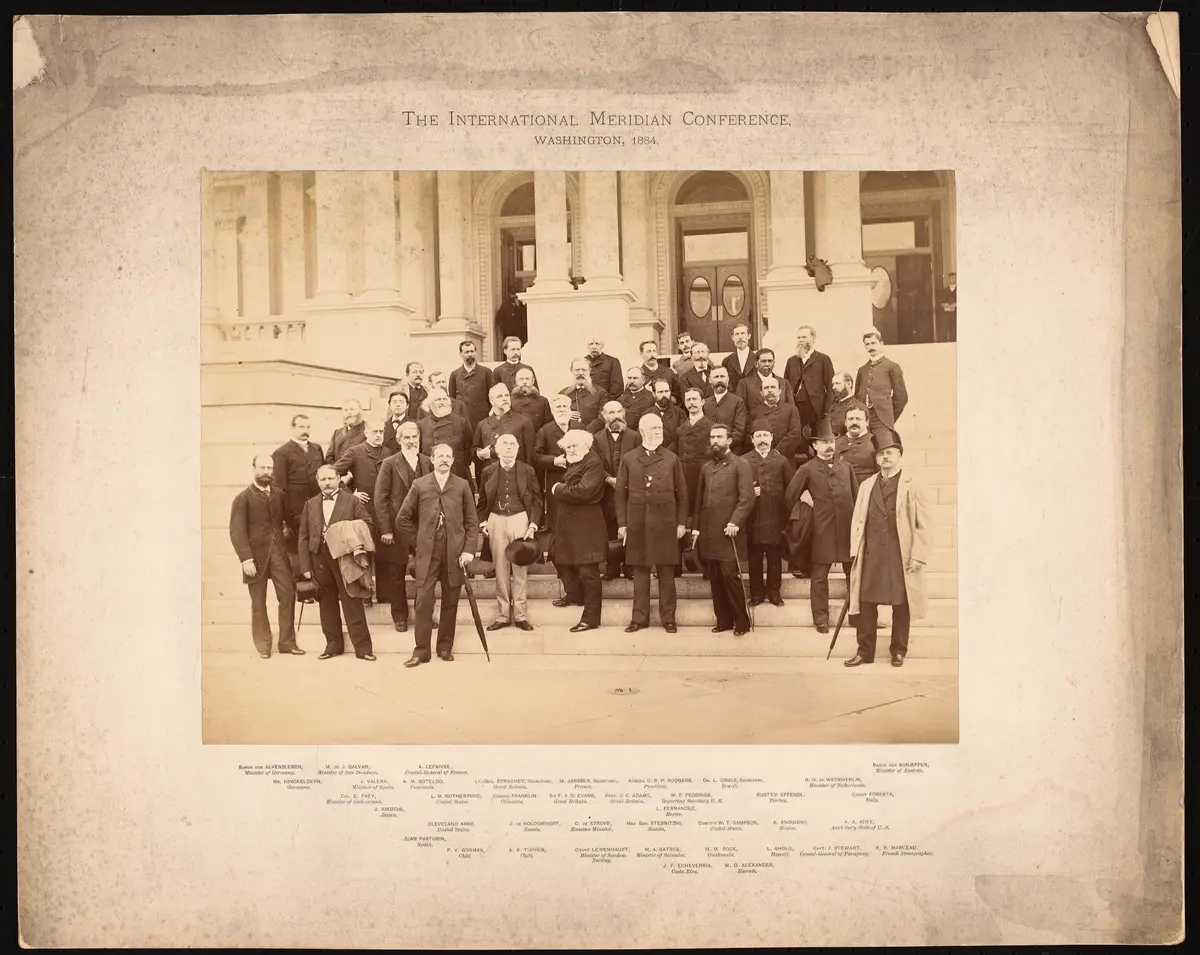
Greenwich becomes the prime meridian
“In October 1884 delegates of 25 countries voted at Washington to recommend the meridian through Greenwich as zero longitude; France and Brazil abstained, and no time zones were created.”
On 1 October 1884 delegates from the nations of the world sat down in the Diplomatic Hall of the US State Department in Washington with one job: to pick a single line to measure longitude from. Every sailor and mapmaker needed a zero, but there was no natural one, so each country used its own: Greenwich, Paris, Cadiz, Naples, the Canary island of Hierro (Ferro), Pulkovo near St Petersburg and others. The conference met seven times between 1 and 22 October; Rear Admiral C. R. P. Rodgers of the US Navy chaired it, and the votes were taken by nations, one vote each. On 13 October the delegates voted on the central question, whether to propose the meridian through the centre of the transit instrument at the Royal Observatory in Greenwich. The roll call at the table gave 21 in favour, 1 against and 2 not voting; the Final Act signed on 22 October records 22–1–2, because El Salvador's minister, ill on the 13th, asked on 14 October to have his vote for Greenwich entered. San Domingo, today the Dominican Republic, voted no, and France and Brazil abstained. The conference had no power to bind anyone: it only recommended Greenwich to the governments.
Greenwich won because it was already the world's default. Sandford Fleming, a Scottish-born Canadian railway engineer who sat for Britain, put numbers before the delegates: of the 57,697 ships counted, Greenwich was the zero for 65 percent of them and 72 percent of the tonnage, with Paris a distant second at about 10 and 8 percent. Britain's Admiralty charts covered the oceans, and navigators everywhere used its Nautical Almanac, issued since 1767. The Observatory itself had been founded by Charles II in 1675 to help sailors find their longitude, and since January 1851 the line had been fixed by the Airy Transit Circle, the telescope the seventh Astronomer Royal, George Airy, designed in 1850: the cross-hairs in its eyepiece marked the zero of longitude. Time had pulled the same way. The Great Western Railway ran to London time from November 1840, the Railway Clearing House recommended Greenwich time to all British railways in September 1847, the electric Shepherd clock at the Observatory gate began showing it to the public in 1852, and Parliament made it the legal time of Great Britain on 2 August 1880. The American railways had gone further: on 18 November 1883, a year before the conference, they had split the continent into four zones, an hour apart, with their dials compared to Greenwich noon.
Not everyone agreed it was fair. The French delegates, the astronomer Jules Janssen and the diplomat Lefaivre, argued on 6 and 13 October for a neutral meridian that would cut through no continent, so that no nation would be seen to give way to another, much as the metre had been made a measure for all. The motion lost by 21 votes to 3: France, Brazil and San Domingo voted for it. Supporters answered that a meridian had to run through a first-class observatory, as the geodesists at Rome had said in 1883, and that moving the world's charts would cost money; Lord Kelvin, invited as a guest, called the question one of business convenience rather than science. Fleming floated a compromise on 13 October, leaving open whether zero should be set at Greenwich or on the opposite side of the globe; his British colleagues said they would vote against it and it was lost. The other resolutions were milder: a unanimous wish for one meridian; longitude would be counted east and west up to 180 degrees (14–5–6), a universal day would be adopted for uses where it helped without disturbing local or standard time (23–0–2), and that day would begin at midnight (15–2–7 on the day, 14–3–7 in the Final Act after the Turkish delegate changed his vote on 1 November), with two hopes, that astronomers and sailors would also start their days at midnight and that the decimal division of angles and time would be studied again. Contrary to a popular belief, the conference did not create time zones: Britain's General Strachey proposed local times at ten-minute meridians on 20 October, but nothing was voted on and he withdrew his proposals on 22 October.
The recommendation worked slowly. The United States was already on Greenwich-based time; Belgium and the Netherlands moved to Greenwich time in 1892 and Germany, Austria-Hungary and Italy in 1893, according to the historian Richard Evans. France held out longest: in 1911 a law defined French time as 'Paris mean time retarded by nine minutes twenty-one seconds', which was Greenwich time without saying its name, and it hosted its own conference on time in 1912. Greenwich Mean Time was the world's civil time until 1972, when Coordinated Universal Time replaced it. The line itself has moved without anyone moving it. Satellite systems such as GPS use the IERS Reference Meridian, which lies about 102 metres east of the brass strip at the Observatory, because modern coordinates are measured from the centre of the Earth while Airy's telescope was levelled by gravity, which pulls slightly sideways at Greenwich. So the line tourists stand on is the 1884 one, and the zero in your phone is not on it.
What happened
- 1884
Delegates from the nations that accepted the American invitation meet in the Diplomatic Hall of the State Department; they are presented to Secretary of State Frederick Frelinghuysen at noon, Count Lewenhaupt of Sweden takes the chair, and Rear Admiral C. R. P. Rodgers is elected president. France asks that every motion made in English be put into French as well. Delegates of Chile, Denmark, Liberia, the Netherlands and Turkey had not yet arrived; Denmark's never did.
State, War and Navy Building, Washington (now the Eisenhower Executive Office Building), where the State Department's Diplomatic Hall held the conferenceAt the second sitting, at one o'clock, Rutherfurd offers the first Greenwich resolution, to adopt 'as a standard meridian' the one through the centre of the transit instrument at Greenwich. Lefaivre calls it out of order and Janssen answers for France that the conference has no power to bind its governments. The delegates also argue whether to invite scientists as guests (carried) and whether to let in the public (refused, 7 to 14).
State, War and Navy Building, Washington (now the Eisenhower Executive Office Building), where the State Department's Diplomatic Hall held the conferenceRutherfurd rewords his resolution so that it clearly concerns longitude, then withdraws it for the moment to let the French speak. Lefaivre moves that the initial meridian 'should have a character of absolute neutrality' and cut no great continent. Sir Frederick Evans of Britain reminds the room that the Rome geodetic conference of 1883 wanted a first-class observatory. Janssen asks for the vote to wait a week so the French text can be printed.
Paris Observatory, home of the Paris meridian and the French delegates' caseSandford Fleming speaks at length for Greenwich and reads a table of the world's ships by the meridian they use: Greenwich 37,663 of 57,697 ships, 65 percent, and 72 percent of the tonnage; Paris 10 and 8 percent. He also moves a vague amendment that would leave open whether zero be at Greenwich or on the far side of the Earth; his British colleagues speak against it and it is lost on a voice vote.
State, War and Navy Building, Washington (now the Eisenhower Executive Office Building), where the State Department's Diplomatic Hall held the conferenceSir William Thomson (Lord Kelvin), invited as a guest, tells the delegates that the choice is 'a matter of business arrangement' about convenience, not science: no meridian is more scientific than another, but Greenwich is the most convenient, with the least change to charts.
State, War and Navy Building, Washington (now the Eisenhower Executive Office Building), where the State Department's Diplomatic Hall held the conferenceThe French motion for a neutral meridian is put to the roll and lost: 3 ayes (Brazil, France, San Domingo) and 21 noes. Janssen and Lefaivre say France will not take part in the Greenwich decision, and that giving up the Paris meridian without the metric convention in return would be a sacrifice for nothing.
Paris Observatory, home of the Paris meridian and the French delegates' caseThe roll is called on Rutherfurd's resolution to propose the meridian through the centre of the transit instrument at the Greenwich Observatory: 21 ayes, San Domingo no, Brazil and France not voting. The Final Act of 22 October lists 22 ayes: El Salvador's minister, ill that day, had his vote entered the next day.
Royal Observatory, Greenwich: the Airy Transit Circle and the meridian lineThe conference votes that longitude be counted from Greenwich in two directions up to 180 degrees, east plus and west minus: 14 ayes, 5 noes (Italy, the Netherlands, Spain, Sweden, Switzerland), 6 not voting. Sweden's amendment (count longitude one way only, west to east, as the Rome conference had said) and Spain's (westward from 0 to 360 degrees) were withdrawn, and Fleming dropped his proposal of a committee on the question. Before this, El Salvador's minister Batres, ill the day before, asked to have his vote for Greenwich entered, and the Turkish and French delegates said all votes were 'ad referendum', binding no government.
Royal Observatory, Greenwich: the Airy Transit Circle and the meridian lineOn the universal day, Abbe objects that an amendment listing its uses only adds detail, and W. F. Allen, secretary of the railways' time conventions, proposes that civil time be understood as the mean time of the central meridian of each section of the Earth, which is standard time; Italy's amendment to adopt the Rome wording loses 6 to 18. The resolution passes without a negative vote, 23–0–2: a universal day for any use where it helps, not interfering with local or standard time.
State, War and Navy Building, Washington (now the Eisenhower Executive Office Building), where the State Department's Diplomatic Hall held the conferenceThe universal day is defined: a mean solar day starting at midnight on the Greenwich meridian and counted 0 to 24 hours. Sweden's amendment for a day starting at noon loses 6 to 14; the resolution passes 15–2–7 (Austria-Hungary and Spain against). The astronomers' day, which began at noon and was what the Greenwich gate clock first showed, was now the odd one out.
Royal Observatory, Greenwich: the Airy Transit Circle and the meridian lineThe French delegates win a vote: the chair rules their motion out of order, the conference overturns the ruling 13 to 9 and carries a hope that work on decimal division of the circle and of the day be resumed (21–0–3). At the end of the day Strachey reads two proposals: local civil time at meridians ten minutes (or a multiple) apart, and universal time left to the international telegraph congress. Struve says universal time will sit beside local standard time.
State, War and Navy Building, Washington (now the Eisenhower Executive Office Building), where the State Department's Diplomatic Hall held the conferenceGalvan of San Domingo explains that his no vote came from the French neutral-meridian motion being rejected, and states his country's freedom to act later. Strachey withdraws his time-zone resolutions to avoid a debate with no result; the Final Act with seven resolutions, naming the vote on each, is adopted unanimously, and Rutherfurd moves to adjourn. The conference meets once more, on 1 November, to sign the protocols.
State, War and Navy Building, Washington (now the Eisenhower Executive Office Building), where the State Department's Diplomatic Hall held the conference