The first public steam railway opens in England
“In 1825 George Stephenson's Locomotion pulled the opening train of the Stockton and Darlington, the first public railway to use steam locomotives.”
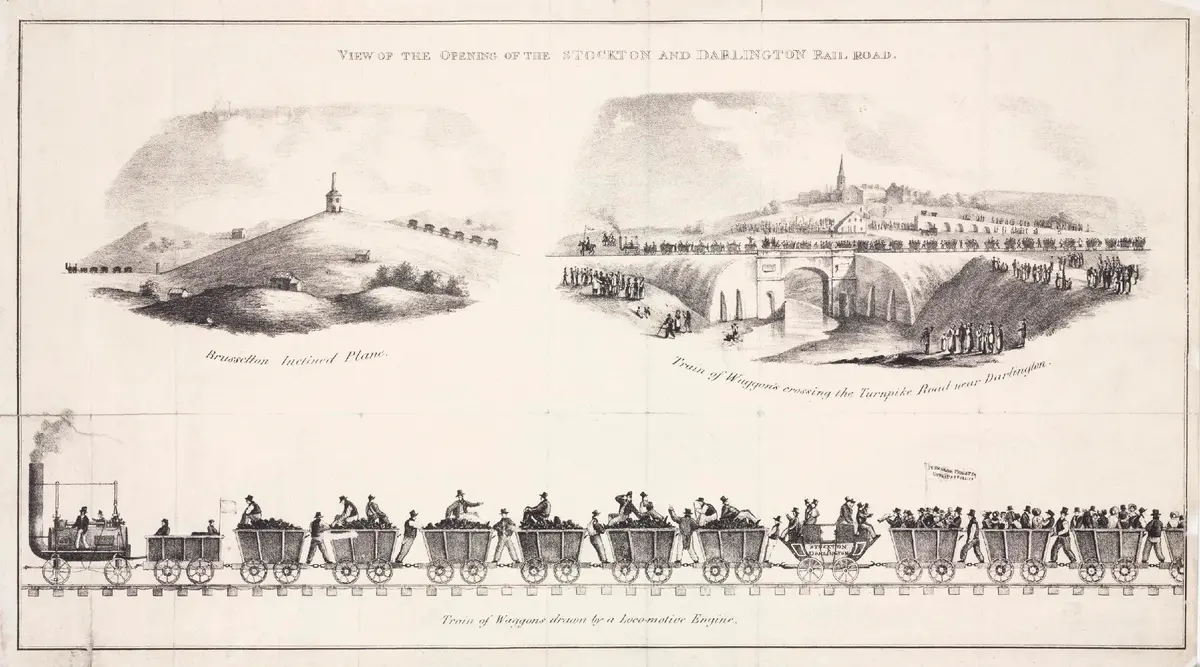
The Stockton and Darlington Railway in north-east England opened on 27 September 1825 as the first public railway to use steam locomotives. Its main line of about 25 miles (40 km) ran from the coal pits near Witton Park, over two ridges at Etherley and Brusselton where fixed steam engines hauled the waggons up by rope, through Shildon and Darlington to the quays on the River Tees at Stockton. On the opening day the engine Locomotion, built in Newcastle by Robert Stephenson and Company and driven by George Stephenson, set off from Shildon with the company's first passenger coach, the Experiment, and more than thirty waggons of coal, flour and people. Between 450 and 600 rode, and crowds put at 40,000 to 50,000 watched. On a falling stretch near Darlington the train reached 15 miles an hour; at Stockton guns fired a salute and 102 guests sat down to dinner.
The railway was built for coal. The collieries of south-west Durham sent their coal to market by cart over poor roads, and for decades local men argued about a canal instead. In 1818 Edward Pease, a retired Quaker wool merchant of Darlington, backed a railway, and Quaker families and their banks put up much of the money. A first bill failed in 1819 against landowners such as the Earl of Darlington, who feared for his fox hunting. The Act of 19 April 1821 allowed a public railway that anyone could use on paying a toll, and it was expected to be worked by horses. That same day George Stephenson, the self-taught engine-wright of Killingworth colliery, called on Pease and argued for locomotives. He surveyed a route better suited to engines, the company made him its engineer, and a second Act of 1823 allowed 'loco-motive or moveable engines' and passengers. In 1823 he, his son Robert and Pease set up a works in Newcastle to build the engines. The gauge he chose, 4 feet 8 inches, soon 4 feet 8½, became the world's standard.
It was not yet an all-steam railway. Horses still pulled many coal trains, and from 10 October 1825 the Experiment carried passengers between Darlington and Stockton behind a horse; contractors and innkeepers ran the coaches and carried 30,000 to 40,000 people in the year to June 1827. The first engines often broke down. Timothy Hackworth, the locomotive superintendent at Shildon, kept them going, and his Royal George of November 1827 gave the company a reliable engine. Trade changed at once: coal at Stockton fell from 18 shillings to 12 soon after the opening, and coal for ships bound for London became the main business. In December 1830 a branch crossed the Tees on the first suspension bridge built for a railway to new coal staiths at Middlesbrough, a town the railway's owners laid out on empty ground. In September 1833 the company began running its own steam passenger trains between Darlington and Stockton.
The Stockton and Darlington was not the first railway, nor the first to use a locomotive or to carry passengers: Richard Trevithick's engine had pulled a train in South Wales in 1804, and horse-drawn coaches already ran on a tramroad at Swansea. What it brought together for the first time was a permanent public line, steam locomotives, goods and passengers, and a profit, and others watched it closely. Men from the Liverpool and Manchester Railway came to study it in 1824 and again in 1828; their line, opened in 1830 as the first between two cities worked only by steam, carried the lesson to the world, and within a generation railways covered Britain, much of Europe and North America.
Long stretches of the 1825 route still carry trains, and the Skerne Bridge at Darlington, built with the help of the architect Ignatius Bonomi, is the oldest railway bridge still in use; it appeared with Stephenson on the Bank of England's £5 note from 1990 to 2003. Locomotion No. 1 itself survives, much rebuilt, at the Locomotion museum in Shildon. The opening has been celebrated every fifty years: in 1875, in 1925, in 1975 and, as S&DR200, in 2025.
What happened
- 1821
King George IV gives royal assent to the Stockton and Darlington Railway Act: a public railway from the collieries near West Auckland to Darlington and Stockton, open to anyone who pays the toll, and planned for horses. The same day George Stephenson, engine-wright at Killingworth colliery, and his friend Nicholas Wood walk the planned line from Stockton and call on Edward Pease at his house in Northgate, Darlington, where Stephenson argues for locomotives.
- 1822
After re-surveying the route to suit locomotives, with his son Robert's help, George Stephenson is appointed the company's engineer at £660 a year, at a shareholders' meeting in its office on High Row, Darlington, and told to start on the parts of the line that will not change.
Ten days after work began on 13 May, the first rails are laid at St John's Well in Stockton, after a procession from the Town Hall led by the chairman, Thomas Meynell, and his Yarm band.
St John's Crossing, Bridge Road, Stockton: the 1825 terminus and booking office, by St John's Well where the first rails were laid in 1822- 1823
A second Act receives royal assent: it approves Stephenson's new route and the use of 'loco-motive or moveable engines', and adds passengers to the long list of things the railway may carry.
Robert Stephenson and Company, set up by George and Robert Stephenson with Edward Pease and Michael Longridge of the Bedlington ironworks, starts work in Forth Street, Newcastle, on less than an acre on the east side of South Street; here it will build Locomotion.
Robert Stephenson and Company's works by Forth Street and South Street, Newcastle upon Tyne: Locomotion No. 1 was built here in 1825- 1824
Because it is proving hard to find a firm foundation for the bridge over the River Skerne at Darlington, the committee asks the Durham architect Ignatius Bonomi to help build it; the stone bridge will be the line's chief architectural work.
Skerne Bridge, Darlington, built in 1824-25 with Ignatius Bonomi: the oldest railway bridge still in use- 1825
Locomotion, which Stephenson calls 'the improved travelling engine', leaves Newcastle on a waggon drawn by a team of horses and is taken by road to the level crossing at Aycliffe Lane, near Heighington, where it is put on the rails; its first fire is said to have been lit with a workman's burning-glass.
Heighington station, the old Aycliffe Lane crossing: Locomotion was first put on the rails here in September 1825Two days after the newspapers announce the opening, the company issues a handbill: the proprietors will meet at the steam engine below Brusselton Tower at eight on the 27th, the train will start from the foot of the Brusselton incline at nine, and the company will dine at three at Stockton Town Hall.
In the evening the company's new coach, the Experiment, just arrived from Newcastle, is coupled to Locomotion at Shildon, and Edward Pease and three of his sons, two other committee men and George Stephenson make a trial trip to Darlington, with George's elder brother James driving.
The former Mason's Arms at Shildon Lane End, New Shildon: the opening train set off from here behind LocomotionFrom half past five crowds head for the Gaunless valley. Between seven and eight, twelve waggons of coal leave the Phoenix Pit and are hauled up Etherley North Bank by the fixed engine at the top, run down the other side to St Helen's Auckland, take on a waggon of flour sacks, and are led by horses across Stephenson's iron bridge over the River Gaunless.
Phoenix Row, below Etherley Ridge: by the Phoenix Pit, where the opening day's coal waggons set offAt Shildon Lane End, by the Mason's Arms, the train is made up: Locomotion, freshly painted and driven by George Stephenson, the coal and flour waggons, the Experiment with the directors and 21 new waggons fitted with seats. Room had been made for 300 passengers, but 450 or more crowd aboard. Led by a man on horseback with a flag, the train reaches 10 to 12 miles an hour and leaves riders on hunters behind. The Pease family is not there: Edward Pease's youngest son, Isaac, died that morning.
The former Mason's Arms at Shildon Lane End, New Shildon: the opening train set off from here behind LocomotionAfter two stops, for a waggon that kept leaving the rails and for 35 minutes near Simpasture to clear the engine's feed pump, the train reaches 15 miles an hour on the slope into Darlington and halts at the branch junction: eight and a half miles in two hours, 65 minutes of it moving. Some 10,000 to 12,000 people are waiting; six waggons of coal go to the depots for the town's poor, and two waggons with the Yarm band are added.
Hopetown Darlington at North Road station: the opening train stopped at the Darlington branch junction nearby, and Locomotion stood on a plinth at North Road from 1857Racing a stagecoach beside the turnpike near Preston Hall, the train runs into Stockton at 15 miles an hour and stops at the terminus three hours and seven minutes after leaving Darlington, with some 600 people on board; seven 18-pounder guns on the company's wharf fire a salute three times, and the band plays 'God Save the King'. A keelman clinging to a waggon had fallen on the way and had his foot crushed.
St John's Crossing, Bridge Road, Stockton: the 1825 terminus and booking office, by St John's Well where the first rails were laid in 1822An hour later 102 people sit down to dinner at Stockton Town Hall, with the chairman, Thomas Meynell, presiding. Of 23 toasts, one is to the Liverpool and Manchester Railway, still only a project, and the last is to George Stephenson.
Stockton Town Hall: 102 guests dined here on the opening night- 8:00 a.m.
About eight o'clock, before thousands of people on the slope below Brusselton Tower, the 60-horsepower engine at Brusselton draws the loaded waggons up the West Bank on a rope 1,850 yards long; they are then let down the East Bank to Shildon Lane End.
Brusselton engine house, at the top of the Brusselton inclines west of Shildon - 12:30 p.m.
A little after half past twelve Locomotion sets off again with 31 vehicles and about 550 people, crossing the Skerne Bridge to the music of the Yarm band; among the onlookers is the ten-year-old John Dobbin, who later painted the scene. On the level ground beyond, with 80 to 90 tons behind it, the engine manages about four miles an hour.
Skerne Bridge, Darlington, built in 1824-25 with Ignatius Bonomi: the oldest railway bridge still in use Having bought a licence, the company starts a passenger coach service between Darlington and Stockton: the Experiment, drawn by a horse, run from 14 October by Thomas Close for two guineas a week. In Stockton a plaque at St John's Crossing later marked the place where the company 'booked the first passenger'.
St John's Crossing, Bridge Road, Stockton: the 1825 terminus and booking office, by St John's Well where the first rails were laid in 1822- 1827
Timothy Hackworth's Royal George, built in the company's works at Shildon around the boiler of an unsuccessful engine from Robert Wilson of Newcastle, starts work; by 13 December it has run 434 miles hauling coal. The Friends of the railway see it as the turning point for steam on the line.
Locomotion, the National Railway Museum at Shildon, with Timothy Hackworth's house and works buildings: Locomotion No. 1 is shown here today- 1828
Edward Pease warns Hackworth that a deputation is coming from Liverpool to inquire about locomotive power, and asks him to have the engines and men neat and clean and his figures ready to show how much work they do.
Locomotion, the National Railway Museum at Shildon, with Timothy Hackworth's house and works buildings: Locomotion No. 1 is shown here today- 1830
The branch to Middlesbrough opens: trains cross the Tees on Samuel Brown's suspension bridge, the first built to carry a railway, to new coal staiths at Port Darlington, where the owners of the Middlesbrough estate have laid out a new town; Hackworth's Globe, built for passenger work, hauls the opening train.
Middlehaven, Middlesbrough: Port Darlington, the coal staiths reached by the branch opened on 27 December 1830- 1833
Horses are taken off the passenger service, and the company starts its own trains of passengers and goods between Darlington and Stockton, hauled by locomotives at 12 to 14 miles an hour and stopping only at Fighting Cocks and the Yarm branch end: between the two towns the railway is now worked by steam.
Hopetown Darlington at North Road station: the opening train stopped at the Darlington branch junction nearby, and Locomotion stood on a plinth at North Road from 1857