Newcomen's steam engine
“In 1712 Thomas Newcomen's 'atmospheric' engine began pumping water from a coal mine near Dudley Castle: the first practical steam engine, and the start of machines that turn burning coal into work.”
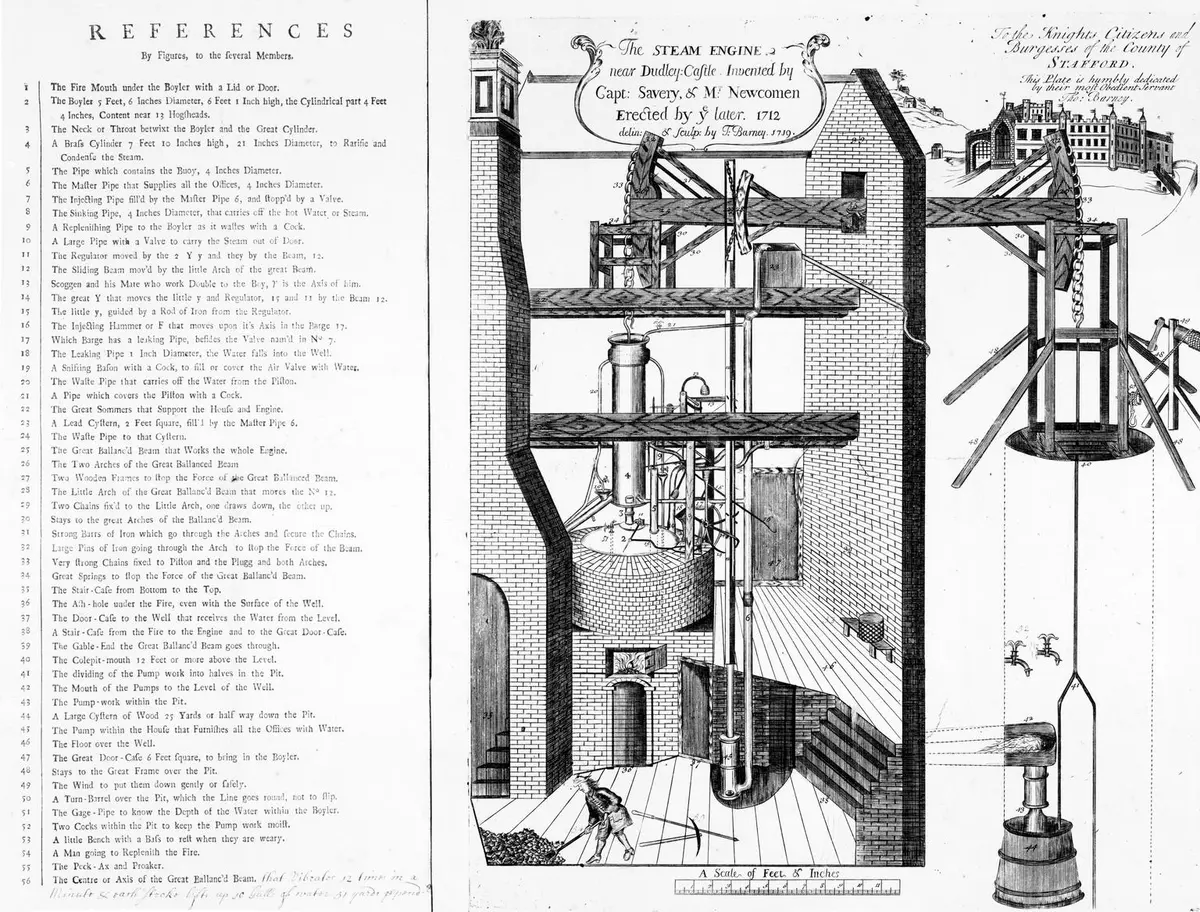
In 1712 a new kind of machine began pumping water out of a coal mine at Coneygree, near Tipton, in sight of Dudley Castle in the English Midlands. It was the work of Thomas Newcomen, an ironmonger and Baptist preacher from Dartmouth in Devon, and his partner John Calley. A great wooden beam rocked on the wall of a brick engine house. From one end hung the pump rods that went down the shaft; from the other, a piston in a brass cylinder 21 inches wide. Steam from a boiler filled the cylinder, a spray of cold water turned it back into water, and the partial vacuum this left let the weight of the air push the piston down, which lifted the pump rods; their own weight then pulled the piston up again, about twelve times a minute. Because the air did the work, it was called an 'atmospheric' engine, or simply a 'fire engine'. It was the first practical machine to turn the heat of a fire into steady work.
Britain's mines were going deeper, and water flooded them faster than horses or water wheels could lift it. In 1698 Thomas Savery, another Devon man, had patented a steam pump he called 'The Miner's Friend', but it could not raise water far enough to drain a deep pit. Newcomen's idea of joining a steam cylinder to a beam and a pump was quite different, yet Savery's patent was written so widely, for 'raising water by the impellent force of fire', and Parliament had stretched it so long, to 1733, that Newcomen built his engines under it as Savery's partner. After Savery died in 1715 a company of 'proprietors', in which Newcomen held shares, licensed every engine for a yearly fee. How Newcomen got there is barely recorded. A later account speaks of years of private trials and a lucky accident, when cold water leaking through a hole in the piston showed that spraying it inside the cylinder worked far better; and the only document that fixes the first engine to 1712 is Thomas Barney's engraving of it, made in 1719.
The engine spread quickly. By 1716 the proprietors were advertising engines at work in Staffordshire, Warwickshire, Cornwall and Flintshire, and when the patent ran out in 1733 at least 95 had been built in Britain. Belgium had one by 1721, Hungary by 1722 and Sweden by 1728, and in 1753 the parts of America's first steam engine were shipped from England for a copper mine in New Jersey. Newcomen himself died in London in 1729. Most of the engines worked at mines, where they let men reach coal and metal ores far deeper than before. They were hungry for fuel, because the cylinder was cooled and heated again at every stroke. In the winter of 1763–64 the University of Glasgow asked its instrument maker, James Watt, to mend the model Newcomen engine used in its lectures; his effort to stop that waste of heat is where Watt's own story begins.
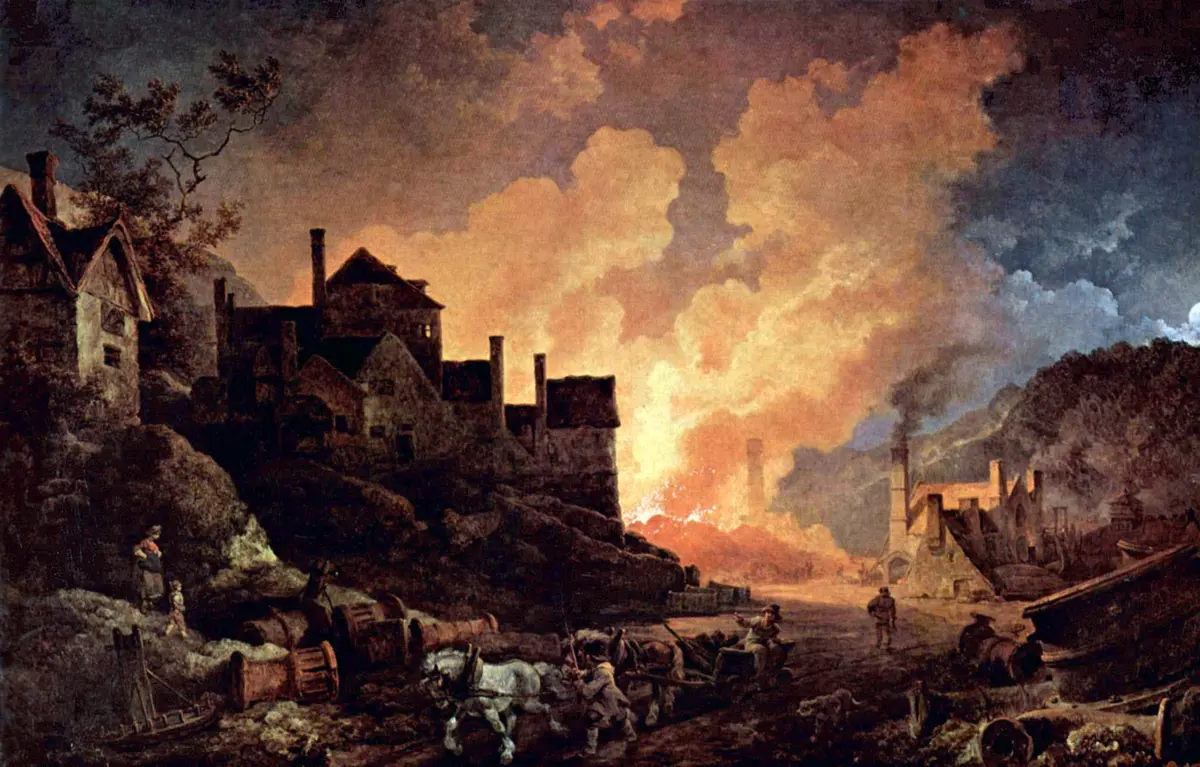
Newcomen's engine was the first of the long family of machines that burn fuel to do work, and with it began the age of coal, and later of oil and gas, that still shapes the world and its climate. Engines of his kind went on being built for decades after Watt's improvements. One at Elsecar in South Yorkshire pumped water from 1795 until 1923 and still stands in its engine house, the only Newcomen engine left where it was built; 'Fairbottom Bobs', from a colliery near Ashton-under-Lyne, is in the Henry Ford Museum in Michigan; a small engine that once fed a canal near Coventry works as a memorial in Newcomen's home town of Dartmouth; and the Science Museum in London shows Barney's print and an engine of 1791 from Pentrich in Derbyshire. About a mile from the first engine's site, the Black Country Living Museum runs a full-size working replica. No portrait of Newcomen is known.
What happened
- 1712
Newcomen's engine near Dudley Castle starts pumping water from a coal mine at Coneygree: a brass cylinder 21 inches wide and nearly 8 feet tall over a boiler 5½ feet across, rocking a timber beam about 12 times a minute. Desaguliers wrote in 1744 that, after colliery owners at Griff turned them down at the end of 1711, Newcomen and Calley agreed in March 1712 to drain water for 'Mr. Back of Wolverhampton', probably the same engine.
Coneygree, Tipton, below Dudley Castle: the coal works where the engine of 1712 stood; the exact spot is not known - 1714
An engine is at work at Griff colliery near Nuneaton in Warwickshire, the pit that had refused Newcomen's offer in 1711.
Griff, near Nuneaton, Warwickshire: the colliery that turned Newcomen down in 1711 and had an engine by about 1714 - 1715
Thomas Savery dies. His patent for raising water by fire, extended by Parliament in 1699 to 1733, passes to the 'Proprietors of the Invention for Raising Water by the Impellent Force of Fire', in which Newcomen holds shares; they license every engine built until the patent ends.
- 1716
The proprietors advertise in the London Gazette that their invention 'is lately brought to the greatest Perfection', with engines at work in Staffordshire, Warwickshire, Cornwall and Flintshire, and invite mine owners to treat with them every Wednesday at the Sword Blade Coffee House in London.
- 1717
Henry Beighton draws and engraves 'The Engine for Raising Water (with a power made) by Fire', the earliest known picture of a Newcomen engine.
John Calley, Newcomen's partner, dies at Austhorpe near Leeds while putting up an engine there.
- 1718
At an engine he has built at Newcastle upon Tyne, Beighton has the beam itself open and shut the valves, replacing the catches and strings an engine boy had tied up, by Desaguliers's account; Barney's print shows the first engine already working on its own.
- 1719
Thomas Barney publishes his engraving 'The Steam Engine near Dudley Castle', dedicated to the gentlemen of Staffordshire; it is the only document that dates the first engine to 1712.
Dudley Castle: the castle on its hill in Barney's engraving of the first engine - 1721
The engine reaches the Continent: the first one there is built in Belgium in 1720–21, another follows in Hungary in 1722, and France, Germany and Austria soon have them too.
- 1725
Andrew Wauchope signs for an engine at his Edmonstone colliery in Midlothian with the London committee of the proprietors, paying a royalty of £80 a year until 1733, when the patent will run out.
- 1728
By 1727–28 Sweden has an engine too: Mårten Triewald's 'fire and air machine' at the Dannemora iron mines, which he later dedicates to the Royal Board of Mines in an engraving of 1734.
Dannemora iron mines, Sweden: Mårten Triewald's 'fire and air machine', Sweden's first steam engine - 1729
Newcomen dies in London, where he had come on business about the patent, and is buried in Bunhill Fields, the Dissenters' burial ground; the Monthly Chronicle calls him the 'sole inventor of that surprising machine for raising water by fire'.
Bunhill Fields, London: the Dissenters' burial ground where Newcomen was buried in 1729- 1733
Savery's extended patent expires; at least 95 engines have been built in Britain under it.
- 1744
J. T. Desaguliers publishes the second volume of his Course of Experimental Philosophy, with plates of the engine and the first history of it: Newcomen's private trials, the hole in the piston that showed how to condense the steam inside the cylinder, and the boy Humphry Potter's catches, a story historians now doubt.
- 1753
The parts of America's first steam engine leave England and, after a long voyage, reach New York in early September; Josiah Hornblower, son of one of Newcomen's associates, sets it up to drain the Schuyler copper mine in New Jersey.
Schuyler copper mine, North Arlington, New Jersey: America's first steam engine, set up by Josiah Hornblower - 1763
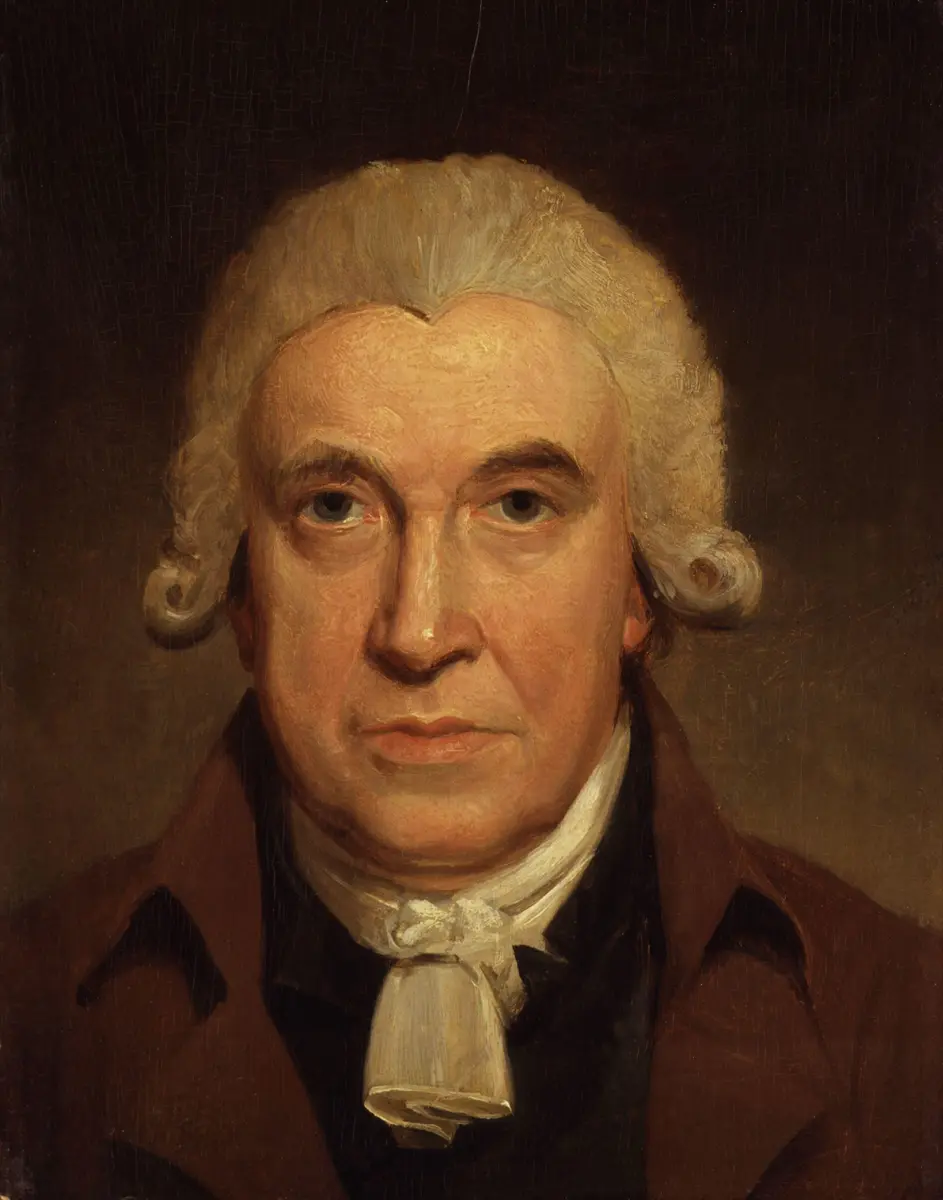
In the winter of 1763–64 Professor John Anderson asks James Watt, the University of Glasgow's instrument maker, to repair the class model of a Newcomen engine, which keeps failing. Working on it, Watt sees in 1765 how much heat is wasted by cooling and reheating the cylinder at every stroke: from here the story is his.
University of Glasgow: James Watt repaired the class model of a Newcomen engine in the winter of 1763–64; the model is in the Hunterian Museum