Mechanical clocks spread in Europe
“Between about 1270 and 1410 weight-driven clocks spread through Europe's churches and towns; their bells struck equal hours, and time became something a machine measured.”
Between the late thirteenth century and about 1400 a new machine spread through the churches and towns of Western Europe: the mechanical clock. A heavy weight on a cord wound round a drum turned a train of iron wheels, and a device called the escapement, usually a 'verge and foliot', let the wheels move only in small, regular steps, so that the falling weight measured out the time. The first hint comes from 1271, when the English astronomer Robertus Anglicus, teaching in France, wrote that clockmakers were trying to make a wheel turn exactly once a day but could not yet get it right. In 1283 the annals of Dunstable Priory recorded that a clock had been made and set above the screen of its church; St Paul's in London was paying a clock-keeper by 1286, and Canterbury put up a great clock in 1292. Because the Latin word horologium meant any timekeeper, from a water clock to a bell, nobody can say which of these was the first truly mechanical clock.
The first clocks served monks and clergy, who had to ring bells for prayers at fixed hours of the day and night. They had no dial and no hands: they struck a bell. Within a generation they became showpieces of learning. From 1327 Richard of Wallingford, a blacksmith's son who had studied at Oxford and become abbot of St Albans, designed a clock that struck the hours and showed the Sun, the Moon, the planets and the high tide at London Bridge; leprosy killed him in 1336, and the clock was finished about twenty years later. In Padua, Giovanni de' Dondi spent sixteen years, from 1348 to 1364, building his Astrarium, a clock about a metre tall with a dial for each of the seven planets, and he described every wheel in a book that survives. In Milan the bell tower of San Gottardo, finished in 1336 for the city's lord Azzone Visconti, held a clock whose bell struck the twenty-four hours of the day and night, and Strasbourg Cathedral's clock of 1352 to 1354 had a mechanical cockerel that still survives.
The striking clock changed how people counted time. Before it, hours were mostly 'temporary' hours, a twelfth of the daylight or of the night, which grew longer or shorter with the seasons, and church bells marked the hours of prayer. A clock's hours were all the same length, day and night, summer and winter, and its bell told the whole town. By the end of the century cathedrals and cities across Europe had clocks: Salisbury in 1386 (its clock, which has no dial, still works), Rouen in 1389, Wells around 1390 (with the oldest clock face still in place and knights that joust every quarter of an hour), and Prague, whose astronomical clock is first recorded on 9 October 1410. The French historian Jacques Le Goff described the change as a move from the 'church's time' of bells for prayer to the 'merchant's time' of work, trade and town life. The clocks were not accurate, and could be wrong by half an hour a day, but time had become something a machine measured and announced.
The idea had a longer history outside Europe. In China, Su Song had built a great astronomical clock tower at Kaifeng around 1090, its water wheel held back by an escapement-like system of levers, and in 1206 the engineer al-Jazari described elaborate water clocks. Whether news of such machines reached Europe is still debated, but the clock driven only by a falling weight and a mechanical escapement appears first in Europe, and the foliot remained the usual regulator until Christiaan Huygens applied the pendulum to clocks from 1656. The medieval clock gave us twenty-four hours of equal length, quarter chimes and the clock tower at the heart of the town; by about 1334 the clock was so familiar that the German mystic Henry Suso called a book of devotion the Clock of Wisdom.
What happened
- 1271
In a commentary on Sacrobosco's textbook of astronomy, the English astronomer Robertus Anglicus, then teaching in France, writes that clockmakers are trying to make a wheel that turns exactly once a day, driven by a lead weight, 'but they cannot quite perfect their work'.
- 1283
The annals of Dunstable Priory record: 'In the same year we made the horologium that is placed above the pulpitum', the screen between nave and choir; whether it was mechanical is not known.
Dunstable Priory: its annals record a clock made in 1283 and set above the screen between nave and choir - 1286
The accounts of St Paul's Cathedral in London allow a daily loaf to Bartholomew the clock-keeper (orologiarius), so the cathedral already had a clock; before 1298 it had jacks to strike the hours.
Old St Paul's Cathedral, London: a clock-keeper paid in 1286, striking jacks before 1298, a dial ordered in 1344 (the medieval cathedral burned in 1666; the point is the present cathedral's site) - 1292
Canterbury Cathedral sets up a great clock at a cost of £30.
Canterbury Cathedral: a great clock set up in 1292 at a cost of £30 - 1327
Richard of Wallingford, a blacksmith's son trained at Oxford, is elected abbot of St Albans and begins designing an astronomical clock that will strike the hours and show the Sun, the Moon, the planets and the tide at London Bridge; his treatise on it survives in the Bodleian Library.
St Albans Abbey (now the cathedral): Richard of Wallingford's astronomical clock, designed from 1327 and placed in the south transept about 1356 - 1334
About this year the German mystic Henry Suso dedicates his Horologium Sapientiae, the 'Clock of Wisdom', to the master general of the Dominicans: a devotional book named after the new machine.
- 1336
In Milan the bell tower of San Gottardo, Azzone Visconti's palace church, is finished; its clock strikes a bell 'twenty-four times according to the number of the twenty-four hours of the day and night', the first documented public clock to strike every hour.
San Gottardo in Corte, Milan: Azzone Visconti's bell tower of 1336, whose clock struck the twenty-four hoursRichard of Wallingford dies of leprosy at St Albans, his clock unfinished.
St Albans Abbey (now the cathedral): Richard of Wallingford's astronomical clock, designed from 1327 and placed in the south transept about 1356- 1339
Azzone Visconti dies; a Milanese chronicle gives the time of his death as 'the twentieth hour', which Lapham's Quarterly calls the first modern reference to an hour of the clock in such a record.
San Gottardo in Corte, Milan: Azzone Visconti's bell tower of 1336, whose clock struck the twenty-four hours- 1348
In Padua, Giovanni de' Dondi, son of a clockmaker, begins building his Astrarium, a planetary clock with a dial for each of the seven planets.
Padua, the clock tower on the Piazza dei Signori: the city where Giovanni de' Dondi, a clockmaker's son, built his Astrarium from 1348 to 1364 - 1354
Strasbourg Cathedral's first astronomical clock, begun in 1352 under Bishop John of Lichtenberg, is completed; its mechanical cockerel survives in the city's Museum of Decorative Arts.
Strasbourg Cathedral: its first astronomical clock, with the crowing cockerel, built 1352 to 1354 - 1356
Richard of Wallingford's clock, finished after his death to his written design, is set up in the south transept of St Albans Abbey, where it runs until the Dissolution in the 1530s.
St Albans Abbey (now the cathedral): Richard of Wallingford's astronomical clock, designed from 1327 and placed in the south transept about 1356 - 1364
De' Dondi finishes the Astrarium after sixteen years: about a metre tall, with 107 moving parts driven by one weight and escapement, and describes it wheel by wheel in his Tractatus astrarii.
Padua, the clock tower on the Piazza dei Signori: the city where Giovanni de' Dondi, a clockmaker's son, built his Astrarium from 1348 to 1364 - 1386
Salisbury Cathedral has a clock that strikes the hours on a bell, with no dial; the clock still in the cathedral is believed to be this one, the world's oldest working mechanical clock.
Salisbury Cathedral: a clock recorded in 1386, which the cathedral calls the world's oldest working mechanical clock - 1389
Rouen sets up a town clock whose iron movement still exists, with a mechanism to chime the quarters.
The Gros-Horloge, Rouen: a clock movement of 1389, still in existence - 1392
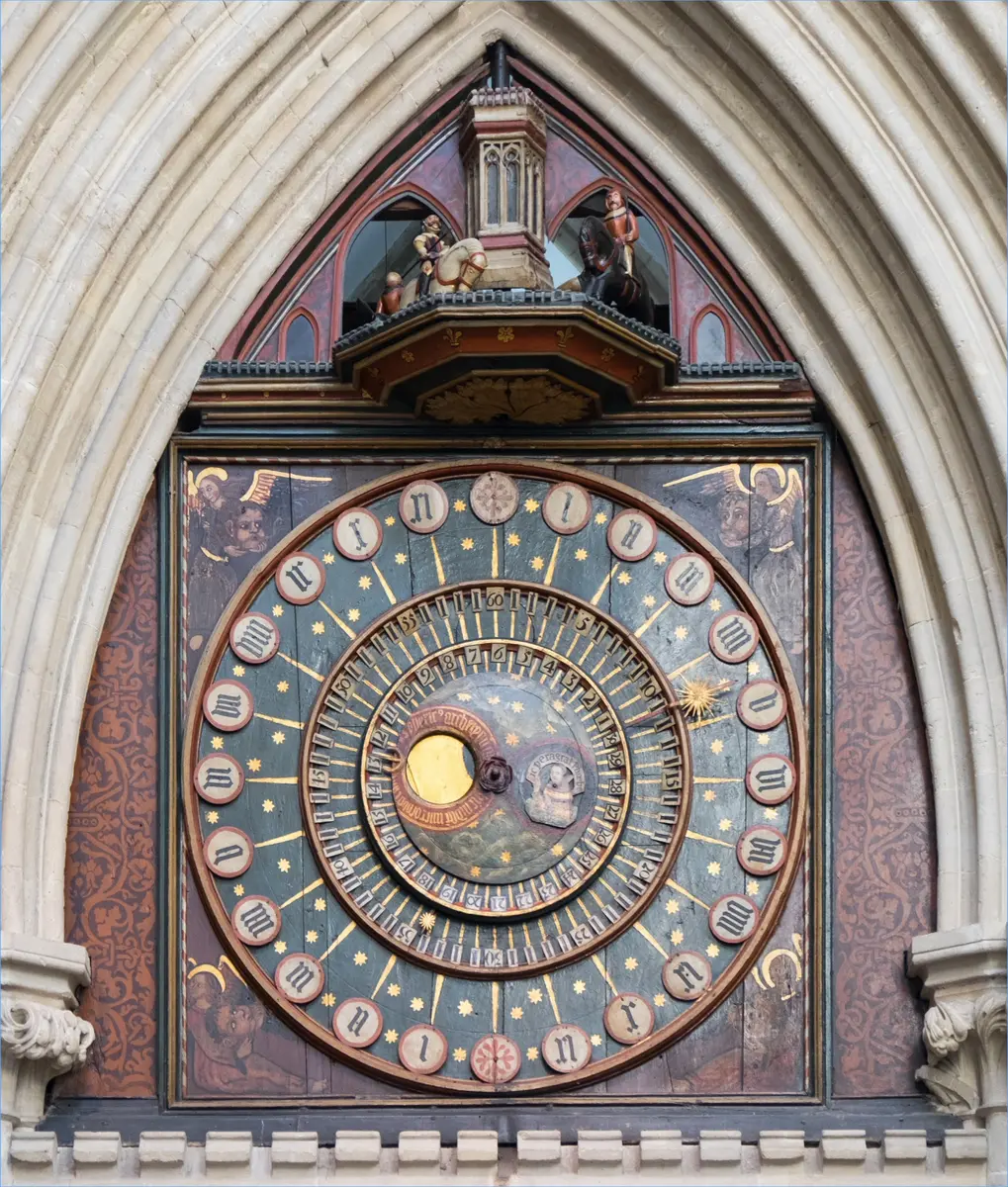
Wells Cathedral pays a keeper for its clock (1392–93); the clock, with its astronomical dial, jousting knights and quarter jack, is dated by the Science Museum to 1392 and by the cathedral to about 1390.
Wells Cathedral: the clock of about 1390, its dial still in the north transept - 1410
Prague's town records first mention the astronomical clock on the Old Town Hall, made by the clockmaker Mikuláš of Kadaň and the astronomer Jan Šindel; today it is the oldest astronomical clock still working.
The Old Town Hall, Prague: the astronomical clock, first recorded on 9 October 1410