Eyeglasses appear in Italy
“An unknown craftsman in northern Italy made the first spectacles around 1286; a friar praised the new art in 1306, and in 1352 a painter in Treviso showed a cardinal wearing them.”
Eyeglasses, or spectacles, appeared in northern Italy in the last years of the thirteenth century. The first pairs were simply two convex magnifying lenses, each set in a rim of wood or bone with a short handle; the two handles were joined by a rivet, and the wearer clamped them on the nose or held them up by hand. They helped people who could no longer read small letters as they grew older, the long sight that comes with age. Nobody knows who made the first pair. The best evidence is a sermon that the Dominican friar Giordano da Pisa preached in Florence on 23 February 1306: it was 'not yet twenty years' since the art of making eyeglasses had been found, he said, and he had seen and talked with the man who first made them. Hence the usual date, about 1286.
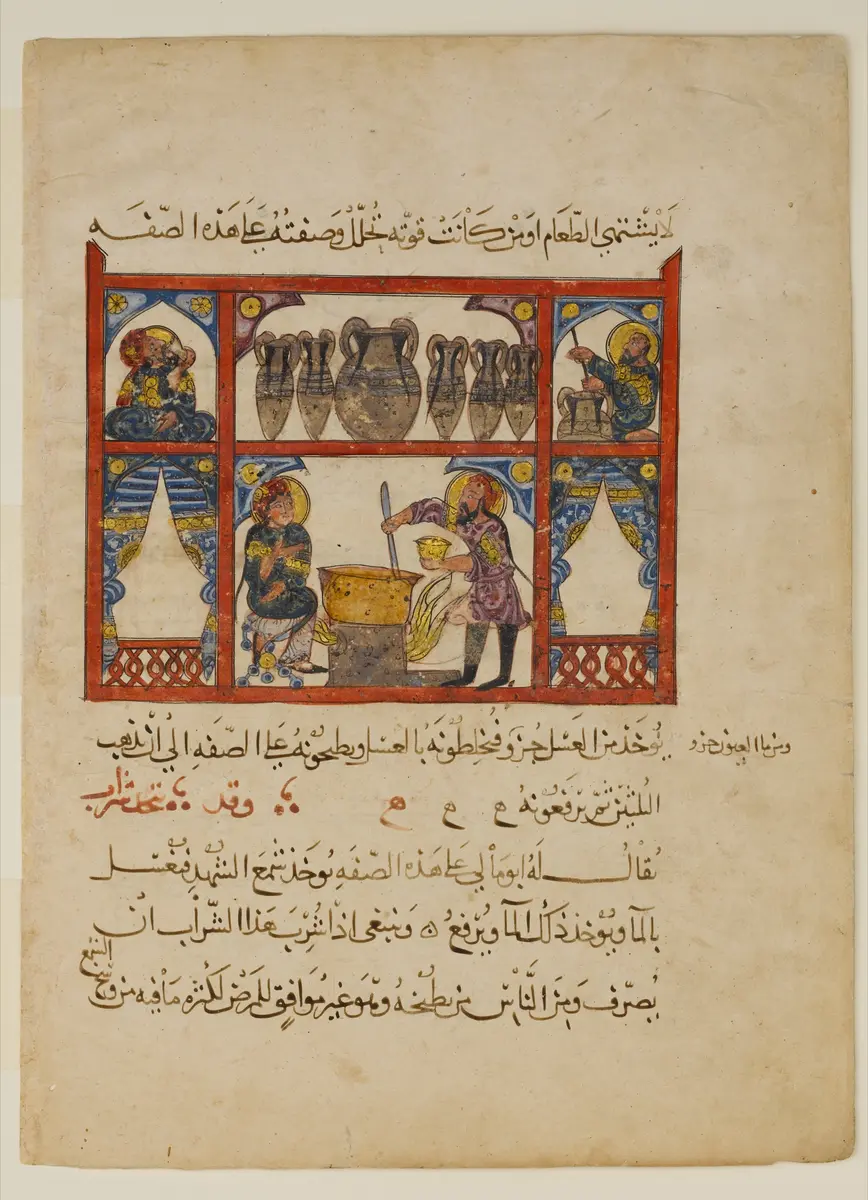
The idea had a long history. People had long read with a lens laid on the page or held in the hand, and early in the eleventh century the scholar Ibn al-Haytham wrote his great Book of Optics in Cairo; in Latin it became the reference book of the thirteenth-century European scholars of 'perspective', the science of seeing. In 1266 and 1267 the English Franciscan Roger Bacon, writing for Pope Clement IV, explained how a lens could help old people with weak eyes. But historians doubt that the inventor read such books. Spectacles came out of the workshop, and the glassmakers of Venice, who were learning to make an unusually clear glass called crystal, were crucial to them: Venetian rules of 1300 and 1301 already speak of 'roidi da ogli', discs for the eyes, and of glass 'for the eyes, for reading'.
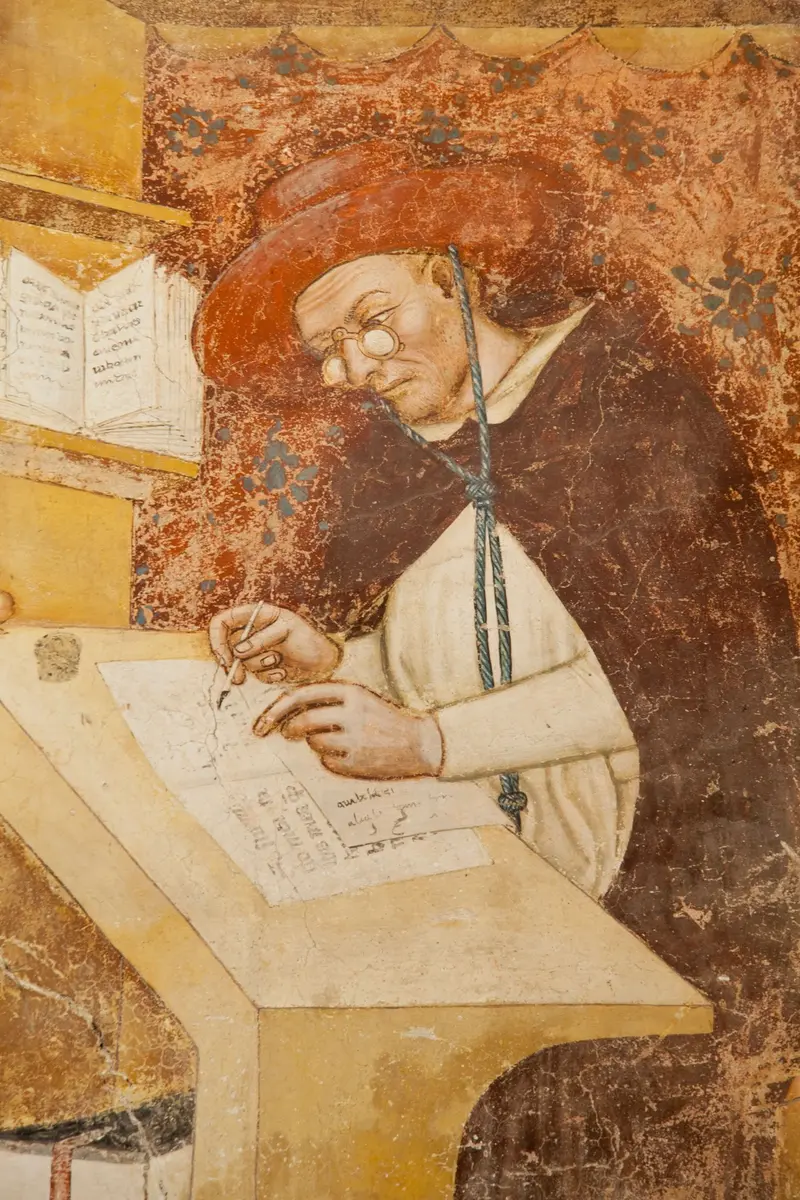
The new art spread fast through a world of friars, scholars and merchants. In Pisa the chronicle of the Dominican convent of Santa Caterina praised friar Alessandro della Spina, who died in 1313: when the first maker kept his method to himself, Alessandro made spectacles on his own and shared the art with everyone. By 1316 a pair with its case had a price, and in 1329 a merchant complained that the spectacles he had bought in Florence had been stolen. In 1352 Tommaso da Modena painted the oldest known picture of them, on the nose of Cardinal Hugh of Saint-Cher, in the chapter house of a Dominican convent at Treviso, near Venice. The oldest frames that survive, of wood, were found in 1953 under the floor of the nuns' choir at Wienhausen in northern Germany. Doctors were slower: in 1363 the French surgeon Guy de Chauliac still offered spectacles only when eye lotions had failed.
In the fifteenth century Florence became a great centre of the trade, with nearly fifty spectacle makers known by name between 1413 and 1562, and its craftsmen learned to grind concave lenses for the short-sighted: in 1462 the Duke of Milan ordered three dozen pairs from Florence, one dozen of them 'for distant vision, that is for the young'. Printing, from the 1450s, multiplied the need. Florence also produced the best-known myth. In 1684 the antiquarian Ferdinando Leopoldo del Migliore wrote that a lost tombstone in the church of Santa Maria Maggiore had named one Salvino degli Armati, who died in 1317, as 'inventor of eyeglasses'. A monument went up in 1841, but in the 1920s scholars showed that the inscription was a forgery; the plaque is still there, hidden in a corner of a chapel.
Spectacles changed working lives. A scholar, a scribe, a merchant or a craftsman whose eyes were failing in his forties could go on reading and doing fine work for many more years, with his hands free. The spectacle makers' lenses also opened new worlds: around 1600 craftsmen who made spectacles put two lenses in a tube and made the microscope and the telescope. More than seven hundred years after that unknown craftsman, spectacles are still the most common way to correct the defects of the eye.
What happened
- 1286
About this year, by the later reckoning of the friar Giordano da Pisa, an unknown craftsman in northern Italy finds 'the art of making eyeglasses': two convex lenses in rims whose handles are riveted together, clamped on the nose for reading. Who he was, and whether he worked in Pisa, Florence or the Veneto, is not known.
- 1300
Venice regulates its glass trade: a rule of 1300 for the city's crystal workers names 'roidi da ogli', discs for the eyes, and a decree of the next year speaks of 'vitreos ab oculis ad legendum', glass for the eyes, for reading. Venice's clear 'crystal' glass is coming into wide use just as spectacles spread.
Murano, Venice: the glassmakers' island; Venetian rules of 1300 and 1301 already name glass discs for the eyes - 1306
In a Lent sermon at Santa Maria Novella in Florence, the Dominican Giordano da Pisa praises human skill: it is not yet twenty years, he says, since the art of making eyeglasses was found, one of the most useful arts in the world, and he has seen the man who first made them and talked with him. He does not give his name.
Santa Maria Novella, Florence: where Giordano da Pisa preached on 23 February 1306 that eyeglasses had been invented less than twenty years before- 1313
Friar Alessandro della Spina dies at the Dominican convent of Santa Caterina in Pisa. The convent's chronicle remembers that he had seen spectacles made by someone who would not share the secret, made them himself, and gave the art gladly to everyone.
Santa Caterina, Pisa: the Dominican convent whose chronicle remembers friar Alessandro della Spina (d. 1313), who made spectacles and shared the art - 1316
An Italian manuscript gives the price of a pair of spectacles with its case: six Bolognese soldi. Spectacles have become goods that can be bought and sold.
- 1329
A Tuscan merchant complains that spectacles he had bought in Florence have been stolen from him.
- 1330
About this time the 'Lüneburg casket', now at the convent of Wienhausen in northern Germany, is made with four convex glass discs of about 3.5 dioptres. If, as some think, they began as ground spectacle lenses, they are the oldest glass spectacle lenses to survive.
Kloster Wienhausen, near Celle: the oldest surviving spectacles, wooden rivet frames of about 1400, found under the nuns' choir stalls in 1953 - 1352
In the chapter house of the Dominican convent of San Nicolò in Treviso, Tommaso da Modena paints famous Dominicans at their desks. Cardinal Hugh of Saint-Cher, who had died in the 1260s, writes with rivet spectacles on his nose: the first known painting of spectacles.
The former Dominican convent of San Nicolò, Treviso (now the bishop's seminary): Tommaso da Modena's chapter-house frescoes of 1352, the first painting of spectaclesAcross the same room Tommaso paints Cardinal Nicholas of Rouen straining to read through a single lens held in his hand, the older way of magnifying a page.
The former Dominican convent of San Nicolò, Treviso (now the bishop's seminary): Tommaso da Modena's chapter-house frescoes of 1352, the first painting of spectacles