Islamic Golden Age
“From the Abbasid revolution of 750 to the Mongol sack of Baghdad in 1258, scholars writing in Arabic translated Greek science and added algebra, a new optics and the Canon of Medicine.”
The Islamic Golden Age is the name historians give to the centuries when the cities of the Islamic world, above all Abbasid Baghdad, led the world in science and learning. Scholars writing in Arabic, Arabs, Persians, Christians and others, first translated the science and philosophy of the Greeks and learned from Persian and Indian books, then went beyond them. Al-Khwarizmi wrote the first book of algebra and explained the Indian numerals with zero that Europe later called Arabic; Ibn al-Haytham showed by experiment that we see because light travels from objects into the eye; Ibn Sina's Canon of Medicine was taught in Europe's universities until the seventeenth century. The usual frame, 750 to 1258, runs from the revolution that brought the Abbasid caliphs to power to the Mongol sack of their capital. Both ends are conventions, and science did not stop on either date.
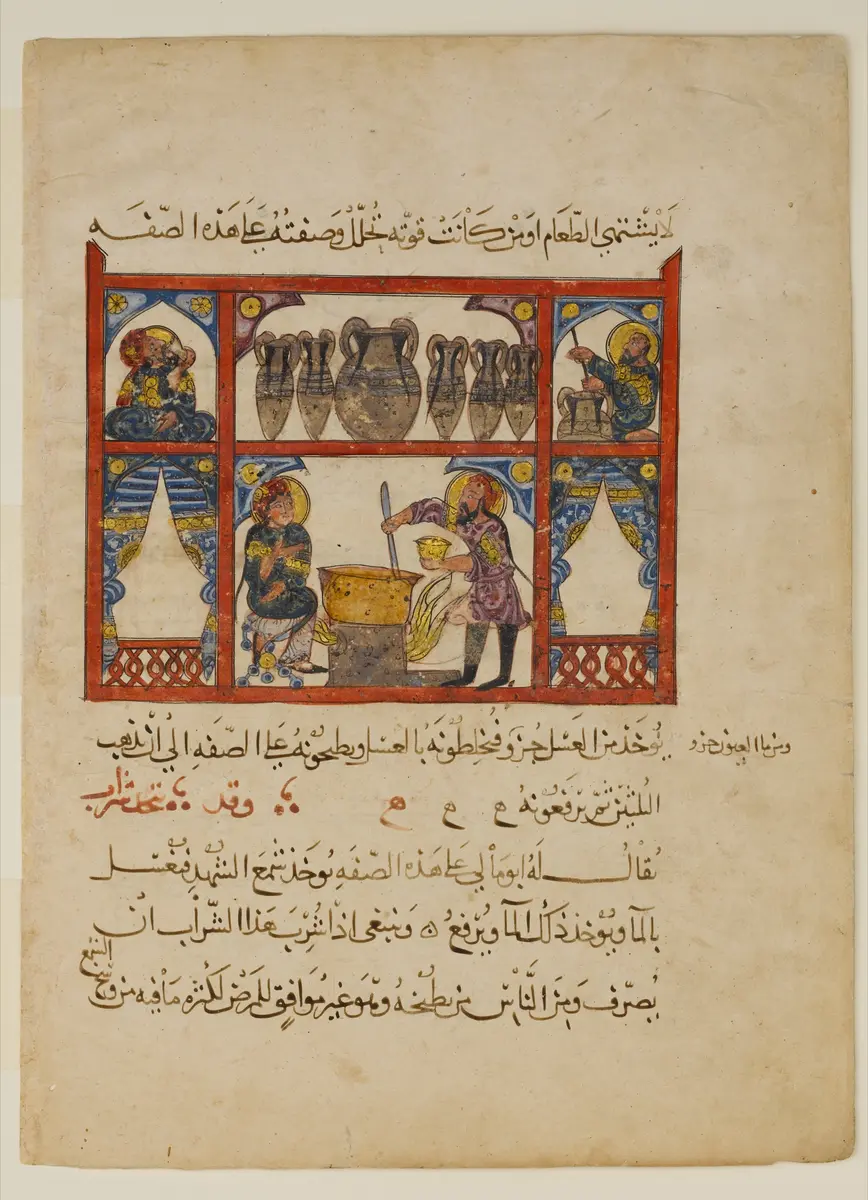
The Abbasids overthrew the Umayyad caliphs in 750, moved the centre of the empire east to Iraq and in 762 founded Baghdad, a planned round city on the Tigris. From the 790s paper was made there, and soon scholars everywhere were copying books on it. Under Harun al-Rashid and his son al-Ma'mun (813–833) the caliphs and their courtiers paid for translations of Aristotle, Euclid, Ptolemy and Galen into Arabic, often by way of Syriac and often by Christian scholars such as Hunayn ibn Ishaq. Al-Ma'mun's palace library, the 'House of Wisdom', is often remembered as a great academy, though historians such as Dimitri Gutas doubt that it was ever the centre of the translations. In this world al-Khwarizmi wrote the book whose title gave us the word 'algebra', and al-Kindi became the first philosopher writing in Arabic.
As the caliphs lost real power, first to their own Turkish soldiers, then to the Buyids, who took Baghdad in 945, and to rival caliphs in Córdoba and Cairo, learning spread to many courts. At Raqqa al-Battani measured the motions of the Sun and Moon more accurately than Ptolemy; in Rayy and Baghdad the physician al-Razi ran hospitals and kept more than a thousand case histories; in Bukhara the teenage Ibn Sina read his way through the Samanid royal library; in Fatimid Cairo Ibn al-Haytham wrote his Optics; al-Biruni measured the size of the Earth and wrote a long study of India. In Spain, the Umayyads of Córdoba took the title of caliph in 929 and made their country, in one historian's words, the most splendid and cultivated part of the Islamic world; later the Córdoban judge and physician Ibn Rushd wrote the commentaries on Aristotle that made him 'the Commentator' of Christian Europe.
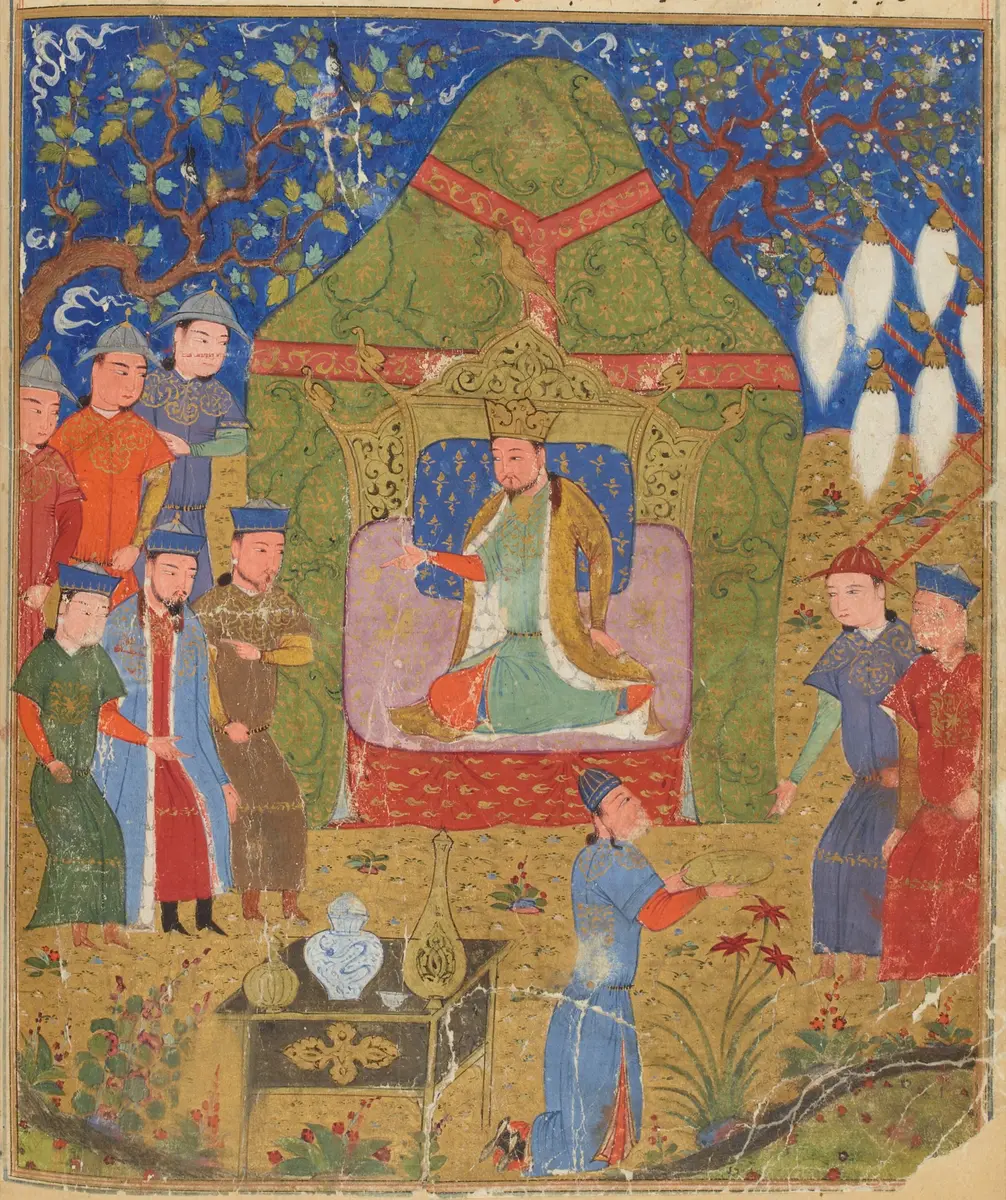
The end is usually dated to February 1258, when the Mongol prince Hülegü, a grandson of Genghis Khan, took Baghdad, plundered and burned it, and put the last Abbasid caliph to death; the libraries were looted, and books, the story goes, were thrown into the Tigris. Yet Hülegü himself began an observatory at Maragha the next year for the astronomer Nasir al-Din al-Tusi, and historians of mathematics follow the Arabic tradition to the middle of the fifteenth century, while Gutas describes science under the patronage of rulers in 'the first three Abbasid centuries', from 750 to 1050.
Its learning reached Europe through Spain and Sicily. In Toledo, from the 1140s, Gerard of Cremona alone translated some eighty Arabic books into Latin, among them Ptolemy's Almagest; al-Battani's tables, al-Khwarizmi's arithmetic and Ibn Sina's Canon all passed into Latin, and in Palermo the geographer al-Idrisi made his map of the world for the Norman king Roger II. The words 'algebra' and 'algorithm', and the numerals 0 to 9 on every screen, still carry its memory.
What happened
- 750
Risen in Khorasan in 747 under Abu Muslim, the Abbasid movement defeats Marwan II, the last Umayyad caliph, at the Great Zab river in Mesopotamia. Abu al-Abbas al-Saffah is proclaimed the first Abbasid caliph, and the empire turns east, from Damascus towards Iraq and Persia.
- 751
Muslim armies defeat a Chinese army at Talas in Central Asia. The legend that captured Chinese craftsmen then taught papermaking at Samarkand is doubted today: paper was already in use there, and the craft had probably moved west before the battle.
- 756
Abd al-Rahman, an Umayyad prince who escaped the Abbasids' massacre of his family, makes himself ruler at Córdoba, founding an Umayyad state in Spain independent of Baghdad that lasts until 1031.
Córdoba: capital of the Umayyads of Spain from 756 and of their caliphate from 929, city of Ibn Rushd; the point is the Great Mosque, founded in 786 - 762
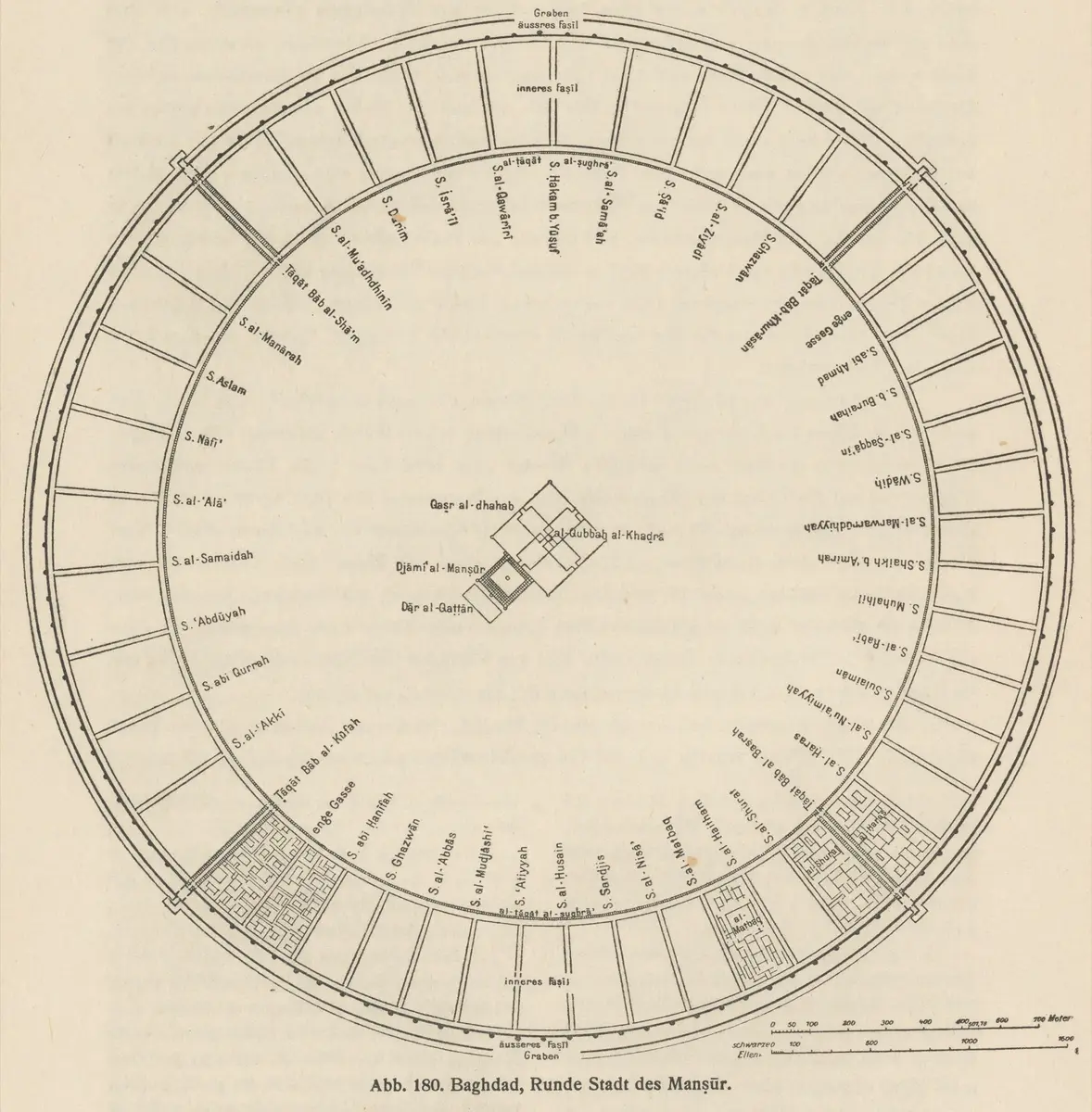
The caliph al-Mansur founds his new capital on the west bank of the Tigris: a round city, Madinat al-Salam, the 'Abode of Peace', with his palace and great mosque at its centre. It soon spreads over both banks and takes the old name of the site, Baghdad.
Baghdad: founded by al-Mansur in 762 as the round city of the Abbasid caliphs, home of the translators and of al-Ma'mun's court library, sacked by the Mongols in February 1258; the point is the Mustansiriya madrasa, finished in 1233 - 770
Around this year an Indian embassy brings an astronomical treatise to the caliph's court in Baghdad; turned into Arabic, it later becomes the basis of al-Khwarizmi's astronomical tables.
Baghdad: founded by al-Mansur in 762 as the round city of the Abbasid caliphs, home of the translators and of al-Ma'mun's court library, sacked by the Mongols in February 1258; the point is the Mustansiriya madrasa, finished in 1233 - 786
Abd al-Rahman I founds the Great Mosque of Córdoba on the site of a church, its arches carried on columns reused from Roman and Visigothic buildings; his successors enlarge it in 832–848, 962 and 987.
Córdoba: capital of the Umayyads of Spain from 756 and of their caliphate from 929, city of Ibn Rushd; the point is the Great Mosque, founded in 786Harun al-Rashid becomes caliph. In his reign al-Hajjaj translates Euclid's Elements into Arabic and Sallam al-Abrash Aristotle's Physics.
Baghdad: founded by al-Mansur in 762 as the round city of the Abbasid caliphs, home of the translators and of al-Ma'mun's court library, sacked by the Mongols in February 1258; the point is the Mustansiriya madrasa, finished in 1233- 796
The Abbasids sponsor a papermaking workshop in Baghdad. Soon scholars all over the Islamic world are copying their books on paper.
Baghdad: founded by al-Mansur in 762 as the round city of the Abbasid caliphs, home of the translators and of al-Ma'mun's court library, sacked by the Mongols in February 1258; the point is the Mustansiriya madrasa, finished in 1233 - 813
After a civil war in which his brother al-Amin is killed, al-Ma'mun becomes caliph (813–833). He collects Greek manuscripts, some from Byzantium, pays translators, builds observatories and keeps a palace library, the Bayt al-Hikma or 'House of Wisdom'. It is often described as an academy of translation and research; historians such as Dimitri Gutas argue that it was a court library rather than the centre of the translations.
Baghdad: founded by al-Mansur in 762 as the round city of the Abbasid caliphs, home of the translators and of al-Ma'mun's court library, sacked by the Mongols in February 1258; the point is the Mustansiriya madrasa, finished in 1233 - 820
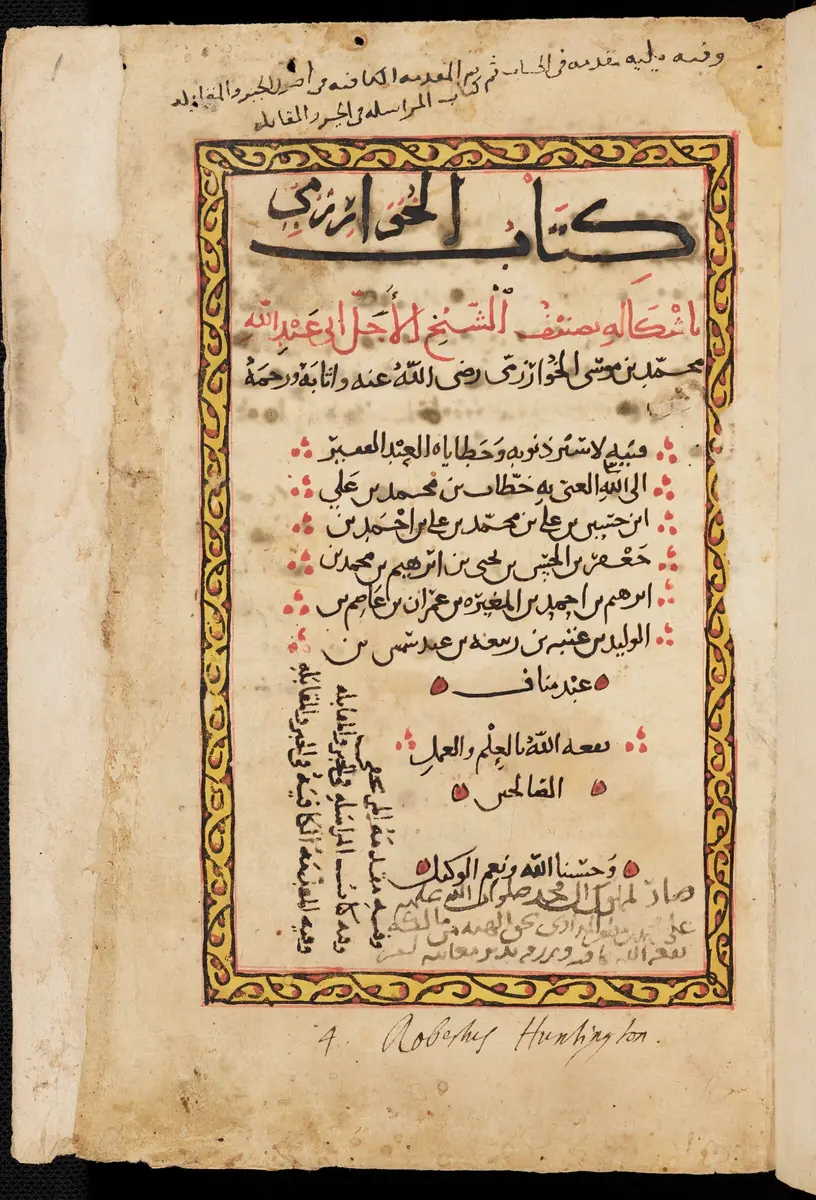
About this time al-Khwarizmi, a scholar of al-Ma'mun's court, writes a short book on 'al-jabr' and 'al-muqabala', 'completion' and 'balancing', which reduces every linear and quadratic equation to six types and solves them in words, proving the rules with squares; its title gives us 'algebra'. His book on reckoning with the Indian numerals and zero survives only in Latin, where his name became 'Algorizmi', our 'algorithm'.
Baghdad: founded by al-Mansur in 762 as the round city of the Abbasid caliphs, home of the translators and of al-Ma'mun's court library, sacked by the Mongols in February 1258; the point is the Mustansiriya madrasa, finished in 1233 - 833
Al-Mu'tasim becomes caliph. Al-Kindi, leader of a circle of translators and the first philosopher writing in Arabic, addresses his chief work, On First Philosophy, to him and tutors his son Ahmad.
Baghdad: founded by al-Mansur in 762 as the round city of the Abbasid caliphs, home of the translators and of al-Ma'mun's court library, sacked by the Mongols in February 1258; the point is the Mustansiriya madrasa, finished in 1233 - 836
Al-Mu'tasim builds a new capital at Samarra, up the Tigris from Baghdad, for his army of Turkish slave soldiers; it remains the capital for about half a century, and al-Mutawakkil (847–861) gives it the largest mosque of the age, with its spiral minaret.
Samarra: the Abbasid capital founded by al-Mu'tasim in 836, with al-Mutawakkil's Great Mosque and its spiral minaret, the Malwiya - 873
Hunayn ibn Ishaq dies, a Nestorian Christian physician of Baghdad and the most productive translator of all. With his son Ishaq and his nephew Hubaysh he had put much of Galen, Aristotle and other Greek authors into Syriac and Arabic; of Galen alone he listed 95 Syriac and 34 Arabic versions.
Baghdad: founded by al-Mansur in 762 as the round city of the Abbasid caliphs, home of the translators and of al-Ma'mun's court library, sacked by the Mongols in February 1258; the point is the Mustansiriya madrasa, finished in 1233 - 877
Al-Battani, from a Sabian family of Harran, begins forty years of observations at Raqqa on the Euphrates. His tables of the Sun, Moon and planets correct Ptolemy; translated into Latin in 1116, they influenced Copernicus, Tycho Brahe and Kepler.
Raqqa, on the Euphrates: where al-Battani made most of his observations of the Sun, Moon and planets, from 877 to 918 - 925
The physician al-Razi (Rhazes) dies in his home town of Rayy. He had run hospitals in Rayy and Baghdad; his students gathered his notes into the vast Comprehensive Book on Medicine, and more than a thousand of his case histories survive.
Rayy, near today's Tehran: home town of the physician al-Razi, who ran its hospital and died there about 925 - 929
Abd al-Rahman III, the Umayyad ruler of Córdoba, takes the title of caliph, a rival to Baghdad; under the caliphate Spain becomes the most splendid and cultivated part of the Islamic world.
Córdoba: capital of the Umayyads of Spain from 756 and of their caliphate from 929, city of Ibn Rushd; the point is the Great Mosque, founded in 786 - 945
The Buyids, a dynasty from Iran, enter Baghdad. The caliphs keep their title but lose their power, and for a century much of the empire is ruled by local dynasties.
Baghdad: founded by al-Mansur in 762 as the round city of the Abbasid caliphs, home of the translators and of al-Ma'mun's court library, sacked by the Mongols in February 1258; the point is the Mustansiriya madrasa, finished in 1233 - 969
The Fatimids, an Ismaili dynasty with a rival caliphate in North Africa, conquer Egypt and found Cairo. Its congregational mosque, al-Azhar, begun that year and dedicated in 972, grows into the most celebrated college of the Islamic world.
Cairo: founded by the Fatimids in 969; Ibn al-Haytham spent his later years here, near the al-Azhar mosque (the point) - 997
In Bukhara, capital of the Samanid emirs, the teenage Ibn Sina (Avicenna) cures the ruler Nuh II and is allowed into the royal library, where he reads the Greek sciences in Arabic translation.
Bukhara: capital of the Samanid emirs, in whose royal library the young Ibn Sina studied; the point is the Samanid mausoleum - 1009
A copy of the Book of the Fixed Stars by the astronomer al-Sufi (903–986) is finished. Al-Sufi had revised Ptolemy's star catalogue with the Arabic names of the stars and drawn each constellation twice, as seen in the sky and as on a globe.
- 1021
In Cairo the caliph al-Hakim dies. By one account Ibn al-Haytham (Alhazen) had feigned madness to escape his service and was kept in his house until now. His seven-book Optics argues from experiment that we see because light comes from objects into the eye, and is the first work to mention the camera obscura.
Cairo: founded by the Fatimids in 969; Ibn al-Haytham spent his later years here, near the al-Azhar mosque (the point) - 1024
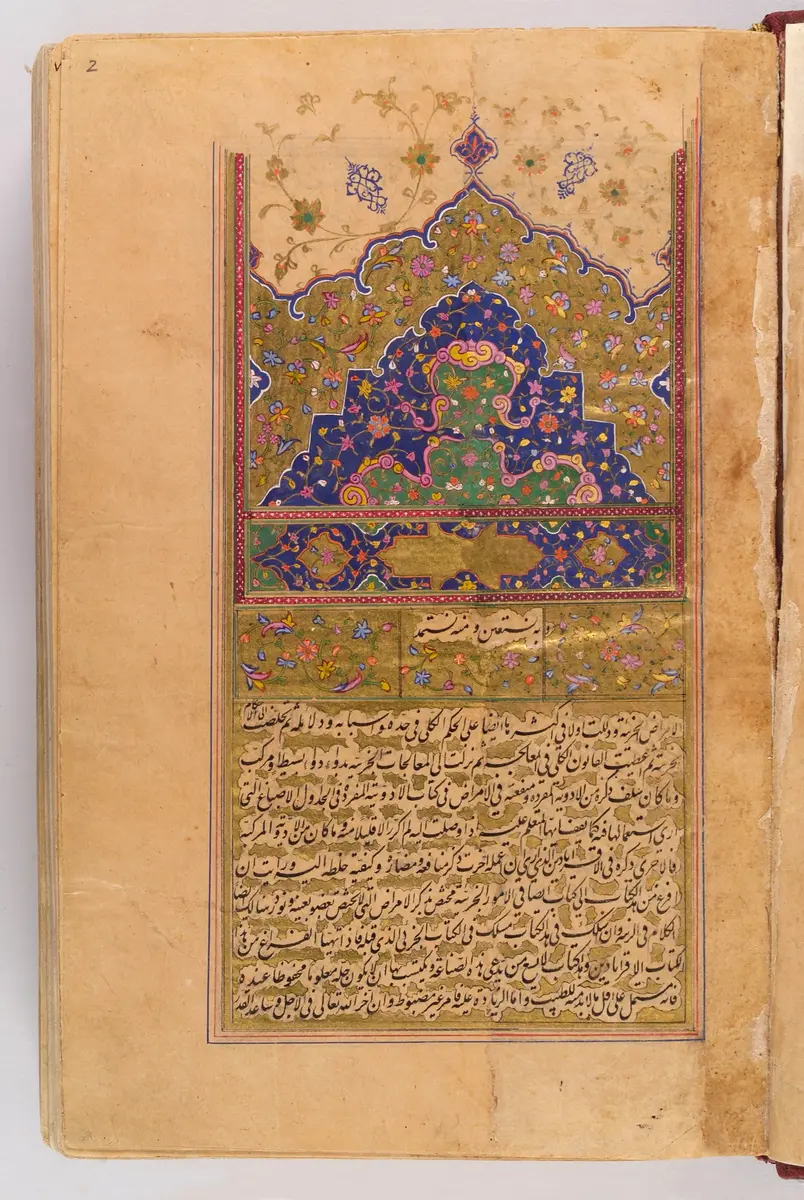
Ibn Sina settles at the court of Isfahan, where he spends his last years and completes his great works, among them the Canon of Medicine, five books that join Greek and Islamic medicine; he had begun it earlier, at Gurgan according to the Aga Khan Museum, at Hamadan according to MacTutor.
Isfahan: Ibn Sina's home in his last years, from about 1024, where he completed his great works - 1030
Al-Biruni, who had followed the armies of Mahmud of Ghazni into India and read its books in Sanskrit, brings out his India, a study of its religions, sciences and customs. He also measured the radius of the Earth as about 6,340 kilometres.
- 1055
The Seljuk Turks take Baghdad. Their sultans hold the real power while respecting the caliph as the titular head of the Muslim community.
Baghdad: founded by al-Mansur in 762 as the round city of the Abbasid caliphs, home of the translators and of al-Ma'mun's court library, sacked by the Mongols in February 1258; the point is the Mustansiriya madrasa, finished in 1233 - 1067
In Toledo, then the seat of one of Spain's Muslim taifa kingdoms, Ibrahim ibn Sa'id al-Sahli signs a brass astrolabe with plates for eleven latitudes, from Mecca to Zaragoza.
Toledo: where al-Sahli made his astrolabe in 1067, and where Gerard of Cremona and others translated Arabic science into Latin from the 1140s- 1144
By now the Italian scholar Gerard of Cremona is in Toledo, learning Arabic to read Ptolemy's Almagest. Over forty years he translates some eighty Arabic books into Latin, Greek works in Arabic dress and Arabic science alike. Al-Battani's tables had been put into Latin in 1116, and twelfth-century Latin versions of al-Khwarizmi's arithmetic were teaching Europe the Indian numerals.
Toledo: where al-Sahli made his astrolabe in 1067, and where Gerard of Cremona and others translated Arabic science into Latin from the 1140s - 1154
At Palermo, in the Norman kingdom of Sicily, the geographer al-Idrisi, who had studied at Córdoba, finishes for King Roger II the 'Book of Roger', some seventy regional maps of the known world with their descriptions, and a world map engraved on a silver disc, now lost. Roger dies the same year.
Palermo, seat of the Norman kings of Sicily (the point is their palace): al-Idrisi worked at Roger II's court and finished his Book of Roger in 1154 - 1198
Ibn Rushd (Averroes) of Córdoba dies, by one account in Marrakesh, after a late disgrace. Judge, physician to the Almohad caliph and, at the caliph Abu Ya'qub Yusuf's request, commentator on Aristotle, he is known in Latin Europe by the 1230s simply as 'the Commentator'.
Córdoba: capital of the Umayyads of Spain from 756 and of their caliphate from 929, city of Ibn Rushd; the point is the Great Mosque, founded in 786 - 1233
The caliph al-Mustansir finishes his great madrasa on the Tigris at Baghdad, which teaches all four schools of Sunni law under one roof.
Baghdad: founded by al-Mansur in 762 as the round city of the Abbasid caliphs, home of the translators and of al-Ma'mun's court library, sacked by the Mongols in February 1258; the point is the Mustansiriya madrasa, finished in 1233 - 1237
In Baghdad Yahya ibn Mahmud al-Wasiti finishes his copy of al-Hariri's Maqamat, writing the text and painting its pictures himself, among them a gathering of scholars in a library.
Baghdad: founded by al-Mansur in 762 as the round city of the Abbasid caliphs, home of the translators and of al-Ma'mun's court library, sacked by the Mongols in February 1258; the point is the Mustansiriya madrasa, finished in 1233 - 1258
The Mongol prince Hülegü, grandson of Genghis Khan, takes Baghdad after a siege. The city is plundered and burned, and the last Abbasid caliph, al-Musta'sim, is killed with some 300 of his officials; at the Mustansiriya the students are put to the sword and the books, the story goes, thrown into the Tigris.
Baghdad: founded by al-Mansur in 762 as the round city of the Abbasid caliphs, home of the translators and of al-Ma'mun's court library, sacked by the Mongols in February 1258; the point is the Mustansiriya madrasa, finished in 1233