Al-Khwarizmi
“The Baghdad scholar of the House of Wisdom whose book on al-jabr gave algebra its name, and whose Latin name, Algoritmi, gave us the word algorithm.”
Muhammad ibn Musa al-Khwarizmi was a mathematician, astronomer and geographer at the court of the Abbasid caliphs in Baghdad in the first half of the ninth century. He wrote the first book on algebra in Arabic, and its title, al-jabr, became our word 'algebra'. He also wrote a short book on calculating with the nine Indian figures and a sign for nothing, the zero; in Latin it began 'Dixit Algorizmi', 'al-Khwarizmi said', and his name, turned into 'algorism', became our word 'algorithm'. Both books were translated into Latin in the twelfth century and taught medieval Europe to solve equations and to reckon on paper.
Very little is known about his life. Britannica gives his dates as about 780 to about 850. His name means 'the man from Khwarazm', the oasis on the lower Amu Darya south of the Aral Sea, around today's Khiva in Uzbekistan. But the historian al-Tabari also calls him al-Qutrubbulli, after Qutrubbul, a district just outside Baghdad, so perhaps only his family came from Khwarazm. Since the preface of his Algebra shows a believing Muslim, al-Tabari's further name for him, al-Majusi, 'the Zoroastrian', may only mean that his forebears followed the old Persian religion; the historian Roshdi Rashed thinks the words describe a second man. Under the caliph al-Ma'mun (813–833) he belonged to the House of Wisdom, the caliph's library and circle of scholars, together with the three Banu Musa brothers and al-Hajjaj, the translator of Euclid. How far it was a real academy is still debated.
His Algebra, 'The Compendious Book on Calculation by Completion and Balancing', is dedicated to al-Ma'mun and meant to be practical, for 'inheritance, legacies, partition, lawsuits, and trade', measuring land and digging canals. Every problem is brought to one of six standard equations of the first or second degree by two moves: al-jabr, 'restoring', which removes a quantity subtracted on one side, and al-muqabala, 'balancing', which cancels like terms on both sides. All is said in words, without symbols: the unknown is 'a thing', its square 'wealth'. He proves his rules with simple figures, the method we call completing the square. His astronomical tables, the Zij al-Sindhind, rest mostly on Indian astronomy brought to Baghdad around 770; they are the first Arabic astronomical work to survive almost whole, though only in Latin. His 'Book of the Image of the Earth' reworks Ptolemy's Geography as the latitudes and longitudes of 2,402 places, and improves on Ptolemy for the Islamic lands, shortening his far too long Mediterranean. He also wrote on the Jewish calendar, the astrolabe and the sundial, and a chronicle that is lost.
The last sure sign of him comes from al-Tabari: in 847 he was one of the astronomers called to the bed of the dying caliph al-Wathiq at Samarra, who read in his horoscope fifty more years of life; the caliph died ten days later. A story that al-Wathiq had sent him to the chief of the Khazars in 842 may confuse him with Muhammad ibn Musa ibn Shakir, one of the Banu Musa. Britannica says he helped to make al-Ma'mun's map of the world and to measure a degree of the meridian on the plain of Sinjar; other historians doubt his part in the measurement. He probably died around 850. No portrait of him was made in his lifetime; the statues raised to him in Uzbekistan and the Soviet stamp of 1983 are imagined.
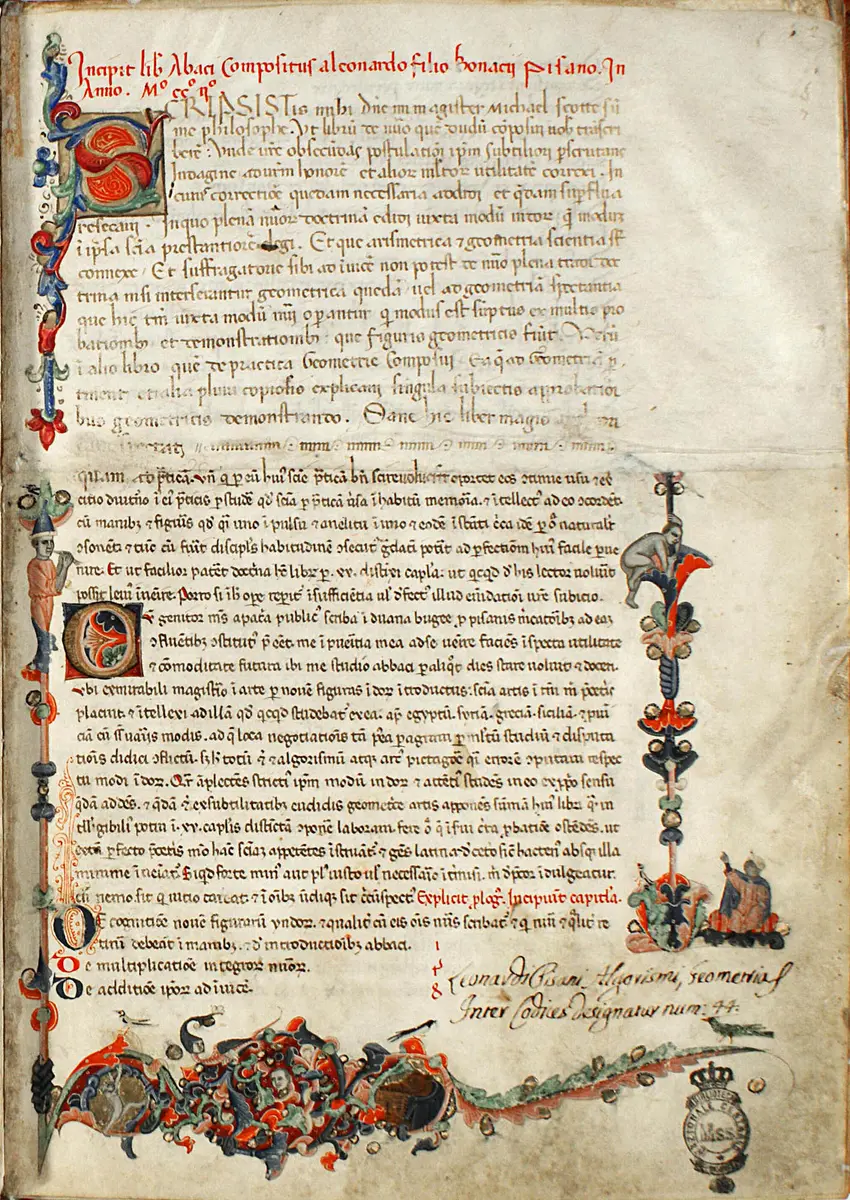
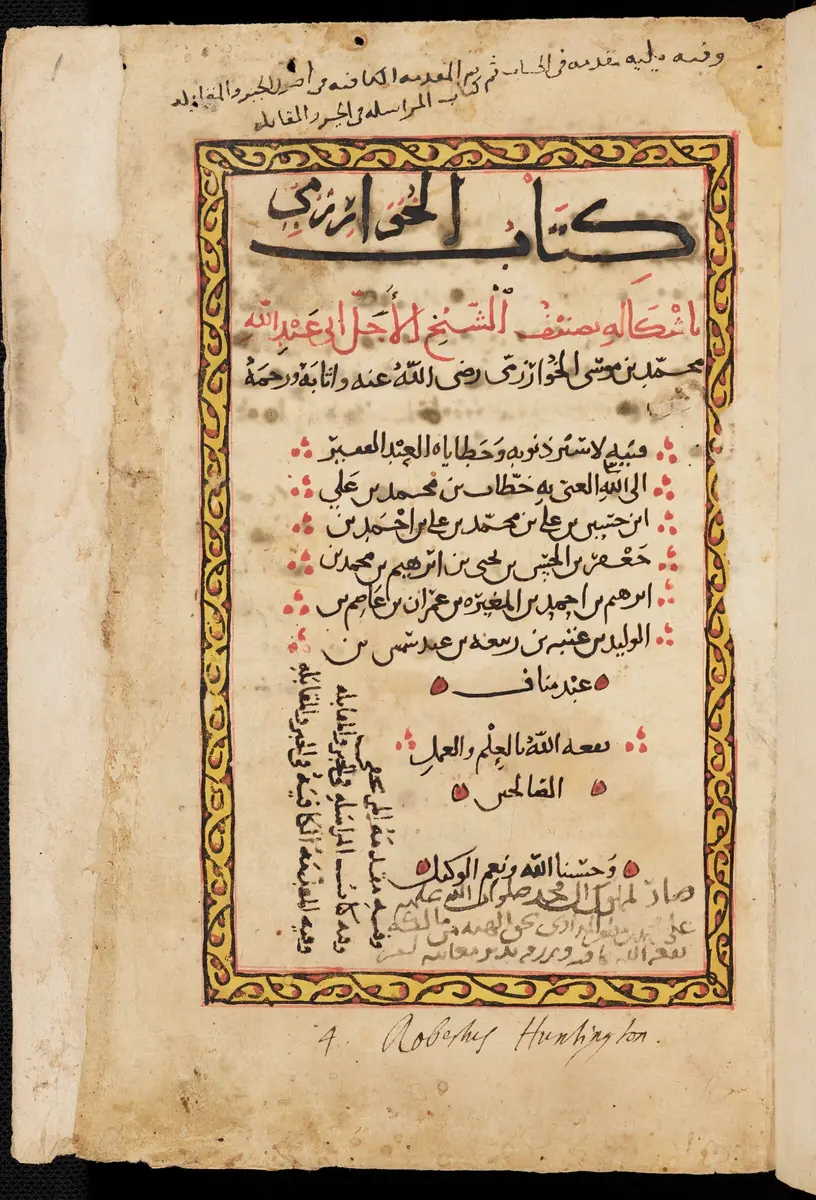
His books lived on in other hands. Adelard of Bath put an Andalusian revision of the tables into Latin around 1126, Robert of Chester translated the Algebra at Segovia in 1145 and Gerard of Cremona made a second version, so that 'algebra' entered the languages of Europe; the Latin arithmetic spread the Indian numerals that Leonardo of Pisa would make popular. The Arabic Algebra survives in a copy of 1342 at Oxford, first printed with an English translation by Frederic Rosen in 1831. His geography stayed unknown in Europe until its single copy, made in 1036–37, was found in Cairo in the nineteenth century and came to Strasbourg; its four sketch maps, among them a map of the Nile, are the oldest surviving maps from the Islamic world. The historian G. J. Toomer called his achievements 'at best mediocre' but 'uncommonly influential'; others call him the father of algebra.
What happened
- 780
Muhammad ibn Musa al-Khwarizmi is born, about this year. His name says he or his family came from Khwarazm, the oasis south of the Aral Sea; the historian al-Tabari also calls him al-Qutrubbulli, after a district by Baghdad.
Khiva, in the old Khwarazm oasis on the lower Amu Darya: the land his name points to; whether he was born here or only his family came from here is uncertain - 786
Harun al-Rashid becomes the fifth Abbasid caliph in Baghdad and begins to gather scholars and books at his court.
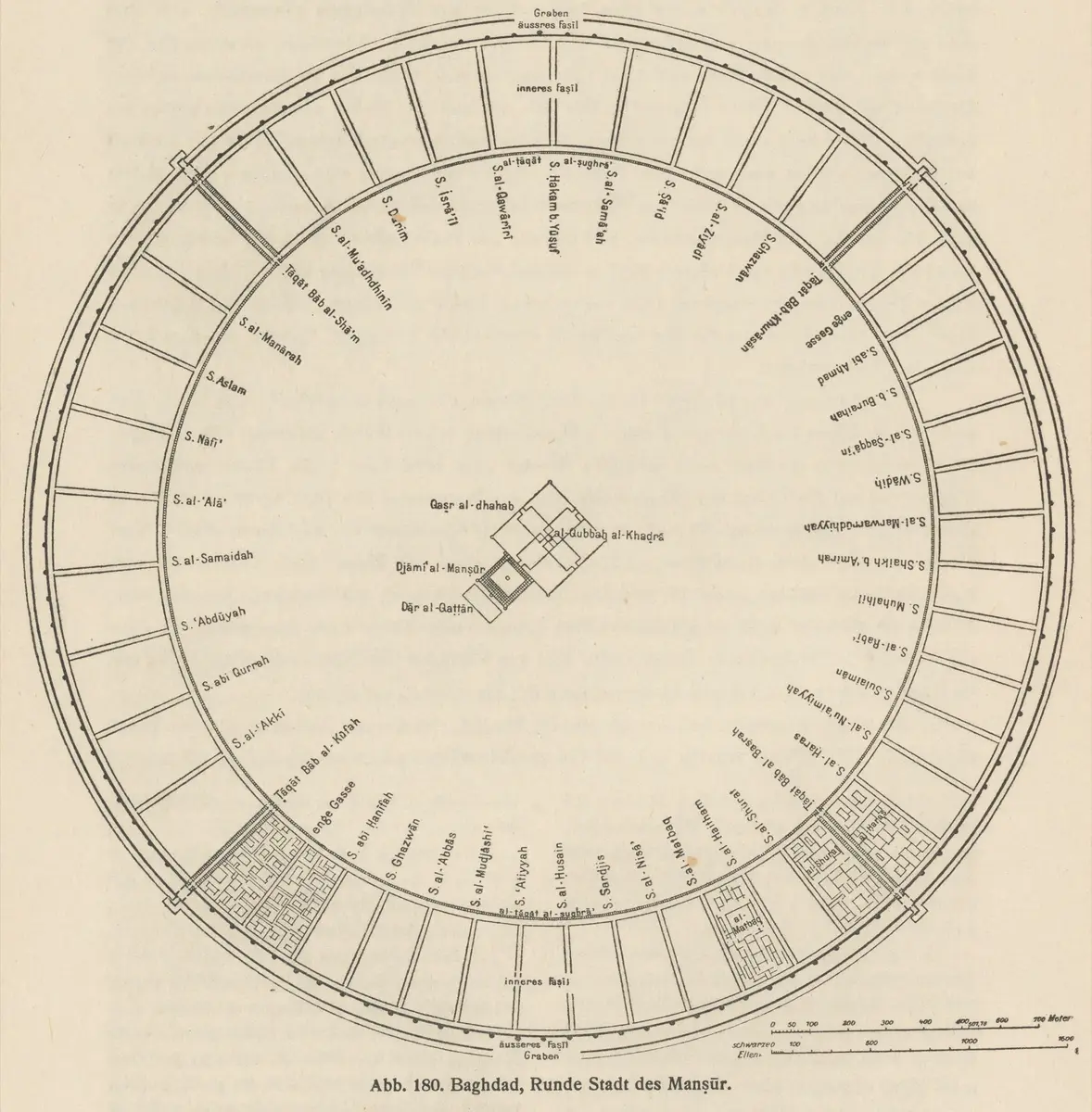
The Round City of Baghdad, founded in 762: the caliphs' capital, where he worked in al-Ma'mun's House of Wisdom; the district of Qutrubbul, after which al-Tabari also names him, lay just to the north-west- 813
After a civil war in which his brother al-Amin is killed, al-Ma'mun becomes caliph. Under him al-Khwarizmi works in the House of Wisdom, the caliph's library and circle of scholars, beside the Banu Musa brothers and al-Hajjaj, the translator of Euclid.
The Round City of Baghdad, founded in 762: the caliphs' capital, where he worked in al-Ma'mun's House of Wisdom; the district of Qutrubbul, after which al-Tabari also names him, lay just to the north-west - 817
Perhaps soon after this year he writes his geography, 'The Image of the Earth', a reworking of Ptolemy's Geography listing the latitude and longitude of 2,402 places; it names a village where a battle was fought in 816–817.
- 823
He writes a treatise on the Jewish calendar, dated by its own worked example to 823–824: the 19-year cycle of leap months and the rules for the Jewish New Year.
- 833
Al-Ma'mun dies on campaign near Tarsus. In his reign al-Khwarizmi has written, and dedicated to him, the Algebra and the astronomical tables of the Sindhind; the arithmetic with Indian numerals follows the Algebra.
- 836
The caliph al-Mu'tasim moves his capital from Baghdad to the new city of Samarra, up the Tigris.
Samarra, the caliphs' capital from 836: where in 847 he was among the astronomers at the deathbed of the caliph al-Wathiq, the last time we hear of him - 842
Al-Wathiq becomes caliph. A later geographer says he sent al-Khwarizmi on a mission to the chief of the Khazars in the northern Caucasus, but the story may confuse him with Muhammad ibn Musa ibn Shakir, one of the Banu Musa.
- 847
Called with other astronomers to the sickbed of al-Wathiq at Samarra, he reads in the caliph's horoscope fifty more years of life; al-Wathiq dies ten days later. It is the last time we hear of al-Khwarizmi alive.
Samarra, the caliphs' capital from 836: where in 847 he was among the astronomers at the deathbed of the caliph al-Wathiq, the last time we hear of him - 850
He dies, about this year; no source records the date or the place.