Ptolemy's Earth-centered universe
“About 150 CE Ptolemy of Alexandria put a motionless Earth at the centre of a universe of circles; his Almagest predicted the sky so well that it ruled astronomy for 1,400 years.”
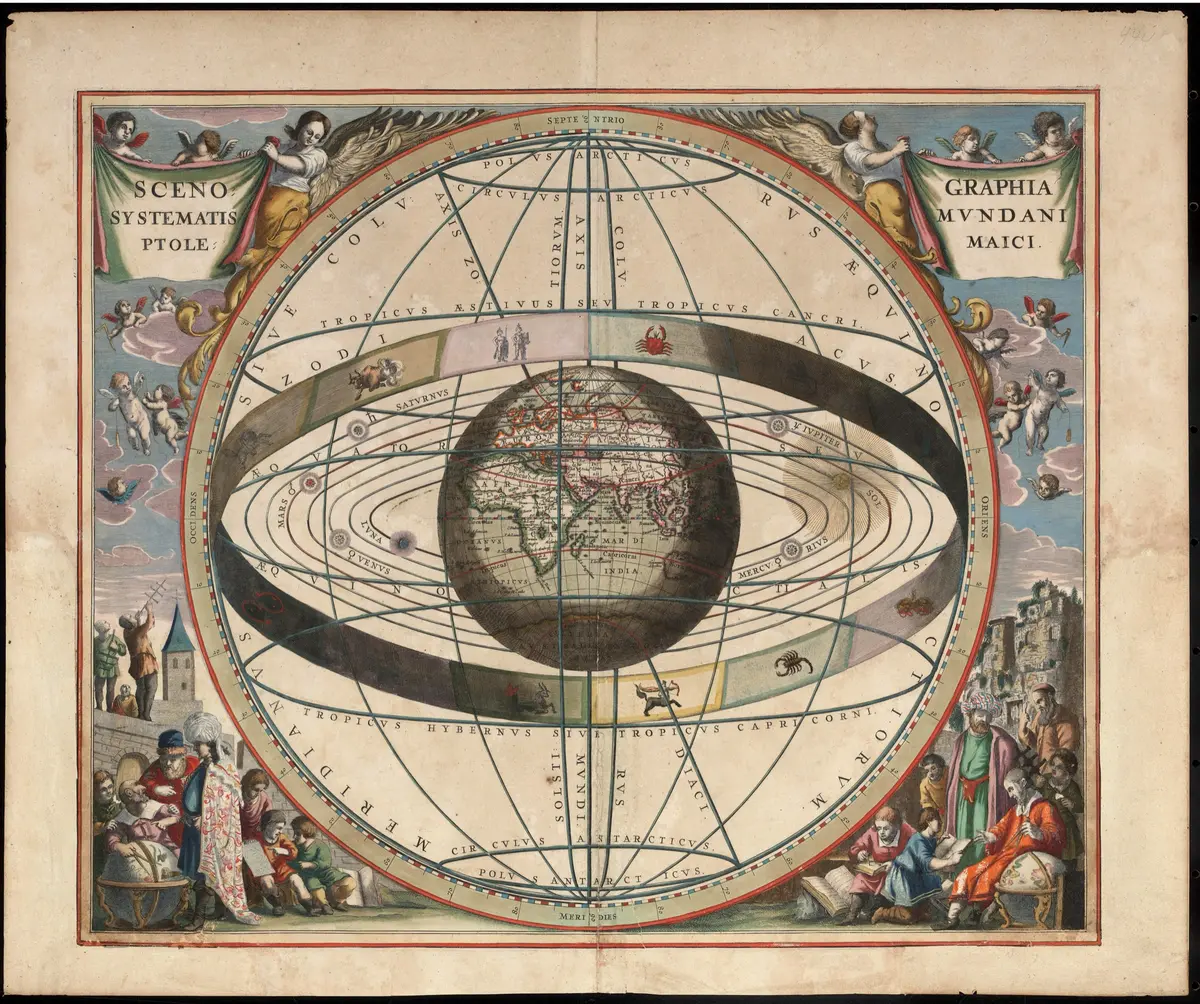
Around 150 CE Claudius Ptolemy, a Greek-speaking astronomer in Alexandria, the great city of Roman Egypt, finished a book in thirteen parts that he called the Mathematical Syntaxis, the 'mathematical collection'. It argued that the Earth is a motionless ball at the centre of a much larger sphere of stars that turns once a day, and it then explained the wandering paths of the Sun, the Moon and the five planets known at the time as combinations of perfectly regular circles. A planet rides on a small circle, the epicycle, whose centre travels round a large circle, the deferent; because the deferent is set a little off the Earth's position (an eccentric), and because the epicycle's centre moves at an even pace as seen from a third point, the equant, the model could reproduce the planets' changing speeds and the loops in which they seem to move backwards. Tables turned the geometry into numbers, so that anyone could work out where a planet would be on any date. Books 7 and 8 listed 1,022 stars in 48 constellations, most of whose names are still used.
Almost nothing is known about Ptolemy's life except what his books tell. The earliest of his own observations that can be dated exactly was made on 26 March 127 and the last on 2 February 141, all reported from Alexandria. In 146 or 147 he set up an inscription at Canopus, a town near Alexandria, listing the numbers of an earlier version of his system. He built on the Greek astronomer Hipparchus, who had worked three centuries before him, and how much of the work is his own has been argued about since Tycho Brahe showed that some of his reported observations could not be genuine; much of his star catalogue was probably taken from Hipparchus. What no one doubts is his mathematical mastery. After the Almagest he published the Handy Tables for everyday calculation, the Planetary Hypotheses, which nested the spheres of all the heavenly bodies inside one another without gaps, a book on astrology (the Tetrabiblos), a Geography that gave latitudes and longitudes for about 8,000 places, and a study of light and vision, the Optics. He probably died around 170.
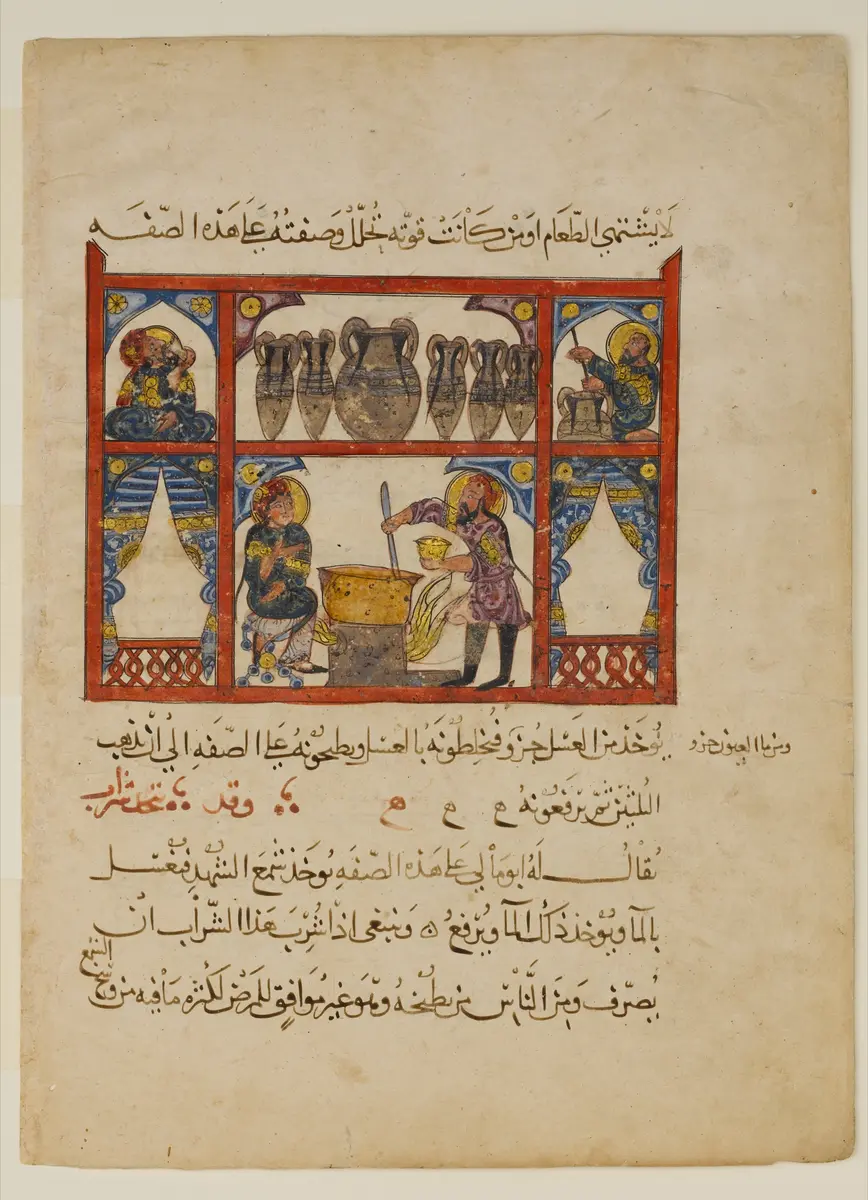
The book outlived the Roman world. Theon of Alexandria and his daughter Hypatia wrote commentaries on it in the late fourth century, and Byzantine scribes kept copying it. In the late eighth and ninth centuries it was translated into Arabic, under the name al-majisti, an Arabic form of the Greek for 'the greatest', from which comes the name Almagest. Astronomers of the Islamic world checked its numbers against new observations; some, like Ibn al-Haytham, objected that its arrangements could not exist in nature, and the astronomers of Maragha in the thirteenth century designed new combinations of circles to do the equant's work. In the twelfth century Gerard of Cremona went to Toledo to learn Arabic so that he could read it, and his Latin translation, dated 1175, remained Europe's main text even after the Greek original came back into circulation in the fifteenth century. A shorter guide, the Epitome begun by Georg Peurbach and finished by Regiomontanus in the 1460s, was printed in Venice in 1496 and read by the young Copernicus.
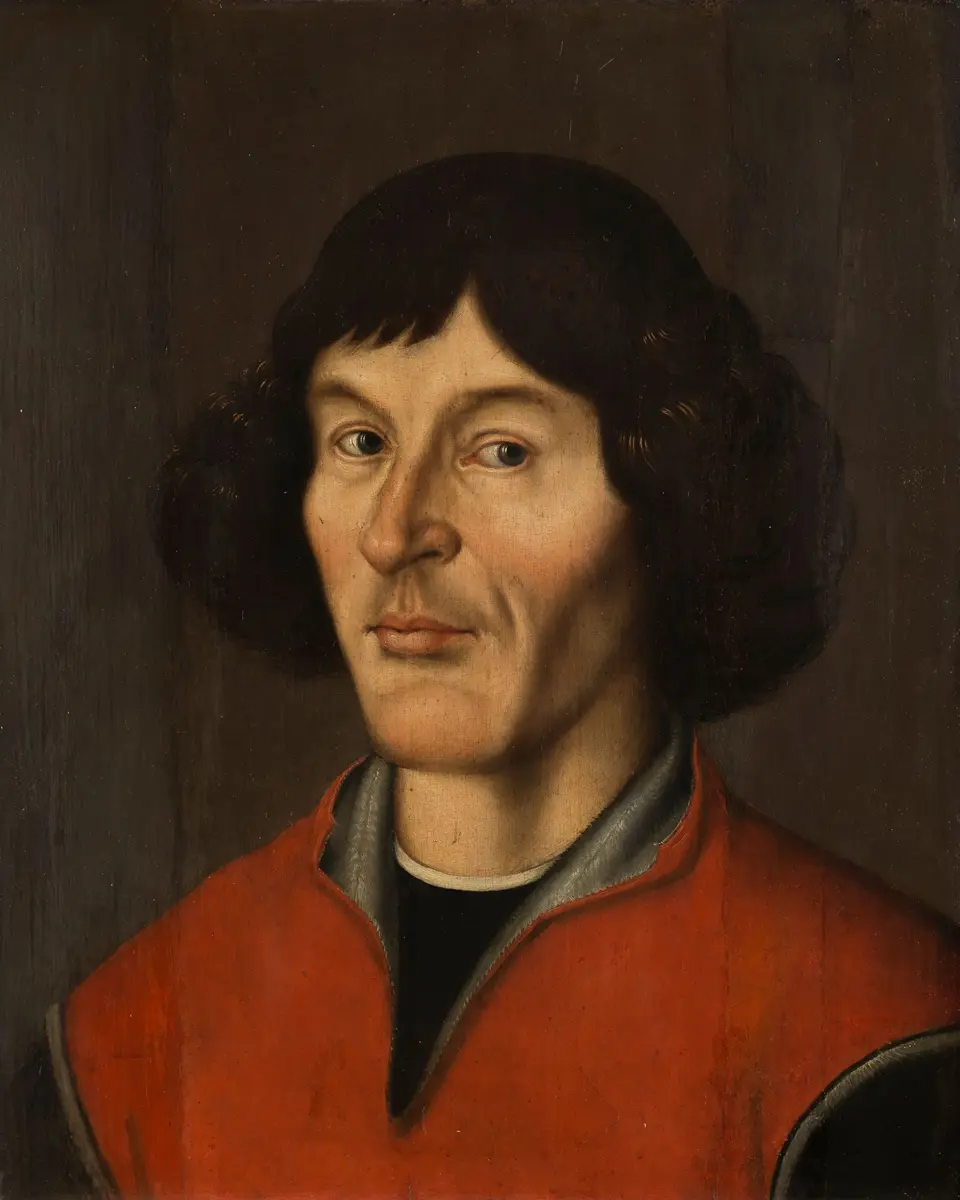
The picture was wrong, but the model worked well enough to rule astronomy for about 1,400 years: as the historian Gerd Grasshoff puts it, astronomy itself was defined as what the Almagest described. Its weak point was the equant. Copernicus, who objected to it, rebuilt the heavens around the Sun in 1543; Tycho Brahe's comet of 1577 cut through the solid spheres; Galileo's telescope showed in 1610 that Venus circles the Sun; and Kepler, puzzling over the equant, found that the planets move in ellipses. Ptolemy's lasting gift is the method he taught: dated observations, a mathematical model, and predictions that can be tested and improved. The 48 constellations of his catalogue are still on our star charts, and the grid of latitude and longitude he used to fix 8,000 places is on every map.
What happened
- 127
In Alexandria Ptolemy makes the earliest of his own observations that can be dated exactly. Over the next fourteen years he watches the Sun, the Moon and the planets, always reporting from Alexandria, and compares his results with those of Hipparchus, three centuries before him.
Alexandria, Ptolemy's city: every observation in the Almagest is reported from here- 141
The last of his observations that can be dated exactly. With these and older records, such as Hipparchus's and the Athenian Meton's solstices of 432 BCE, he fixes the sizes and speeds of his circles.
Alexandria, Ptolemy's city: every observation in the Almagest is reported from here- 146
In 146 or 147, the tenth year of the emperor Antoninus Pius, he sets up an inscription at Canopus, near Alexandria, dedicated to the 'Saviour God': a list of the numbers of his system of the heavens in an earlier form than the Almagest's. The stone is lost, but a late-antique copy survives in manuscripts of the Almagest.
Canopus, the temple town east of Alexandria where he set up his inscription of 146 or 147 - 150
About now he completes the Mathematical Syntaxis, the Almagest: thirteen books that argue the Earth is a motionless sphere at the centre, build a model of eccentrics, epicycles and the equant for the Sun, the Moon and the five planets, give tables to compute their places on any date, and list 1,022 stars in 48 constellations.
Alexandria, Ptolemy's city: every observation in the Almagest is reported from here - 170
By about 170, when he probably dies, he has followed the Almagest with the Handy Tables for practical calculation, the Planetary Hypotheses, which nest the spheres of the planets inside one another out to the stars at 20,000 Earth radii, the Tetrabiblos on astrology, the Geography with coordinates for about 8,000 places, and the Optics.
Alexandria, Ptolemy's city: every observation in the Almagest is reported from here