Baghdad is founded
“In 762 the Abbasid caliph al-Mansur founded Baghdad on the Tigris as a round 'City of Peace': the caliphs' capital for five centuries and the world's great centre of trade and learning.”
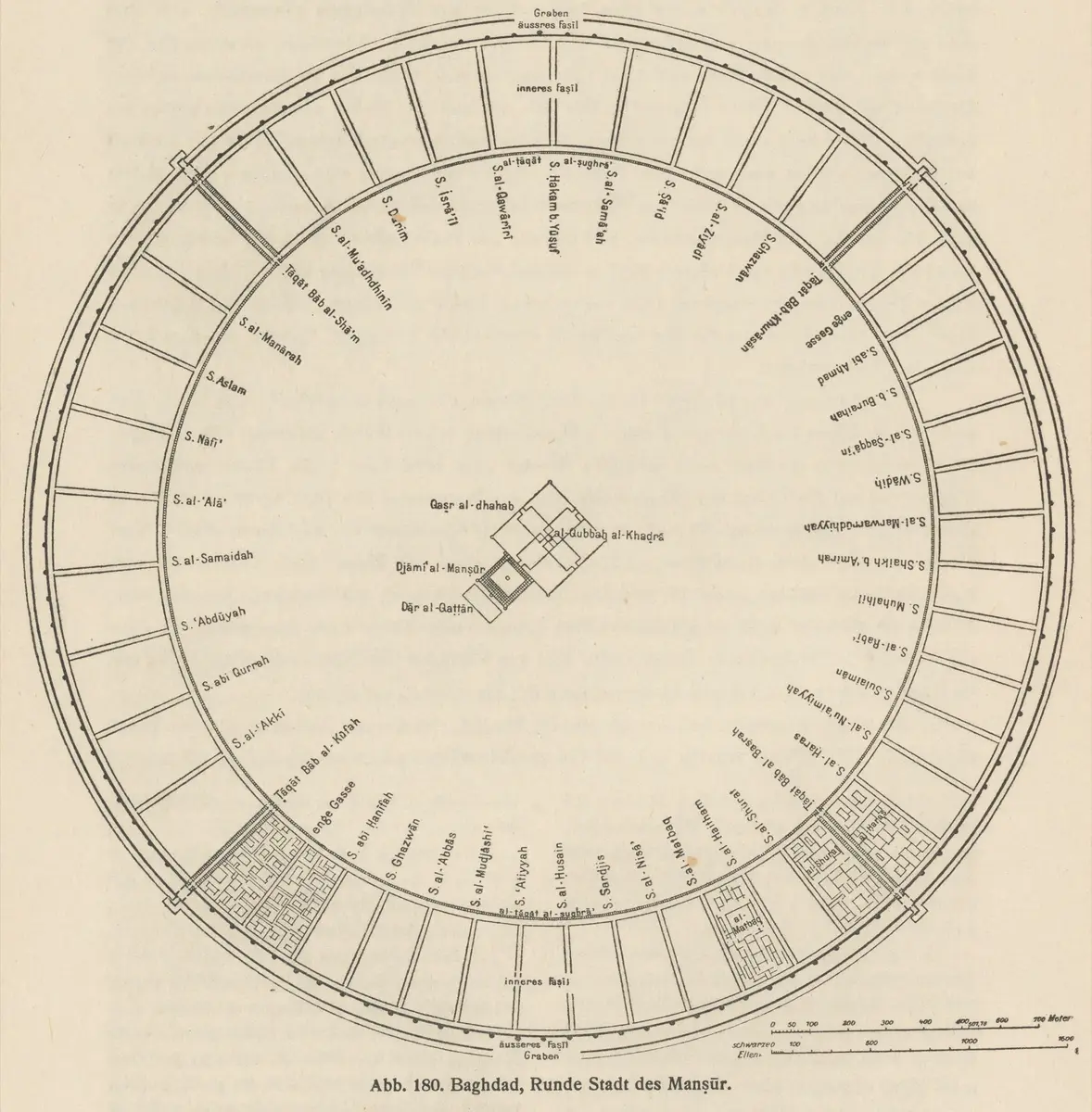
On 30 July 762, at an hour chosen by his astrologers, the Abbasid caliph al-Mansur began building a new capital on the west bank of the Tigris, at a village called Baghdad, just above the point where the Sarat canal flowed into the river. Its official name was Madinat al-Salam, the City of Peace, and it was perfectly round: a ditch and two rings of brick walls about 2.7 kilometres across, with four gates named after the roads they opened onto, to Kufa, Basra, Khurasan and Syria. In the open centre stood the caliph's palace, the Golden Gate, under a green dome that could be seen from every part of the city, and the great mosque beside it; a ruler, al-Mansur is reported to have said, should live in the middle, no nearer one place than another. The geographer al-Ya'qubi says 100,000 workers and craftsmen were brought in from across the empire.
The Abbasids had overthrown the Umayyad caliphs of Damascus in 750 with armies raised in Khurasan, in the east, and their power rested on Iraq and the lands beyond it. Al-Mansur, caliph from 754, ruled at first from al-Hashimiyya near Kufa, but he distrusted the restless towns of Kufa and Basra, and a sect that worshipped him as a god, the Rawandiyya, had stirred up trouble against him there. A new city would also show that the dynasty had come to stay, and house its growing government. He travelled up the Tigris looking for a site and chose Baghdad for its rivers and its food: ships could come up the Tigris from the Gulf, and from China beyond it, grain and goods could come down the Euphrates by the canals, and the rivers would serve as moats. The round plan recalled the round cities of Sasanian Iran, whose old capital, Ctesiphon, stood about 35 kilometres downstream; al-Mansur started pulling down its palace for bricks and stopped only when the rubble proved dearer than new ones. A revolt of the descendants of Ali halted the work in 762, but the caliph moved in during 763 and the walls were finished in 766.
The city outgrew its walls at once. Merchants filled the arcades inside the gates until al-Mansur moved the markets out to al-Karkh, south of the walls (one story blames a Byzantine envoy who told him that his enemies were living inside his city), and in 768 he began a palace and mosque at Rusafa, across the Tigris, for his son al-Mahdi; the east bank grew into the larger half of Baghdad. Under al-Mahdi and Harun al-Rashid (786–809) it was thought the richest city in the world, with ships from China, India and East Africa at its wharves, and al-Ma'mun (813–833) paid for Greek science and philosophy to be translated into Arabic and kept a palace library, the House of Wisdom, where scholars such as al-Khwarizmi worked. The Round City itself did not last: it was battered in the civil war between Harun's sons, the caliphs moved to Samarra from 836 to 892 and then lived on the east bank, and the Green Dome fell in a storm in 941.
Baghdad stayed the seat of the Abbasid caliphs for five hundred years, even after real power passed to Buyid and Seljuk rulers in 945 and 1055, until the Mongol prince Hülegü sacked it in 1258 and killed the last caliph; it has been the capital of modern Iraq since 1920. Of al-Mansur's city nothing is left. It was built of sun-dried brick, and its site lies somewhere under the west-bank districts between al-Kadhimiya and al-Karkh. What we know comes from writers who could still see much of it, al-Ya'qubi in the 890s and al-Tabari some twenty years later, and from the plans that Guy Le Strange (1900) and Ernst Herzfeld (1920) drew from their words. Their circle, a ruler's palace at the exact centre of a planned capital, is still the picture most people have of early Baghdad.
What happened
- 762
At the hour chosen by the astrologers Nawbakht and Mashallah, al-Mansur lays the foundations of his round city on the west bank of the Tigris. He is said to have had its plan traced on the ground in ashes first, walked through its gates and courts, and had cotton seeds soaked in oil set alight along the lines to see the whole.
The Round City: al-Mansur's Madinat al-Salam, the City of Peace, built 762–766 on the west bank of the Tigris; the point is Wikidata's for the vanished cityWith the walls only a man's height, news comes that Muhammad ibn Abdallah, a descendant of Ali's son Hasan, has risen at Medina (22 or 25 September). Al-Mansur stops the work and leaves for Kufa, leaving his freedman Aslam to guard the timber and teak gathered for the building.
The Round City: al-Mansur's Madinat al-Salam, the City of Peace, built 762–766 on the west bank of the Tigris; the point is Wikidata's for the vanished cityMuhammad's brother Ibrahim rises at Basra and sends his men to Wasit, al-Ahwaz and Fars, while al-Mansur, his best troops away in Arabia, gathers an army at Kufa. Hearing that Ibrahim has beaten the caliph's forces, Aslam burns the stored teak rather than let the rebels have it.
Kufa: near al-Mansur's earlier seat, al-Hashimiyya; he directed the war against the Alid rebels from here in 762–763The caliph's army under his nephew Isa ibn Musa takes Medina, and Humayd ibn Qahtaba kills Muhammad. Isa turns back towards Iraq to face Ibrahim.
- 763
On 14 February Isa ibn Musa's army defeats Ibrahim at Bakhamra, about 100 km from Kufa, and he is killed. Al-Mansur returns to his building site, and in the month of Safar (20 April to 18 May 763) he moves from his old seat near Kufa into Baghdad with his treasury and government offices.
The Round City: al-Mansur's Madinat al-Salam, the City of Peace, built 762–766 on the west bank of the Tigris; the point is Wikidata's for the vanished cityIn the Islamic year 146, which began on 21 March 763, the mint of the new capital is already striking silver dirhams in its name: Madinat al-Salam, the City of Peace.
The Round City: al-Mansur's Madinat al-Salam, the City of Peace, built 762–766 on the west bank of the Tigris; the point is Wikidata's for the vanished city- 766
In the year 149 al-Mansur finishes the walls, the ditch and all the work of the Round City. The jurist Abu Hanifa, whom the caliph had put in charge of making and counting the bricks, stays on until the wall next to the ditch is complete.
The Round City: al-Mansur's Madinat al-Salam, the City of Peace, built 762–766 on the west bank of the Tigris; the point is Wikidata's for the vanished city