Paper is invented in China
“Paper, made by catching beaten plant fibres on a screen, was invented in Han China; Cai Lun's improved paper of 105 CE made it standard, and it reached Europe through the Islamic world.”
Paper is a thin sheet of plant fibres that have been beaten in water until they come apart, caught on a screen, and left to dry into a felted mat. It was invented in China under the Han dynasty. Tradition gives the credit to Cai Lun, a eunuch official at the Eastern Han court in Luoyang, who in 105 CE presented Emperor He with a way of making paper from tree bark, the ends of hemp, old rags and fishing nets. The official history of the dynasty says that from then on paper was used everywhere and was called 'the paper of Marquis Cai'. But archaeologists have found paper in tombs and frontier forts that is two or three centuries older, so 105 is the date of an official report, not of the first sheet.
Before paper, the Chinese wrote on narrow strips of bamboo or wood tied together with cord, or on silk; the history explains that silk was too costly and bamboo too heavy. The oldest papers found so far are coarse, thick sheets of hemp. A scrap with black lines, perhaps a map, lay in a tomb at Fangmatan in Gansu that dates from 179 to 141 BCE; pieces lay under bronze mirrors in a tomb at Baqiao near the old capital Chang'an; others turned up at frontier posts on the northwestern border, at Jinguan on the Juyan line and at the Xuanquan post station near Dunhuang, where hundreds of fragments were found, some with writing. Several of these dates are disputed. Early paper was used for wrapping as much as for writing: in 12 BCE poison for a palace murder came wrapped in a thin red sheet.
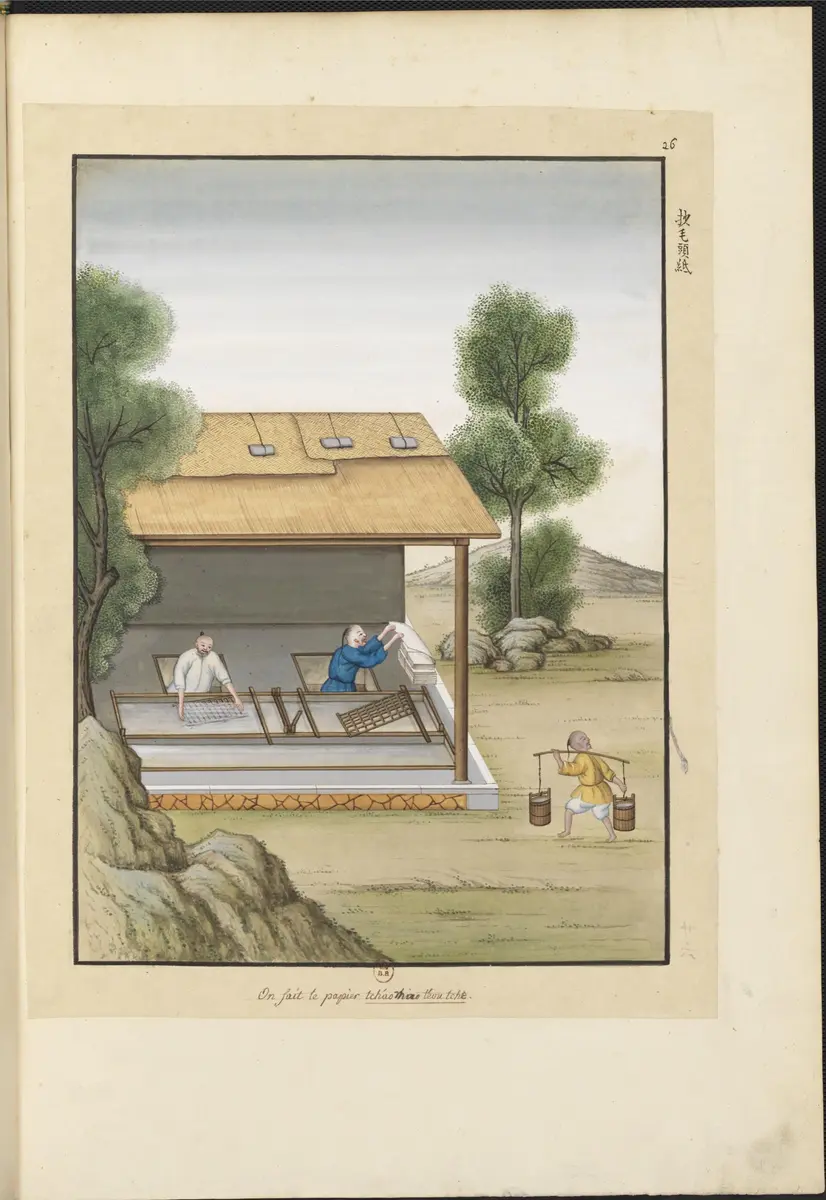
Cai Lun's real step seems to have been new raw material. As head of the imperial workshops he used fresh fibre such as the inner bark of the paper mulberry, which could be had in any quantity, alongside second-hand rags and nets. The method he reported is still the method of handmade paper: soak and cook the fibres, pound them to a pulp, dip a screen mould into a vat of pulp and water, lift out a wet sheet, press the pile and dry the sheets on a warm wall. He was made Marquis of Longting in 114. In 121, called to account by the new emperor for his part in an old palace intrigue, he took his own life; he was buried at Longting in Shaanxi, where his tomb and temple still stand, and papermakers in China and Japan worshipped him as their patron saint.
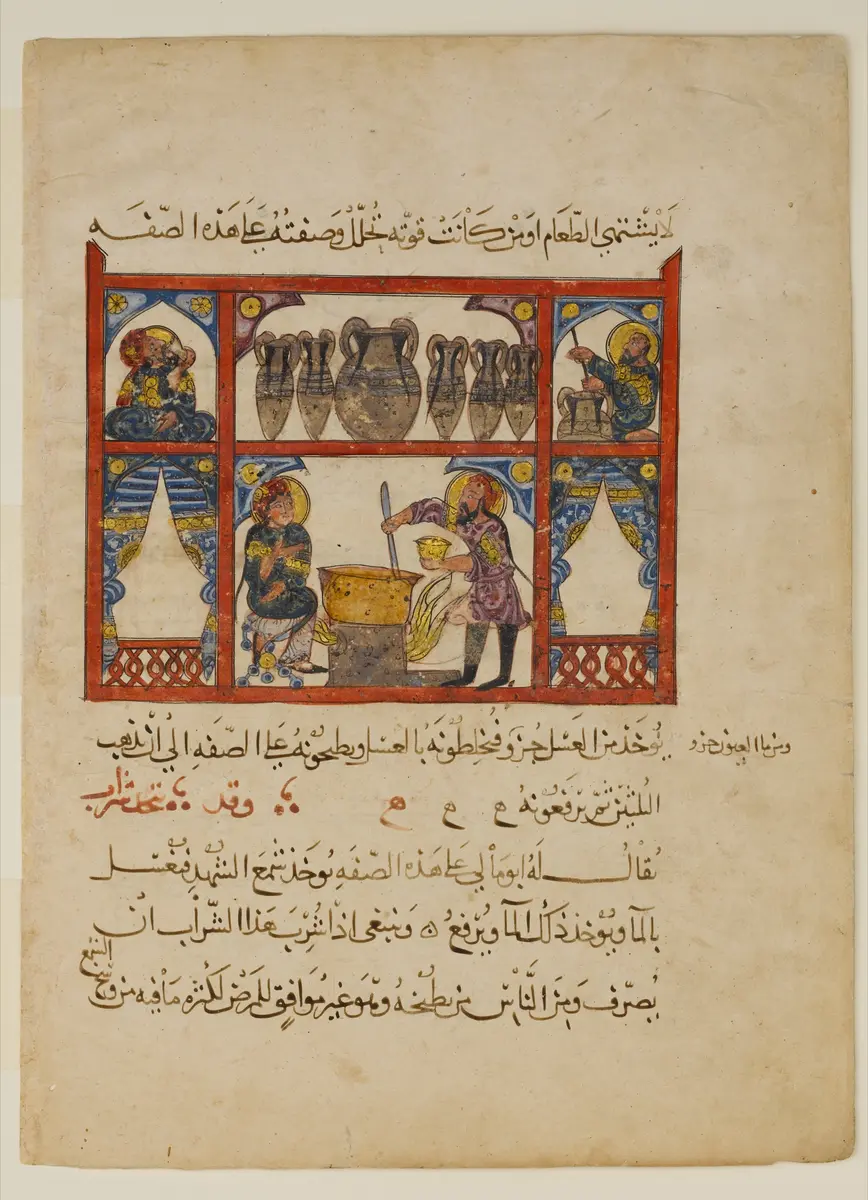
By the fourth century paper had replaced bamboo and wood for books in China, and it travelled with Buddhism, trade and diplomacy. It reached Korea by the third century; Japanese tradition says the Korean monk Damjing brought the craft to Japan in 610. Merchants on the Silk Road wrote letters on paper long before Islam. An Arab writer of the eleventh century said that Chinese prisoners taken at the Battle of Talas in 751 taught papermaking at Samarkand, a story historians now treat as a later tradition, since paper was already known in Central Asia. Under Caliph Harun al-Rashid paper spread to Baghdad, where a paper mill is said to have worked by about 794, and then to Syria and Egypt, where it ended four thousand years of papyrus. Muslim Spain made paper at Xàtiva by the twelfth century, and from about 1276 Fabriano in Italy became Europe's great paper town, adding watermarks by 1282.
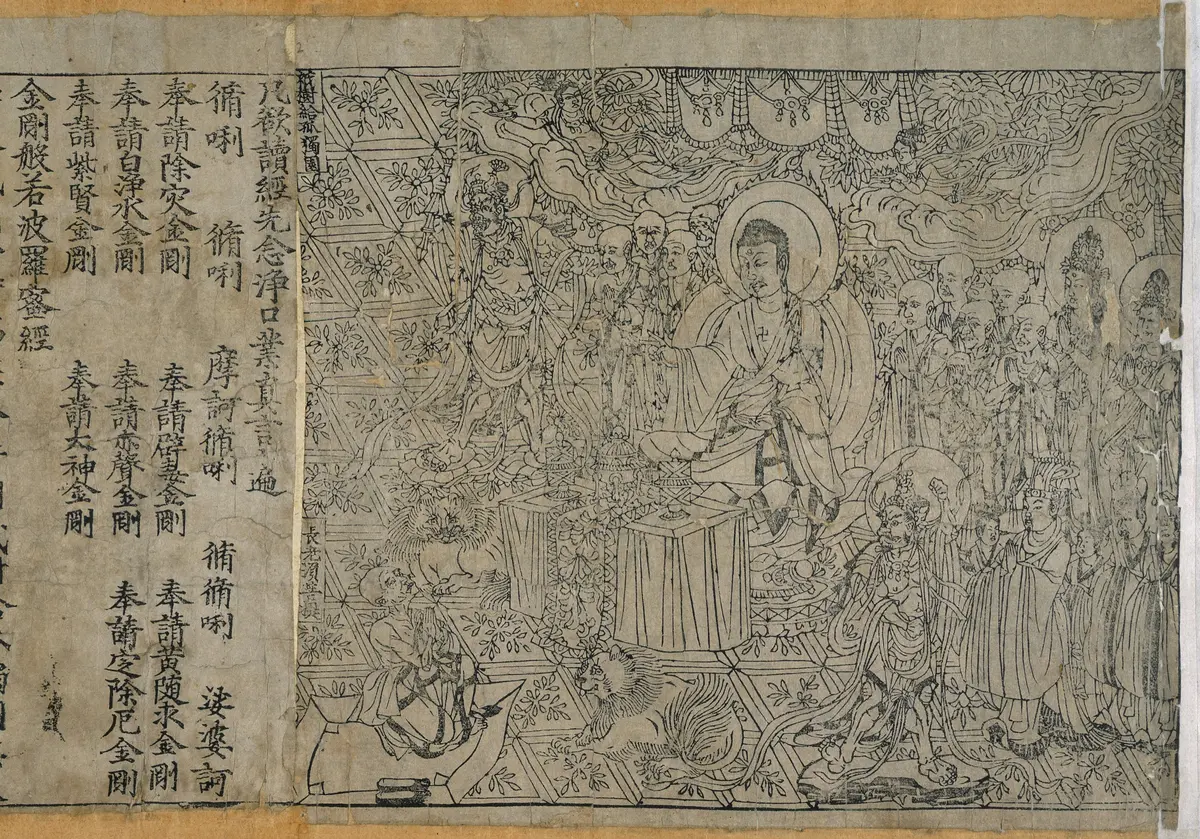
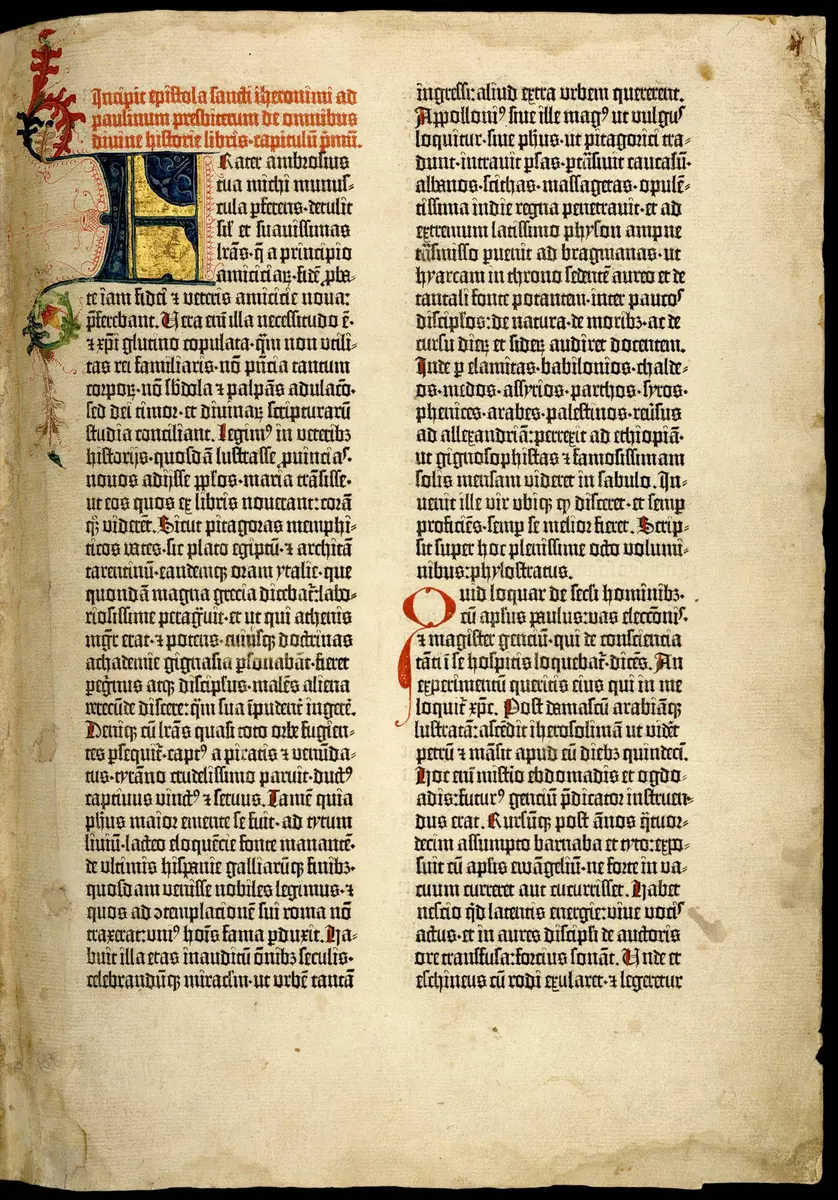
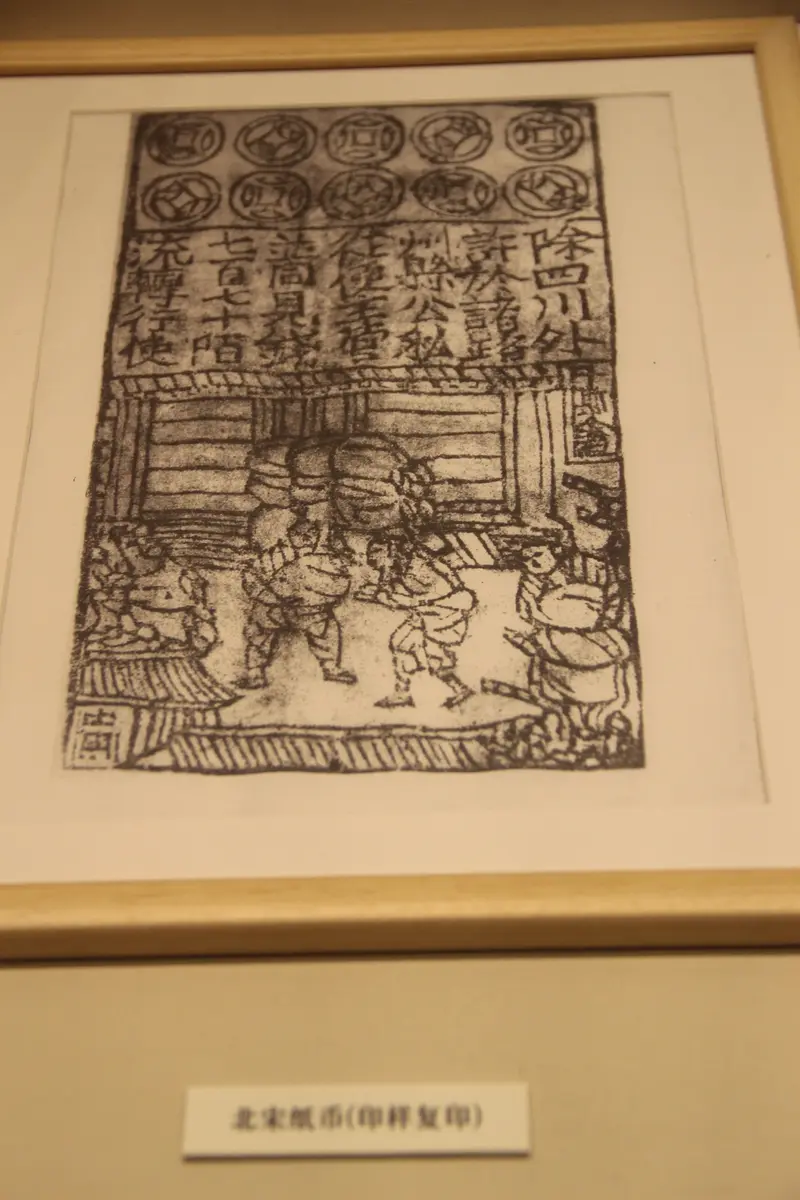
Paper changed what could be written down and who could afford it. It carried the Han state's paperwork, Buddhist scriptures and Confucian classics, and later made printing possible: the Diamond Sutra of 868 and the paper money of the Song were printed on it. In Baghdad it fed an explosion of books, from translations of Greek science to The Thousand and One Nights, and in Europe Gutenberg's press could not have worked without paper mills to feed it. Even the word ream, for a bundle of 500 sheets, comes from Arabic. Two thousand years on, paper is still the cheapest way to keep a thought.
What happened
- 179 BCE
Between 179 and 141 BCE a man is buried at Fangmatan in Gansu with a scrap of yellowish paper on his chest, drawn with black lines that may show mountains, rivers and roads: if the date holds, the oldest paper yet found, and a map. Some specialists doubt both the date and that it is paper.
Fangmatan, near Tianshui, Gansu: a scrap of paper with black lines in a tomb of 179-141 BCE, the oldest paper claimed so far (disputed) - 141 BCE
In a tomb at Baqiao near Chang'an, closed no later than the reign of Emperor Wu (141-87 BCE), pieces of thick, coarse hemp paper are laid under three bronze mirrors; found in 1957, they were long called the oldest paper in the world.
- 73 BCE
Fragments of hemp paper are buried at Zhongyan, Fufeng, Shaanxi, stuck to a lacquer vessel together with coins of Emperor Xuan (73-49 BCE); they were found in 1978.
- 50 BCE
In the second half of the 1st century BCE paper reaches the Jinguan pass on the Juyan frontier, where two larger pieces were found in 1974 among the garrison's wooden documents.
Jianshui Jinguan, a Han pass on the Juyan frontier: paper of the 1st century BCE found among its wooden documents - 12 BCE
In a murder at the palace the poison is delivered wrapped in hexi, a thin red sheet: one of the earliest mentions of paper in the histories, used for wrapping rather than writing.
- 25
Emperor Guangwu (r. 25-57) restores the Han with Luoyang as its capital; in his reorganised secretariat one official is responsible for the seals and cords and for 'paper, brush and ink'.
Han-Wei Luoyang, the Eastern Han capital: Cai Lun served at court here and presented his paper to Emperor He in 105 - 75
Cai Lun, a eunuch from Guiyang (now Leiyang, Hunan), enters the service of the imperial palace in Luoyang.
Han-Wei Luoyang, the Eastern Han capital: Cai Lun served at court here and presented his paper to Emperor He in 105 - 76
A scholar summoned to court to teach twenty students gives each of them a copy of a classic written on tablets and on paper.
Han-Wei Luoyang, the Eastern Han capital: Cai Lun served at court here and presented his paper to Emperor He in 105 - 89
Under the young Emperor He, Cai Lun becomes chief eunuch and is put in charge of the imperial workshops, the office that makes the palace's instruments and weapons.
Han-Wei Luoyang, the Eastern Han capital: Cai Lun served at court here and presented his paper to Emperor He in 105 - 102
Empress Deng, a lover of literature whom Tsien credits with a hand in Cai Lun's work, asks that paper be sent to the court as tribute.
Han-Wei Luoyang, the Eastern Han capital: Cai Lun served at court here and presented his paper to Emperor He in 105 - 105
In the first year of Yuanxing, Cai Lun presents Emperor He with paper made from tree bark, hemp ends, rags and fishing nets. The emperor praises him, and from then on, says the dynasty's history, paper is used everywhere and called 'the paper of Marquis Cai'.
Han-Wei Luoyang, the Eastern Han capital: Cai Lun served at court here and presented his paper to Emperor He in 105 - 110
About 109-110 a sheet of paper with some two dozen written characters is left in a watchtower at Tsakhortei near Juyan, abandoned during a revolt of the Qiang; found in 1942, it was the first paper with writing known from Cai Lun's own time.
- 114
Cai Lun is made Marquis of Longting, in what is now Yang county, Shaanxi.
Tomb and temple of Cai Lun, Longting, Yang county, Shaanxi: his marquisate from 114 and his grave - 121
Once Emperor An rules in his own right, he orders an inquiry into Cai Lun's part in an old palace plot against Lady Song, and Cai Lun takes his own life. He is buried at Longting, where his tomb and temple stand.
Tomb and temple of Cai Lun, Longting, Yang county, Shaanxi: his marquisate from 114 and his grave