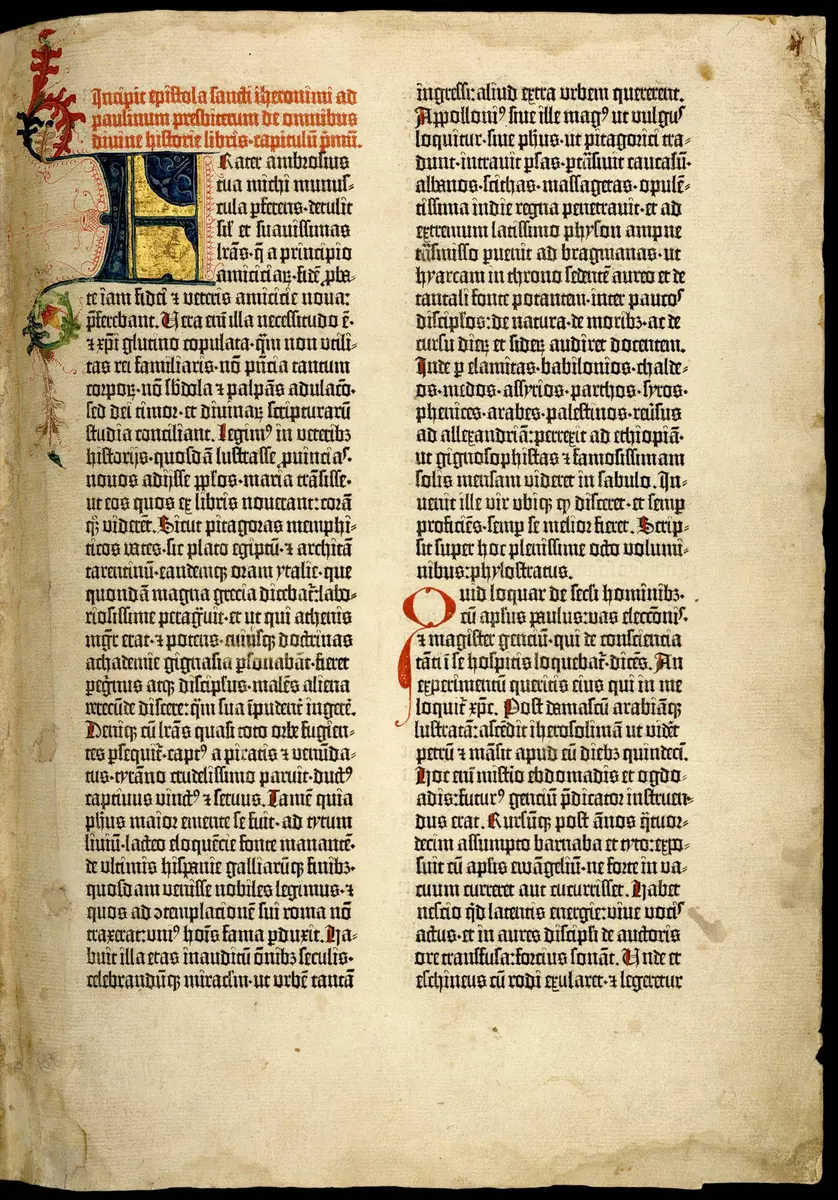
Gutenberg
“The Mainz goldsmith who invented printing with movable metal type around 1450, and whose Bible of about 1455 is Europe's first great printed book.”
Johannes Gutenberg was the goldsmith of Mainz who, around 1450, worked out how to print books from movable metal type, and whose Bible of about 1455 is the first great printed book of Europe. He was born into a patrician family of Mainz, on the Rhine, around 1400; the year is a convention, since the only evidence is that he had come of age by 1420. His family fled the city's guild riots in 1411, probably to Eltville, and a Johannes from Eltville is enrolled at the University of Erfurt in 1418. From 1434 to 1444 he lived in Strasbourg, where he was a member of the goldsmiths' guild and ran a business making metal pilgrim mirrors for the Aachen relics fair; a lawsuit of 1439 shows him teaching partners a secret 'art and venture' that most historians take to be the beginnings of printing.
His invention was a system, not a single device: a hand mould that could cast thousands of identical letters in an alloy of lead, tin and antimony; an oil-based ink that would stick to metal; and a press, adapted from the wine and paper presses of the Rhineland, that pushed paper evenly onto a bed of inked type. Printing from carved wooden blocks was old in Asia and known in Europe, and movable type had been tried in Korea and China; what Gutenberg added was the mould and the press, which made the letters cheap and the pages fast.
Back in Mainz by 1448, he borrowed 800 guilders from the merchant Johann Fust in 1450, and 800 more in 1452, to set up a workshop in the Humbrechthof. It printed grammars, calendars and indulgences for the church, and from about 1452 to 1455 the 42-line Latin Bible, some 180 copies of about 1,280 pages each, in a type cut to look like a scribe's hand. In November 1455 Fust sued him for the loans and their interest; the notarised record of the case, the Helmasperger Instrument, is the one document that ties Gutenberg's name to the 'work of the books'. Fust seems to have taken the Bible workshop and its type, and with Gutenberg's assistant Peter Schöffer printed the Mainz Psalter of 1457, the first book to name its printers and date.
Gutenberg kept printing on a smaller scale; the Catholicon of 1460, a Latin dictionary, is usually his. In 1462 Mainz was sacked in a war between rival archbishops and its printers scattered, carrying the craft down the Rhine and over the Alps. In January 1465 the winning archbishop, Adolf of Nassau, made Gutenberg a gentleman of his court, with a yearly suit of clothes, grain and wine. He died in Mainz in early 1468, by tradition on February 3, and was buried in the Franciscan church, which no longer exists.
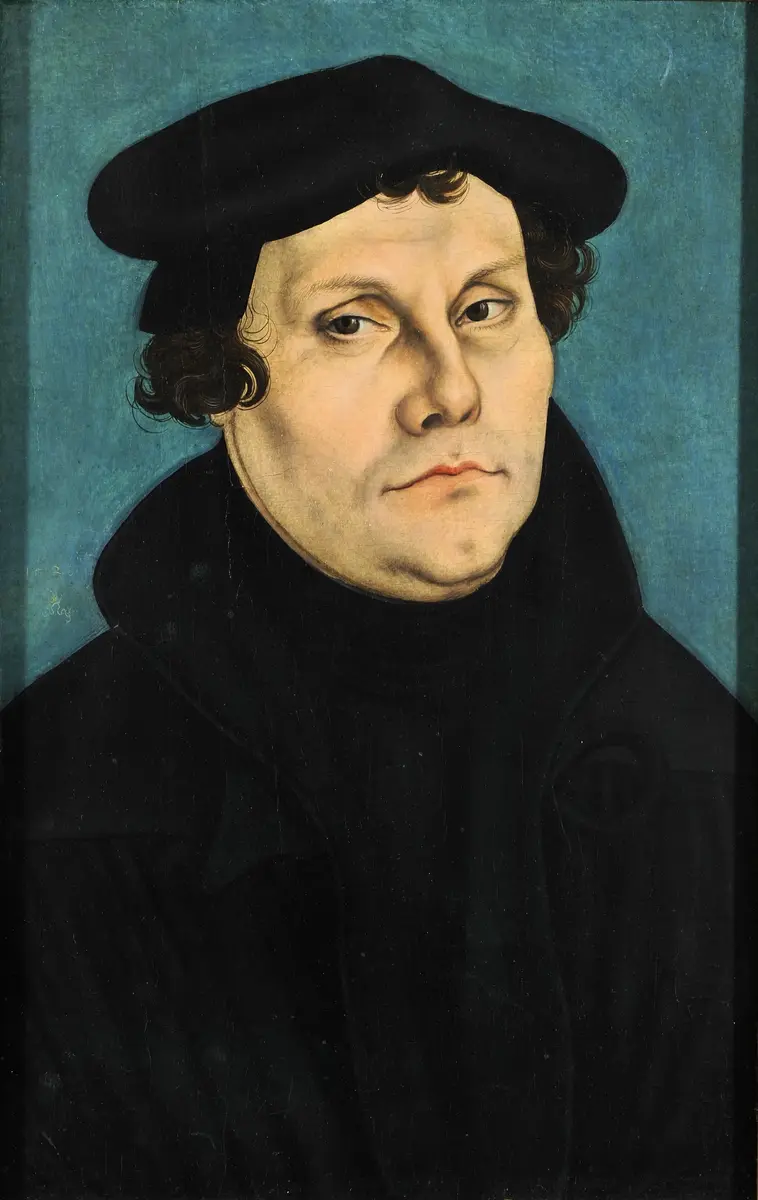
Within fifty years of the Bible there were presses in more than 250 European towns and some twenty million printed books; by 1600 perhaps two hundred million. Printing made the Reformation possible, standardised languages, spread science and news, and ended the monopoly of the few who could afford a scribe. Forty-eight copies of Gutenberg's Bible survive, in Mainz, Munich, London, Paris, New York, Washington, Austin and elsewhere, and are the most valuable books in the world. No portrait of him was made in his lifetime; the bearded face everyone knows was invented in 1584.
What happened
- 1400
Born in Mainz to the patrician Gensfleisch family, in the house zum Gutenberg that gave him his name; the year is a convention, somewhere between 1393 and 1406.
Hof zum Gutenberg, Mainz: the family house he was named after, and the site of his first press - 1411
The family leaves Mainz during the guild riots against the patricians, probably for Eltville.
Eltville am Rhein: the family's refuge after 1411, and his base in the 1460s - 1418
A 'Johannes de Altavilla', Johannes of Eltville, is enrolled at the University of Erfurt; it is probably him.
Erfurt: a Johannes from Eltville is enrolled at its university in 1418, probably him - 1434
A letter places him in Strasbourg, where he lives for ten years as a goldsmith and businessman.
Strasbourg: ten years from 1434 to 1444, the mirrors, the lawsuit and the first experiments - 1439
A lawsuit in Strasbourg over a venture making metal mirrors for the Aachen pilgrimage records that he is teaching his partners a secret 'art and venture': the first trace of printing.
Strasbourg: ten years from 1434 to 1444, the mirrors, the lawsuit and the first experiments - 1450
Back in Mainz, he borrows 800 guilders from Johann Fust to set up a press; a second 800 follows in 1452 for 'the work of the books', the Bible.
Hof zum Gutenberg, Mainz: the family house he was named after, and the site of his first press - 1454
His press prints indulgences for the church, the earliest dated pieces of European printing, and the Bible is under way.
- 1455
The 42-line Bible is finished, about 180 copies of some 1,280 pages; in March the future Pope Pius II writes from Frankfurt that he has seen the sheets and that they can be read without spectacles.
Fust sues him for the loans and interest, 2,026 guilders; the notary Helmasperger's record of the case is the one document that ties his name to the printing of the books.
- 1457
Fust and Peter Schöffer, now running the workshop, print the Mainz Psalter, the first book to carry its printers' names and date.
- 1460
The Catholicon, a Latin dictionary, is printed at Mainz, usually by his hand.
- 1462
Mainz is sacked in the feud between two archbishops; the printers scatter, and the craft spreads across Europe.
- 1465
Archbishop Adolf of Nassau makes him a gentleman of his court, with a yearly suit, grain and wine, in recognition of his services.
- 1468
Dies in Mainz and is buried in the Franciscan church, later destroyed; the day is traditional.
Gutenberg Museum, Mainz: two Gutenberg Bibles and a working reconstruction of his press