The Silk Road
“For some 1,700 years, from the Han dynasty's opening of the west to the 16th century, caravan routes carried silk, silver, religions and diseases between China and the Mediterranean.”
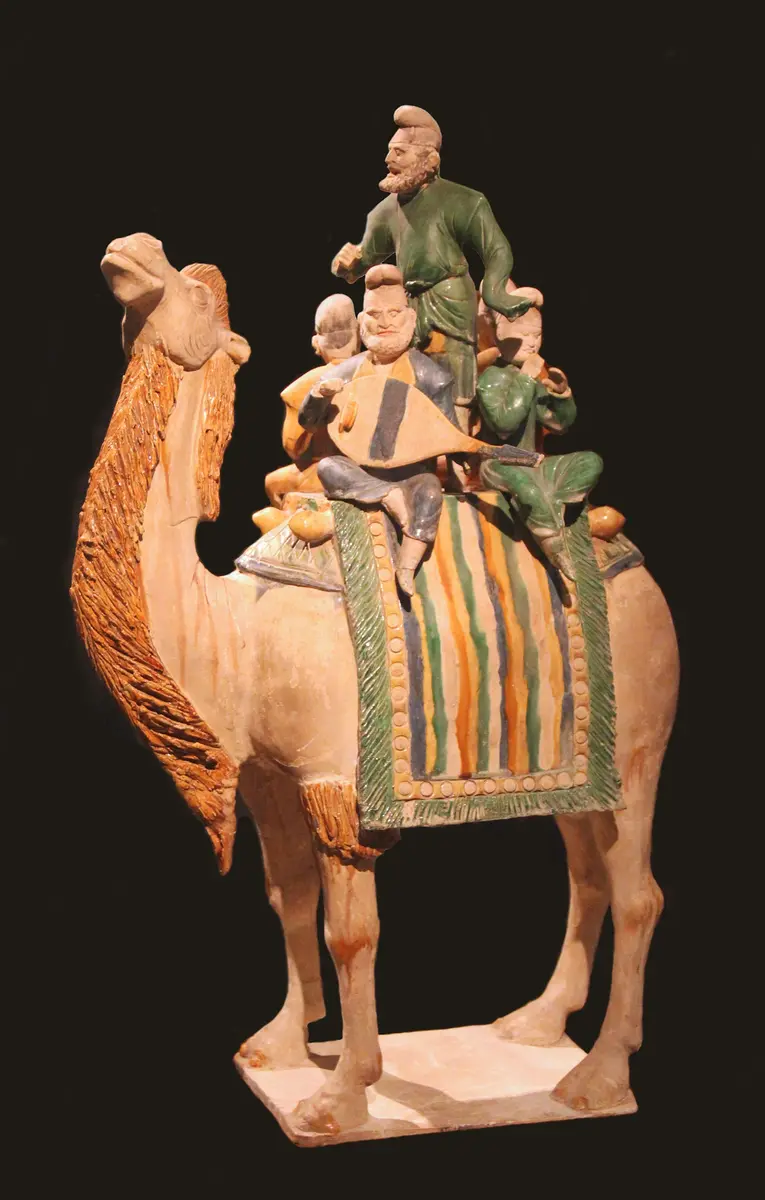
The Silk Road was not one road but a web of caravan routes across Asia. From Chang'an (today's Xi'an), the capital of the Han and Tang emperors, it ran west through the Hexi Corridor to Dunhuang and the Jade Gate, along the edges of the Taklamakan desert from oasis to oasis to Kashgar, over the Pamir mountains to Samarkand, Bukhara and Merv, and on across Iran to Ctesiphon, Palmyra and Antioch, from where goods went on by sea. Few people travelled the whole way. Bactrian camels and pack horses carried the loads in stages, and the goods changed hands many times between middlemen. Silk went west; wool, gold, silver and horses went east, and with them travelled monks, missionaries, techniques and diseases.
It began with diplomacy and war. In 138 BCE the Han emperor Wu sent Zhang Qian west to find allies against the Xiongnu nomads; he was held captive for ten years and came home after thirteen with the first reliable account of Ferghana, Bactria and Sogdiana. Han armies then took the Hexi Corridor, set up a commandery at Dunhuang in 111 BCE and marched as far as Ferghana for its famous horses. At the other end, silk became a Roman luxury: around 77 CE Pliny the Elder complained that India, the 'Seres' of the silk country and Arabia took a hundred million sesterces a year out of the empire. The two ends hardly knew each other. According to the Han history, Parthia blocked the Romans' way to keep the trade in Chinese silks in its own hands, and the caravan cities in between lived on the traffic: in 137 CE Palmyra's council carved its whole tariff of tolls in stone.
The great middlemen were the Sogdians of Samarkand and Bukhara, who kept colonies all over China; their 'Ancient Letters' of about 313 CE, never delivered and found in a watchtower near Dunhuang, talk of silver, linen, musk and pepper. In the Turfan oasis Sasanian silver drachms from Iran were the money of the market. Buddhism travelled east along the same roads: the first Mogao caves at Dunhuang were cut in 366, and the monk Xuanzang walked to India and back between 629 and 645. China's secret leaked west too, when monks brought silkworm eggs to the emperor Justinian in Constantinople around 552. The road was at its height under the Tang in the 7th and 8th centuries, when Chang'an was one of the greatest cities in the world, until the Tibetans took Dunhuang in 781 and cut Tang China off from the western routes. In Central Asia the Muslim and Turkic dynasties that followed kept the trade going, with caravanserais and covered markets.
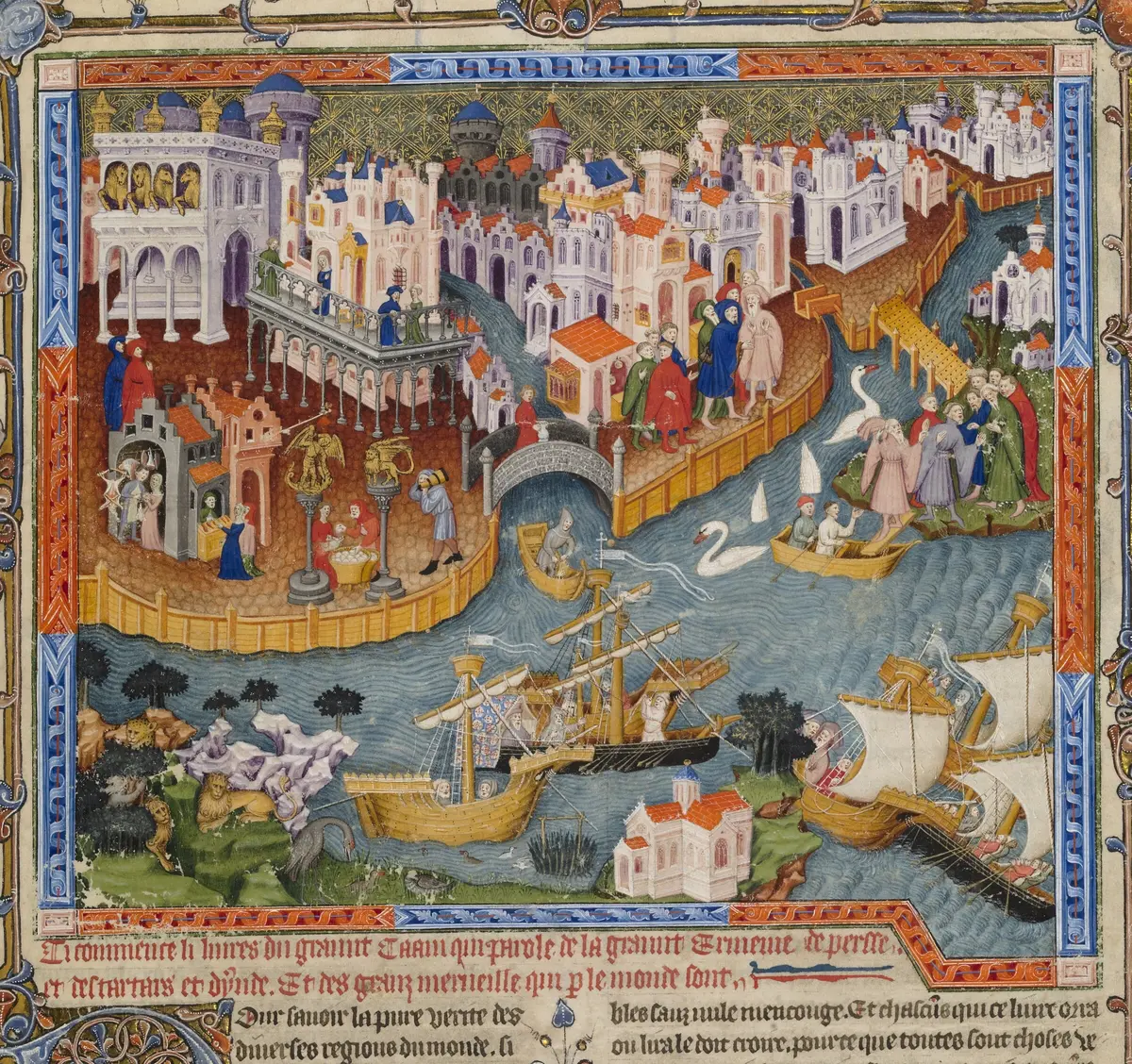
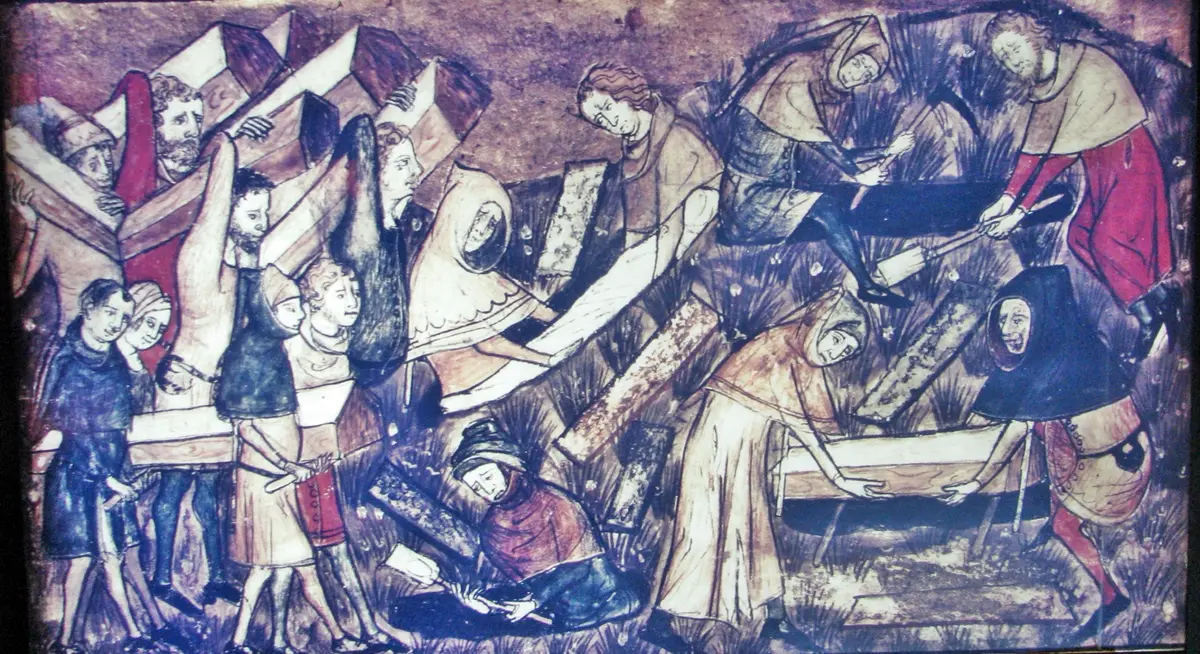
The Mongol conquests of the 13th century revived the routes. In this 'Mongol peace' Marco Polo travelled to Kublai Khan, and a Florentine merchants' handbook of about 1340 called the road from the Sea of Azov to China perfectly safe. The same traffic is widely thought to have carried the plague that reached the Black Sea in 1346 and became the Black Death. After the Mongol states broke apart, wars closed the roads more often, and from 1498, when Vasco da Gama reached India by sailing round Africa, European ships began to carry Asia's goods by sea. When the English merchant Anthony Jenkinson reached Bukhara in 1558, he found no caravans from China at all: war had shut the way for three years. The land routes, UNESCO says, stayed in use as a major trade route until the 16th century.
The name is modern. The German geographer Carl Ritter used the word 'Seidenstraße' in passing in 1838, but it was Ferdinand von Richthofen who made it a concept in 1877, in the first volume of his China and on his map of the trade of the Han age. Historians now prefer 'the Silk Roads', in the plural, because there were many routes, by land and by sea, and silk was only one of the goods. UNESCO has listed two stretches as World Heritage, the Chang'an-Tianshan corridor in 2014 and the Zarafshan-Karakum corridor in 2023. The road's lasting legacy is less what it carried than what it spread: Buddhism to China, paper to the Islamic world, and an idea of Eurasia linked by trade that China's Belt and Road Initiative still borrows.
What happened
- 138 BCE
The Han emperor Wu sends Zhang Qian west from Chang'an to find the Yuezhi and win them as allies against the Xiongnu nomads; the Xiongnu capture him and hold him for ten years.
Chang'an (Xi'an): the Han and Tang capital, where the road began - 125 BCE
Zhang Qian is back in Chang'an after thirteen years, with the first reliable account of Ferghana, Bactria and Sogdiana and of the trade beyond them.
Chang'an (Xi'an): the Han and Tang capital, where the road began - 111 BCE
A Han commandery is set up at Dunhuang, at the western end of the Hexi Corridor; with the Yumen and Yangguan passes it becomes the gate through which caravans leave China.
Yumen Pass, the Jade Gate, west of Dunhuang: where caravans left Han China; the Sogdian letters were found in a watchtower near it - 101 BCE
After a failed first campaign in 104 BCE, a Han army comes back from Ferghana with the 'blood-sweating' horses the emperor wanted and the head of Ferghana's ruler; the small states on the way submit.
- 77
Pliny the Elder's Natural History describes silk as a 'wool' the Seres comb from the leaves of their trees, and complains that India, the Seres and Arabia take a hundred million sesterces a year from the Roman empire.
- 97
The Han general Ban Chao sends Gan Ying towards Da Qin, the Roman empire; he reaches the Persian Gulf and turns back. The Han history says Parthia kept the Romans away to hold the trade in Chinese silks.
- 137
The council of Palmyra publishes a revised tax law for goods entering and leaving the caravan city, carved in stone to end the quarrels between tax collectors and merchants.
Palmyra: the caravan city of the Syrian desert - 166
Men claiming to be envoys of Andun, king of Da Qin (the emperor Marcus Aurelius Antoninus), reach the Han court by sea through central Vietnam; the Han history calls it the first direct contact, and suspects exaggeration.
- 313
Sogdian merchants in the Hexi Corridor write home to Samarkand about the sack of Luoyang and the chaos in China; their letters are never delivered, and Aurel Stein finds them in 1907 in a watchtower near the Jade Gate.
Yumen Pass, the Jade Gate, west of Dunhuang: where caravans left Han China; the Sogdian letters were found in a watchtower near it - 366
Buddhists at Dunhuang cut the first of the Mogao caves; over the next centuries officials and rich merchants pay for hundreds of painted cave temples.
Dunhuang, the Mogao Caves: where the northern and southern routes met, and Buddhism's gateway into China - 552
Monks who have lived in 'Serinda' bring silkworm eggs to the emperor Justinian in Constantinople; silk can now be made in the Roman lands instead of being bought from the Persians.
Constantinople: where silkworms arrived about 552, and silk-making began in the Roman lands - 629
The monk Xuanzang leaves Chang'an secretly, without a travel permit, for India, by Turfan, Kucha, Tashkent and Samarkand.
Chang'an (Xi'an): the Han and Tang capital, where the road began - 639
At Gaochang in the Turfan oasis, a contract in Sogdian records the sale of a slave girl, paid in Sasanian silver drachms, the coin of the oasis markets.
Gaochang (Qocho), in the Turfan oasis: a market city on the northern route - 645
Xuanzang returns to Chang'an after sixteen years with the scriptures he collected in India, and spends the rest of his life translating them.
Chang'an (Xi'an): the Han and Tang capital, where the road began - 658
The Tang emperor Gaozong sends an envoy to Samarkand to invest its king Varkhuman; in these years Varkhuman's hall is painted with envoys bringing gifts, the Chinese among them carrying silk.
Samarkand (Afrasiab, the old city): home of the Sogdian merchants - 751
An Arab army defeats the Tang at the river Talas. An 11th-century writer, al-Tha'alibi, says Chinese prisoners taught Samarkand to make paper, a story historians doubt because paper was already in use there.
- 781
A stele put up in Chang'an tells the history of the Church of the East, the Christianity that had come to China along the road.
Chang'an (Xi'an): the Han and Tang capital, where the road beganDunhuang falls to the Tibetans, and Tang China loses its hold on the western routes.
Dunhuang, the Mogao Caves: where the northern and southern routes met, and Buddhism's gateway into China- 1078
Rabati Malik is built on the road from Samarkand to Bukhara for the Karakhanid ruler Shams al-Mulk Nasr: a royal halting place that serves for centuries as a caravanserai.
Rabati Malik: a royal halting place and caravanserai on the road from Samarkand to Bukhara - 1220
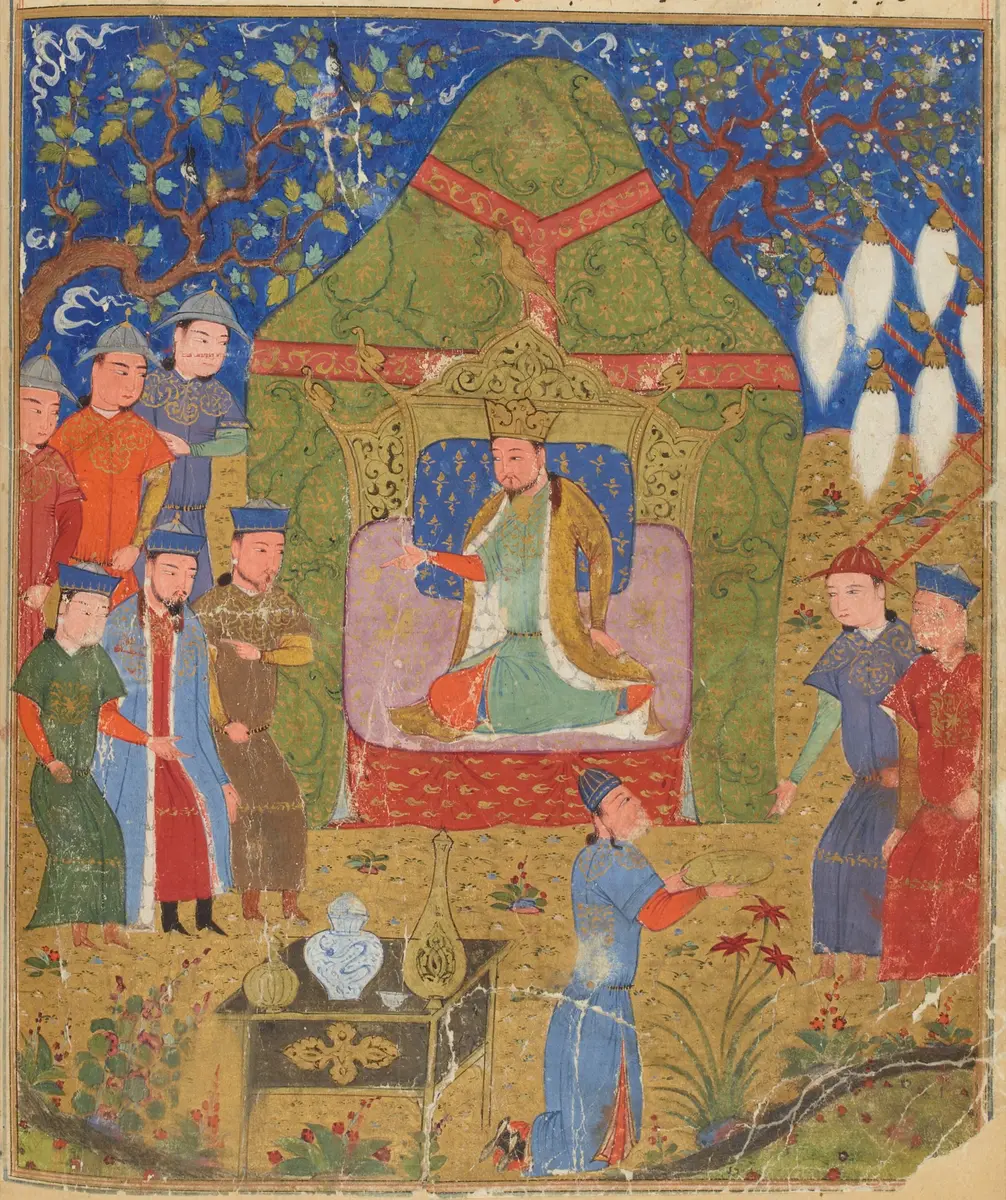
Genghis Khan's armies take Bukhara and Samarkand; the conquest is ruinous, but it soon brings the roads from China to the Black Sea under Mongol rule.
Bukhara: Sogdian city, later a great market of covered bazaars - 1271
The Venetian Marco Polo sets out with his father and uncle for the court of Kublai Khan; the book of his travels makes the road famous in Europe.
- 1340
The Florentine Francesco Pegolotti writes in his merchants' handbook that the road from Tana on the Sea of Azov to Cathay is 'perfectly safe, whether by day or by night', and that in Cathay silver is changed into paper money.
- 1346
Plague strikes the Golden Horde's army besieging Caffa, the Genoese trading port in the Crimea; from the Black Sea it reaches the Mediterranean and becomes the Black Death.
- 1498
Vasco da Gama reaches Calicut in India by sailing round Africa, opening a direct sea route between Europe and Asia.
- 1558
The English merchant Anthony Jenkinson reaches Bukhara with a caravan; he finds merchants from India, Persia and Russia but none from Cathay, because war has closed the road for three years.
Bukhara: Sogdian city, later a great market of covered bazaars