The microscope
“Lenses in a tube, first firmly recorded around 1620 (the famous 1590 date rests on a later family claim); the Lincei in Rome named it the microscope in 1625, and in 1676 Leeuwenhoek saw microbes.”
The first microscopes were tubes holding two or more lenses that made small things look large, and nobody knows for certain who made the first one. The usual story, still told in encyclopedias, says that around 1590 the spectacle maker Hans Jansen and his son Zacharias put lenses in a tube in Middelburg, the Dutch town where the telescope appeared in 1608. But that story comes from testimony gathered in 1655, more than twenty years after Zacharias died: his son, and the diplomat Willem Boreel, who said he had played with Zacharias as a boy, gave it to the French physician Pierre Borel, who printed it in a book on the 'true inventor' of the telescope. Zacharias was born about 1585 and is recorded as a spectacle maker only from 1616, and historians such as Albert Van Helden and Huib Zuidervaart treat the claim as unreliable. The brass tube in Middelburg long shown as 'Janssen's microscope' was first given that name in 1867.
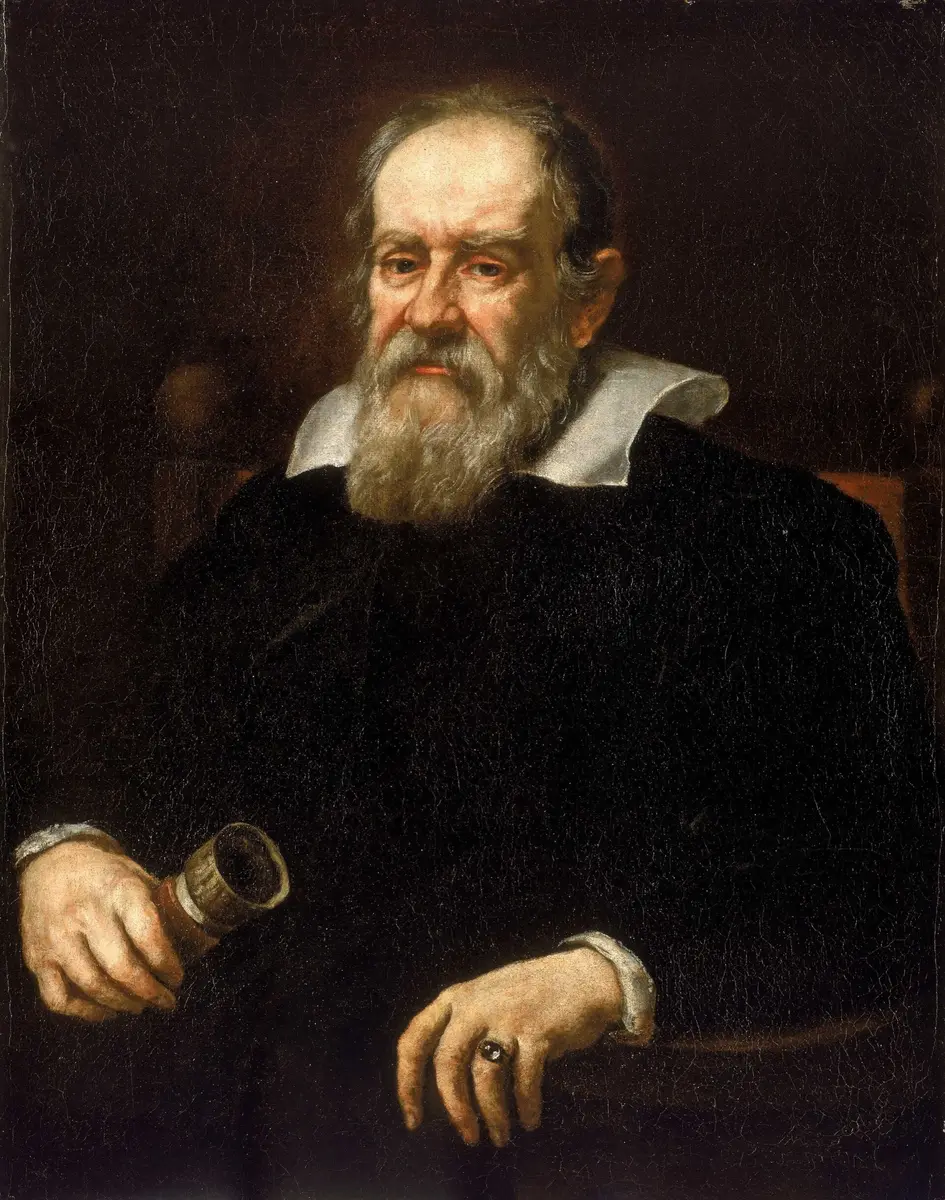
The firm record begins with the telescope's own makers and users. By 1610 Galileo was telling people in Padua that his telescope showed the organs of the tiniest animals, even the eye of an insect. In London the Dutch inventor Cornelis Drebbel was making microscopes with two convex lenses from about 1619, and one of them reached Rome at the end of 1623. In 1624 Galileo built his own 'occhialino', or little eyeglass: on 10 May in Rome he showed a fly through one and gave it to a cardinal for the Duke of Bavaria, and on 23 September he sent another to Federico Cesi, founder of the Accademia dei Lincei, the 'Academy of the Lynxes', with a letter that called the flea 'most horrible' and the mosquito and the moth 'beautiful'. On 13 April 1625 Johannes Faber, a physician of the academy, proposed a Greek name for it, 'microscope', as the Lincei had named the telescope before.
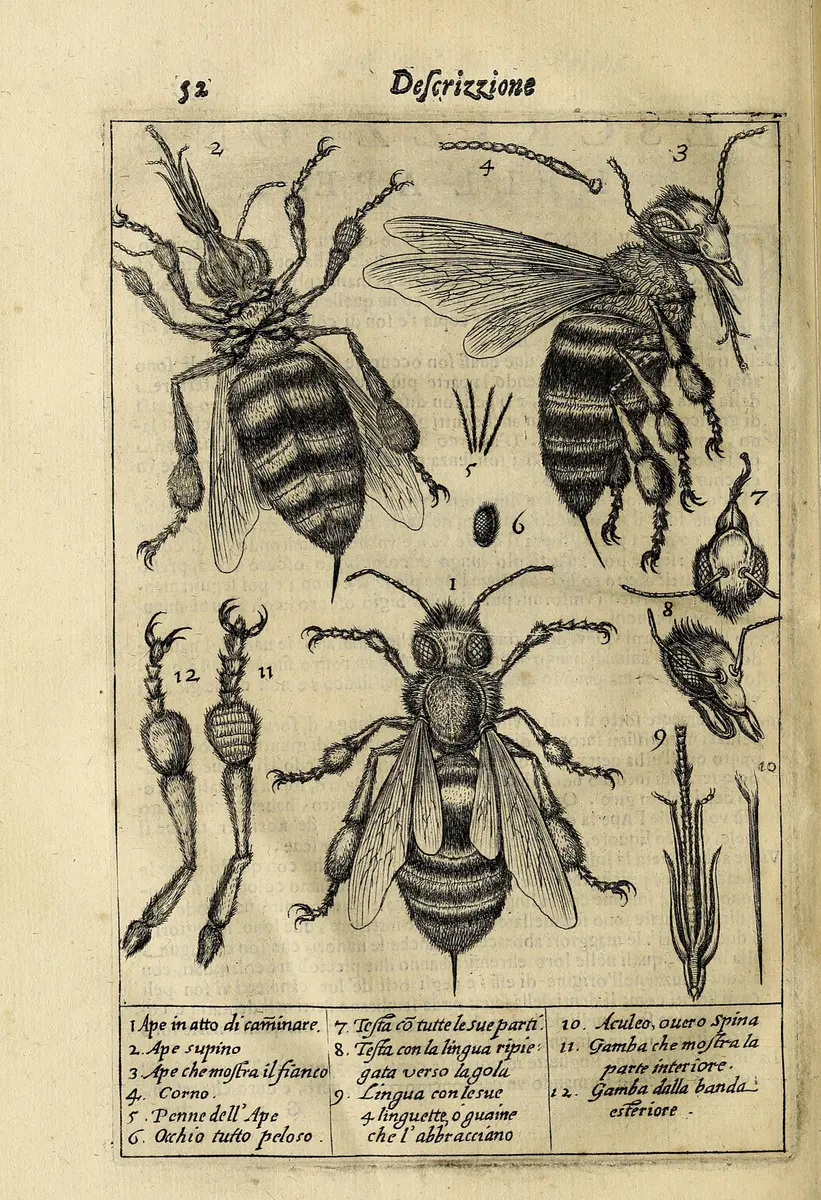
The Lincei also made the first pictures. Their member Francesco Stelluti drew honeybees seen through the microscope, a compliment to Pope Urban VIII, whose family arms carried three bees, and in 1625 the academy printed them on a large engraved sheet for the pope, the same year as Cesi's Apiarium, a study of bees printed on a single sheet a metre wide. In 1630 Stelluti printed the bees again, with a magnified grain weevil, in his translation of the Roman poet Persius: the first pictures made with a microscope to appear in a book. For decades the compound microscope stayed something of a luxury: its lenses magnified their own faults along with the object, and the clearest images still came from a single strong lens.
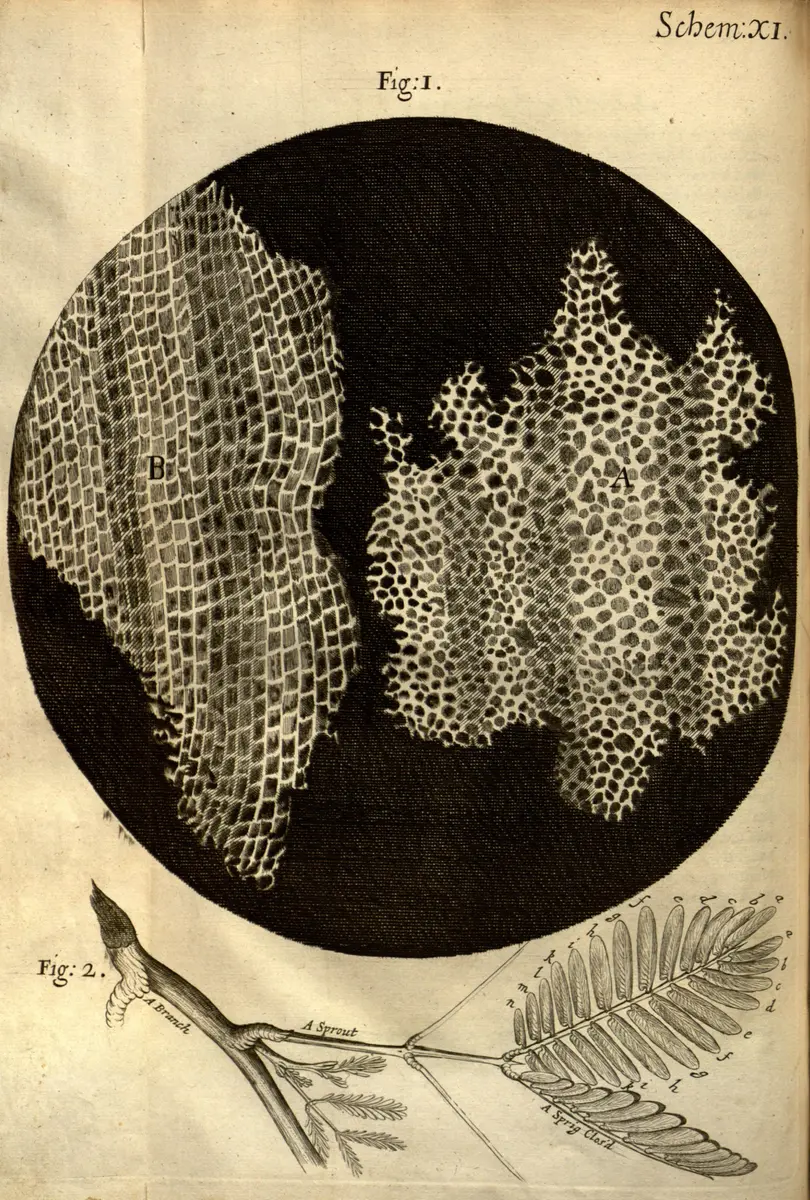
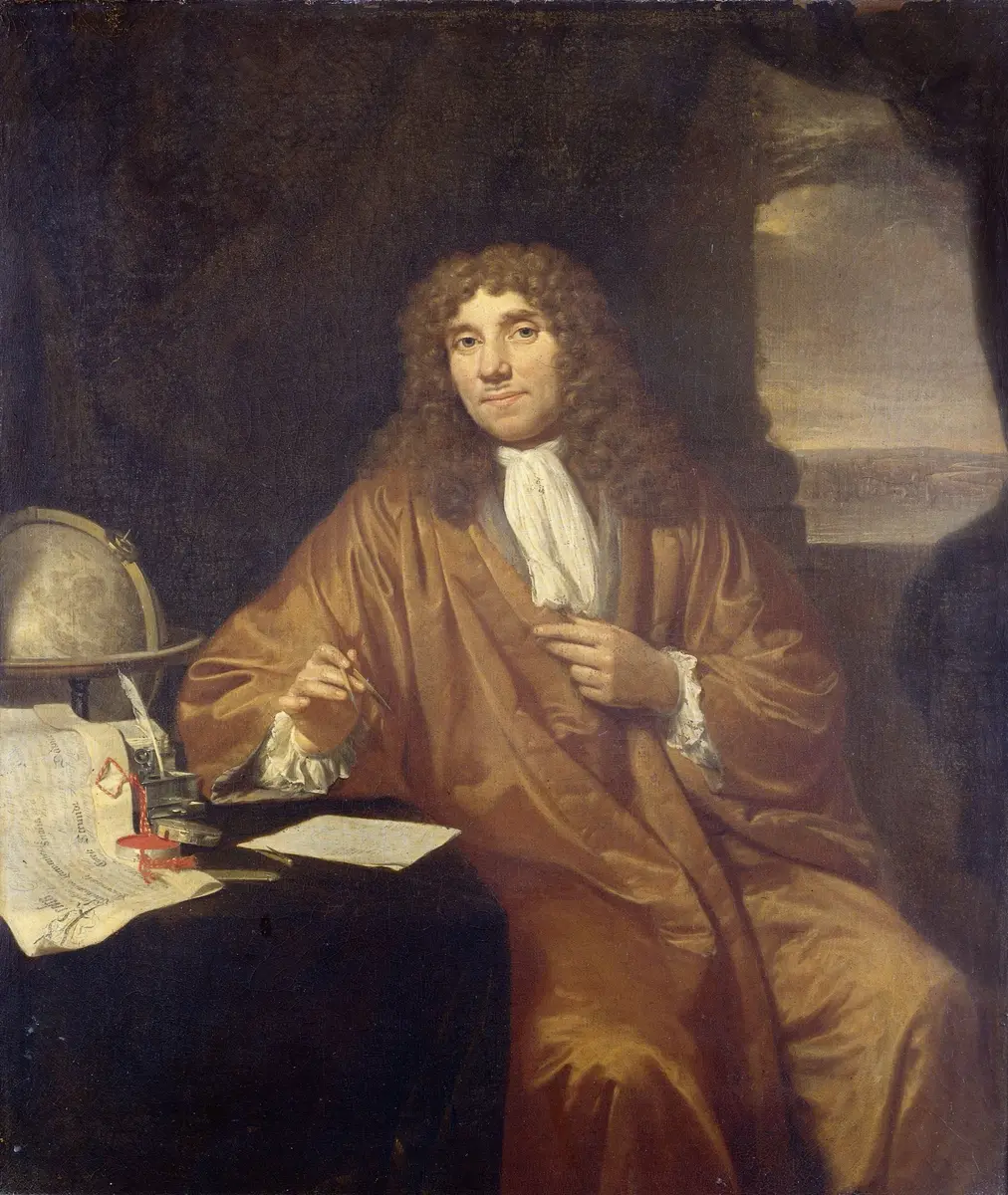
In the 1660s it became a working tool of science. In 1661 Marcello Malpighi of Bologna saw in a frog's lung the tiny vessels that join arteries to veins, the missing piece in William Harvey's circulation of the blood. In London Robert Hooke showed microscope views to the new Royal Society from 1663 and printed them in Micrographia (1665), the book that made the instrument famous, and the Dutch naturalist Jan Swammerdam dissected insects under it. A draper in Delft, Antoni van Leeuwenhoek, went the other way, with tiny single lenses that magnified more than 200 times. On 9 October 1676 he wrote to the Royal Society that water in which pepper had soaked was full of 'little animals' of several kinds, the letter that made his name and opened the study of microbes.
The microscope and the telescope were the first instruments to stretch a human sense, and both showed that nature holds far more than the eye can see. The microscope's world of cells, tissues and microbes led, two centuries later, to cell theory and to the germ theory of disease, and laboratories still depend on it. Its untidy beginnings are also a lesson in how history gets written: a family's claim, backed by a nobleman's word and printed in Latin, became a date that books still repeat.
What happened
- 1590
The traditional date: in Middelburg the spectacle maker Hans Jansen and his son Zacharias are said to have put lenses in a tube and made the first compound microscope. The story was first told in 1655, by Zacharias's son and the diplomat Willem Boreel; Zacharias was born about 1585, so most historians doubt it.
The Nieuwe Kerk of Middelburg Abbey, on the Groenmarkt: the Jansen family's house stood against its wall, and Hans Lipperhey's spectacle shop faced the church in the Kapoenstraat - 1608
In The Hague the States General discuss the request of Hans Lipperhey, a Middelburg spectacle maker, for a patent on a tube for seeing faraway things as if they were near: the telescope, whose lenses would soon be turned on small things too.
- 1610
John Wedderburn, a Scottish follower of Galileo, writes in a pamphlet printed in Padua that he heard Galileo tell the philosopher Cremonini that his telescope shows the organs of the smallest animals, and an insect's eye covered by a membrane pierced with seven slits like a visor: the first record of a telescope used as a microscope.
- 1614
In mid-November Jean Tarde visits Galileo in Florence, and Galileo talks to him about his microscope.
- 1619
In London the Dutch inventor Cornelis Drebbel begins making compound microscopes with two convex lenses, which probably show the image upside down; he makes several until 1623, and none survives. They are the earliest microscopes firmly on record.
London: Cornelis Drebbel made compound microscopes here from about 1619, and Hooke published Micrographia here in 1665 - 1623
Galileo's The Assayer is published in Rome by the Lincei. In passing he tells his opponent to look at a sunlit stone or metal through 'a telescope adjusted to see objects very close up'.
Palazzo Cesi, Via della Maschera d'Oro, Rome: the house of Federico Cesi and his Accademia dei Lincei, which named the microscope in 1625One of Drebbel's microscopes is brought to Rome, where Galileo examines it the next year.
- 1624
In the evening, at his lodging near the Maddalena in Rome, Galileo gives a fine 'occhialino' to Cardinal Zollern for the Duke of Bavaria. The Lincean Johannes Faber looks at a fly through it and tells Galileo that he is 'another Creator'.
From Bellosguardo, Galileo sends Federico Cesi an 'occhialino to see the tiniest things close up', with directions for lighting and focusing it: 'the flea is most horrible, the mosquito and the moth are beautiful'.
Villa dell'Ombrellino, Bellosguardo, Florence: Galileo's home from 1617 to 1631, from which he sent Cesi his occhialino on 23 September 1624- 1625
In Rome the Lincei print the Melissographia, Francesco Stelluti's bee seen through the microscope on its back, from the side and from above, with its parts around it, engraved by Matthäus Greuter as a gift for Pope Urban VIII: the first picture ever printed of something seen through a microscope.
Palazzo Cesi, Via della Maschera d'Oro, Rome: the house of Federico Cesi and his Accademia dei Lincei, which named the microscope in 1625Johannes Faber writes to Cesi that he calls the new instrument the 'microscope': the Lincei, who named the telescope, wish to name this one too, since they were the first in Rome to have it.
Cesi sends Galileo an advance copy of his Apiarium, a study of bees printed for the Barberini pope on one sheet 63 by 101 cm.
- 1628
From Florence Galileo sends one of his microscopes to Landgrave Philip of Hesse; in 1630 he sends another to the King of Spain.
- 1630
Stelluti publishes his translation of the poet Persius in Rome, dedicated to Cardinal Francesco Barberini, with the bee drawings of 1625 on page 52: the first pictures made with a microscope to appear in a book.
In the same book Stelluti draws the grain weevil both at its natural size and magnified, a way of showing scale that microscopists will copy for two centuries.
- 1631
In the Netherlands the scholar Isaac Beeckman draws a compound microscope on a tripod in his journal, one of the earliest pictures of the instrument itself.
- 1644
In Palermo the astronomer Giovanni Battista Hodierna publishes The Fly's Eye (L'occhio della mosca), using the microscope for anatomy.
- 1646
In Naples Francesco Fontana publishes his observations and claims to have made a compound microscope of two convex lenses in 1618: one of several rival claims to the invention.
- 1655
From Paris the Dutch ambassador Willem Boreel writes to the physician Pierre Borel that Hans and Zacharias Jansen 'first invented the microscope', and that in 1619 he saw one of their microscopes at Drebbel's house in London. Historians think he confused it with Drebbel's own.
- 1656
Borel's De vero telescopii inventore, dated 1655 on its title page, is published at The Hague with Boreel's testimony and portraits of Jansen and Lipperhey. It makes Jansen the first inventor, a version still repeated today.
- 1661
In Bologna Marcello Malpighi publishes his observations on the lungs, two letters to Giovanni Alfonso Borelli: with the microscope he sees the tiny vessels in a frog's lung that link arteries and veins, completing Harvey's circulation of the blood.
Bologna: Marcello Malpighi's city, where his letters on the lungs, De pulmonibus, were printed in 1661 - 1663
In London Robert Hooke begins regular microscope demonstrations for the new Royal Society.
Site of Gresham College, Bishopsgate, London (now Tower 42): the Royal Society met here when Hooke showed it microscope views from 1663 - 1665
Hooke publishes Micrographia, with his compound microscope and its lamp on the first plate and the flea, the louse and the cells of cork inside; the book makes the microscope famous.
London: Cornelis Drebbel made compound microscopes here from about 1619, and Hooke published Micrographia here in 1665 - 1669
Jan Swammerdam publishes his general history of insects, Historia insectorum generalis, the work of a master of dissection under the microscope.
- 1673
Antoni van Leeuwenhoek, a Delft draper who grinds his own tiny lenses, sends his first observations to the Royal Society in London, among them the sting of a bee.
Delft: Antoni van Leeuwenhoek's town, from which he wrote his letters to the Royal Society - 1674
Leeuwenhoek describes water from a lake, with green spiral threads now known as the alga Spirogyra; Museo Galileo dates his discovery of the protozoa to this year.
Delft: Antoni van Leeuwenhoek's town, from which he wrote his letters to the Royal Society- 1676
Leeuwenhoek writes to Henry Oldenburg of the Royal Society that water in which pepper has soaked swarms with 'little animals' of five kinds, one possibly bacteria. The Society prints an English extract in March 1677, and the world of microbes is open.
Delft: Antoni van Leeuwenhoek's town, from which he wrote his letters to the Royal Society