Hooke sees cells under a microscope
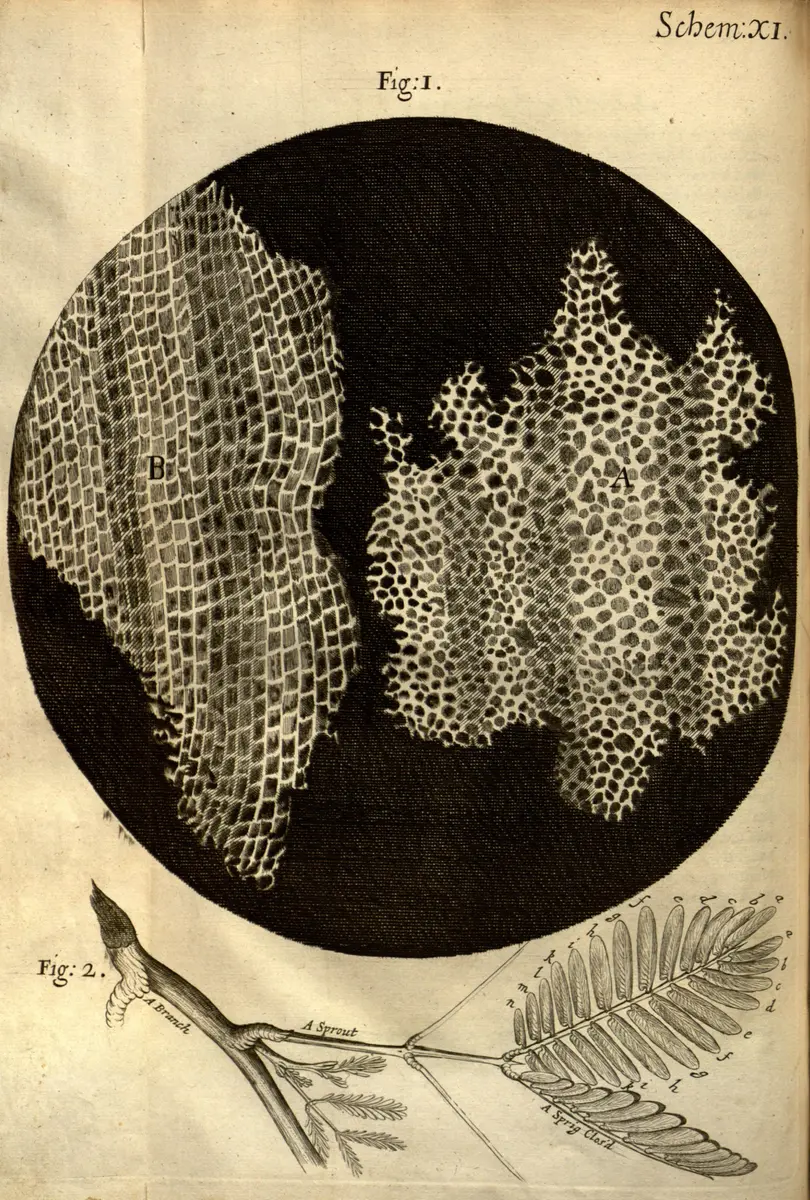
“In 1665 Robert Hooke's book Micrographia showed cork under the microscope as rows of tiny empty boxes, which he called 'cells': the first use of the word for the building blocks of life.”
On 15 April 1663 Robert Hooke, the young Curator of Experiments of the newly chartered Royal Society of London, showed its Fellows a drawing of a thin slice of cork as it looked through his microscope. Instead of a solid mass he had found rows of tiny empty boxes, 'much like a Honey-comb'. When he printed the picture in his book Micrographia in January 1665, he called these boxes 'cells', the first time the word was used for the small units that living things are made of. He counted about sixty of them in the eighteenth part of an inch and worked out that a cubic inch of cork held more than twelve hundred million, 'a thing almost incredible'.
Hooke, born in 1635 at Freshwater on the Isle of Wight, the son of a curate, was a brilliant maker of instruments. At Oxford he had built Robert Boyle's air pump, and in November 1662 the Society took him on to show three or four experiments at each of its weekly meetings at Gresham College in London, at first without pay. Christopher Wren had made the first drawings of insects seen through a microscope, which went into the King's collection, and then given the work up. In the spring of 1663 the Society asked Hooke to take it over and to bring at least one microscope observation to every meeting. He used a compound microscope with a tube six or seven inches long, and lit his specimens at night with an oil lamp shining through a glass ball filled with salt water.
Micrographia, licensed by the Society's Council on 23 November 1664, printed by its own printers and dedicated to King Charles II, was the first large book of pictures made through a microscope. Its sixty observations and 38 copperplates, engraved after Hooke's own drawings, showed the point of a needle, mould, seeds, the eye of a fly, a flea in 'sable Armour' and a louse holding a human hair, the biggest on fold-out sheets wider than the book itself. It was a sensation. The diarist Samuel Pepys took his copy home on 20 January 1665 and sat up till two in the morning reading 'the most ingenious book that ever I read in my life'. A few months later the plague emptied London, and the Society did not meet again until March 1666.
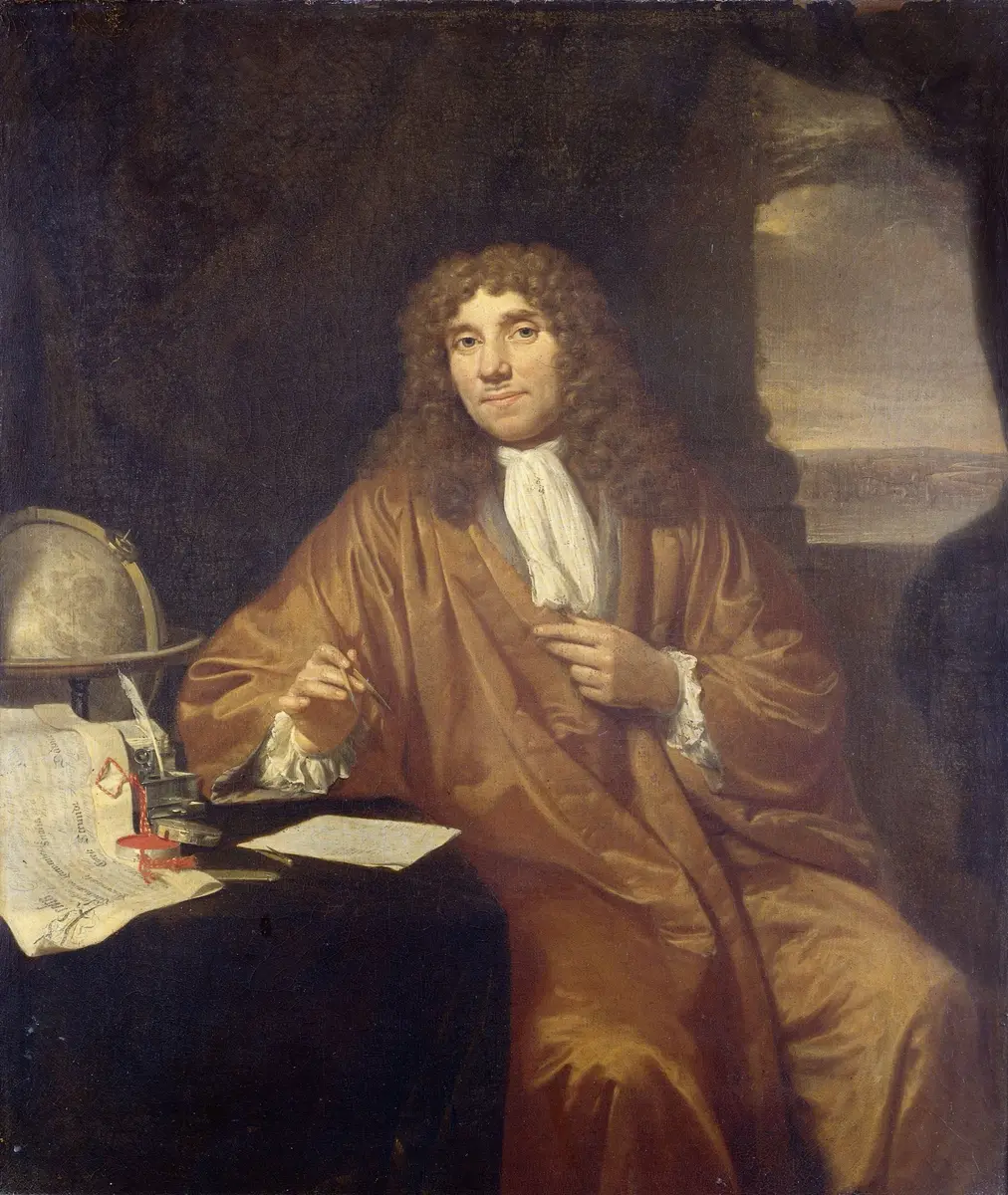
What Hooke saw in the cork were only the empty walls of dead plant cells; he thought such pores might be channels for the plant's juices. The cell's true importance was understood only in 1838 and 1839, when Matthias Schleiden and Theodor Schwann proposed that all plants and animals are built of cells. But Micrographia showed what the microscope could do for the study of life. It seems to have inspired a draper in Delft, Antonie van Leeuwenhoek, whose tiny single lenses revealed living bacteria and other cells, and in November 1677 it was Hooke who confirmed Leeuwenhoek's 'little animals' before the Royal Society. After the Great Fire of 1666 Hooke also worked as a City surveyor, helping Wren to rebuild London. No portrait of him made in his lifetime is known: he is remembered by his pictures, not his face.
What happened
- 1662
Proposed by Sir Robert Moray, Robert Hooke, until now Robert Boyle's assistant and the builder of his air pump, is accepted as the Royal Society's Curator of Experiments: he is to bring three or four experiments of his own to every weekly meeting, at first without pay. Boyle is thanked for releasing him.
The site of Gresham College in Bishopsgate, London (now Tower 42): where the Royal Society met, where Hooke showed his cork drawing on 15 April 1663, and where he lived from 1665- 1663
The Society asks Hooke to press on with his observations through the microscope 'in order to publish them'. He later wrote that he took up the work on John Wilkins's advice, after Christopher Wren, who had made the first such drawings (kept in the King's collection), had given it up.
The site of Gresham College in Bishopsgate, London (now Tower 42): where the Royal Society met, where Hooke showed his cork drawing on 15 April 1663, and where he lived from 1665Hooke is charged to bring at least one microscope observation to every meeting of the Society.
The site of Gresham College in Bishopsgate, London (now Tower 42): where the Royal Society met, where Hooke showed his cork drawing on 15 April 1663, and where he lived from 1665Hooke shows the Fellows two microscope drawings: the pores of cork, cut across and lengthways, and a piece of Kettering stone. He is asked to examine the bark of other trees and to write down all he sees.
The site of Gresham College in Bishopsgate, London (now Tower 42): where the Royal Society met, where Hooke showed his cork drawing on 15 April 1663, and where he lived from 1665Preparing to entertain King Charles II, the Society's Council asks Hooke to show his microscope observations 'in a handsome book'.
The site of Gresham College in Bishopsgate, London (now Tower 42): where the Royal Society met, where Hooke showed his cork drawing on 15 April 1663, and where he lived from 1665- 1664
The Council orders Hooke to bring one of his microscope essays to every meeting, so that they can be printed by order of the Society.
The site of Gresham College in Bishopsgate, London (now Tower 42): where the Royal Society met, where Hooke showed his cork drawing on 15 April 1663, and where he lived from 1665Since the book is to carry the Society's name, its President, Viscount Brouncker, is asked to read the manuscript first and pass it to other Fellows.
The site of Gresham College in Bishopsgate, London (now Tower 42): where the Royal Society met, where Hooke showed his cork drawing on 15 April 1663, and where he lived from 1665Samuel Pepys buys a microscope from the London maker Richard Reeve for £5 10s, 'a great price, but a most curious bauble', and reads Henry Power's new book on microscopy to learn how to use it.
Seething Lane, London: Samuel Pepys's house at the Navy Office, where he sat up till two in the morning reading Micrographia on 21 January 1665The Society hears Hooke's paper on petrified wood and shells, part of his microscope book, 'then in the press'. It praises his modest claims but advises him to leave out what he says about how fossils came to be.
The site of Gresham College in Bishopsgate, London (now Tower 42): where the Royal Society met, where Hooke showed his cork drawing on 15 April 1663, and where he lived from 1665The Council asks the President to sign the licence for 'Mr. Hooke's microscopical book'; the licence printed in Micrographia bears this date and Brouncker's name. The same day Hooke is proposed as the Society's salaried Curator.
The site of Gresham College in Bishopsgate, London (now Tower 42): where the Royal Society met, where Hooke showed his cork drawing on 15 April 1663, and where he lived from 1665Hooke writes to Boyle that his observations have been printed for more than a month, held back by the Fellows' reading and by the long preface. He worries that 'so great an expectation' has been raised.
- 1665
Micrographia comes out, printed by the Society's printers John Martyn and James Allestry and sold at the Bell in St Paul's Churchyard: sixty observations and 38 copperplates, dedicated to the King. In Observation XVIII Hooke calls the boxes in cork 'cells'.
St Paul's Churchyard, London: Micrographia's printers, John Martyn and James Allestry, sold it 'at their Shop at the Bell' hereAt his bookseller's binder Pepys sees 'Hooke's book of the Microscope, which is so pretty that I presently bespoke it'.
Pepys takes his copy home: 'a most excellent piece, and of which I am very proud'.
Seething Lane, London: Samuel Pepys's house at the Navy Office, where he sat up till two in the morning reading Micrographia on 21 January 1665Pepys sits up till two in the morning reading 'Mr. Hooke's Microscopicall Observations, the most ingenious book that ever I read in my life'.
Seething Lane, London: Samuel Pepys's house at the Navy Office, where he sat up till two in the morning reading Micrographia on 21 January 1665The Society's new journal, the Philosophical Transactions, prints a long account of Micrographia: through the microscope 'a new visible world is discovered'.
As the plague spreads through London, the Royal Society holds its last meeting; it will not meet again until March 1666, more than eight months later.
The site of Gresham College in Bishopsgate, London (now Tower 42): where the Royal Society met, where Hooke showed his cork drawing on 15 April 1663, and where he lived from 1665Before leaving London, Hooke writes to Boyle that the plague seems to spread by contagion, not through the air, and notes 'a very great scarcity of flies and insects' this summer. A week later he goes with Sir William Petty and John Wilkins to Durdans near Epsom to carry on experiments.
The Durdans, near Epsom: Lord Berkeley's house, where Hooke went with Petty and Wilkins to make experiments while the plague closed the Society in the summer of 1665