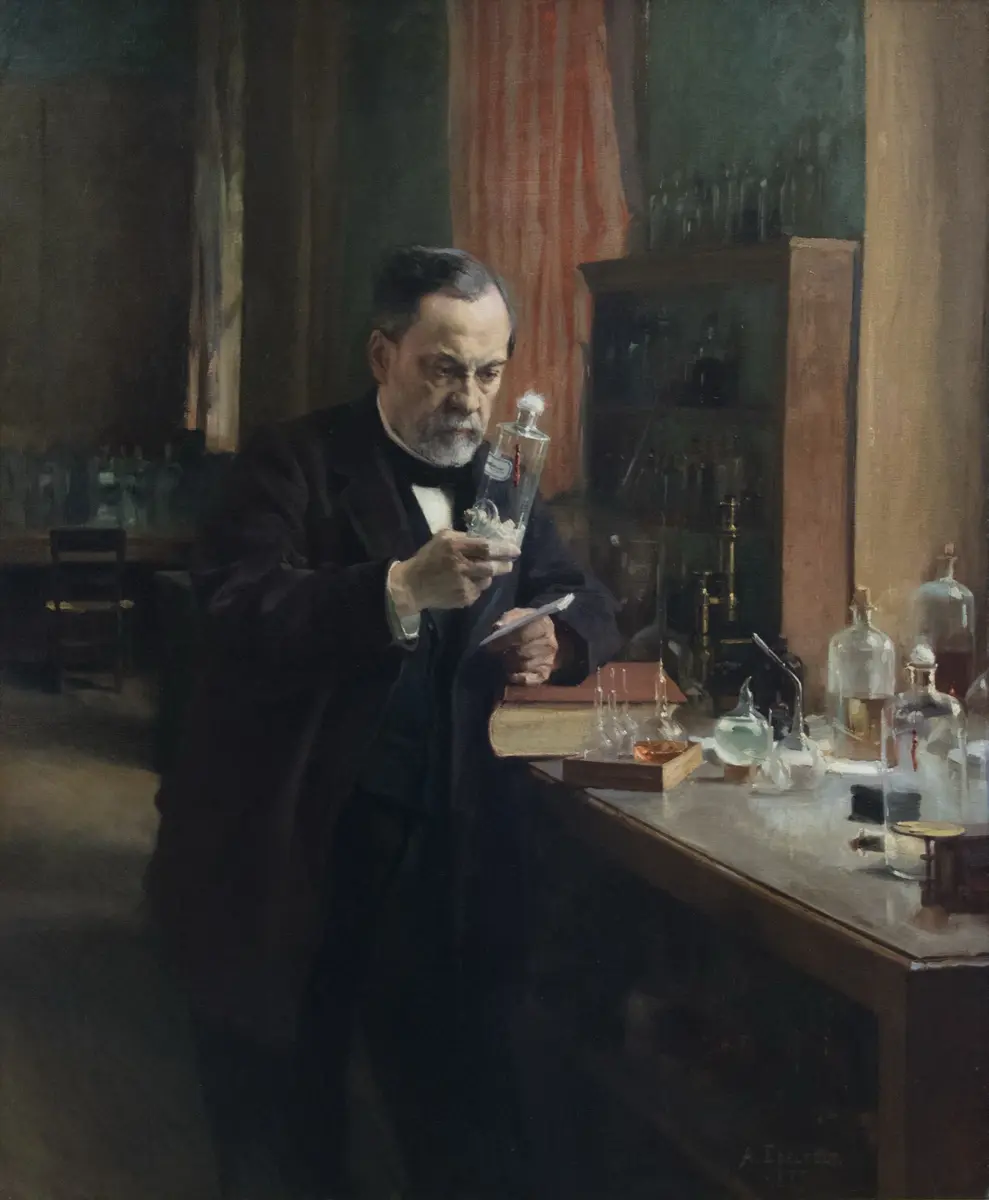
Pasteur proves germ theory
“Pasteur's swan-neck flasks (1859–62) showed that microbes come only from other microbes; with Koch's anthrax work in the 1870s this proved that germs cause disease, and gave us pasteurization and new vaccines.”
The germ theory is the idea that tiny living things, microbes, cause fermentation, decay and infectious disease, and that they always come from other microbes, never from dead matter. The French chemist Louis Pasteur (1822–1895) did more than anyone to make the world accept it, together with the German doctor Robert Koch. The year 1862 marks Pasteur's famous paper on the swan-neck flasks, which won a prize of the French Academy of Sciences and showed that life does not arise by itself in a sterile liquid. The proof that particular germs cause particular diseases came later, in the 1870s and 1880s, from Koch's work on anthrax and from Pasteur's own work on animal diseases and vaccines.
Pasteur began with wine, beer and sour milk. As dean of the new science faculty in Lille he was asked to help local distillers, and in 1857 he showed that each kind of fermentation is the work of its own living organism. Back in Paris at the École normale supérieure, he took on the old belief in 'spontaneous generation', still defended by the naturalist Félix Pouchet. He boiled a nutrient broth in glass flasks whose necks he had drawn out into long, bent tubes: air could get in, but dust and germs stuck in the bend, and the broth stayed clear. Once the neck was broken off, the broth soon swarmed with life. He also carried sealed flasks up the Jura and to the Mer de Glace above Chamonix: the higher and cleaner the air, the fewer of them spoiled.
The same ideas soon had practical uses. Asked by Emperor Napoleon III to find out why French wines went bad, Pasteur showed that unwanted microbes were to blame and that gentle heating killed them: pasteurization, later used above all for milk. From 1865 he spent five years on the diseases that were destroying France's silkworms, his first study of infectious disease, although he was slow to accept that the main one was caused by a parasite. In Glasgow the surgeon Joseph Lister read Pasteur in 1865, reasoned that germs from the air infect wounds, and began killing them with carbolic acid; deaths after amputations in his ward fell from about 45 to 15 percent.
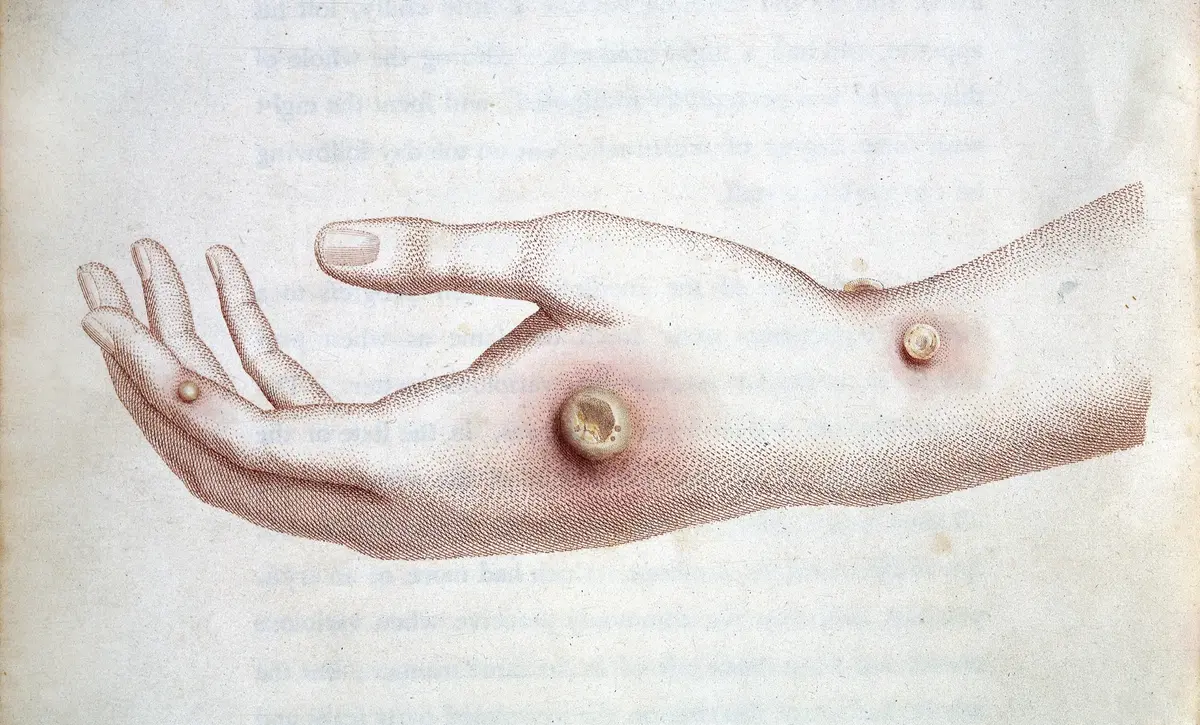
The decisive step was to show that one germ causes one disease. In 1876 Koch, then a country doctor at Wollstein, grew the anthrax bacillus outside the body, traced its life cycle and showed that it alone causes anthrax; he went on to find the germs of tuberculosis (1882) and cholera (1883). Pasteur turned to prevention. He found that weakened cultures of chicken cholera protected hens, and in May and June 1881, at Pouilly-le-Fort near Melun, he vaccinated sheep against anthrax in public: the vaccinated animals lived and the others died. In honour of Jenner he called all such methods 'vaccination'. On 6 July 1885 his rabies treatment saved the nine-year-old Joseph Meister, and the gifts that followed built the Institut Pasteur, opened on 14 November 1888.
Pasteur died on 28 September 1895. Historians reading his private notebooks have shown that he did not always tell the whole story: he played down rivals such as Davaine, Béchamp and Toussaint, the anthrax vaccine was made with a chemical rather than by exposure to air as he implied, and Meister was not the first person he treated. But the theory he and Koch established changed the world: antiseptic and sterile surgery, pasteurized milk, vaccines and later antibiotics all rest on the knowledge that infections are caused by living germs.
What happened
- 1857
In Lille, where he is dean of the new faculty of sciences and has been asked to help the local alcohol distillers, Pasteur shows that the souring of milk is the work of a living ferment, and argues that every fermentation has its own microbe. Later that year he returns to Paris as director of scientific studies at the École normale supérieure.
Lille: dean of the new faculty of sciences from 1854 to 1857, where local distillers' troubles led him to study fermentation - 1859
In a small laboratory under the roof of the École normale he has begun to test the old belief that life arises by itself in broths and infusions, defended that year in Félix Pouchet's book 'Hétérogénie'. He gives his first results to the Chemical Society of Paris.
The École normale supérieure, rue d'Ulm, Paris: his laboratory from 1857 to 1888, where he did the flask experiments and, in 1885, treated Joseph Meister- 1860
With the Academy of Sciences now offering its Alhumbert Prize for new light on spontaneous generation, he lays 73 flasks of yeast broth before it: twenty opened in the fields below the Jura, of which eight spoiled; twenty on a Jura mountain at 850 metres, five; and twenty at the Montanvert by the Mer de Glace at 2,000 metres, just one. Germs float in the air, unevenly.
The Montanvert above the Mer de Glace, Chamonix: twenty flasks opened here at 2,000 metres in 1860, of which only one spoiled- 1862
His memoir 'On the organised corpuscles that exist in the atmosphere' fills the January number of the Annales de chimie et de physique. Broth boiled in a flask with a long, bent neck stays clear because the dust and its germs stop in the bend; break off the neck and it soon teems with life.
The École normale supérieure, rue d'Ulm, Paris: his laboratory from 1857 to 1888, where he did the flask experiments and, in 1885, treated Joseph MeisterThe Academy's committee, with Claude Bernard as reporter, awards him the Alhumbert Prize unanimously for the memoir. The same year he is elected to the Academy of Sciences.
- 1863
At the request of Emperor Napoleon III he begins to study why French wines spoil, and finds that unwanted microbes are to blame.
The family house at Arbois in the Jura, with the laboratory where he spent his summers working on fermentation and the diseases of wine - 1864
Before a fashionable audience at the Sorbonne's scientific evenings he shows his flasks, still clear after years, and declares that the doctrine of spontaneous generation will never recover from this simple experiment.
The Sorbonne, Paris: his lecture against spontaneous generation on 7 April 1864, and his seventieth-birthday jubilee on 27 December 1892- 1865
He patents a way of keeping wine by heating it gently to kill the microbes that sour it: pasteurization, later applied to beer and, above all, milk.
The family house at Arbois in the Jura, with the laboratory where he spent his summers working on fermentation and the diseases of wineIn Glasgow the surgeon Joseph Lister, who has just read Pasteur's work, reasons that germs from outside infect open wounds, and first dresses one with carbolic acid to kill them.
Glasgow Royal Infirmary: where Joseph Lister, after reading Pasteur, first treated a wound with carbolic acid in August 1865Sent south by his old teacher Dumas, now a minister, to save the silk farms of the Cévennes, he reports from Alès to the Academy. For two years he denies that the silkworm disease is caused by a parasite, as Béchamp and Balbiani say; then he accepts it, and his method of selecting healthy eggs spreads across Europe.
Alès in the Cévennes: his base for five seasons of work on the silkworm diseases, from 1865- 1867
Lister publishes his first cases of antiseptic treatment in The Lancet. Deaths after amputations in his ward fall from about 45 to 15 percent by 1869.
Glasgow Royal Infirmary: where Joseph Lister, after reading Pasteur, first treated a wound with carbolic acid in August 1865- 1868
Aged 45, Pasteur suffers a stroke that leaves his left side partly paralysed. He goes on working.
- 1873
He is elected to the Academy of Medicine, although many doctors still resist a theory of disease put forward by a chemist.
- 1876
Robert Koch, a country doctor at Wollstein, shows how the anthrax bacillus forms spores and that bacilli grown for generations outside any animal still cause the disease. His paper, published by the botanist Ferdinand Cohn at Breslau, makes him famous: one germ, one disease.
Wollstein (Wolsztyn), then in Prussian Posen: where the district doctor Robert Koch worked out the cause of anthrax in his home in 1876 - 1877
Pasteur and Jules Joubert confirm that the anthrax bacillus causes the disease, and notice that other microbes can stop it growing: 'life prevents life'.
- 1878
The surgeon Charles Sédillot coins the word 'microbe' as a tribute to Pasteur's work.
- 1879
Cultures of chicken cholera, left standing over the summer, no longer kill hens, and the hens they were given then survive the full disease. Weakened germs can protect: Pasteur turns all his work to vaccines.
- 1881
Before a crowd of farmers, vets, officials and a reporter from The Times, Pasteur's team vaccinates sheep, goats and cattle against anthrax on a farm at Pouilly-le-Fort near Melun, with a second dose twelve days later; on 31 May every animal, vaccinated or not, is injected with virulent anthrax.
Pouilly-le-Fort, near Melun: the public trial of the anthrax vaccine on the farm of the vet Hippolyte Rossignol, 5 May to 2 June 1881The crowd returns to find the vaccinated sheep alive and the unvaccinated dead or dying. Later that summer, at the International Medical Congress in London, Pasteur proposes to call all such protection 'vaccination', in honour of Jenner.
Pouilly-le-Fort, near Melun: the public trial of the anthrax vaccine on the farm of the vet Hippolyte Rossignol, 5 May to 2 June 1881- 1882
In Berlin, Koch announces that he has found the bacillus that causes tuberculosis, then the leading killer in Europe.
- 1883
Leading a German commission to an epidemic in Egypt, Koch finds the comma-shaped germ of cholera.
- 1885
Joseph Meister, nine, from Alsace, bitten fourteen times by a rabid dog, is brought to Pasteur's laboratory. Over ten days the doctor Jacques-Joseph Grancher gives him a course of injections of dried spinal cord from rabid rabbits, from weak to strong. The boy never develops rabies.
The École normale supérieure, rue d'Ulm, Paris: his laboratory from 1857 to 1888, where he did the flask experiments and, in 1885, treated Joseph MeisterPasteur announces his rabies treatment to the Academy of Sciences, after treating the young shepherd Jean-Baptiste Jupille. Bitten patients soon come from all over Europe and from America.
The École normale supérieure, rue d'Ulm, Paris: his laboratory from 1857 to 1888, where he did the flask experiments and, in 1885, treated Joseph Meister- 1888
The Institut Pasteur, paid for by a public appeal at home and abroad, is opened in the presence of President Sadi Carnot, as a rabies clinic, a research centre for infectious diseases and a school.
The Institut Pasteur, rue du Docteur-Roux, Paris: opened on 14 November 1888; Pasteur lived in its first building from 1888 and is buried in its crypt- 1892
Scientists from around the world celebrate his seventieth birthday at the Sorbonne. Lister, now president of the Royal Society, tells him that no one in the world has done more for medical science.
The Sorbonne, Paris: his lecture against spontaneous generation on 7 April 1864, and his seventieth-birthday jubilee on 27 December 1892- 1895
Pasteur dies at the Institut's country annex at Marnes-la-Coquette, west of Paris. He is buried at Notre-Dame; in December 1896 his coffin is moved to the crypt of the Institut Pasteur.
Villeneuve-l'Étang, Marnes-la-Coquette: the Institut Pasteur's country annex, where he died on 28 September 1895