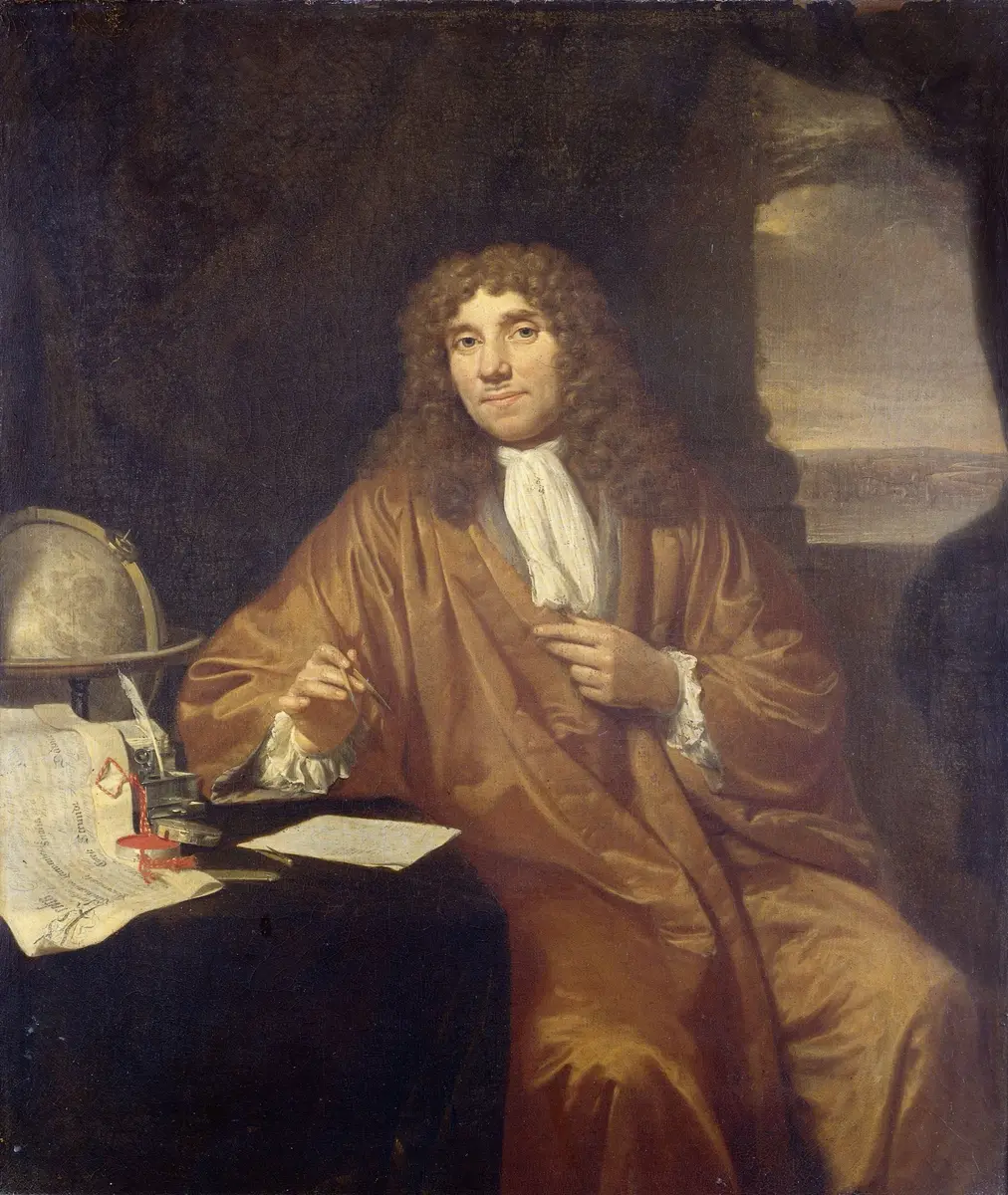
Antonie van Leeuwenhoek
“The Delft draper whose tiny home-made lenses first revealed bacteria, protists, sperm and blood cells, described in fifty years of letters to the Royal Society: the father of microbiology.”
Antonie van Leeuwenhoek was a cloth merchant and town official in Delft who became the first person to see bacteria and other single-celled life. He had no university education and read no language but Dutch, yet with tiny lenses that he made himself he looked at almost anything he could put on a pin: pond water, rain water, pepper soaked in water, the white matter between his teeth, blood, sperm, insects and wood. For fifty years, from 1673 until the week he died, he described what he saw in long, chatty letters to the Royal Society in London, which translated them and printed them in its journal, the Philosophical Transactions. Because he was the first to find this hidden world and to study it carefully, he is called the father of microbiology.
He was born in Delft on 24 October 1632 into a family of basket makers and was baptised in the Nieuwe Kerk on 4 November, a few days after another child of the town, the future painter Johannes Vermeer. His father died when he was five and his mother married a painter, Jacob Molijn. After school at Warmond, near Leiden, and some time with an uncle at Benthuizen, he went at sixteen to Amsterdam to learn the cloth trade from a Scottish merchant, William Davidson. In 1654 he married Barbara de Mey and set up in Delft as a draper and haberdasher; the next year he bought a house and shop called Het Gulden Hoofd ('the Golden Head') on the Hippolytusbuurt canal, where he lived for almost seventy years. In 1660 the town made him chamberlain to the aldermen in the town hall, a paid post that gave him a steady income. He also qualified as a surveyor, gauged the wine coming into the town, and served as curator of bankrupt estates; in 1676 one of these was the estate of Vermeer's widow. Barbara died in 1666, and of their five children only Maria survived; his second wife, Cornelia Swalmius, died in 1694.
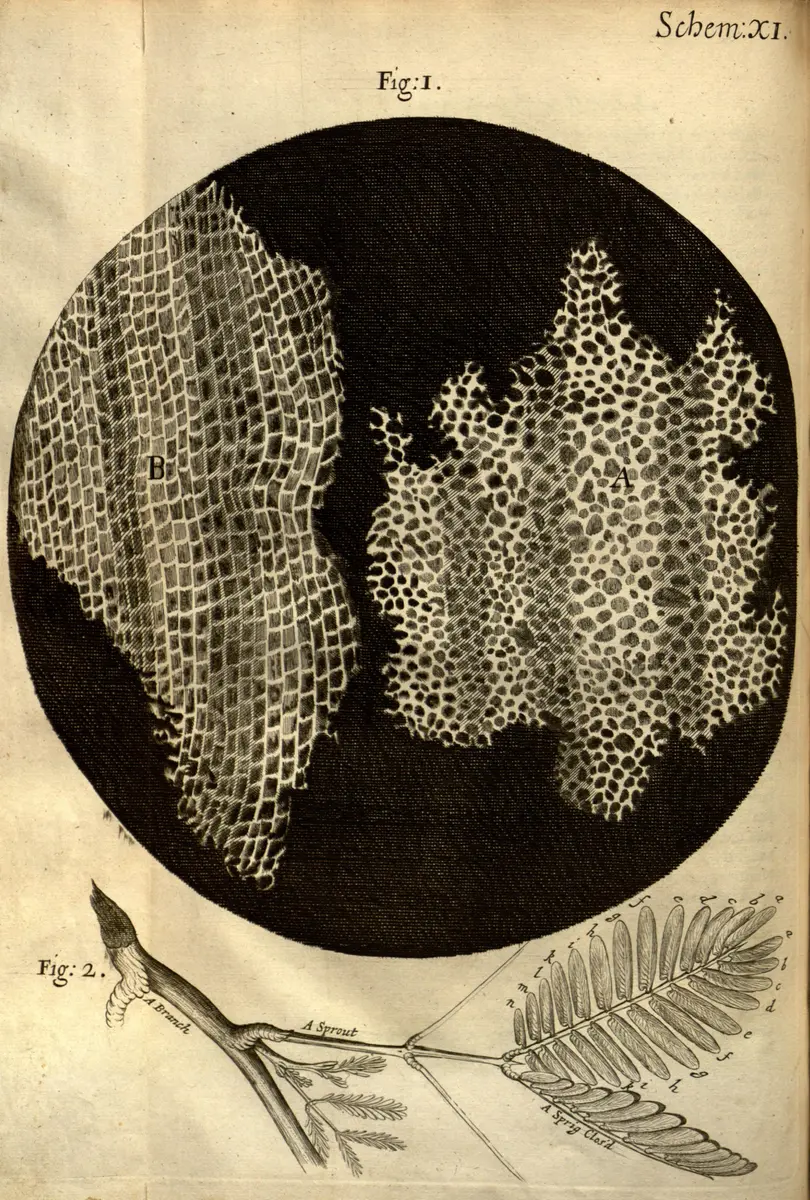
In the 1660s he began to make microscopes, perhaps after seeing Robert Hooke's Micrographia of 1665. Each was simply one very small lens held between two metal plates, with screws to move the specimen on its pin into focus, and had to be held close to the eye; the best surviving one, in Utrecht, magnifies 266 times, far more than the compound microscopes of his day. In April 1673 the Delft doctor Reinier de Graaf told the Royal Society about him, and his letters began. In 1674 he found tiny moving creatures in lake water, and in his famous letter of 9 October 1676 he described 'little animals' in rain, well and sea water and in water in which pepper had soaked, some of them so small that they were probably bacteria. Many doubted him, until in November 1677 Robert Hooke saw them too and showed them to the Society. That year he also described sperm cells, and in 1680 he was elected a Fellow of the Royal Society, although he never went to its meetings. In 1683 he drew the bacteria in the plaque from his teeth, and in 1688 he watched red blood cells flowing through the finest vessels in the tails of tadpoles and fish.
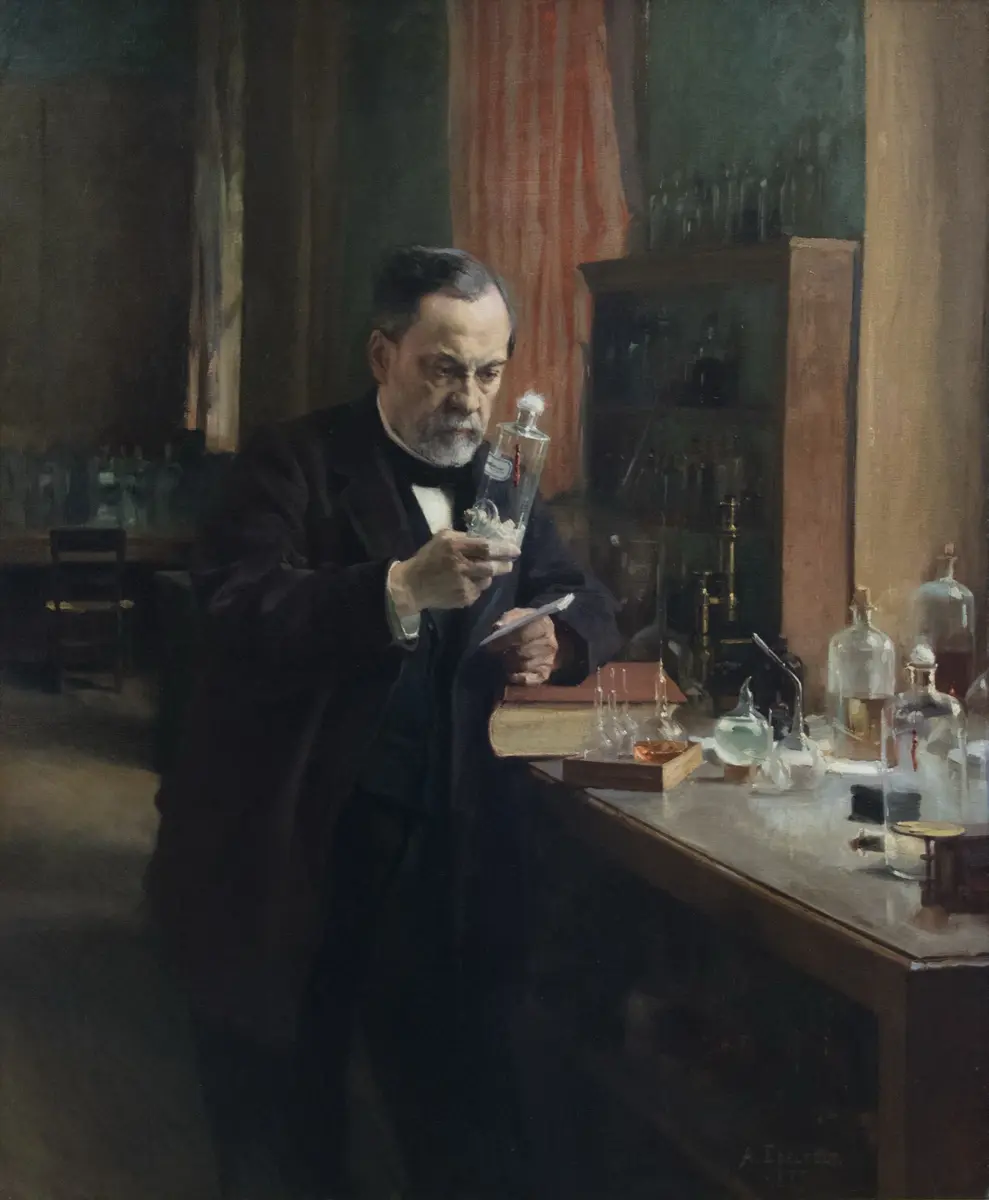
He became one of the sights of Delft. The future James II of England came to see him, and in 1697 Tsar Peter the Great of Russia had him brought to his boat on the Schie to look at blood flowing in an eel's tail. He made more than five hundred lenses and microscopes but kept his best methods secret, and only about ten of his microscopes survive. He died at home on 26 August 1723, aged 90, and was buried in the Oude Kerk, where his daughter Maria later raised a monument to him; she also sent the Royal Society the cabinet of 26 microscopes he had left it. Because no one could match his lenses, his discoveries were long doubted and half forgotten. He himself did not believe that his little animals caused disease; that link was made only in the nineteenth century by Louis Pasteur and Robert Koch, who built on the world he had been the first to see.
What happened
- 1632
Antoni Philipsz, later van Leeuwenhoek, is born in Delft, on the Oosteinde, into a family of basket makers. On 4 November he is baptised in the Nieuwe Kerk, a few days after Johannes Vermeer was baptised there.
- 1638
His father dies and is buried in the Nieuwe Kerk. In 1640 his mother marries the painter Jacob Jansz Molijn, and the boy is sent to school at Warmond, near Leiden, and later lives with an uncle at Benthuizen.
- 1648
At sixteen he goes to Amsterdam to learn the cloth trade with William Davidson, a Scottish linen merchant.
- 1654
Back in Delft, he marries Barbara de Mey, the daughter of a cloth merchant, and sets up as a draper and haberdasher.
The gunpowder store of Delft blows up, killing many people and wrecking much of the town.
- 1655
He buys a house and shop, Het Gulden Hoofd, on the west side of the Hippolytusbuurt canal, for 5,000 guilders. He will live and work there for almost seventy years.
Het Gulden Hoofd on the Hippolytusbuurt, Delft: the house and shop he bought in February 1655 and lived in until his death in 1723; his workroom was here- 1660
The town appoints him chamberlain to the aldermen in the town hall, a paid post that gives him a secure income for the rest of his life.
The town hall of Delft, on the Markt: from 1660 he was chamberlain to the aldermen who met here- 1666
Barbara dies and is buried in the Oude Kerk; of their five children only Maria, born in 1656, lives. In October he becomes the town's general district supervisor (wijkmeester), a post he keeps until 1711.
The Oude Kerk, Delft: where his first wife and children were buried, where he was buried on 31 August 1723, and where his daughter raised his monument in 1739- 1669
He passes the examination as a land surveyor. By now he is grinding lenses and making small microscopes, perhaps inspired by Robert Hooke's Micrographia of 1665.
- 1671
He marries Cornelia Swalmius, a minister's daughter.
- 1673
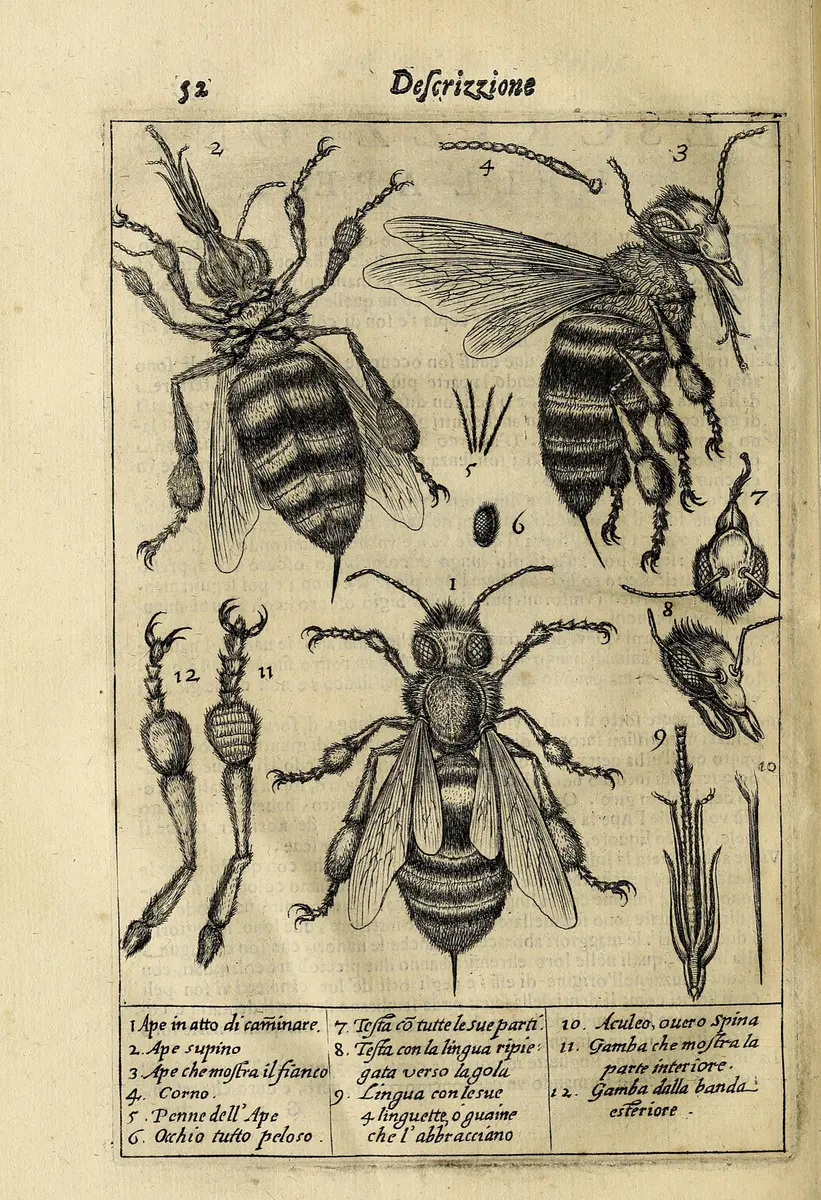
The Delft doctor Reinier de Graaf writes to Henry Oldenburg, secretary of the Royal Society, about Leeuwenhoek's microscope, enclosing his first observations, of mould and of the sting and eye of a bee. They are printed in the Philosophical Transactions in May, and the letters begin that will run for fifty years.
- 1674
In letters to Constantijn Huygens and to Oldenburg he describes the red 'globules' of human blood, the red blood cells.
He writes of water from the Berkelse Meer, a lake near Delft, full of green spiral threads (the alga Spirogyra) and of tiny moving creatures: his first report of single-celled animals.
- 1676
The aldermen appoint him curator of the estate of Catharina Bolnes, the bankrupt widow of the painter Johannes Vermeer, who had died the previous December.
In a long letter to Oldenburg he describes 'little animals' in rain, well and sea water and in water in which pepper has soaked, some so small that a hundred laid end to end would not reach the length of a grain of coarse sand: the first known description of bacteria.
- 1677
Oldenburg prints an English extract of the letter in the Philosophical Transactions, 'Concerning little Animals'.
He writes to Lord Brouncker, President of the Royal Society, about the 'little animals' swarming in human semen, the sperm cells, first shown to him by a medical student, Johan Ham.
After two failures, Robert Hooke shows the Fellows of the Royal Society the tiny creatures in pepper water (15 November by the English calendar), so that, as the minutes say, there was no longer any doubt of Leeuwenhoek's discovery.
The site of Gresham College in Bishopsgate, London (now Tower 42): where the Royal Society was founded in 1660 and where Robert Hooke lived and wrote to him- 1680
The Royal Society elects him a Fellow (29 January by the English calendar) and sends his diploma in a silver box. He thanks the Fellows in May, but never attends a meeting.
The site of Gresham College in Bishopsgate, London (now Tower 42): where the Royal Society was founded in 1660 and where Robert Hooke lived and wrote to him- 1683
Writing to Francis Aston of the Royal Society, he describes and has drawn the many kinds of tiny living things in the white matter between his teeth and in the mouths of others: bacteria.
- 1686
Jan Verkolje paints his portrait and makes a mezzotint of it, showing him with one of his microscopes.
- 1688
He describes blood flowing from arteries into veins through the finest vessels in the tails of tadpoles and small fish, and the shape of the red blood cells.
- 1694
His second wife, Cornelia, dies and is buried in the Oude Kerk.
The Oude Kerk, Delft: where his first wife and children were buried, where he was buried on 31 August 1723, and where his daughter raised his monument in 1739- 1695
Arcana naturae detecta, a Latin edition of his letters, is printed in Delft, making them readable across Europe.
- 1697
Tsar Peter the Great of Russia, travelling incognito, has him brought to his yacht near Delft and spends two hours with his microscopes, watching the blood flow in a living eel's tail.
- 1716
Professors of the University of Leuven send him an honorary medal and a poem in praise of his work.
- 1723
He dies at home on the Hippolytusbuurt, aged 90, after dictating his last letters to the Royal Society, and is buried in the Oude Kerk on 31 August.
The Oude Kerk, Delft: where his first wife and children were buried, where he was buried on 31 August 1723, and where his daughter raised his monument in 1739