Krakatoa erupts
“On 27 August 1883 the volcano Krakatau, between Java and Sumatra, blew itself apart; its tsunamis killed some 36,000 people, its bang was heard 4,800 km away and its dust reddened skies worldwide.”
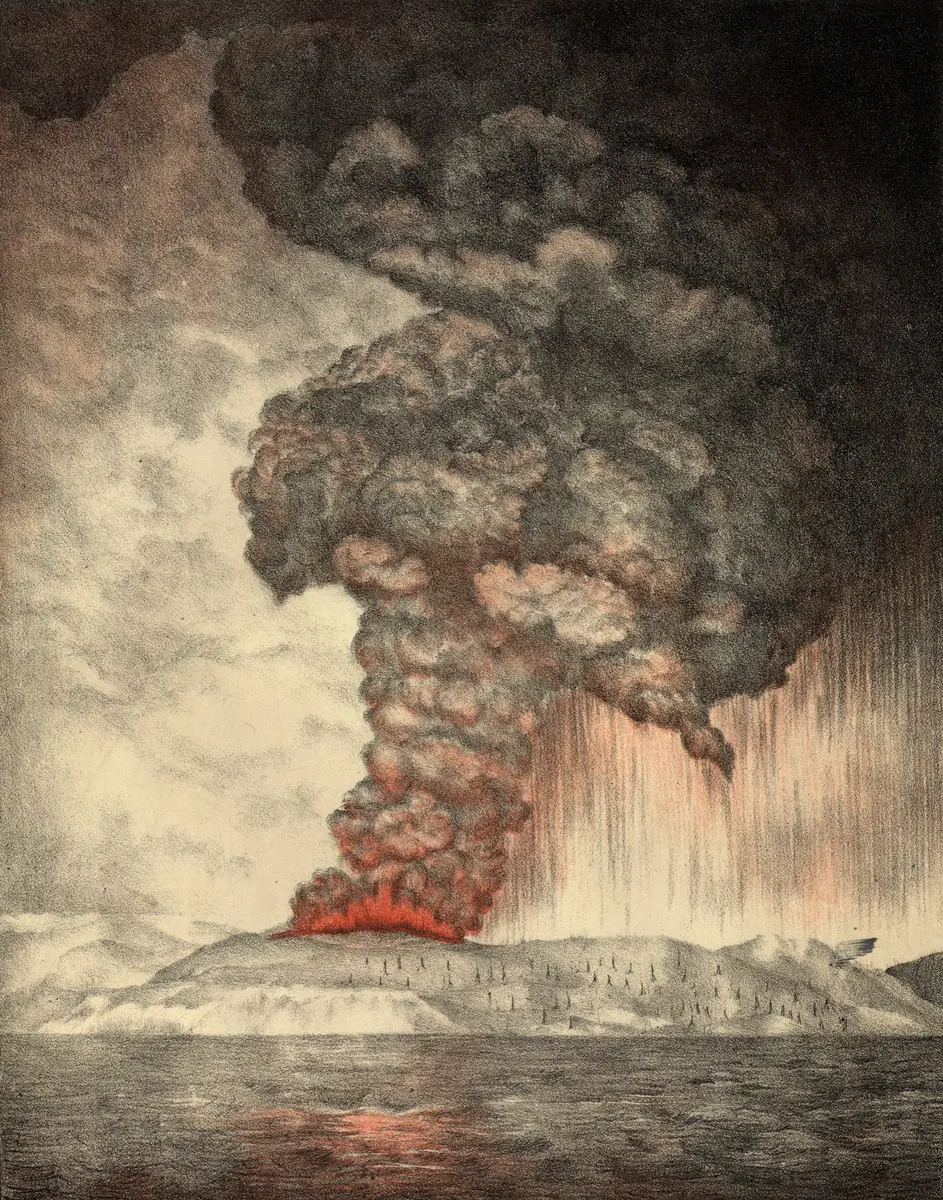
Krakatau, which the English-speaking world calls Krakatoa, was an uninhabited volcanic island in the Sunda Strait, the narrow sea between Java and Sumatra in what was then the Dutch East Indies. Only fishermen from Lampung landed on it, and it had last erupted in 1680. On 20 May 1883 Perboewatan, the lowest of its three peaks, came to life, and for three months it threw out ash and pumice; a week after it began, a steamer full of sightseers from Batavia went to watch, and they climbed to its smoking crater. On the afternoon of Sunday 26 August the eruption turned violent, and on the morning of 27 August four enormous explosions, at about 5:30, 6:44, 10:02 and 10:52 local time, tore the volcano apart. The greatest, at 10:02, was probably the loudest sound in recorded history: it was heard like distant gunfire on Rodrigues, an island near Mauritius almost 4,800 km away, and in Australia, over about a thirteenth of the Earth's surface. By the next morning two-thirds of the island had collapsed into the sea, leaving a sheer cliff some 800 metres high and water 200 to 300 metres deep where the mountain had stood.
Few people died from the explosions themselves. The killers were the sea waves raised as the volcano collapsed and masses of hot ash and rock fell into the strait. Tsunamis up to 35 to 40 metres high swept the low coasts of western Java and southern Sumatra: the town of Anjer (today Anyer) was already gone by six in the morning, and at Telok Betong (today part of Bandar Lampung) the waves carried the government steamer Berouw about three kilometres up a river valley. The official count was 36,417 dead, nearly all of them Javanese and Sumatran villagers, and 165 villages were wiped out; about 2,000 people in southern Sumatra were killed not by water but by clouds of hot ash that crossed 40 km of sea. In Batavia, 150 km away, the sky turned yellow and then, at 11:20 that morning, completely dark as the ash rained down.
The whole world could follow the catastrophe: in the last days of August the telegraph cable from Batavia carried the news to Singapore and from there to every continent. And instruments everywhere recorded it. The pressure wave of the great explosion was traced on barometers around the globe, passing many weather stations up to seven times as it travelled out to the far side of the Earth and back; in Batavia it was caught by the pressure gauge of the gasworks, and small waves showed on tide gauges as far away as France and England. The finest dust and the volcano's sulphur gas rose into the stratosphere and circled the globe in about two weeks. People in India saw a blue and green sun in September, and from November skies across Europe and America glowed so red after sunset that on 27 November fire engines were called out in Poughkeepsie, New York, to fight a fire that was not there. For a year or two the haze dimmed the sunlight enough to cool the Earth's surface slightly, by a few tenths of a degree at most.
Two great studies turned the catastrophe into science. The Dutch government sent Rogier Verbeek, head of the geological survey of Java, who surveyed the strait and climbed the ruined island in October 1883; his report 'Krakatau' (1885–86), with its maps and coloured plates, showed that the north of the volcano had not been blown into the sky but had sunk into the emptied chamber below it. In London the Royal Society set up a Krakatoa Committee in January 1884, which gathered hundreds of reports from ships, observatories and ordinary observers, from the barograms and tide gauges to the colour of the sunsets; its report of 1888 is still the most thorough study of the worldwide effects of a single eruption, read to this day by scientists who study how volcanoes change the atmosphere and the climate.
In December 1927 a new volcano began to grow from the sea floor inside the drowned crater, and by 1930 it had become an island: Anak Krakatau, 'child of Krakatau', which has erupted often ever since. On 22 December 2018 part of it slid into the sea, and its tsunami killed more than 400 people on the same coasts. Krakatau remains the yardstick for a violent eruption and for how far its effects can reach.
What happened
- 1883
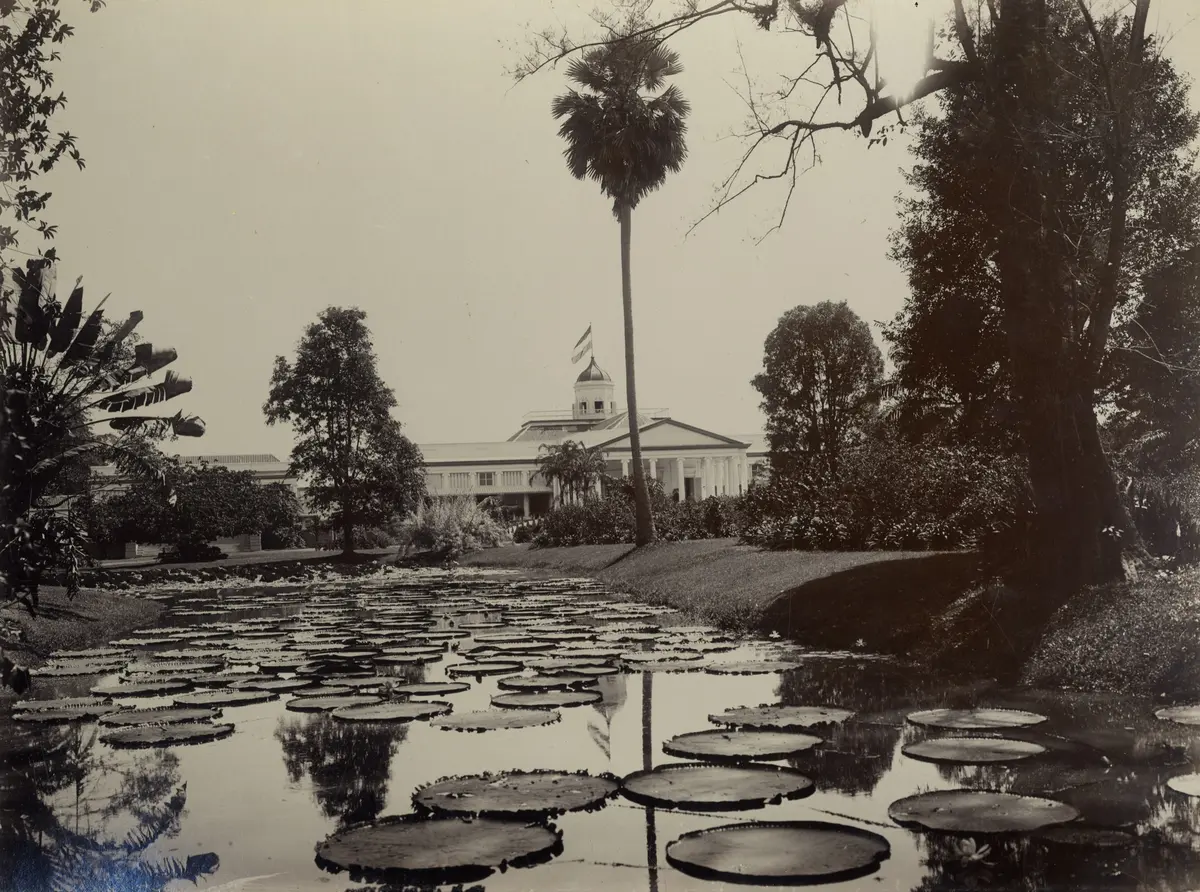
On a Sunday morning booming sounds like gunfire rattle doors and windows in Batavia and Buitenzorg, some 160 km away: Perboewatan, the low northern cone of uninhabited Krakatau, has come to life after two centuries of quiet. The German warship Elisabeth, which left Anjer that morning, measures the ash column at about 11 km high.
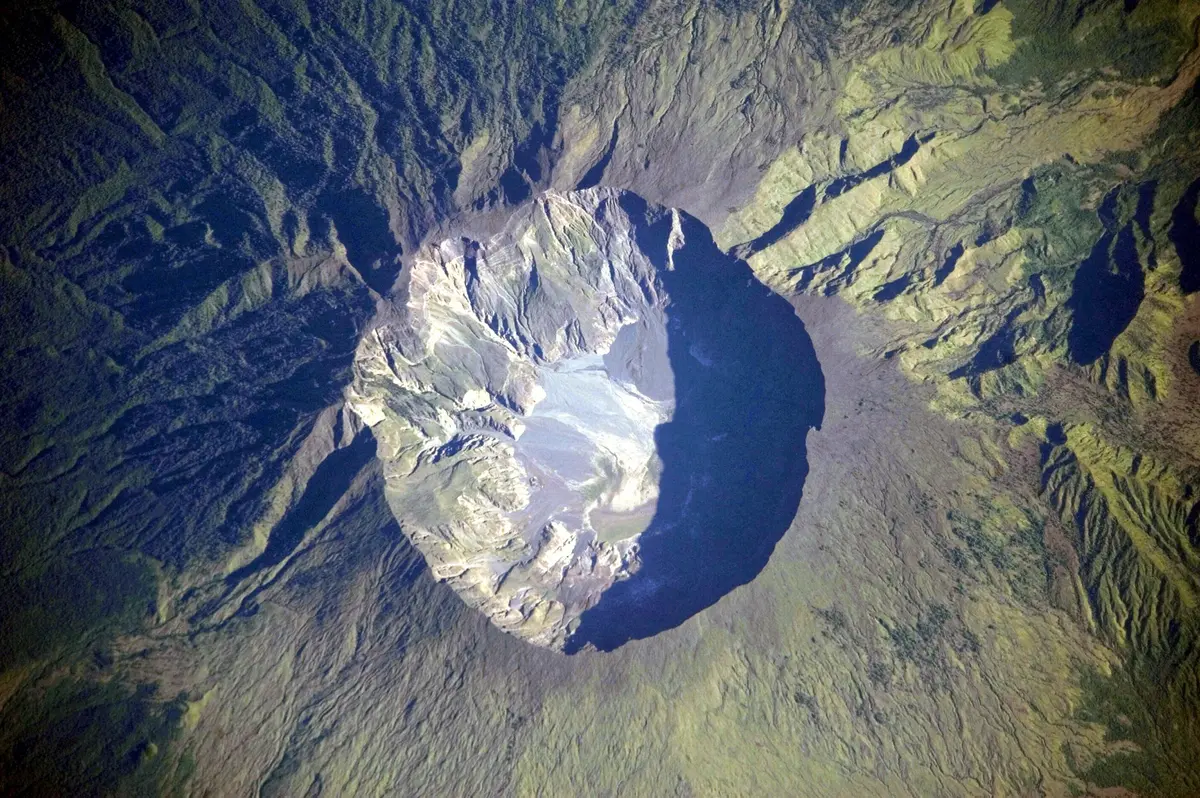
Anak Krakatau: where the vanished cones of Perboewatan and Danan stood, and where the 'child of Krakatau' rose from 1927A party of sightseers who left Batavia by steamer the day before reaches the island, finds it white with ash and climbs ankle-deep in pumice to Perboewatan's crater, about 900 metres across, where explosions burst from the vent every five to ten minutes. A photographer on board takes the picture of the eruption that the world will know.
Anak Krakatau: where the vanished cones of Perboewatan and Danan stood, and where the 'child of Krakatau' rose from 1927After a quieter spell the eruption grows again (Anjer notices it from 19 June), and a second column of vapour is seen rising from the centre of the island, from the cone of Danan. Through July passing ships and the coasts hear explosions now and then, but people in the region pay it little attention.
Anak Krakatau: where the vanished cones of Perboewatan and Danan stood, and where the 'child of Krakatau' rose from 1927Captain Ferzenaar, head of the survey staff in Bantam, sails along the island: three large columns and at least eleven smaller vents are pouring out ash, the forests of the north are dead, and the ash on the shore lies half a metre deep. It is the last look at Krakatau before the catastrophe; the trees on Rakata's peak are still growing.
Anak Krakatau: where the vanished cones of Perboewatan and Danan stood, and where the 'child of Krakatau' rose from 1927- 1:00 p.m.
Around one in the afternoon the eruption turns violent; by two a black ash cloud stands some 27 km above the island. Explosions follow through the night while the British ship Charles Bal beats about within a dozen miles of the volcano, and the first sea waves reach the Java and Sumatra shores between six and seven in the evening.
Anak Krakatau: where the vanished cones of Perboewatan and Danan stood, and where the 'child of Krakatau' rose from 1927 At Telok Betong, at the head of Lampung Bay in Sumatra, the waves run 22 metres up the hill below the Resident's house and carry the government steamer Berouw, anchored at the pier, almost three kilometres up a river valley; the barque Marie, riding on three anchors in the bay, survives. Through the strait more than 36,000 people are drowned or killed by hot ash.
Telok Betong (Teluk Betung, Bandar Lampung): where the waves carried the steamer Berouw about three kilometres inland- 5:30 a.m.
The first of the four great explosions. Another follows at 6:44. In the darkness the waves they raise sweep the Java coast: Anjer is already destroyed and abandoned by about six in the morning.
Anjer (Anyer), on the Java shore of the strait: destroyed by the sea wave around six in the morning of 27 August - 10:02 a.m.
The greatest explosion, probably the loudest sound in recorded history, as the north of the island collapses into the sea; a fourth, smaller one follows at 10:52. The bang is heard in Ceylon, the Philippines, New Guinea and at Perth in Australia; on Rodrigues, almost 4,800 km away, the police chief records 'the distant roars of heavy guns'. The largest tsunami of the day, raised around this moment, runs 30 to 36 metres up the coasts around Merak and north of Anjer.
Rakata: the southern third of Krakatau that survived, its north side a cliff cut through the old volcano - 11:20 a.m.
In Batavia, about 150 km east, the air waves of the explosions have rattled windows, stopped clocks and set the great gasometer of the gasworks rocking, its pressure gauge drawing the record by which the explosions are timed. The sky turns yellow after ten, ash begins to fall, and at 11:20 the city is in complete darkness; the dust rain lasts until three.
Batavia (Jakarta), 150 km away: the gasworks' gauge recorded the air waves, and the ash made it dark at 11:20 The explosions stop at about six in the morning, and the volcano falls silent. Meanwhile the pressure wave of the great explosion is travelling around the planet: barometers from Mauritius to Melbourne, Bombay and the British observatories record it as it goes out to the far side of the Earth and back, up to seven times over the following days, and tide gauges as far away as France and England show small waves.
At Ongole in India the sun rises 'blue, green, and yellow' for three days: the band of fine volcanic dust high in the stratosphere has gone once round the world near the equator in about two weeks and is passing over again.
The last eruption, as Verbeek later works it out: at about half past nine in the evening Krakatau throws out mud that streams down the slopes of the ruined peak, and a small wave washes 75 metres inland at Tjikawoeng in Welcome Bay on the Java coast.
Rakata: the southern third of Krakatau that survived, its north side a cliff cut through the old volcanoRogier Verbeek, sent by the government to investigate, climbs to the top of the remnant (831 metres, he measures) during his three days on the island. His seventeen-day voyage on the hopper Kediri, which left Batavia on 11 October, surveys the islands and the wrecked coasts of Java and Sumatra and measures how high the waves ran.
Rakata: the southern third of Krakatau that survived, its north side a cliff cut through the old volcanoOn the bank of the Thames west of London, William Ascroft sketches the sky from just after sunset, at 3:57, until the afterglow dies at about 5:15. Glowing red skies are now seen across Europe and North America.
Chelsea, London: where William Ascroft sketched the afterglow on 26 November 1883The glow is so intense at Poughkeepsie, on the Hudson in New York State, that fire engines are called out in the morning.
- 1884
A week after hearing reports from the Sunda Strait read at the Royal Society, its Council appoints a Krakatoa Committee 'to collect the various accounts of the volcanic eruption at Krakatoa, and attendant phenomena'. Its appeal in The Times asks the world for observations of pumice, dust, air waves, sea waves, sounds and the colours of the sky; the report appears in 1888.
At Buitenzorg Verbeek signs his short report on the eruption, the first account by the official investigator; Nature publishes it in English on 1 May. It names the hours of the four great explosions from the gasworks record, reckons 18 cubic kilometres of rock thrown out, and finds that the north of the island has sunk.
- 1885
Verbeek's full report, 'Krakatau', appears with an atlas of maps and coloured drawings of the island and the devastated coasts; a French edition follows. The Royal Society dates it 1885-86.