The spinning jenny
“Around 1764 the Lancashire weaver James Hargreaves built the spinning jenny, which let one person spin eight, then dozens, of cotton threads at once: the first spinning machine used on a large scale.”
Around 1764, in the hamlet of Stanhill near Blackburn in Lancashire, a weaver named James Hargreaves built a machine that let one person spin many threads of cotton at once. Until then every thread was spun on a spinning wheel, one at a time, mostly by women working at home, and weavers, who had become faster since John Kay's flying shuttle of 1733, were always short of yarn. The story goes that Hargreaves saw a wheel knocked over on the floor, its spindle still turning upright, and saw that a row of upright spindles could be turned together. His frame held the loose rolls of cotton in a sliding wooden clasp: the spinner drew the clasp back with one hand, stretching the cotton, while the other hand turned a wheel that spun all the spindles at once. The first jenny had eight spindles. Hargreaves himself could not read or write.
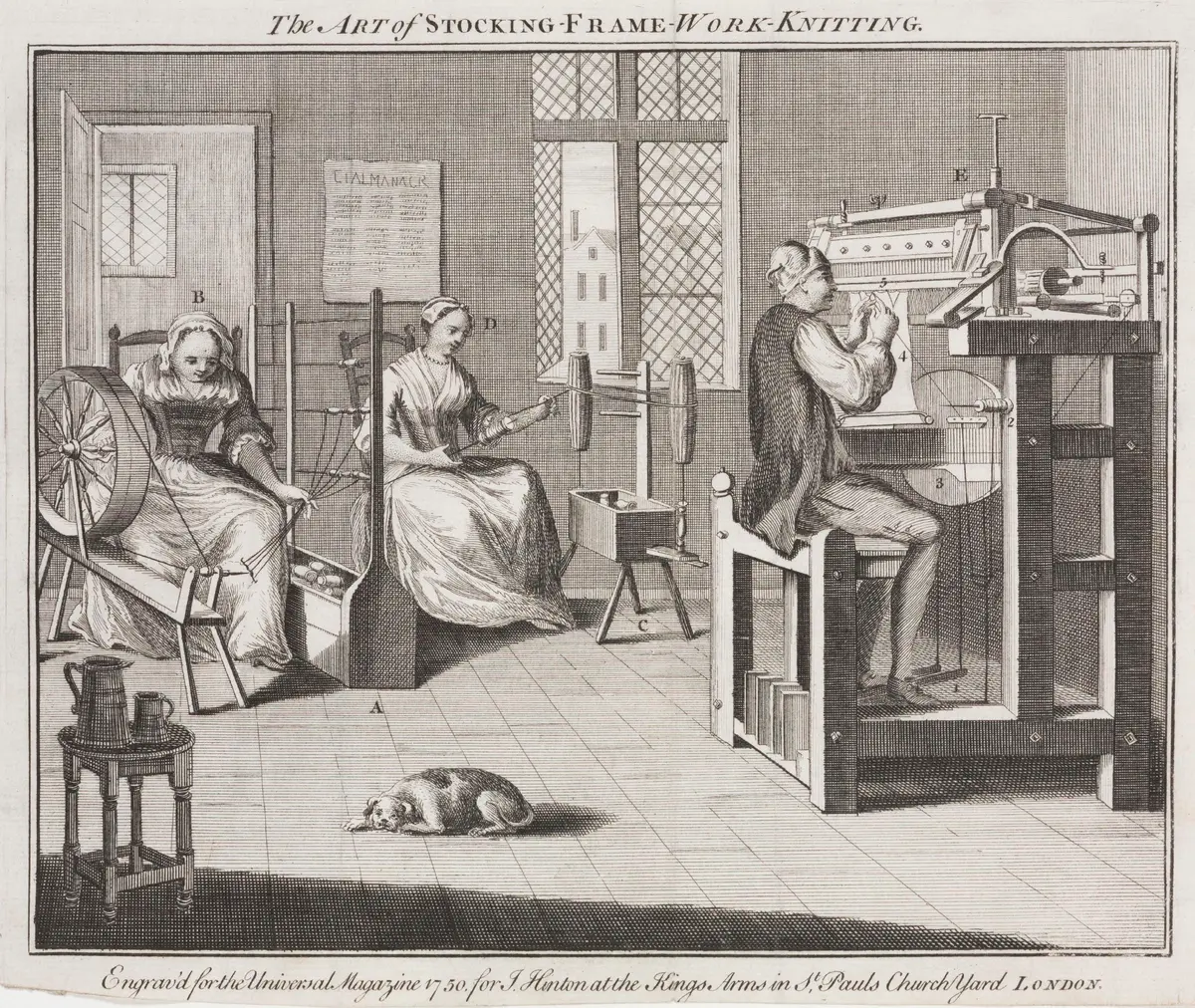
At first he and his family used the jenny to spin weft for his own weaving and kept it quiet, but he sold a few machines to buy clothes for his children, and word got out. Hand spinners feared for their living: in 1768 his neighbours broke into his house and smashed his jenny, and a mob attacked the workshop at Brookside where his backer, Robert Peel, had set him up. Hargreaves left Lancashire for Nottingham, where, with a joiner named Thomas James, he built a small mill at Hockley spinning cotton yarn for the town's stocking-knitters. In 1770 he patented the jenny, now with sixteen spindles or more, and sued the Lancashire spinners who were using it. They offered him £3,000; he held out for £4,000, and then his lawyer dropped the cases, because the machines Hargreaves had sold before the patent made it unenforceable. He died in April 1778, comfortable but not rich, and not, as Richard Arkwright later claimed, in poverty.
The jenny spread anyway, because it was cheap and simple. It was turned by hand and fitted in a cottage; a 24-spindle jenny cost about 70 shillings, against a shilling or less for a spinning wheel, and still paid for itself in Britain, where wages were high. Twenty-four spindles became the standard in the 1770s, and by 1780 workshop jennies had 80 to 120. Spinners rioted against them again in 1779, when crowds around Blackburn broke the jennies with more than twenty spindles. By 1788, reportedly, more than 20,000 jennies were spinning cotton in Britain, while France had only about 900 in 1790. Jenny yarn was soft and best for weft, the crosswise threads; Arkwright's water frame (1769) spun the strong warp, and in 1779 Samuel Crompton, who had learned to spin on a Hargreaves jenny, combined the water frame's rollers with the jenny's way of stretching and twisting the thread in his mule, which in time replaced the jenny in the factories.
The spinning jenny was the first spinning machine used on a large scale, and it began the mechanisation of cotton, the industry that led Britain's Industrial Revolution. The cheap yarn it made went into fustians, printed cottons and cotton stockings, and helped turn cotton from an imported luxury into everyday clothing. Historians still use the jenny to ask why the Industrial Revolution began in Britain: it was not a scientific breakthrough but a weaver's practical idea, and it paid in Britain, where labour was dear, and not in France or India, where it was cheap.
What happened
- 1764
At Stanhill near Blackburn, the weaver James Hargreaves builds a spinning machine, the jenny: a row of upright spindles turned by one wheel, with a sliding clasp that draws out eight threads at once. He and his family use it to spin weft for his own weaving and keep it secret.
Stanhill, Oswaldtwistle, near Blackburn: the hamlet where Hargreaves lived as a weaver and built the first jenny around 1764, and where his neighbours smashed it - 1768
Hand spinners, afraid for their living, break into Hargreaves' house and smash his jenny. He moves to Brookside, where his backer Robert Peel pays for a workshop, but a mob attacks that too and destroys the jennies.
Stanhill, Oswaldtwistle, near Blackburn: the hamlet where Hargreaves lived as a weaver and built the first jenny around 1764, and where his neighbours smashed itHargreaves leaves Lancashire for Nottingham. He first makes jennies in secret for a Mr Shipley, then goes into partnership with the joiner Thomas James, who borrows the money to build a small mill at Hockley, with two houses beside it, to spin cotton yarn for the town's stocking-knitters.
Hockley, Nottingham: where Hargreaves and Thomas James built their small jenny mill, spinning cotton yarn for the town's stocking-knitters, from about 1768- 1769
Samuel Crompton, aged about sixteen, learns to spin on 'a jenny of Hargreaves's make' at Hall-in-the-Wood near Bolton; ten years later he will improve on it.
Hall i' th' Wood, Bolton: Samuel Crompton's home, where he learned to spin on a Hargreaves jenny in 1769 and finished his mule in 1779 - 1770
Hargreaves' patent, No. 962, is granted for 'a wheel or engine of an entire new construction' that spins, draws and twists 'sixteen or more threads at one time'. He then sues Lancashire manufacturers using the jenny; they offer £3,000, he asks £7,000, then £4,000, and before trial his attorney drops the cases, because Hargreaves had sold jennies before the patent to buy clothes for his children.
Hockley, Nottingham: where Hargreaves and Thomas James built their small jenny mill, spinning cotton yarn for the town's stocking-knitters, from about 1768- 1775
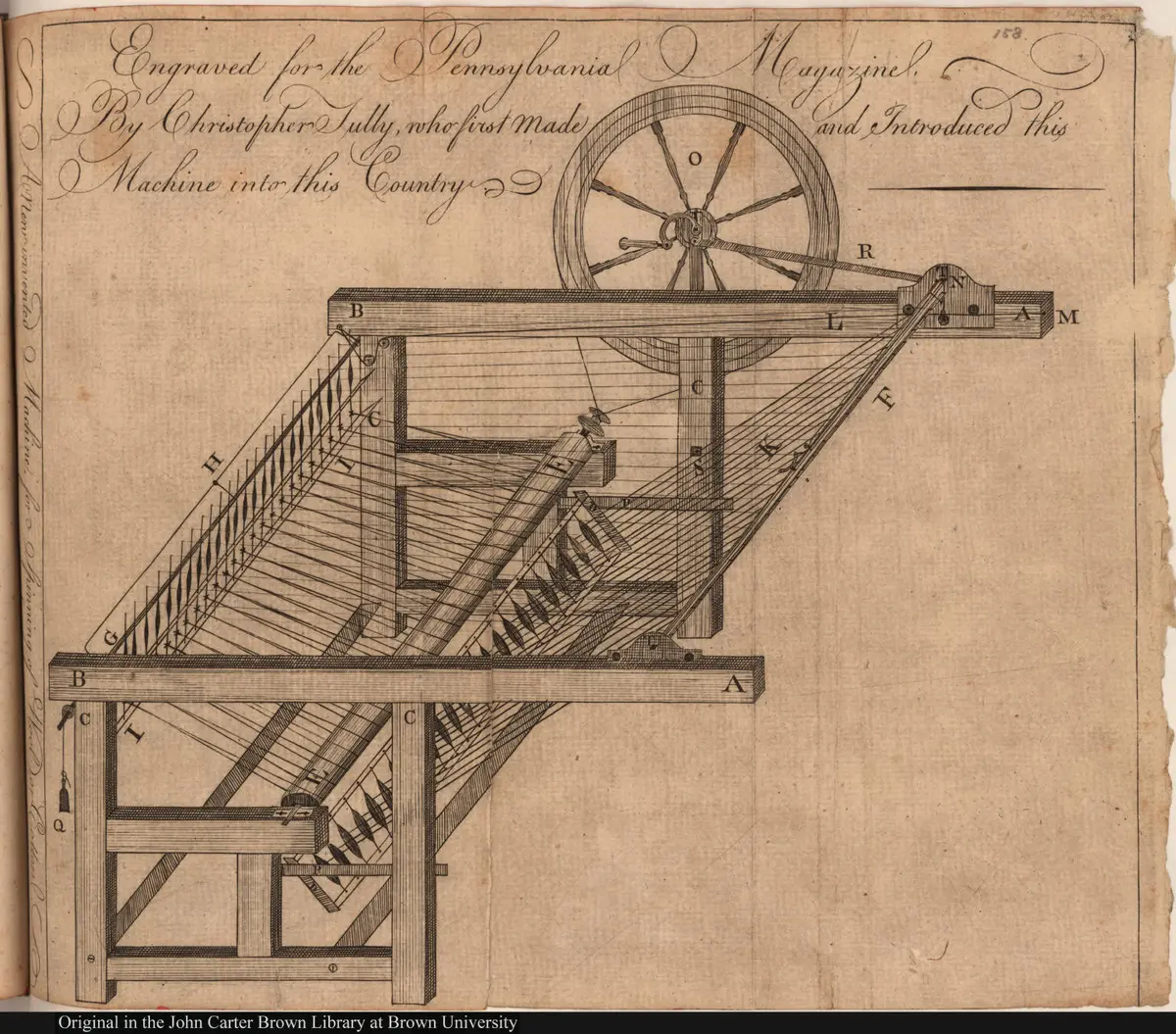
In Philadelphia the Pennsylvania Magazine prints an engraving of a 24-spindle jenny by Christopher Tully, 'who first made and introduced this machine into this country': the earliest known picture of a jenny.
Philadelphia: Christopher Tully's jenny, the first in America, was shown and engraved here in 1775- 1778
Hargreaves dies at his house beside the Hockley mill and is buried at St Mary's, Nottingham ('James Hargraves' in the register). His widow receives £400 for his share of the business; he had lived in modest comfort, not in the poverty Arkwright later described.
St Mary's Church, Nottingham: Hargreaves was buried here in April 1778- 1779
In a slump, crowds scour the country for miles round Blackburn, breaking jennies with more than twenty spindles, carding engines and water-powered machines; Robert Peel's machinery at Altham is thrown into the river and Arkwright's mill at Birkacre near Chorley is wrecked.
Blackburn, Lancashire: the cotton district around Hargreaves' home, where crowds broke the larger jennies in the riots of 1779At Hall-in-the-Wood Samuel Crompton completes his mule, or 'mule jenny', which combines the rollers of Arkwright's water frame with the jenny's stretching and twisting of the thread, its spindles riding on a moving carriage; it spins finer yarn than either and will replace the jenny in the mills.
Hall i' th' Wood, Bolton: Samuel Crompton's home, where he learned to spin on a Hargreaves jenny in 1769 and finished his mule in 1779- 1780
A Manchester pamphlet 'by a friend of the poor', Thoughts on the use of machines in the cotton manufacture, tells spinners and weavers that the new machines will make more work, not less.
Manchester: centre of the cotton trade, where the 1780 pamphlet defending the machines was printed and where a writer of 1783 recorded the jenny's storyA jenny with 120 spindles is built; jennies of 80 spindles in workshops become the standard, while cottage jennies of 24 spindles begin to give way to them.
- 1783
A Manchester writer records that about 1764 'a poor man, of the name of Hargreaves' first made a machine near Blackburn that spun eleven threads, patented in 1770, and that one woman can now spin a hundred threads at a time.
Manchester: centre of the cotton trade, where the 1780 pamphlet defending the machines was printed and where a writer of 1783 recorded the jenny's story - 1788
Some 20,070 jennies are reported to be spinning cotton in Britain, most of them in Lancashire.