The stocking frame
“Around 1589 William Lee built the stocking frame, the first knitting machine; he won no patent in England and died in France, but his frame founded the hosiery trade.”
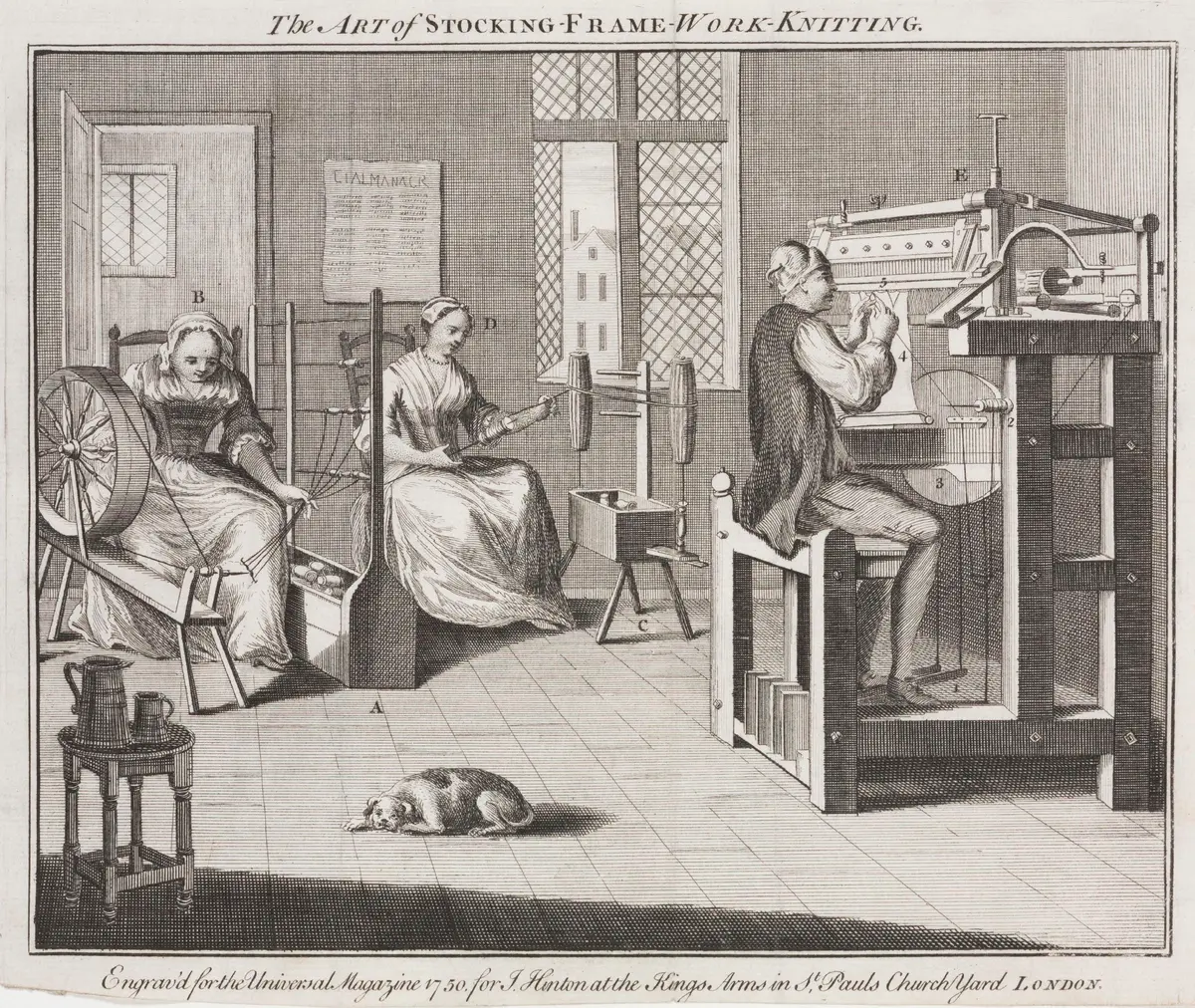
Around 1589 an Englishman named William Lee built a machine that could knit. A hand-knitter makes one loop at a time with two needles. Lee's frame held a long row of fine steel needles, each with a springy hooked tip called a beard, one needle for every loop. Working bars and treadles with hands and feet, the knitter laid the thread across all the needles and formed a whole row of loops at once. The frame made flat pieces, which were shaped as they were knitted and then sewn up into stockings. It was the first machine ever built for making a textile, almost two centuries before the spinning machines of the Industrial Revolution.
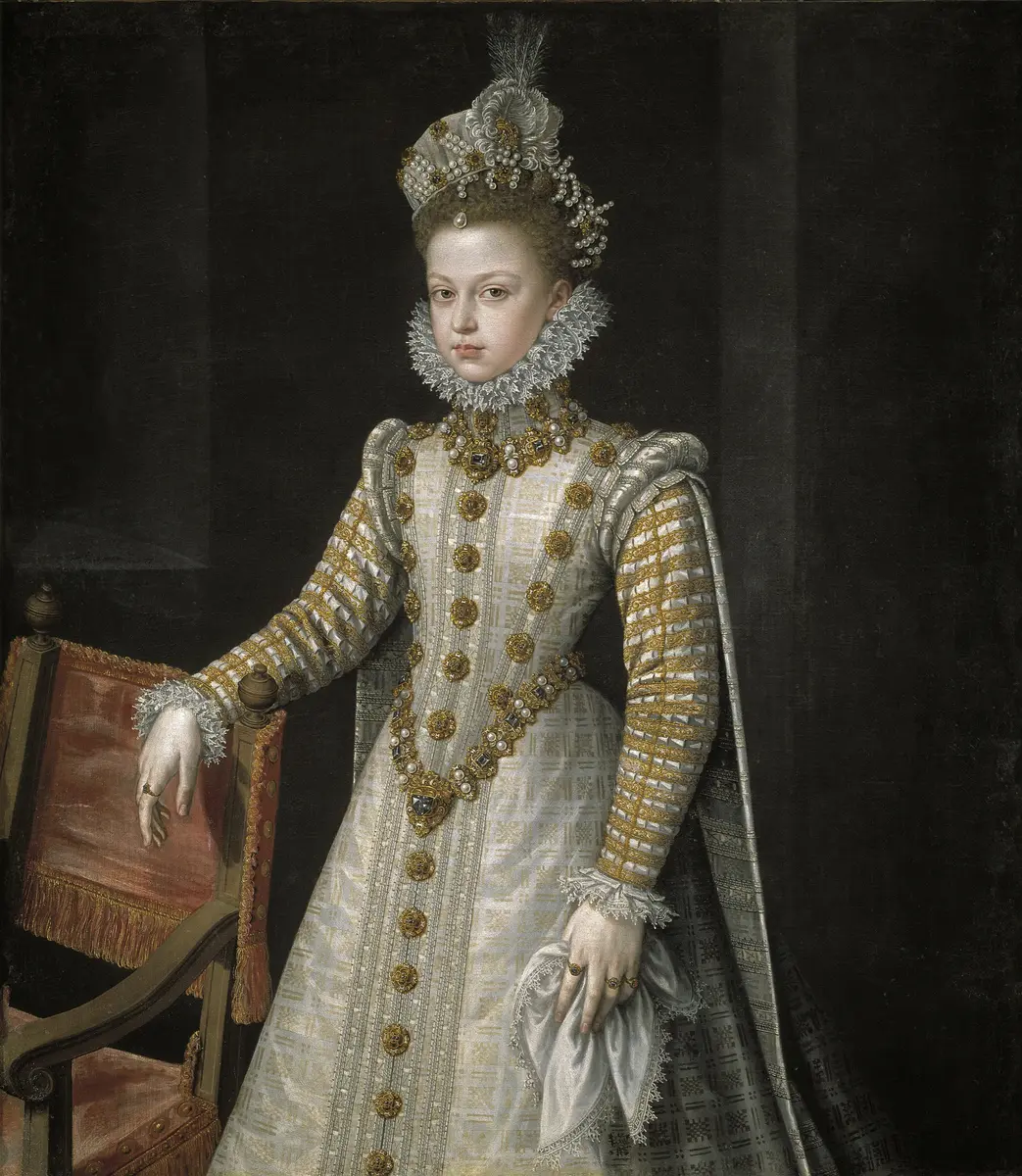
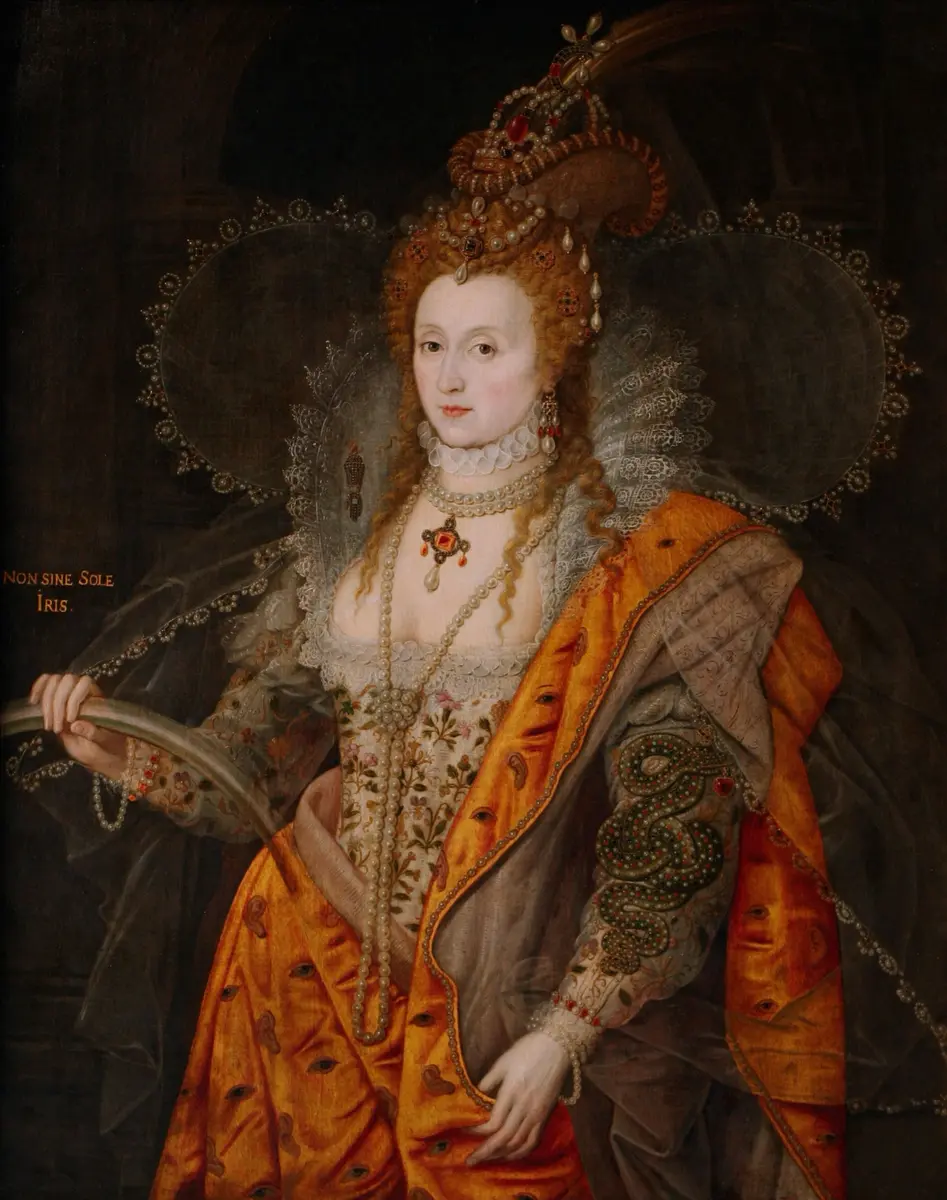
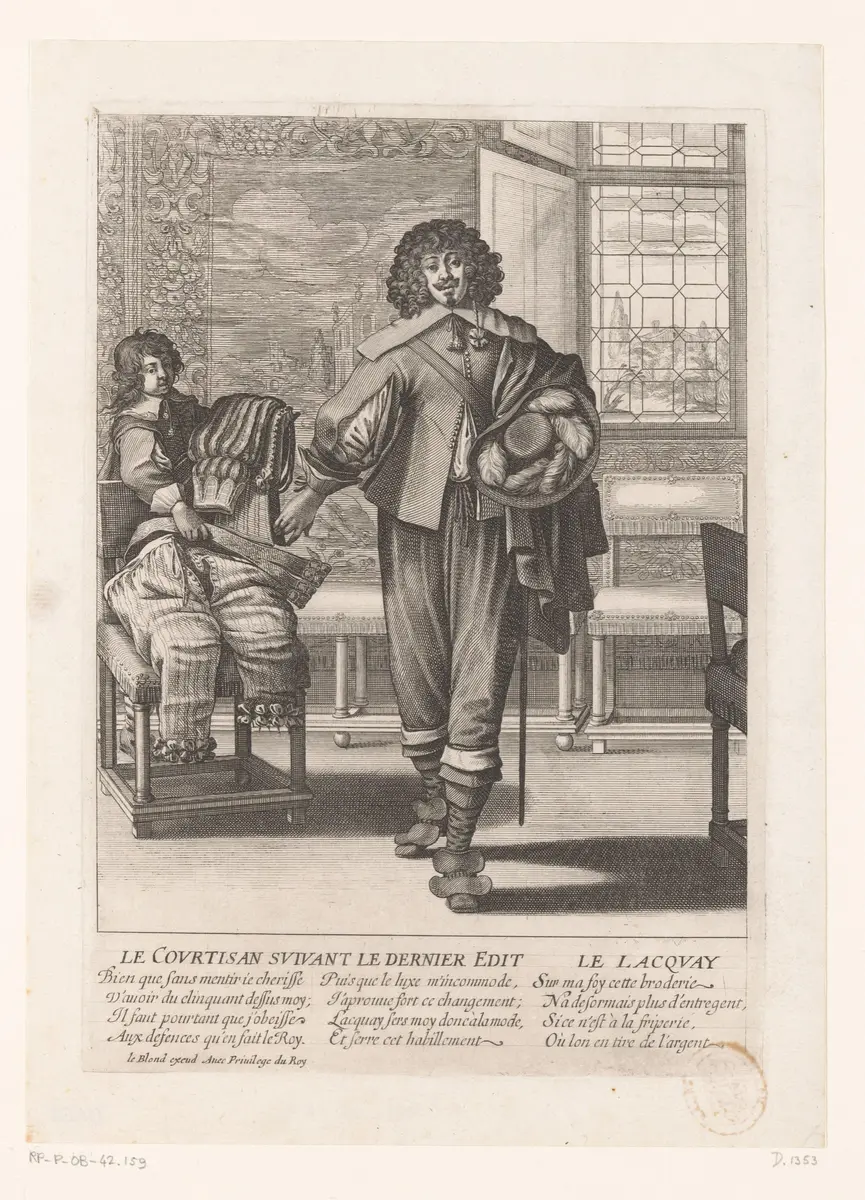
Lee aimed at a fashion market. In the sixteenth century men's legs were on show, and close-fitting knitted stockings had replaced hose cut from cloth. Hand-knitting had grown into a real trade, with worsted stockings made for sale across England and even exported, while silk stockings, imported and very expensive, were the height of fashion in London. A machine that could knit fine silk quickly promised a fortune. By 1605 Lee was calling himself the 'first inventor of an engine to make silk stockings'.
Much of what is usually told about Lee is legend. The stories that he was a country clergyman, that he invented the frame to win, or to spite, a woman who cared more for her knitting than for him, and that Elizabeth I refused him a patent because she feared for her poor hand-knitters, all come from writers of 1677 and later; the Queen's famous speech was first printed in 1831. The few records from his own lifetime show something plainer: a partnership with the courtier George Brooke in 1600, ended when Brooke was executed for treason in 1603; a request to the City of London in 1605 for its freedom and workrooms; a place in the Weavers' Company in 1609; and then a new start in Rouen in Normandy, where in 1612 he contracted with a merchant, Pierre de Caux, to set up frames and train French workers. He is last recorded there in 1615 and seems to have died in France, without profit from his machine.
His invention outlived him. His brother James brought workmen and frames back to London, and Lee's former apprentice John Aston, a miller from Thoroton in Nottinghamshire, improved the machine. Frame-knitting took root in London and in the villages around Nottingham, and in 1657 Oliver Cromwell gave the London framework knitters a charter as a company to protect their trade. Frames were costly, as much as a worker's yearly wage in the 1660s, but the stockings they made sold at home and abroad.
Lee's design stayed in use, little changed in its basic action, into the late nineteenth century, and the hosiery trade it created made the East Midlands one of Britain's great knitting regions. It also showed how a machine could threaten skilled hand-work: in 1811 and 1812 Nottinghamshire stockingers smashed hundreds of frames in the Luddite riots. Today's knitting machines, and every machine-made sock and pair of tights, descend from the frame Lee built in the 1580s.
What happened
- 1589
William Lee completes a frame that knits: a row of bearded needles forms a whole row of loops at once. The year comes from the chronicler Edmund Howes (1607); tradition puts the work at Calverton.
Calverton, Nottinghamshire: the village Thoroton (1677) named as Lee's birthplace and home, where tradition puts the first frame; framework knitting later became its trade - 1600
Lee signs a 22-year partnership with George Brooke, a well-connected courtier, to make 'knit works' on his 'very speedy' frame; Brooke is to put about £500 into it.
Guildhall, City of London: where Lee petitioned the Court of Aldermen on 1 October 1605 for the freedom of the City and rooms in Bridewell; London was the scene of all his recorded work in England, 1600–1609- 1603
Elizabeth I dies and James VI of Scotland becomes James I of England. No royal patent for Lee's frame is known from either reign.
Lee's partner George Brooke is beheaded at Winchester for his part in the Bye Plot against the new king, ending Lee's best hope of backing.
- 1605
Calling himself a Master of Arts and the 'first inventor of an engine to make silk stockings', Lee asks the City of London's Court of Aldermen for the freedom of the City and for workrooms in Bridewell. The request goes to a committee and is heard of no more.
Guildhall, City of London: where Lee petitioned the Court of Aldermen on 1 October 1605 for the freedom of the City and rooms in Bridewell; London was the scene of all his recorded work in England, 1600–1609- 1607
Edmund Howes's chronicle prints the first account of the invention: in 1589 the art of knitting silk stockings and waistcoats 'by engines or steel loom' was invented by William Lee of St John's College, Cambridge.
- 1609
The Weavers' Company of London admits Lee, 'weaver of silk stockings by engine', as a 'foreign brother' for £2, with £1 more due when he sets up a loom. The second payment was never recorded.
Guildhall, City of London: where Lee petitioned the Court of Aldermen on 1 October 1605 for the freedom of the City and rooms in Bridewell; London was the scene of all his recorded work in England, 1600–1609- 1610
Henri IV of France is stabbed to death in Paris. The traditional story says the king had invited Lee to France and that his death ruined Lee's hopes of the privileges promised there.
- 1612
Lee's brother James returns to London with seven framework knitters and eight frames and starts a small trade there.
Guildhall, City of London: where Lee petitioned the Court of Aldermen on 1 October 1605 for the freedom of the City and rooms in Bridewell; London was the scene of all his recorded work in England, 1600–1609In Rouen, 'William Lee, English gentleman', and the merchant Pierre de Caux form a company to make silk and wool stockings: Lee is to supply four more frames, six English workmen and training for French apprentices, and to teach an ironworker how to build the machines.
Rouen, Normandy: where Lee contracted with Pierre de Caux on 16 February 1612 to set up knitting frames and train French workers, and where he is last recorded on 1 March 1615- 1615
Howes's new chronicle, the Annales, adds that Lee went to France, won a patent from its king and taught the craft there, and that his men were working in Spain, Venice and Ireland.
A Rouen legal record shows 'Master William Lee, English gentleman' and two other Englishmen still knitting stockings there: the last record of Lee alive. He is thought to have died in France soon after.
Rouen, Normandy: where Lee contracted with Pierre de Caux on 16 February 1612 to set up knitting frames and train French workers, and where he is last recorded on 1 March 1615- 1618
In a new edition of his chronicle Howes restores 1589 as the year of the invention and says Lee went to France 'because he was not regarded in England'.
- 1656
John Aubrey, with Sir John Hoskyns and Stafford Tyndale, goes to see a frame at work at a weaver's in London and notes what the weaver tells him of Lee, a 'poor curate' who copied the stitch from a stocking his wife had knitted.
In France, Jean Hindret makes the earliest surviving drawings of the stocking frame.
- 1657
Oliver Cromwell incorporates the London framework knitters as a company, to regulate the trade and keep the frames from being sent abroad; Charles II renews and widens the charter in 1663.