Elizabeth I
“The last Tudor monarch, queen of England from 1558 to 1603, who made the Church of England Protestant, never married, and saw off the Spanish Armada in 1588.”
Elizabeth I was queen of England and Ireland for forty-four years, from 1558 to 1603, the last of the Tudors and one of the best-known rulers in English history. She gave the country a Protestant church that it kept, survived a long series of Catholic plots to put her cousin Mary, Queen of Scots, on her throne, and led England through the war with Spain in which the Armada was defeated in 1588. She never married, and made that choice into a public image: the Virgin Queen, married to her kingdom. Her reign gave its name to the Elizabethan age, the time of Drake's voyage round the world, the first English ventures to America and the East, and the plays of Marlowe and Shakespeare.
She was born at Greenwich Palace on 7 September 1533, the daughter of Henry VIII and his second wife, Anne Boleyn: a girl, when her father wanted a son. Before she was three her mother was beheaded and Parliament declared her illegitimate. She was brought up in her own household, mostly at Hatfield, and given the education of an heir, in Latin, Greek, French, Italian and theology, under tutors such as Roger Ascham. Her teenage years were dangerous. Under her brother Edward VI she was questioned over Thomas Seymour, who was beheaded in 1549 for plotting, among other things, to marry her. Under her Catholic sister Mary I she was sent to the Tower of London after Wyatt's rebellion of 1554 and spent most of a year under guard at Woodstock, and she learned to keep her beliefs to herself.
Mary died on 17 November 1558 and Elizabeth, at 25, became queen; she was crowned in Westminster Abbey on 15 January 1559. That spring Parliament made her Supreme Governor of the Church of England and ordered one Protestant prayer book for every parish, a settlement that still left room for many old forms of worship. With William Cecil, later Lord Burghley, as her chief minister for forty years, she ruled carefully and spent little. In 1568 Mary, Queen of Scots, driven out of Scotland, fled to England, and for nineteen years she was the centre of Catholic hopes: the Rising of the North in 1569, the Pope's bull of 1570 that excommunicated Elizabeth, and a run of plots that ended with Mary's trial and her execution at Fotheringhay in February 1587.
Open war with Spain had begun in 1585. In the summer of 1588 Philip II's Armada sailed up the Channel to carry an army across from the Netherlands; English fireships and the battle off Gravelines broke it up, and storms wrecked many of its ships on the way home round Scotland and Ireland. At the army's camp at Tilbury the queen told her soldiers that she had the body of a weak woman but the heart of a king. Her last fifteen years were harder: war in Ireland, bad harvests, high prices, and a court split between Burghley's son Robert Cecil and her young favourite, the Earl of Essex, who tried to raise London against her ministers in February 1601 and was beheaded. She had chartered the East India Company on the last day of 1600, and in November 1601 her 'Golden Speech' won back a House of Commons angry about royal monopolies.
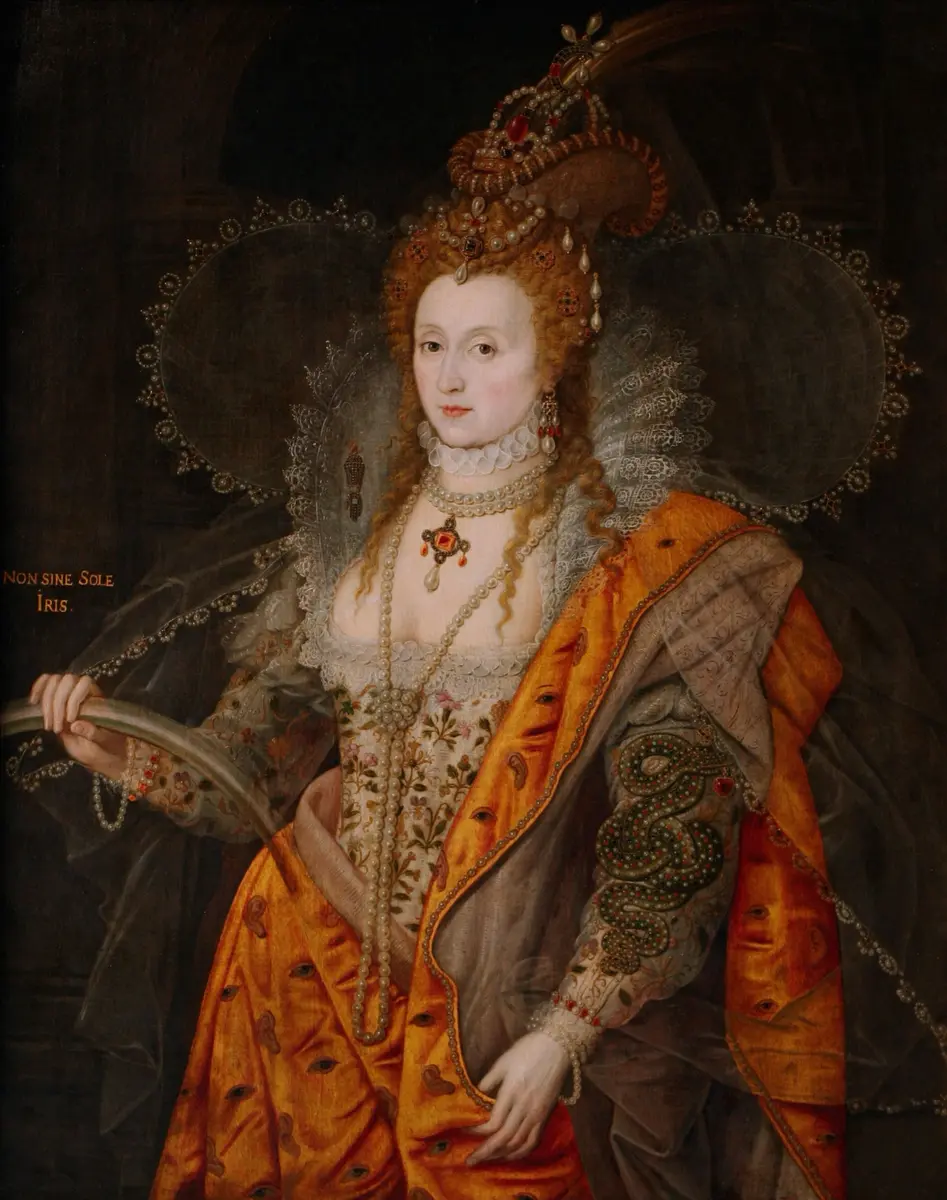
She died at Richmond Palace on 24 March 1603, aged 69, having refused to the end to name an heir; that day her council proclaimed Mary's son, James VI of Scotland, King of England. She was buried in Westminster Abbey, where James later laid her coffin on top of her sister Mary's under a marble monument. Elizabeth controlled her image closely: she sat to few painters and approved patterns of her face for others to copy, so that in her portraits she never grows old, from the young queen of the Darnley portrait to the ageless figure of the Rainbow portrait, painted when she was nearly seventy.
What happened
- 1533
Born at Greenwich Palace, the daughter of Henry VIII and his second wife, Anne Boleyn: a disappointment to a king who wanted a son.
Greenwich Palace (the Palace of Placentia): where she was born in 1533; the Old Royal Naval College stands on its siteBaptised in the church of the Observant Friars beside the palace, with Archbishop Thomas Cranmer among her godparents.
Greenwich Palace (the Palace of Placentia): where she was born in 1533; the Old Royal Naval College stands on its site- 1536
Her mother is beheaded in the Tower of London. In July Parliament declares Elizabeth, like her half-sister Mary, illegitimate and puts her out of the succession.
The Tower of London: where her mother was beheaded in 1536 and she was a prisoner from March to May 1554- 1547
Henry VIII dies; she hears the news at Enfield with her brother, now Edward VI at nine. She goes to live with her stepmother Catherine Parr, who soon marries Thomas Seymour.
- 1549
Thomas Seymour is arrested for treason, accused among other things of plotting to marry her. Questioned at Hatfield, she gives nothing away; he is beheaded in March.
- 1553
Edward VI dies at Greenwich at fifteen. His will passes over both his sisters for Lady Jane Grey, but within two weeks Mary is proclaimed queen, and Elizabeth rides into London to stand with her.
Greenwich Palace (the Palace of Placentia): where she was born in 1533; the Old Royal Naval College stands on its site- 1554
After Wyatt's rebellion against Mary's Spanish marriage she is taken by water to the Tower, a day later than planned: the day before, she wrote her sister a long plea, the 'Tide Letter', until the tide had turned under London Bridge.
The Tower of London: where her mother was beheaded in 1536 and she was a prisoner from March to May 1554Released from the Tower, she is sent to the royal manor of Woodstock, to spend almost a year under the guard of Sir Henry Bedingfield.
- 1558
Mary dies before sunrise and Elizabeth, at 25, is queen. She is at Hatfield, where three days later she makes William Cecil her secretary and tells her lords that she will rule by good counsel.
- 1559
She is crowned in Westminster Abbey by Owen Oglethorpe, Bishop of Carlisle, since Canterbury is vacant and the Archbishop of York refuses; the service is partly in Latin and partly in English.
Westminster Abbey: where she was crowned in 1559 and buried in 1603Parliament ends after passing the Act of Supremacy, which makes her Supreme Governor of the Church of England, and the Act of Uniformity, which orders the Protestant prayer book in every church from midsummer.
- 1562
She falls ill with smallpox and for some hours her life is in danger; the next Parliament begs her to marry and settle the succession, and she will do neither.
- 1568
Mary, Queen of Scots, beaten at Langside, crosses the Solway Firth in a fishing boat to Workington and asks for her help; Elizabeth keeps her in custody in England for the next nineteen years.
- 1569
The Rising of the North: the Catholic earls of Northumberland and Westmorland rebel to free Mary and bring back the old religion. The revolt soon collapses and several hundred rebels are executed.
- 1570
Pope Pius V's bull Regnans in Excelsis excommunicates her by name and releases her subjects from their oath of loyalty.
- 1577
Francis Drake sails from Plymouth with five small ships, on a voyage kept secret from Spain that will take him round the world.
- 1580
Drake comes home in the Golden Hind, the first Englishman to sail round the world, loaded with gold, silver and pearls taken from the Spanish.
- 1581
She goes aboard the Golden Hind at Deptford and knights Drake on its deck.
- 1587
Mary, Queen of Scots is beheaded at Fotheringhay Castle. Elizabeth had signed the death warrant on 1 February; afterwards she says it was sent without her consent and punishes her secretary, William Davison.
- 1588
The Spanish Armada reaches the coast of Cornwall and fights its way up the Channel, harried by the English fleet under Lord Howard and Francis Drake.
After English fireships drive the Armada from its anchorage off Calais in the night, the fleets fight the decisive battle off Gravelines; the Spanish are pushed into the North Sea and sail home round Scotland and Ireland.
At the army's camp at Tilbury she rides among her soldiers in white with a silver breastplate and tells them she has 'the heart and stomach of a king, and of a king of England too'.
West Tilbury, Essex: the army's camp, where she spoke to her troops in August 1588Robert Dudley, Earl of Leicester, her favourite for thirty years, dies; she keeps his last letter by her bed and marks it 'his last letter'.
She goes in state to St Paul's Cathedral to give thanks for the defeat of the Armada.
- 1598
Lord Burghley, her chief minister for forty years, dies; his son Robert Cecil takes his place at the head of her government.
- 1600
She grants a charter to the 'Governor and Company of Merchants of London trading into the East Indies', the East India Company, with the sole right to England's trade in the East.
- 1601
The Earl of Essex tries to raise the City of London against her councillors; few join him, the rising fails the same day, and he is beheaded on 25 February.
In her 'Golden Speech' at Whitehall she answers 141 members of the Commons who have come to thank her for reforming the monopolies, and tells them that nothing is dearer to her than her subjects' love.
- 1603
Ill and low in spirits, she moves to Richmond Palace, her 'warm box' for the winter.
Richmond Palace: where she died on 24 March 1603; only the gatehouse and outbuildings surviveShe dies at Richmond Palace in the early hours, aged 69, after a sign that her council took to mean that James VI of Scotland should succeed her; the same day they proclaim him king. She is buried in Westminster Abbey on 28 April.
Richmond Palace: where she died on 24 March 1603; only the gatehouse and outbuildings survive