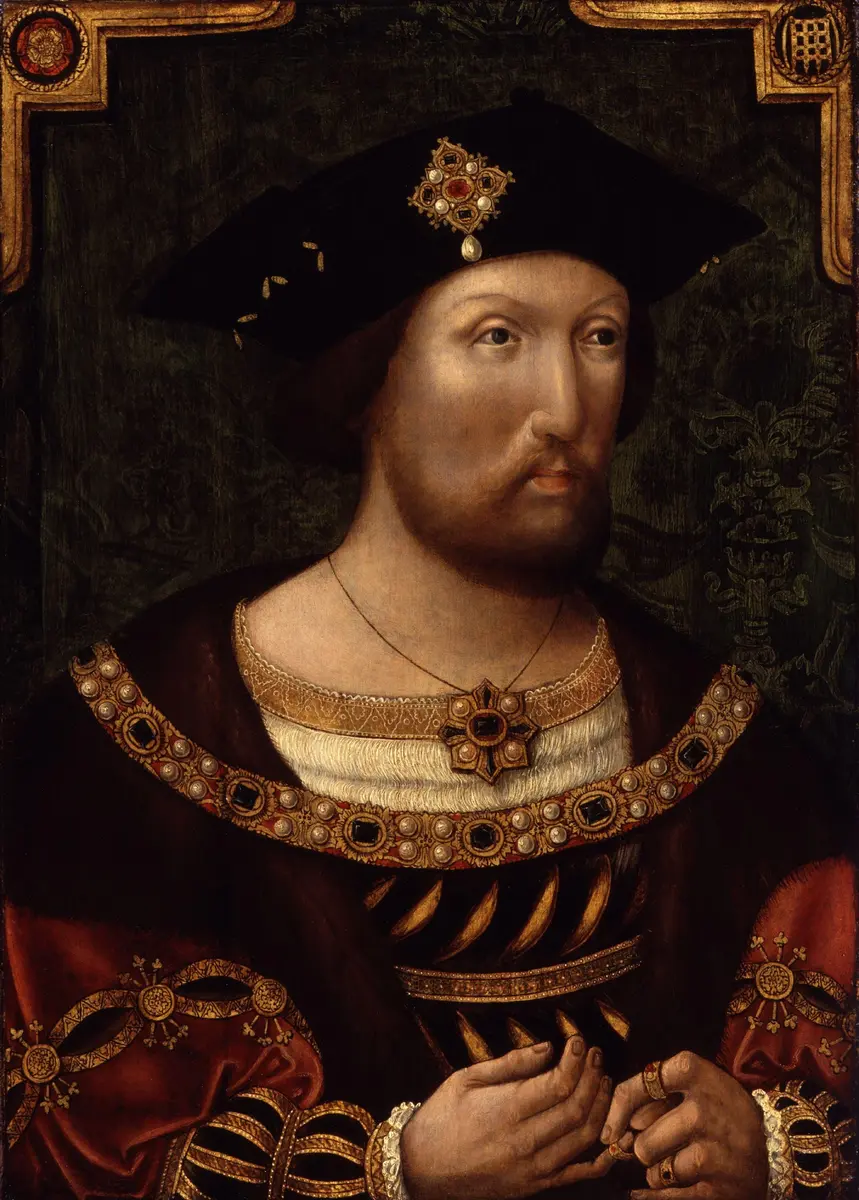
Henry VIII
“The Tudor king of England (1509–47) who married six times and broke with the pope to end his first marriage, making himself head of the Church of England in 1534.”
Henry VIII was king of England from 1509 to 1547, the second Tudor king and the best known. He is remembered for his six wives, two of whom he had beheaded, and for his break with the pope: to end his first marriage and marry Anne Boleyn, he had Parliament make him Supreme Head of the Church of England in 1534. That break began the English Reformation. He closed more than 800 monasteries and other religious houses and took their wealth, built up the navy, and left three children who each ruled after him: Edward VI, Mary I and Elizabeth I.
He was born at Greenwich Palace on 28 June 1491, the second son of Henry VII and Elizabeth of York, and became heir when his elder brother Arthur died in 1502. He became king at seventeen in April 1509, married Arthur's widow, Catherine of Aragon, and was crowned with her in Westminster Abbey on 24 June. Six feet tall, athletic, a musician and a good scholar, he wanted glory: he fought France in 1513, took Thérouanne and Tournai, and met the French king Francis I with enormous display at the Field of the Cloth of Gold in 1520. Cardinal Thomas Wolsey ran the government for him. In 1521 his book against Martin Luther earned him from the pope the title Defender of the Faith, which British monarchs still use.
Catherine gave him only one child who lived, a daughter, Mary. By 1527 Henry was in love with Anne Boleyn and convinced that his marriage to his brother's widow had broken God's law, and he asked the pope for an annulment. Pope Clement VII, under the power of Catherine's nephew the emperor Charles V, would not give it. Wolsey failed and fell in 1529. With Thomas Cromwell as his chief minister from 1532, Henry married Anne in secret in January 1533, had his own archbishop, Thomas Cranmer, declare the first marriage void that May, and in 1534 had Parliament cut England's ties with Rome. Those who refused to accept him as head of the Church died for it, among them Sir Thomas More and Bishop John Fisher in 1535. Between 1536 and 1540 the king dissolved the monasteries; a great northern rising against this, the Pilgrimage of Grace of 1536, was put down, and about 220 to 250 men were executed.
Anne Boleyn gave him a daughter, Elizabeth, but no son, and was beheaded in May 1536. Jane Seymour gave him his son, Edward, in October 1537 and died twelve days later. His marriage to Anne of Cleves in 1540 lasted six months and destroyed Cromwell, who was beheaded; Catherine Howard was beheaded in 1542; Katherine Parr, married in 1543, outlived him. After a bad fall at a joust in 1536 and with an ulcer on his leg, he grew enormously fat. His last wars, against Scotland and France, where he took Boulogne in 1544, cost so much that he sold monastic lands and debased the coinage. He died at Whitehall Palace on 28 January 1547, aged 55, and was buried at Windsor beside Jane Seymour; his nine-year-old son became Edward VI.
Henry's image is still the one Hans Holbein made of him: broad, jewelled and standing with his legs apart. Historians still argue over him. He made England's church independent and its king supreme within it, gave the country an English Bible and a much larger navy, and changed the land itself with the end of the monasteries; he was also the bloodiest of the Tudor monarchs. His warship the Mary Rose, which sank in front of him in 1545, was raised in 1982 and is now a museum in Portsmouth. The days in this entry are those of the Julian calendar England used in his lifetime.
What happened
- 1491
Born at Greenwich Palace, the second son of Henry VII and Elizabeth of York; his elder brother Arthur, not he, is meant to be king.
Greenwich Palace (the Palace of Placentia): where he was born in 1491 and married Catherine of Aragon in 1509 and Anne of Cleves in 1540; the Old Royal Naval College stands on its site- 1509
Henry VII dies at Richmond. Henry, his heir since Arthur's death in 1502, becomes king at seventeen, the first adult heir in almost a hundred years to inherit the throne peacefully.
He marries his brother's widow, Catherine of Aragon, at Greenwich.
Greenwich Palace (the Palace of Placentia): where he was born in 1491 and married Catherine of Aragon in 1509 and Anne of Cleves in 1540; the Old Royal Naval College stands on its siteHenry and Catherine are crowned together in Westminster Abbey on midsummer's day, after the traditional night at the Tower.
- 1513
Campaigning in France, his army scatters a French relief force near Thérouanne in the 'Battle of the Spurs'; Thérouanne surrenders, and Henry enters Tournai on 25 September.
With Catherine as regent in England, the Earl of Surrey defeats the invading Scots at Flodden, where James IV is killed.
- 1520
The Field of the Cloth of Gold: for two and a half weeks, until 24 June, Henry and Francis I of France meet near Guînes among tents, a palace of painted canvas and fountains of wine, with jousting and banquets.
The Field of the Cloth of Gold, between Guînes and Ardres near Calais: where he met Francis I of France in June 1520- 1521
His book against Luther, the Assertio septem sacramentorum ('Defence of the Seven Sacraments'), wins him from the pope the title Defender of the Faith, still used by British monarchs.
- 1527
The 'Great Matter' begins: in love with Anne Boleyn, and with only a daughter, Mary, from Catherine, Henry asks the pope to annul his marriage, arguing from Leviticus that marrying his brother's widow broke God's law; Pope Clement VII is in the power of Catherine's nephew, the emperor Charles V.
- 1529
After the legatine court at Blackfriars ends without a verdict in July, Wolsey has to give up the Great Seal and his palace of Hampton Court passes to the king; on the 25th Thomas More becomes Lord Chancellor.
Hampton Court Palace: Wolsey's palace, the king's from 1529; his son Edward was born here in 1537 and he married Katherine Parr here in 1543- 1532
The clergy submit to the king's authority over church law, and More at once gives up the Great Seal; Thomas Cromwell, in control of the council since April, now steers the break with Rome.
- 1533
Henry secretly marries Anne Boleyn, who is already pregnant; in April Parliament forbids appeals to Rome.
Archbishop Thomas Cranmer, sitting at Dunstable, declares the marriage to Catherine void; on 1 June Anne is crowned in Westminster Abbey.
Anne gives birth at Greenwich to a daughter, the future Elizabeth I, not the son the king expected.
Greenwich Palace (the Palace of Placentia): where he was born in 1491 and married Catherine of Aragon in 1509 and Anne of Cleves in 1540; the Old Royal Naval College stands on its site- 1534
Parliament confirms the king as Supreme Head of the Church of England, the Act of Supremacy, and a new treason law makes it treason even to call him a heretic or wish to deprive him of his titles; earlier that year More and Bishop John Fisher had gone to the Tower for refusing the oath to the Act of Succession.
- 1535
Thomas More, who would not accept the king as head of the Church, is executed at the Tower, two weeks after Bishop Fisher.
The Tower of London: where his mother died in 1503, Thomas More was held before his execution in 1535, and Anne Boleyn and Catherine Howard were beheaded- 1536
Thrown from his horse in a tournament at Greenwich, he lies unconscious for two hours and never jousts again; with a recurring ulcer on his leg he grows ever heavier, and some historians link the harsher king of the later years to this fall.
Greenwich Palace (the Palace of Placentia): where he was born in 1491 and married Catherine of Aragon in 1509 and Anne of Cleves in 1540; the Old Royal Naval College stands on its siteCatherine of Aragon dies at Kimbolton, still calling herself queen; Henry and Anne dress in yellow.
Anne Boleyn, arrested on 2 May and condemned for adultery and treason, is beheaded with a sword inside the Tower of London.
The Tower of London: where his mother died in 1503, Thomas More was held before his execution in 1535, and Anne Boleyn and Catherine Howard were beheadedDays after Anne's death he marries Jane Seymour at Whitehall Palace; a new Act of Succession that summer bastardises both his daughters.
Riots at Louth against the king's tax commissioners and the closing of the smaller monasteries, voted that spring, set off the Pilgrimage of Grace; by late October Robert Aske leads some 30,000 men in Yorkshire. The Duke of Norfolk promises a pardon, and after new risings in early 1537 about 220 to 250 men, Aske among them, are executed.
- 1537
Holbein paints a life-size wall painting at Whitehall Palace of Henry and Jane Seymour with his parents, Henry VII and Elizabeth of York.
At Hampton Court Jane gives birth to his longed-for son, Edward, christened three days later in the Chapel Royal; Jane dies at the palace on 24 October.
Hampton Court Palace: Wolsey's palace, the king's from 1529; his son Edward was born here in 1537 and he married Katherine Parr here in 1543- 1539
The great abbeys surrender one after another, Fountains among them; by early 1540 not one monastery is left in England. The Act of Six Articles of the same year holds the Church to Catholic doctrine.
- 1540
He marries the German princess Anne of Cleves at Greenwich, the alliance Cromwell arranged; he dislikes her from their first meeting, and the marriage is annulled in July.
Greenwich Palace (the Palace of Placentia): where he was born in 1491 and married Catherine of Aragon in 1509 and Anne of Cleves in 1540; the Old Royal Naval College stands on its siteCromwell, blamed for the Cleves marriage, is beheaded, the marriage is annulled, and within weeks Henry has married Catherine Howard, a young niece of the Duke of Norfolk; she is shown at court as queen on 8 August.
- 1542
Catherine Howard, accused of affairs before and during the marriage, is beheaded at the Tower of London.
The Tower of London: where his mother died in 1503, Thomas More was held before his execution in 1535, and Anne Boleyn and Catherine Howard were beheaded- 1543
He marries his sixth wife, the widow Katherine Parr, in her closet at Hampton Court; the next year she governs as regent while he campaigns in France and takes Boulogne.
Hampton Court Palace: Wolsey's palace, the king's from 1529; his son Edward was born here in 1537 and he married Katherine Parr here in 1543- 1545
A French invasion fleet arrives off the Isle of Wight. As Henry watches from Southsea Castle, his favourite warship, the Mary Rose, heels over and sinks in the Solent; most of the roughly 500 men aboard drown.
- 1547
He dies at Whitehall Palace in the early hours, aged 55, having lost the power of speech; his nine-year-old son becomes Edward VI. His body is carried to Windsor and buried in St George's Chapel beside Jane Seymour.