Shakespeare
“The actor from Stratford-upon-Avon whose plays for London's Globe, among them Hamlet, Macbeth and Romeo and Juliet, and 154 sonnets made him the most famous writer in the English language.”
William Shakespeare was an English actor, poet and playwright, often called England's national poet and held by many to be the greatest dramatist who ever lived. In some twenty years as the chief writer of one London company he wrote about 38 plays: comedies such as A Midsummer Night's Dream and Twelfth Night, histories such as Richard III and Henry V, tragedies such as Romeo and Juliet, Hamlet, Othello, King Lear and Macbeth, and late romances such as The Tempest. He also wrote two long poems and 154 sonnets. The plays were written for a small company of actors, yet they are now staged and read in more countries than ever. His friend and rival Ben Jonson wrote that he 'was not of an age, but for all time'.
He was baptised in Stratford-upon-Avon, a market town in Warwickshire, on 26 April 1564; his birthday is kept on 23 April, though the real day is not known. His father, John, was a glover who rose to be the town's bailiff, its mayor, in 1568; his mother, Mary Arden, came from a family of landowners. William almost certainly went to the town's free grammar school, where boys learned Latin and read the Roman poets, but he never went to university. At 18 he married Anne Hathaway, who was 26 and already pregnant. Their daughter Susanna was born in 1583 and the twins Hamnet and Judith in 1585. For the next seven years nothing at all is known of him.
By 1592 he was in London as an actor and playwright, successful enough for a rival to sneer at him in print as an 'upstart crow'. While plague kept the theatres shut he published two long poems, Venus and Adonis and Lucrece, dedicated to the young Earl of Southampton; Venus became the most popular poem of the age. From 1594 he was a sharer in the Lord Chamberlain's Men, the company of the great actor Richard Burbage, writing about two plays a year for it and acting in it as well. In 1599 the company built the Globe on the south bank of the Thames, with Shakespeare as one of its owners, and it played before Queen Elizabeth more often than any other company. In 1603 the new king, James I, took it into his own service as the King's Men, and from 1608 it also used the roofed Blackfriars playhouse inside the city.
He grew rich and invested at home. In 1596, the year his only son Hamnet died aged eleven, he obtained a coat of arms for his father, which made the family gentlemen; in 1597 he bought New Place, one of the largest houses in Stratford, and later farmland and a share of the town's tithes. He seems to have divided his time between the two towns, only lodging in London. His last plays, around 1613, were written with the younger John Fletcher, and during one of them, Henry VIII, a stage cannon set fire to the Globe's thatched roof. In March 1616 he signed his will, which names his wife only once, to leave her 'my second best bed'. He died at New Place on 23 April 1616, aged 52, and was buried in the chancel of Holy Trinity Church, under a stone that curses anyone who moves his bones.
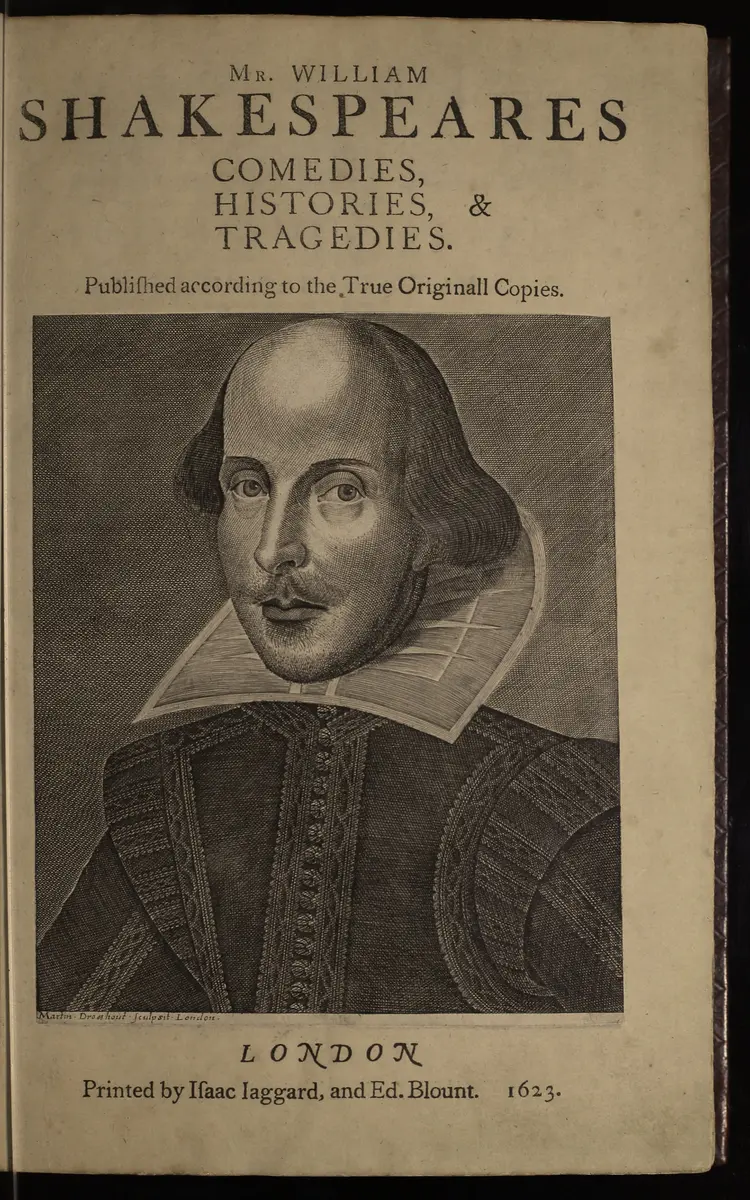
Few records of his life survive beyond baptisms, deeds and lawsuits: there are no letters, no manuscripts of his plays and only six signatures. Seven years after his death two of his fellow actors, John Heminges and Henry Condell, gathered 36 of his plays into the First Folio of 1623; about half of them had never been printed and would otherwise have been lost. Its engraved portrait and the painted bust on his monument in Stratford are the two likenesses accepted by people who knew him. Theories that someone else wrote his works are rejected by Shakespeare scholars, who point to the testimony of his own colleagues and of his monument. Four centuries on, his plays are performed, filmed and adapted all over the world.
What happened
- 1564
Baptised at Holy Trinity Church as the son of John Shakespeare, a glover of Henley Street; he was born a few days before, and his birthday is kept on 23 April. That summer plague kills more than 200 of the town's people, about one in seven.
Holy Trinity Church, Stratford-upon-Avon: where he was baptised in 1564 and buried in 1616- 1568
His father becomes bailiff of Stratford, the town's mayor. The boy almost certainly goes to the free grammar school, where the lessons are Latin.
Shakespeare's Birthplace, Henley Street, Stratford-upon-Avon: his father's house, where he was born in April 1564 and grew up - 1582
At 18 he gets a licence to marry Anne Hathaway of Shottery, who is 26 and three months pregnant; two farmers sign the bond. The bishop's register of the day before calls her 'Anne Whateley of Temple Grafton', and where they married is not known.
- 1583
Their daughter Susanna is baptised.
Holy Trinity Church, Stratford-upon-Avon: where he was baptised in 1564 and buried in 1616- 1585
Twins, Hamnet and Judith, are baptised. Then the records fall silent for seven years, his 'lost years'.
Holy Trinity Church, Stratford-upon-Avon: where he was baptised in 1564 and buried in 1616- 1592
The first sign of him in London: a pamphlet sold as the dying words of the playwright Robert Greene mocks an 'upstart crow' and 'Shake-scene' who thinks he can write blank verse, parodying a line from his Henry VI, Part 3.
- 1593
With the playhouses shut by plague, he publishes Venus and Adonis, dedicated to the young Earl of Southampton; it becomes the most popular poem of the age.
- 1594
Lucrece follows. When the theatres reopen, he becomes a founding sharer of the Lord Chamberlain's Men, Richard Burbage's company, and writes for it for the rest of his career.
- 1595
The royal accounts name him with Will Kemp and Richard Burbage as payees for two plays acted before Queen Elizabeth at Greenwich at Christmas: the first record of him in the company.
- 1596
His only son, Hamnet, is buried in Stratford, aged eleven; the cause of death is unknown.
Holy Trinity Church, Stratford-upon-Avon: where he was baptised in 1564 and buried in 1616The heralds draft a grant of arms to his father, with the motto 'Non sanz droict': the Shakespeares become gentlemen, almost certainly at William's initiative and expense.
- 1597
He buys New Place, one of the largest houses in Stratford, which remains his family's home until his death.
New Place, Chapel Street, Stratford-upon-Avon: the house he bought in 1597 and died in- 1598
Francis Meres praises 'mellifluous and honey-tongued Shakespeare' and lists twelve of his plays; his name now appears on title pages, and he acts in Ben Jonson's Every Man in His Humour.
- 1599
His company pulls down its old playhouse in Shoreditch, the Theatre, carries the timbers across the Thames and builds the Globe on Bankside; Shakespeare owns an eighth of it. Julius Caesar, Hamlet and most of the great tragedies are written for its stage.
The Globe, Bankside, Southwark: his company's playhouse from 1599, of which he was part-owner; it burned in 1613 and was rebuilt - 1601
Followers of the Earl of Essex pay the company to stage Richard II, the play of a king deposed, on the eve of their failed rising; the players are questioned and let go.
His father is buried in Stratford, and William inherits the house on Henley Street.
Shakespeare's Birthplace, Henley Street, Stratford-upon-Avon: his father's house, where he was born in April 1564 and grew up- 1602
He buys 107 acres of farmland in Old Stratford from John and William Combe for £320.
- 1603
Two months after Queen Elizabeth's death, King James I takes the company into his own service: the Lord Chamberlain's Men become the King's Men.
- 1604
For the king's grand entry into London, he and his fellows are issued red cloth for royal livery; his name heads the list of the King's players.
- 1605
He pays £440 for a half-share in the lease of Stratford's tithes, an investment that also gives him the right to be buried in the chancel.
- 1607
His daughter Susanna marries the physician John Hall; their daughter Elizabeth, his first grandchild, is born the next year.
Holy Trinity Church, Stratford-upon-Avon: where he was baptised in 1564 and buried in 1616- 1608
The King's Men take over the roofed Blackfriars playhouse inside the city, and from now on play there in winter and at the Globe in summer.
Blackfriars, London: the roofed playhouse his company used from 1608, and the gatehouse nearby that he bought in 1613 - 1609
The publisher Thomas Thorpe registers 'Shakespeares sonnettes'; the 154 sonnets come out that year, dedicated to a mysterious 'W.H.'.
- 1611
The Tempest is played before the king at Whitehall; it is often read as his farewell to the stage.
- 1612
In London he gives evidence in a lawsuit in the Mountjoy family, the Huguenot household in Cripplegate where he had lodged; he remembers little, and his signature on the statement is the earliest that survives.
- 1613
He buys the gatehouse of the old Blackfriars priory, near his company's indoor playhouse, for £140; the mortgage signed next day carries his signature.
Blackfriars, London: the roofed playhouse his company used from 1608, and the gatehouse nearby that he bought in 1613A cannon fired during his Henry VIII sets the Globe's thatch alight and the playhouse burns to the ground; the company rebuilds it the next year.
The Globe, Bankside, Southwark: his company's playhouse from 1599, of which he was part-owner; it burned in 1613 and was rebuilt- 1616
His daughter Judith marries Thomas Quiney, a Stratford vintner.
Probably already ill, he signs his revised will: most of his property to Susanna, money to Judith, 'my second best bed' to his wife, and money for rings to his fellow actors Burbage, Heminges and Condell.
He dies at New Place, aged 52, of an illness no one recorded. Two days later he is buried in the chancel of Holy Trinity, under a stone that curses whoever moves his bones; his family puts up the monument with his bust.
Holy Trinity Church, Stratford-upon-Avon: where he was baptised in 1564 and buried in 1616