The California Gold Rush
“Gold found at Sutter's Mill in January 1848 drew some 300,000 people to California, made it a state in 1850 and turned the village of San Francisco into a booming port city.”
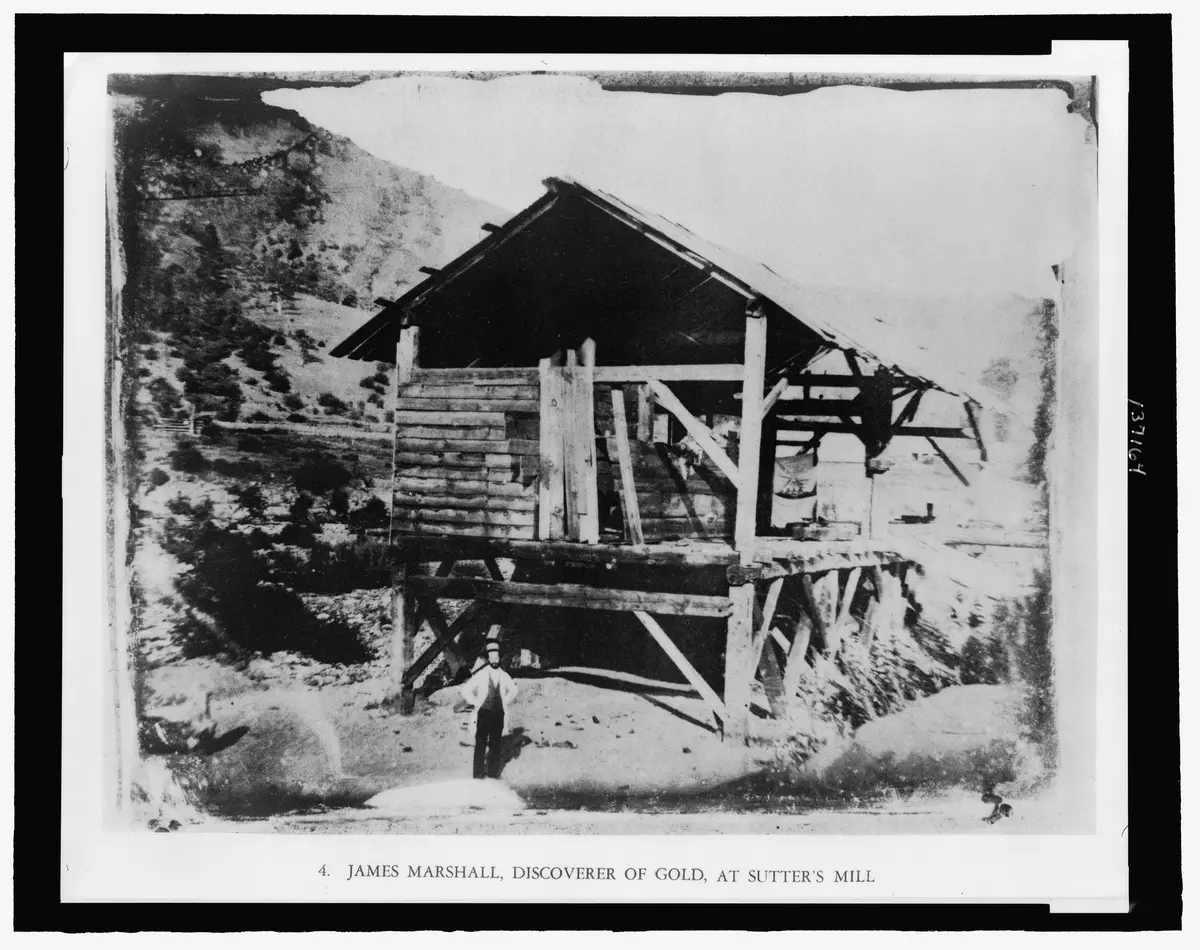
On the morning of 24 January 1848, James Marshall, a carpenter building a sawmill for the Swiss settler John Sutter at Coloma, on the South Fork of the American River in the Sierra Nevada foothills, saw shining flakes in the mill's tailrace, the ditch that carried water away from the wheel. He beat them flat on a rock, and the camp's cook, Jennie Wimmer, left one overnight in her kettle of lye soap. Four days later Marshall rode down to Sutter's Fort, where the two men tested the metal with acid and the help of an encyclopedia: it was gold. They agreed to keep it quiet. Nine days after the find, and without anyone in California knowing it, Mexico signed the Treaty of Guadalupe Hidalgo, which ended the Mexican-American War and gave California to the United States.
The secret did not last. In May the merchant Sam Brannan showed gold from the American River to crowds in San Francisco, a port that had about 800 settlers when gold was found, and within weeks the town was half empty. By July the military governor counted about 4,000 people at the diggings, and on 5 December 1848 President James K. Polk told Congress that the reports were true. In 1849 close to 100,000 people set out for California: about 40,000 by sea, around Cape Horn or across the Isthmus of Panama, 25,000 to 30,000 overland with wagon trains, and thousands more from Mexico, Chile, Hawaii, Europe and China. These forty-niners made San Francisco an instant city. Crews deserted their ships, and by 1851 more than 800 vessels lay in Yerba Buena Cove; some became stores, warehouses and a hotel, and their hulls now lie under the streets of the financial district. California skipped the usual years as a territory: a convention at Monterey wrote a constitution that banned slavery, and on 9 September 1850 it became the 31st state, as part of the Compromise of 1850.
Few miners grew rich; the money was made by those who fed and supplied them, carried their gold and banked it. Prices soared, eggs sold for a dollar each, and gold dust passed from hand to hand below its full value until it could be coined. Private firms and a federal assay office struck their own gold coins in San Francisco, among them eight-sided fifty-dollar 'slugs', until a branch of the United States Mint opened there on 3 April 1854. Bankers and express companies such as Page, Bacon & Co., Adams & Co. and Wells, Fargo & Co. gathered on Montgomery Street, buying the miners' gold, selling them drafts on New York and shipping bullion east by every steamer, and the young city filled with banks. The boom ended in a bank panic: Page, Bacon & Co. closed its doors on 22 February 1855, Adams & Co. failed to open the next morning, and runs hit every bank in the city.
By then the easy gold was gone. The rush peaked in 1852, the year 20,000 of the 67,000 newcomers came from China, and from the mid-1850s companies with ditches, flumes and water cannon replaced men with pans; hydraulic mining washed whole hillsides into the rivers until the farm towns downstream won their fight against it in 1884. The cost fell hardest on California's Native peoples, whose fishing and gathering places were overrun. The historian Benjamin Madley counts between 9,492 and 16,094 California Indians killed by vigilantes, militias and US soldiers from 1846 to 1873, many in more than 370 massacres, while their number fell from perhaps 150,000 to 30,000; in 1851 the state's first elected governor, Peter Burnett, told the legislature to expect a war of extermination. Foreign miners were squeezed by a tax of $20 a month in 1850 and another of about $4 from 1852, as hostility turned against the Chinese. Even the men who started it lost out: Sutter, his land overrun, was bankrupt by 1852, and Marshall, whose small state pension was stopped in 1878, died in 1885 still working a blacksmith shop and small mines near Kelsey.
In a few years California went from a thinly settled Mexican province to a state that more than 300,000 newcomers had reached by about 1855, with the mixed, many-nationed population it still has. San Francisco, the port through which the people and the gold passed, grew from about 800 settlers to some 36,000 people by the end of 1852, and the wealth and people the rush brought helped pull the transcontinental railroad across the continent. A century later the same bay had its second great boom, in silicon. Today California State Parks is retelling the story at Sutter's Fort with the Native peoples on whose land it began.
What happened
- 1848
At Coloma, James Marshall finds flakes of gold in the tailrace of the sawmill he is building for John Sutter on the South Fork of the American River. He beats them flat on a rock, and the cook, Jennie Wimmer, leaves one overnight in her lye soap; it comes out still gold.
Sutter's Mill site, Coloma: Marshall found gold in the tailrace here on 24 January 1848Marshall rides down to Sutter's Fort with samples. Behind closed doors the two men test the metal with acid and an encyclopedia, confirm it is gold, and agree to keep the find secret until the mill is running.
Sutter's Fort, Sacramento: the centre of Sutter's New Helvetia, where Marshall brought the first goldNine days after the find, Mexico and the United States sign the Treaty of Guadalupe Hidalgo, ending the Mexican-American War. Mexico gives up California and most of the Southwest; the news of the gold will take months to reach the East.
Sam Brannan, who keeps a store at Sutter's Fort, shows gold from the American River to crowds on the Plaza of San Francisco. By the end of May the town is reported half empty as its men leave for the rivers.
Portsmouth Square, San Francisco: Brannan showed his gold here, and the city celebrated statehood here in 1850The military governor, Colonel Richard Mason, tours the diggings with Lieutenant William T. Sherman and Captain Joseph Folsom. He counts about 4,000 people at work and reports to Washington; samples of the gold, among them a flake said to be Marshall's first, travel east with Lieutenant Lucien Loeser.
In his last annual message to Congress, President Polk confirms that the accounts of gold in California are true and asks for a branch mint there. The news sets off the rush of 1849.
- 1849
The forty-niners arrive: close to 100,000 people, about 40,000 by sea around Cape Horn or across the Isthmus of Panama, 25,000 to 30,000 overland by wagon, and thousands from Mexico, South America, Hawaii, Europe and China.
The whaler Niantic sails into San Francisco Bay with gold seekers picked up in Panama. Its crew deserts for the mines; the ship is hauled ashore and becomes a store, a warehouse and a hotel, one of hundreds of ships abandoned in Yerba Buena Cove.
Site of the Niantic, Clay and Sansome Streets: the old shore of Yerba Buena Cove, where deserted ships became storesVoters approve the constitution written at Colton Hall in Monterey by 48 delegates between 1 September and 15 October. It bans slavery, and California asks to enter the Union as a free state.
Colton Hall, Monterey: the convention that wrote California's constitution met here in 1849- 1850
The new legislature charges every miner who is not a US citizen $20 a month. Many Chinese miners leave the camps for San Francisco, and the tax, set too high to work, is repealed the next year.
At Clear Lake, US Army soldiers massacre the Native people on Bloody Island in revenge for the killing of two white ranchers; by Benjamin Madley's count up to 800 may die in one day, part of a campaign of vigilantes and soldiers that kills 1,000 or more Native people between December 1849 and May 1850.
Bloody Island, Clear Lake: US soldiers massacred the Native people living here in 1850President Millard Fillmore signs the act admitting California as the 31st state, a free state, as part of the Compromise of 1850. The news reaches San Francisco by steamer, and on 29 October the city celebrates with a procession across Portsmouth Square.
Portsmouth Square, San Francisco: Brannan showed his gold here, and the city celebrated statehood here in 1850- 1851
In his message to the legislature, Peter Burnett, California's first elected governor, says a war of extermination will go on until the Native race is extinct. State-funded militia campaigns follow.
- 1852
The rush peaks. Of the 67,000 newcomers this year 20,000 come from China, and the legislature brings back a foreign miners' tax, of about $4 a month, as hostility to them grows. At the end of the year the state census counts about 36,000 people in San Francisco.
- 1853
Columbia, in the southern mines, is now one of the largest towns in California. With the easy surface gold worked out, miners band together to bring water in ditches and flumes, and by the middle of the decade they wash whole hillsides away with jets of water.
Columbia, in the southern mines: by 1853 one of the largest towns in California - 1854
The first branch of the United States Mint in California opens in San Francisco, so that the miners' gold can be struck into federal coin at its full value instead of passing as dust, private coins and assay-office slugs.
- 1855
Page, Bacon & Co., the leading bank in California, has closed its doors the day before, and this morning Adams & Co. does not open. Crowds fill Montgomery Street and run on every bank; the gold-rush boom ends in a panic.