The First Crusade
“Called by Pope Urban II at Clermont in 1095, the First Crusade took Jerusalem on 15 July 1099 with a massacre and founded crusader states that lasted almost two centuries.”
On 27 November 1095, at the close of a church council at Clermont in central France, Pope Urban II spoke to a great crowd in the open air and called on the knights of the West to march east. The Byzantine emperor Alexios I Komnenos had asked for soldiers against the Seljuk Turks, who in the quarter century since their victory at Manzikert in 1071 had taken most of Asia Minor and, in 1085, Antioch. Urban turned that request into something much larger: an armed pilgrimage to help the Christians of the East and to free Jerusalem, the city of Christ's tomb. Those who went would have all the penance for their sins remitted, and they marked their vow by sewing a cloth cross onto their clothes. 'It is the will of God!', the crowd shouted, as one of the chroniclers who were there remembered it years later.
The answer was far greater than Urban had expected. Preachers such as Peter the Hermit, from near Amiens, stirred up peasants as well as knights, and in the spring of 1096 the first bands set off long before the princes' armies. In the Rhineland some of them, above all the followers of Count Emicho, decided that the war on the enemies of Christ should begin at home. They attacked the Jewish communities of Speyer on 3 May, Worms on 18 and 25 May, Mainz on 27 May and then Cologne. Bishops who sheltered the Jews in their palaces mostly failed to save them; offered baptism or death, many killed their own families and themselves rather than convert, and at Mainz, a Hebrew chronicle says, 1,100 died on a single day. Peter's own followers were ferried over to Asia in August and destroyed by the Turks near Civetot in October.
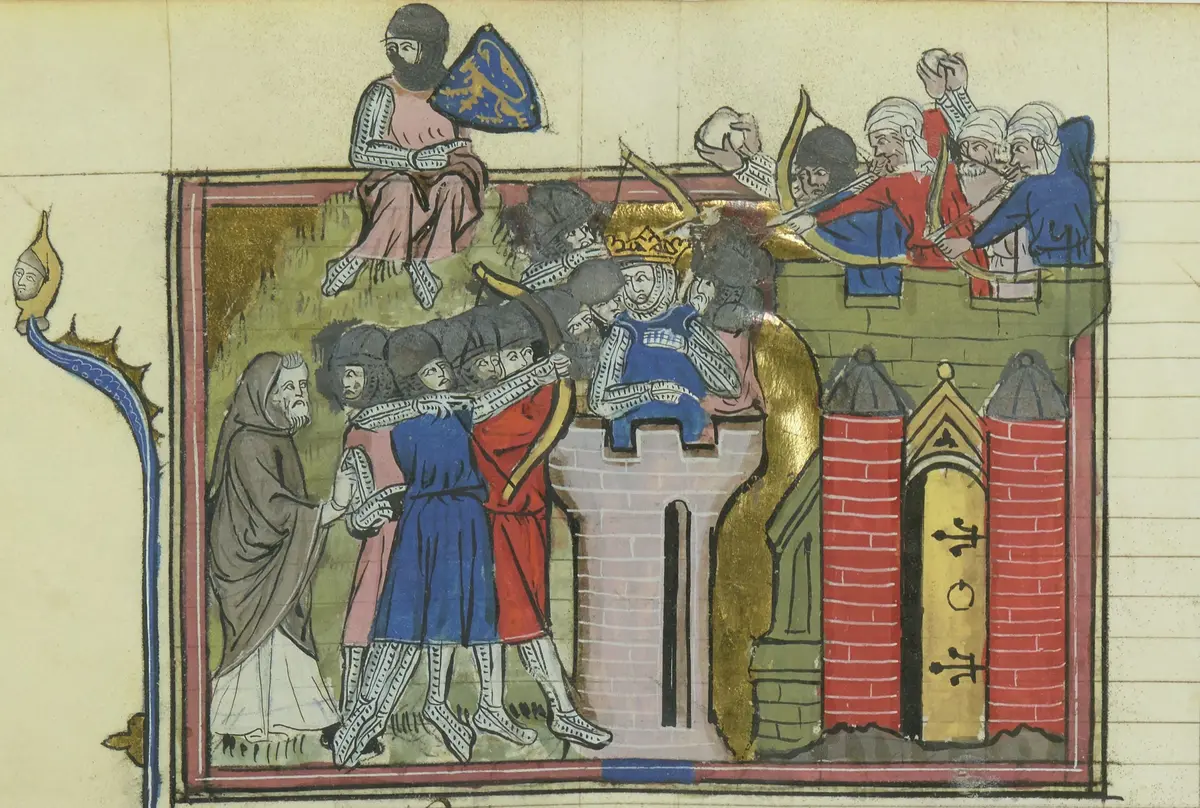
The main armies left in August 1096, as Urban had ordered, led by great lords rather than by any king: Godfrey of Bouillon, duke of Lower Lorraine, the Norman Bohemond from southern Italy, Count Raymond of Toulouse with the pope's legate, Bishop Adhemar of Le Puy, Robert of Flanders, Robert of Normandy and Stephen of Blois. Perhaps 4,000 knights and 25,000 foot soldiers gathered at Constantinople, where Alexios made their leaders swear to hand back any former Byzantine lands they took. Nicaea surrendered to the emperor's men on 19 June 1097, and on 1 July the Turks were beaten at Dorylaeum. Then came seven months of hunger and disease before Antioch, a city ringed by walls with more than 400 towers, while Godfrey's brother Baldwin made himself ruler of Edessa, the first crusader state. On 3 June 1098 a commander inside let Bohemond's men over the wall; days later the crusaders were themselves besieged by the army of Kerbogha of Mosul, and, heartened by the finding of a lance said to have pierced Christ's side, they marched out on 28 June and routed it.
Quarrels over Antioch, which Bohemond kept for himself, held the army there for months; at Ma'arrat al-Nu'man in December starving crusaders ate the bodies of the dead, as their own leaders admitted to the pope. On 7 June 1099 what was left, perhaps 1,200 to 1,500 knights and 12,000 foot soldiers, reached Jerusalem, which the Fatimids of Egypt had taken from the Turks the summer before. A first assault failed for want of ladders. They built siege towers, walked barefoot round the walls in procession on 8 July, and on 15 July Godfrey's men crossed from their tower onto the wall. A massacre followed: the Latin chroniclers boast that their men waded in blood in the 'Temple of Solomon', the al-Aqsa mosque, and the Damascus chronicler Ibn al-Qalanisi records that the Jews were burned in their synagogue. Godfrey was chosen to rule, as Defender of the Holy Sepulchre rather than king, and on 12 August near Ascalon the crusaders scattered the Egyptian army sent to win the city back. Urban II had died in Rome on 29 July, before the news could reach him.
The First Crusade was, as Britannica puts it, astonishingly successful, and it was the model for all that followed. The crusader states it founded, Edessa, Antioch, Jerusalem and, by 1109, Tripoli, lasted almost two centuries: Saladin took Jerusalem back in 1187, and the fall of Acre in 1291 ended crusader rule in the Levant. Crusading itself spread to Spain, the Baltic and wars against fellow Christians, as when the Fourth Crusade sacked Constantinople in 1204. For the Jews of the Rhineland, 1096 became a lasting memory of martyrdom and is often seen as a turning point in the history of antisemitism; between Greek and Latin Christians it deepened the distrust that Bohemond's seizure of Antioch made plain; and in the Islamic world the crusaders were long remembered as cruel invaders.
What happened
- 1095
On the day before his council at Clermont closes, Pope Urban II preaches in the open air: the knights of the West should go to the help of the Eastern Christians and free Jerusalem, with all penance for their sins remitted. The crowd answers 'God wills it!' and those who vow to go take the cross.
Clermont (Clermont-Ferrand): where Urban II preached the crusade in the open air on 27 November 1095, at the end of his council- 1096
On a Sabbath, crusaders under Count Emicho attack the Jews of Speyer and kill eleven who refuse baptism, a woman among them killing herself first; Bishop John shelters the rest.
Speyer, the Jewish courtyard: the community attacked on 3 May 1096 built its synagogue here in 1104Emicho's men attack the Jews of Worms who have stayed in their homes, plunder the houses and tear up a Torah scroll; on 25 May they break into the bishop's court and kill those who took refuge there. Hundreds die, many by their own hands rather than be baptised.
Worms, the synagogue: the Jewish community was attacked on 18 and 25 May 1096 and its synagogue of 1034 badly damagedAt noon the burghers of Mainz open the gate to Emicho; his men storm the archbishop's palace where the Jews have taken refuge, and the community is destroyed, eleven hundred dead on one day by the Hebrew chronicle's count, about seven hundred by Albert of Aix's.
Mainz, the Judensand: the old cemetery of the Jewish community that lost some 1,100 people on 27 May 1096Peter the Hermit's host, which has crossed Germany, Hungary and the Balkans, reaches Constantinople; Alexios advises Peter to wait for the princes, but on 6 August his followers are ferried over the Bosporus into Asia.
Constantinople: Alexios I's capital, where the crusade armies gathered from December 1096 to the spring of 1097 and swore their oaths to himThe princes' armies set out, as Urban had ordered for the feast of the Assumption; Godfrey of Bouillon leads his men down the Danube road through Hungary, while others head for the Adriatic ports of Italy.
Raiding beyond the Byzantine lines while Peter is away in Constantinople, his followers are ambushed by the Turks near their camp at Civetot and all but wiped out.
Civetot (Kibotos), on the Gulf of Nicomedia: where the Turks destroyed Peter the Hermit's followers in October 1096Godfrey of Bouillon reaches Constantinople, the first of the great lords by land; Alexios presses each leader to swear to hand back any former Byzantine lands they take.
Constantinople: Alexios I's capital, where the crusade armies gathered from December 1096 to the spring of 1097 and swore their oaths to him- 1097
Bohemond, the Norman lord from southern Italy who had fought the Byzantines with his father, arrives at Constantinople and alone takes the emperor's oath willingly; Raymond of Toulouse follows on 21 April and swears only to respect the emperor's person and property.
Constantinople: Alexios I's capital, where the crusade armies gathered from December 1096 to the spring of 1097 and swore their oaths to himOn Ascension Day the crusaders begin their assault on Nicaea, the capital of the Seljuk sultan Kilij Arslan, building siege machines against its walls.
Nicaea (Iznik): the Seljuk capital besieged from May 1097, which surrendered to the Byzantines on 19 JuneAfter seven weeks Nicaea surrenders, not to the crusaders but to Alexios's officers, who send its Turkish garrison safely to Constantinople; the emperor has alms given to the crusaders' poor.
Nicaea (Iznik): the Seljuk capital besieged from May 1097, which surrendered to the Byzantines on 19 JuneNear Dorylaeum the Turks fall on the crusaders' advance column; it holds under a rain of arrows until the rest of the army comes up and the Turks are routed.
Dorylaeum (Şarhöyük, Eskişehir): the ancient town near which the crusaders beat the Turks on 1 July 1097At midday the army reaches Antioch, one of the great cities of the Levant, and begins a siege that will last through a winter of famine and disease.
Antioch (Antakya): besieged from October 1097, taken on 3 June 1098 and defended against Kerbogha until 28 June- 1098
Godfrey's brother Baldwin of Boulogne, who had left the main army for the Armenian lands, becomes ruler of Edessa after its prince is murdered by his own people: the first crusader state.
Edessa (Şanlıurfa), the citadel: the city Baldwin of Boulogne took over in March 1098, the first crusader stateBefore dawn a commander inside Antioch, Firuz, lets Bohemond's men climb into his towers; the crusaders take the sleeping city, all but its citadel.
Antioch (Antakya): besieged from October 1097, taken on 3 June 1098 and defended against Kerbogha until 28 JuneBesieged in turn by Kerbogha of Mosul and starving, the crusaders dig in the cathedral of St Peter where a poor Provençal peasant, Peter Bartholomew, says St Andrew told him in visions to look, and bring out a lance he declares is the one that pierced Christ's side.
Antioch (Antakya): besieged from October 1097, taken on 3 June 1098 and defended against Kerbogha until 28 JuneThe crusaders march out of Antioch against Kerbogha's army, which breaks and flees; the Gesta says an army of saints on white horses, led by St George, Mercurius and Demetrius, came down from the hills to help them. The citadel then surrenders.
Antioch (Antakya): besieged from October 1097, taken on 3 June 1098 and defended against Kerbogha until 28 JuneAdhemar of Le Puy, the pope's legate and the crusade's steadiest counsellor, dies in the epidemic that sweeps Antioch after the victory.
Antioch (Antakya): besieged from October 1097, taken on 3 June 1098 and defended against Kerbogha until 28 JuneAt sunset the crusaders storm Ma'arrat al-Nu'man and kill many of its people; in the famine of the following weeks some cut up and cook the bodies of the dead, as the Gesta and the leaders' letter to the pope both admit.
Ma'arrat al-Nu'man: stormed on 11 December 1098, where starving crusaders ate the dead- 1099
Pressed by his own men, Raymond of Toulouse walks barefoot out of Ma'arra at the head of the march to Jerusalem; Bohemond stays behind as master of Antioch.
On a Tuesday the army, perhaps 1,200 to 1,500 knights and 12,000 foot soldiers, reaches Jerusalem, held for the Fatimids of Egypt, and camps round its walls, Robert of Normandy to the north, Godfrey and Tancred to the west, Raymond on Mount Zion.
Jerusalem, the Old City and its walls: besieged from 7 June and stormed on 15 July 1099 (the walls standing today are Ottoman, of the 1530s, largely on the medieval line)A first assault breaks through the outer wall, but with only one ladder the crusaders cannot take the main wall and fall back; short of water and bread, they begin to build siege towers.
Jerusalem, the Old City and its walls: besieged from 7 June and stormed on 15 July 1099 (the walls standing today are Ottoman, of the 1530s, largely on the medieval line)After a fast, the whole army walks barefoot in procession round the walls, mocked by the defenders, to the Mount of Olives, where Peter the Hermit preaches.
The Mount of Olives: where the army ended its barefoot procession on 8 July 1099 and Peter the Hermit preachedOn a Friday, after two days of fighting, Godfrey's men cross from their tower onto the wall; the knight Lethold is said to be the first up. The city falls, the crusaders kill their way to the Temple Mount, and they go to the Holy Sepulchre weeping for joy.
Jerusalem, the Old City and its walls: besieged from 7 June and stormed on 15 July 1099 (the walls standing today are Ottoman, of the 1530s, largely on the medieval line)In the Tower of David the Fatimid governor surrenders to Raymond of Toulouse and is escorted with his men, unharmed, to Ascalon.
The Tower of David: Jerusalem's citadel, whose Fatimid governor surrendered to Raymond of Toulouse on 15 July 1099In the morning crusaders climb onto the roof of the 'Temple of Solomon', the al-Aqsa mosque, and behead the men and women Tancred had promised to protect; across the city Muslims and Jews are killed, and Ibn al-Qalanisi writes that the Jews were burned in their synagogue.
The Temple Mount (Haram al-Sharif): the 'Temple of Solomon' of the chroniclers, the al-Aqsa mosque, where the massacre of 15 and 16 July 1099 was worstOn the eighth day after the capture the leaders choose Godfrey of Bouillon to rule the city; he refuses the title of king and is called Defender of the Holy Sepulchre. Arnulf is chosen patriarch on 1 August.
The Church of the Holy Sepulchre: the goal of the crusade; Godfrey ruled as its DefenderPope Urban II dies in Rome, two weeks after the fall of Jerusalem and before the news could reach him.
Near Ascalon the crusaders surprise and rout the Egyptian army that al-Afdal had led out to win Jerusalem back, and take its camp; most of the crusaders then go home.
Ascalon (Ashkelon): near its walls the crusaders routed the Egyptian relief army on 12 August 1099