Byzantine Empire
“The eastern half of the Roman Empire, ruled from Constantinople, which outlived the West by almost a thousand years until the Ottomans took its capital in 1453.”
The Byzantine Empire is the name historians give to the eastern half of the Roman Empire, which lived on for almost a thousand years after the western half had fallen. Its heart was Constantinople, today's Istanbul, the old Greek town of Byzantium on the Bosporus that the emperor Constantine rebuilt as a 'New Rome' and dedicated in 330. After the death of Theodosius I in 395 the empire was ruled in two halves, and when the last emperor in the west was deposed in 476, the emperor in Constantinople was the only Roman emperor left. Its people never called themselves Byzantines: they were Romans, Christian and mostly Greek-speaking, and their state was simply the Roman Empire. The word 'Byzantine' was invented by later scholars.
The empire was at its largest under Justinian I, who ruled from 527 to 565. His general Belisarius took North Africa from the Vandals in 533 and entered Ravenna, the Gothic capital of Italy, in 540; by 552 the Goths were beaten and a strip of southern Spain was added. Justinian had the whole of Roman law collected in one body, the Corpus of Civil Law, which still underlies the law of much of Europe, and after riots had burned the centre of Constantinople in 532 he built the great church of Hagia Sophia. But the bubonic plague that reached the capital in 542 and the long wars drained the state, and in the late 500s the Lombards took much of Italy back.
In the seventh century the empire nearly died. A long war with Persia was won by Heraclius in 627, but the Arab armies of the new faith of Islam then took Syria after the battle of the Yarmuk in 636, and soon Palestine and Egypt. What was left, Anatolia, the coasts of the Balkans and a few Italian lands, became a smaller and fully Greek state. Its capital held out behind the Theodosian Walls and with the help of 'Greek fire', a burning weapon that set wooden ships alight, against Arab sieges in the 670s and in 717. For more than a century the emperors and the church fought over whether holy images, icons, could be honoured; the images won in 843. After that came a second golden age: under Basil II, who annexed Bulgaria in 1018, the empire again reached from the Danube to Armenia and northern Syria, and Christianity spread from Constantinople to the Slavs of the Balkans and to the Rus of Kyiv.
The decline began in 1071, when the Seljuk Turks destroyed the army of Romanos IV at Manzikert and settled in Anatolia, the empire's old heartland. The crusaders who came from the west in 1096 helped at first, but in 1204 the knights and Venetians of the Fourth Crusade turned on Constantinople itself, sacked it and set up a Latin empire there. Byzantine rulers in exile held on at Nicaea, Trebizond and Arta, and in 1261 the emperor of Nicaea, Michael VIII Palaiologos, took the capital back. The restored empire was small and poor, and the Ottoman Turks slowly surrounded it. On 29 May 1453 the sultan Mehmed II broke through the walls with cannon after a siege of almost two months, and the last emperor, Constantine XI, died in the fighting. Mistra in Greece and Trebizond fell a few years later.
Byzantium carried the Roman state, Roman law and Greek learning through the Middle Ages. Justinian's law code became one of the foundations of Western law, and Byzantine luxury, learning and art, its mosaics and its icons, set a standard that both the Latin West and the Islamic East looked up to long after the empire was gone. The Orthodox churches of Greece, Russia, Serbia, Bulgaria and their neighbours still follow the faith and the forms of worship that came to them from Constantinople, and the walls, churches and mosaics it left still stand from Ravenna to Istanbul.
What happened
- 330
Constantine dedicates his new capital on the site of the Greek town of Byzantium and names it after himself: Constantinople, the 'New Rome'.
Constantinople: the Column of Constantine, set up for the dedication of the city in 330- 395
Theodosius I, the last emperor to rule the whole empire, dies; his son Arcadius takes the east and Honorius the west, and the two halves are never ruled together again.
Constantinople: the Column of Constantine, set up for the dedication of the city in 330- 413
The prefect Anthemius completes the great land wall of Constantinople for the young Theodosius II, the line of walls that will protect the city for over a thousand years.
The land walls of Constantinople, finished in 413 and broken through on 29 May 1453 - 476
In Italy the general Odoacer deposes the boy emperor Romulus Augustulus; from now on the emperor in Constantinople is the only Roman emperor.
- 529
Justinian publishes his first Code of imperial law; the Digest of the Roman jurists follows in December 533 and a revised Code in November 534, together the Corpus of Civil Law.
- 532
The Nika riot: the Blue and Green chariot fans unite against Justinian, burn the centre of the capital with its cathedral and proclaim a rival emperor, until Belisarius and Mundo massacre the crowd in the Hippodrome.
The Hippodrome of Constantinople: the racecourse beside the palace, scene of the Nika riot of 532- 533
Belisarius sails with about 18,000 men against the Vandal kingdom of Africa, beats King Gelimer outside Carthage and enters the city the next day; Africa is a Roman province again.
Carthage: the Vandal capital taken by Belisarius in 533 - 537
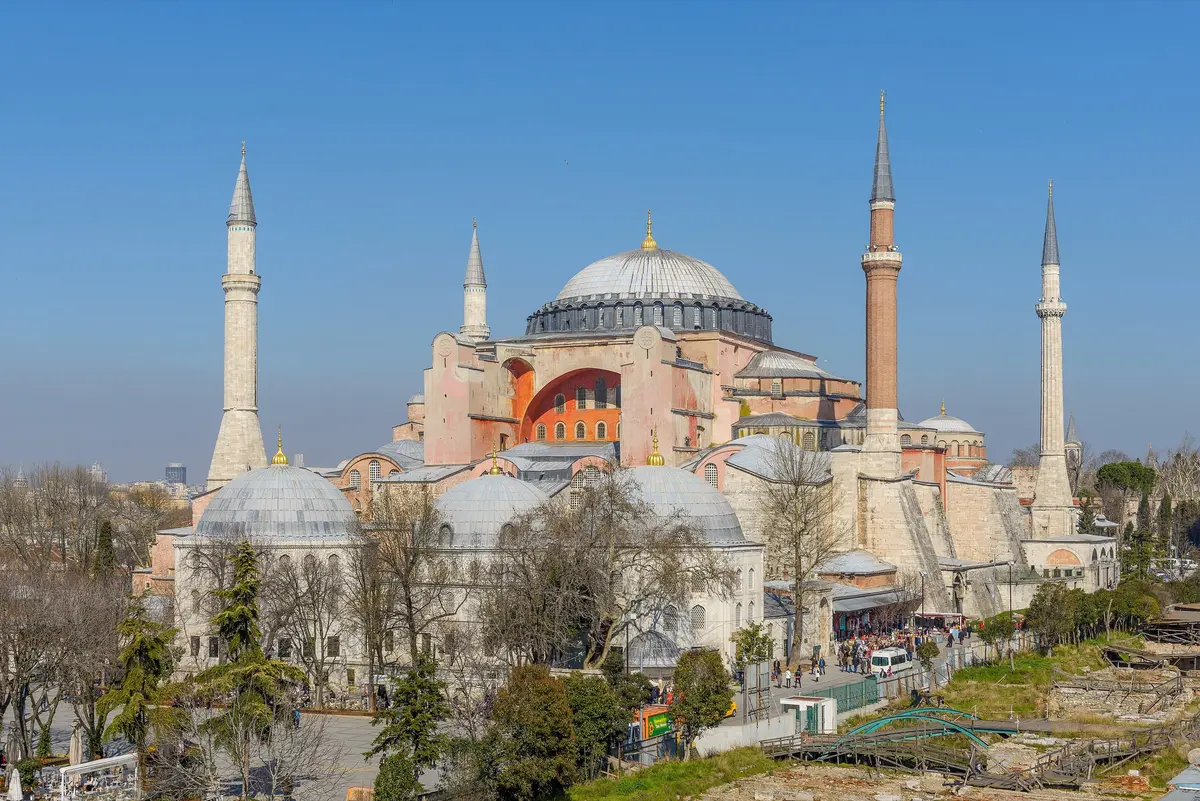
The new Hagia Sophia, built in five years on the ruins of the church burned in the riot, is finished: for centuries the largest church in the Christian world.
Hagia Sophia: Justinian's cathedral, rebuilt after the riot of 532 and finished in 537 - 540
Belisarius enters Ravenna, the capital of the Ostrogothic kingdom of Italy; Justinian's war for Italy seems won, though it will drag on for twelve more years.
San Vitale, Ravenna: the church consecrated in 547 with the mosaics of Justinian and Theodora- 542
Bubonic plague reaches Constantinople, its first appearance in Europe; it kills huge numbers, returns to the capital in 558 and ends a time of growth.
- 547
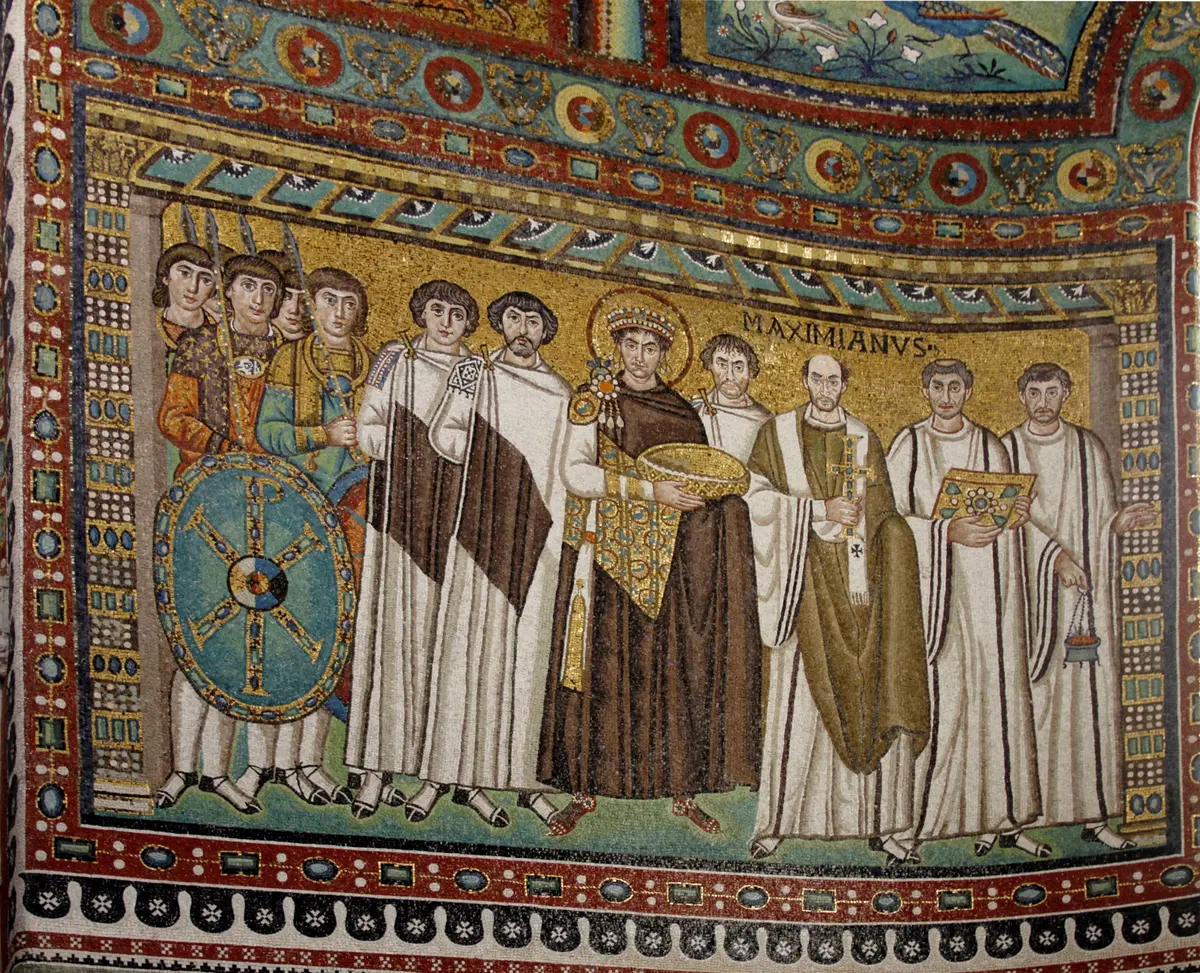
Bishop Maximian consecrates the church of San Vitale in Ravenna, with its mosaics of Justinian and the empress Theodora and their courts.
San Vitale, Ravenna: the church consecrated in 547 with the mosaics of Justinian and Theodora - 552
The eunuch general Narses destroys the Gothic army at Busta Gallorum, where King Totila is mortally wounded; the same year an army lands in southern Spain. The empire is now at its largest.
The Eastern Roman Empire about 600: Italy from Rome to Ravenna - 565
Justinian dies after 38 years on the throne, leaving an empire that borders nearly the whole Mediterranean, a size it never reaches again.
The Eastern Roman Empire about 600: Anatolia, Syria, Palestine, Egypt and the African coast to Carthage, as the historical-basemaps dataset draws it - 627
Heraclius, who had left the capital to strike Persia from behind while Avars and Persians besieged Constantinople in 626, destroys the Persian army at Nineveh; in 630 he brings the Holy Cross back to Jerusalem.
- 636
Near the Yarmuk river, a tributary of the Jordan, the Arab armies of the first caliphs defeat Heraclius's large army; Syria and Palestine are lost for good.
The Yarmuk: where the Arabs defeated Heraclius's army in 636 and won Syria - 642
Alexandria, surrendered by treaty in 641, is handed over to the Arabs; with Egypt the empire loses its richest province and the grain of its capital.
Alexandria: Egypt's capital, lost to the Arabs in 641-642 - 678
After years in which an Arab fleet has attacked Constantinople, the Byzantines first use 'Greek fire', a burning weapon thrown or shot at the enemy that sets wooden ships alight.
Constantinople: the Column of Constantine, set up for the dedication of the city in 330 - 717
An Arab army and fleet under Maslama besiege Constantinople by land and sea; the new emperor Leo III holds the walls with the help of the Bulgar khan Tervel, and the siege fails.
The land walls of Constantinople, finished in 413 and broken through on 29 May 1453 - 726
Leo III has the image of Christ over the Chalke Gate of the palace replaced by a cross (in 726 or 730): the start of Iconoclasm, more than a century of conflict over the honouring of icons.
Constantinople: the Column of Constantine, set up for the dedication of the city in 330 - 843
The icons are restored for good; the end of Iconoclasm opens the middle Byzantine golden age.
- 989
The ruler of Kyiv is crowned at Cherson in the Crimea in the presence of the emperor's envoys and the Rus become Orthodox Christians, part of the Byzantine world of faith.
- 1014
Basil II breaks a Bulgarian army at the pass of Kleidion; the story that he blinded 15,000 prisoners earned him the name 'Bulgar-slayer'. By 1018 all of Bulgaria is annexed.
Kleidion: the pass where Basil II defeated the Bulgarians in 1014 - 1025
Basil II dies after almost fifty years on the throne, leaving the empire at its medieval height, from the Danube to Armenia and Syria.
The Byzantine Empire about 1000, under Basil II: Anatolia and northern Syria, the medieval empire's heartland - 1054
In Constantinople the papal legate Cardinal Humbert excommunicates the patriarch Michael Cerularius: the schism between the Catholic and the Orthodox churches.
Constantinople: the Column of Constantine, set up for the dedication of the city in 330 - 1071
At Manzikert near Lake Van the Seljuk Turks defeat the emperor Romanos IV and take him prisoner; within ten years Turkish bands reach Nicaea and Anatolia is largely lost.
Manzikert (Malazgirt): where the Seljuk Turks defeated and captured Romanos IV in 1071- 1097
The armies of the First Crusade, which reached Constantinople in 1096, take Nicaea from the Turks and hand it over to the emperor Alexios I.
Nicaea (İznik): retaken with the crusaders in 1097, capital of the empire in exile from 1204 to 1261 - 1204
The knights and Venetians of the Fourth Crusade, drawn into a quarrel over the Byzantine throne, storm Constantinople and sack it; a Latin emperor is crowned, and Byzantine princes set up rival empires in exile at Nicaea, Trebizond and Arta.
Constantinople: the Column of Constantine, set up for the dedication of the city in 330- 1261
The general Alexios Strategopoulos slips into Constantinople with a small force and retakes it for the emperor of Nicaea, Michael VIII Palaiologos, who enters the city that summer.
Constantinople: the Column of Constantine, set up for the dedication of the city in 330- 1449
Constantine XI Palaiologos, despot of the Morea, is proclaimed emperor at Mistra; he will be the last.
Mistra: capital of the Despotate of the Morea, where Constantine XI was proclaimed emperor in 1449- 1453
Sultan Mehmed II arrives before the land walls with a huge army and giant cannon, and the siege begins; his ships are later dragged overland into the Golden Horn.
The land walls of Constantinople, finished in 413 and broken through on 29 May 1453- 1:30 a.m.
The final assault begins in the dark, hours before dawn; the Ottomans break through near the gate of St Romanus, the city falls in the morning and Constantine XI is killed. The Byzantine Empire ends with its capital.
The land walls of Constantinople, finished in 413 and broken through on 29 May 1453