Ottoman Empire
“The Turkish Muslim empire founded by Osman around 1300, which took Constantinople in 1453, reached the walls of Vienna and lasted until defeat in the First World War ended the sultanate in 1922.”
The Ottoman Empire was the state of the Turkish dynasty of Osman, which grew from a small Muslim principality on the Byzantine frontier in north-western Anatolia into one of the great powers of the world and lasted more than six hundred years. Osman was a Turkmen chief who led raiders against the Byzantine towns around Bursa. Tradition dates the state to 1299, but no records survive from his time, and historians can only say that it began about 1300. His son Orhan took Bursa, which became the first capital, and from 1354 Ottoman troops held Gallipoli on the European side of the Dardanelles. Murad I moved the capital to Edirne and broke Serbian resistance at Kosovo in 1389. The young state even survived the disaster of 1402, when Timur crushed Bayezid I at Ankara and took him prisoner.
In 1453 Mehmed II took Constantinople after a siege of almost two months and made it his capital, Istanbul. The empire that he and his successors ran rested on the sultan's own household. Boys taken from Christian families in the Balkans through a levy called the devşirme were converted to Islam and trained as Janissary foot soldiers and as officials, while cavalrymen in the provinces lived on the revenues of land grants called timars. Each religious community, or millet, kept its own laws and leaders under the sultan's protection, so Greeks, Armenians and Jews lived and traded beside Muslims in the capital.
The empire reached its height in the sixteenth century. Selim I destroyed the Mamluk sultanate in 1516–17 and added Syria, Egypt and the holy cities of Mecca and Medina, doubling the size of his realm. His son Süleyman, 'the Magnificent' to Europeans and 'the Lawgiver' to his own people, took Belgrade, Rhodes and most of Hungary, besieged Vienna in 1529, and his admiral Barbarossa built a fleet that ruled the eastern Mediterranean, while his architect Sinan raised the Süleymaniye mosque over Istanbul. The defeat at sea at Lepanto in 1571 was soon repaired, and Crete was taken from Venice in 1669. In the 1680s the sultan's provinces and vassals reached from Algeria to Iraq and from Hungary and the Ukrainian steppe to Arabia.
The second siege of Vienna in 1683 failed, and the long war that followed cost the empire Hungary at the peace of Karlowitz in 1699, the first treaty in which the Ottomans accepted defeat. Over the next two centuries Austria and Russia took land in the north, and Greeks, Serbs, Romanians and Bulgarians won their independence; Europeans began to call the empire 'the sick man of Europe'. Reformers tried to rebuild the state on European lines, above all in the Tanzimat, which began with an edict of 1839, and in the constitution of 1876. In 1914 the Young Turk government took the empire into the First World War on Germany's side. Its army held Gallipoli in 1915 but lost the Arab provinces, and during the war the Armenians of Anatolia were deported and massacred in a genocide in which 600,000 to 1.5 million people died. After the armistice of 1918 the Allies occupied Istanbul and planned to divide what was left, but a national movement led by Mustafa Kemal won the war that followed. Its Grand National Assembly in Ankara abolished the sultanate on 1 November 1922, and on 17 November the last sultan, Mehmed VI, left Istanbul on a British warship.
The Republic of Turkey, proclaimed in Ankara in 1923, is the empire's direct successor, but so in a sense are the states of the Balkans and the Arab Middle East, many of whose borders were drawn when its lands were divided after 1918. Its legacy is still visible in the skyline of Istanbul, in mosques, baths and markets from the Balkans to Egypt, and in the food and words the region shares. It also remains a matter of fierce argument, not least over the Armenian genocide.
What happened
- 1299
The traditional founding year of the Ottoman state: Osman, a Turkmen chief whose father Ertuğrul held Söğüt on the Byzantine frontier, leads his raiders against the Byzantine towns of Bithynia. No record survives from his reign; historians date the beginning to about 1300.
Söğüt: the seat of Osman's father Ertuğrul and of the first Ottoman principality - 1326
After a blockade of several years, Osman's son Orhan takes the Byzantine city of Prusa, Bursa. It becomes the first real capital of the Ottomans, and Osman is buried there.
Bursa: taken by Orhan in 1326 and the first capital; the tombs of Osman and Orhan - 1354
Called into Europe as allies of the Byzantine pretender John Cantacuzenus, Ottoman troops under Orhan's son Süleyman occupy Gallipoli on the European side of the Dardanelles and refuse to leave; it becomes their base for raids into Thrace.
- 1361
Murad I takes Adrianople, the second city of the Byzantine Empire. Renamed Edirne, it becomes the Ottoman capital in Europe and the base for the conquest of the Balkans.
Edirne (Adrianople): taken by Murad I and the capital in Europe until 1453 - 1389
On the field of Kosovo, Murad I defeats the army of the Serbian prince Lazar and his allies. Murad is killed, by tradition stabbed by a Serbian nobleman, and his son Bayezid I takes command.
Kosovo field: where Murad I defeated Prince Lazar and was killed in 1389- 1402
Timur, the conqueror from Central Asia, crushes Bayezid I's army near Ankara and takes the sultan prisoner. Bayezid dies in captivity within a year, and his sons fight over what is left for a decade.
Ankara: the Çubuk plain, where Timur crushed and captured Bayezid I in 1402- 1453
After a siege that began on 6 April, in which Mehmed II has ships dragged overland into the Golden Horn, his army breaks through the land walls and takes Constantinople. The city becomes the Ottoman capital, Istanbul.
The land walls of Constantinople, broken by Mehmed II's army on 29 May 1453- 1459
Mehmed II begins a new palace on the tip of the old city, later called Topkapı. It remains the sultans' home and the seat of government until the 1850s.
Topkapı Palace, Istanbul: the sultans' palace from the 1460s until the 1850s - 1481
Mehmed II dies on campaign, a year after his army landed at Otranto in southern Italy. He leaves an empire from the Danube to the Euphrates and codes of secular law, the kanunnames.
- 1517
Selim I, who beat the Mamluk sultan in Syria the summer before, defeats the last Mamluk army at Ridaniya outside Cairo. Syria, Egypt and the guardianship of Mecca and Medina pass to the Ottomans, and the empire doubles in size.
Cairo: the Citadel, seat of the Ottoman governors of Egypt after Selim's conquest of 1517- 1520
Süleyman I succeeds his father Selim. Called 'the Magnificent' in Europe and 'the Lawgiver' by the Ottomans, he reigns for 46 years, longer than any other sultan; Belgrade falls to him in 1521 and Rhodes in 1522.
- 1526
At Mohács on the Danube, Süleyman's army destroys the Hungarian army; King Louis II dies in the flight. Most of Hungary falls under Ottoman rule, and in 1541 its centre becomes an Ottoman province.
Mohács: the battlefield memorial at Sátorhely, where Süleyman destroyed the Hungarian army in 1526- 1529
Süleyman lays siege to Vienna, the Habsburg capital. With his supply lines stretched to the limit and winter coming, he gives up on 15 October; Vienna marks the limit of Ottoman expansion in Europe.
Vienna: besieged by Süleyman in 1529 and by Kara Mustafa in 1683- 1557
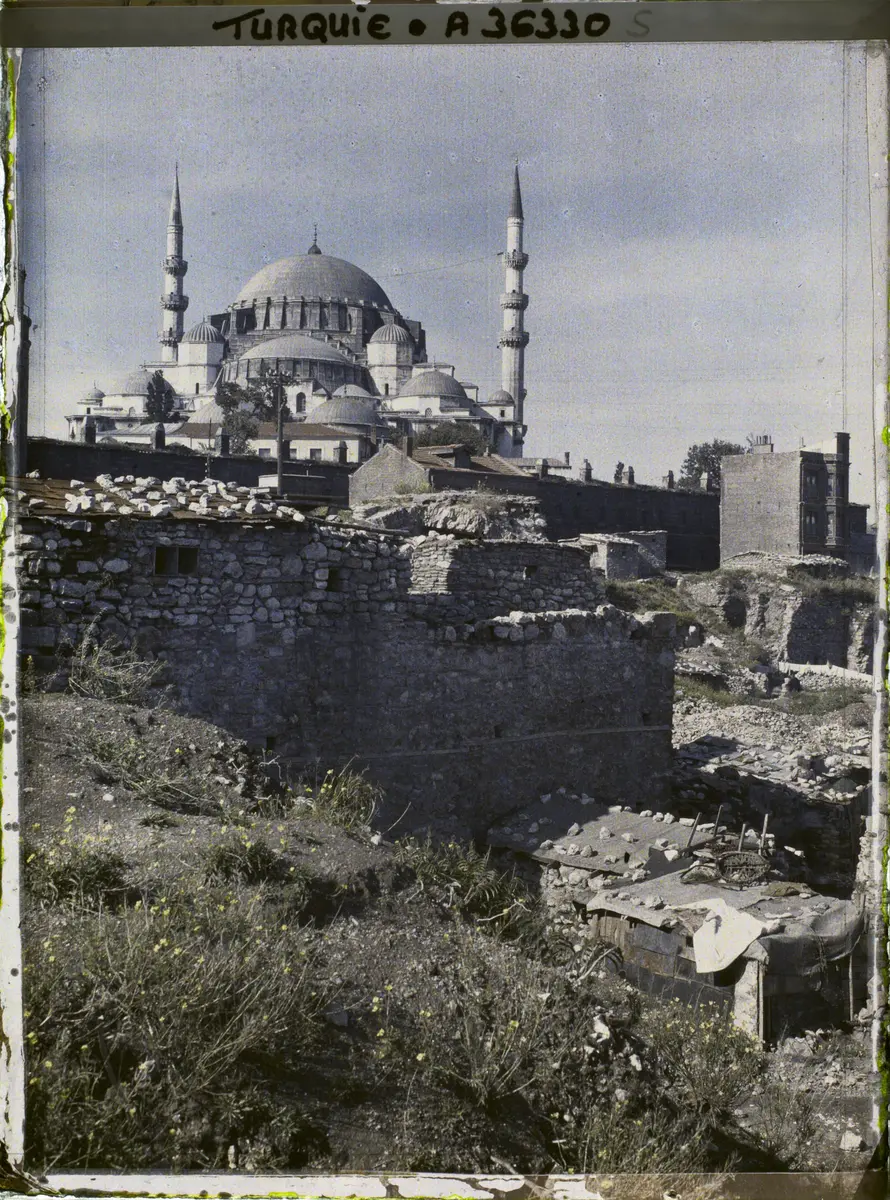
The Süleymaniye Mosque, built for Süleyman by his chief architect Sinan on Istanbul's third hill, is inaugurated, the masterpiece of Ottoman architecture at the empire's height.
The Süleymaniye Mosque, built by Sinan for Süleyman in 1550–57 - 1566
Süleyman dies in his tent during the siege of Szigetvár in Hungary, aged about 71; his death is kept secret for weeks while his son Selim II takes over.
- 1571
In the Gulf of Lepanto the fleet of the Holy League, led by Spain and Venice, destroys the Ottoman fleet. The fleet is soon rebuilt, and the Ottomans keep Cyprus, taken from Venice that year.
The Gulf of Patras off Lepanto: the sea battle of 7 October 1571- 1669
After a war of almost 25 years, Venice gives up Candia (Heraklion), and the whole of Crete becomes Ottoman.
- 1683
The grand vizier Kara Mustafa's two-month siege of Vienna ends in disaster when a relief army of imperial and Polish troops under King Jan Sobieski routs the Ottoman army from the Kahlenberg.
Vienna: besieged by Süleyman in 1529 and by Kara Mustafa in 1683- 1699
At Karlowitz the empire makes peace with the Holy League: Hungary and Transylvania go to Austria, Podolia to Poland, the Morea and Dalmatia to Venice. It is the first treaty in which the Ottomans acknowledge defeat.
Sremski Karlovci (Karlowitz): the Chapel of Peace on the site of the peace congress of 1698–99- 1774
After a disastrous war with Russia, the Treaty of Küçük Kaynarca ends the sultan's overlordship of the Crimean khanate and gives Russia a voice in the affairs of his Orthodox Christian subjects.
- 1839
In the Gülhane, the rose garden of Topkapı Palace, the young Sultan Abdülmecid I's edict is read out, promising every subject, Muslim or not, security of life and property, regular taxes in place of tax farming and fair conscription: the start of the Tanzimat reforms.
Topkapı Palace, Istanbul: the sultans' palace from the 1460s until the 1850s- 1914
Two warships bought from Germany, still crewed by Germans, lead an Ottoman raid on Russia's Black Sea ports. Russia, Britain and France declare war, and the empire fights the First World War on Germany's side.
- 1915
In Constantinople the authorities arrest hundreds of Armenian leaders. Deportations and massacres of the Armenians of Anatolia follow, in which 600,000 to 1.5 million people die; it is now widely called a genocide.
British, French, Australian and New Zealand troops land on the Gallipoli peninsula to force the straits. Ottoman troops, among them Mustafa Kemal's division, hold them on the beaches, and the Allies withdraw in January 1916.
Anzac Cove, Gallipoli: the landing of 25 April 1915- 1918
Beaten in Palestine and Syria and cut off from Germany, the Ottoman government signs the Armistice of Mudros; Allied warships anchor off Constantinople two weeks later.
- 1920
With Constantinople under Allied occupation, the nationalists open a Grand National Assembly in Ankara and elect Mustafa Kemal its president, in defiance of the sultan's government.
Ankara: the first building of the Grand National Assembly, opened in 1920, which abolished the sultanate in 1922The sultan's government signs the Treaty of Sèvres, giving up the Arab provinces and accepting the partition of much of Anatolia. The nationalists reject it and fight on.
- 1922
After the nationalist victory over Greece, the Grand National Assembly in Ankara separates the caliphate from the sultanate and abolishes the sultanate, ending more than six centuries of Ottoman rule.
Ankara: the first building of the Grand National Assembly, opened in 1920, which abolished the sultanate in 1922Early on a rainy morning, Mehmed VI, the last sultan, slips out of Yıldız Palace with his son and a few followers and leaves Constantinople aboard the British warship HMS Malaya, bound for exile in Malta.
Yıldız Palace, Istanbul: the last sultan's residence, which he left on 17 November 1922