The Universal Declaration of Human Rights
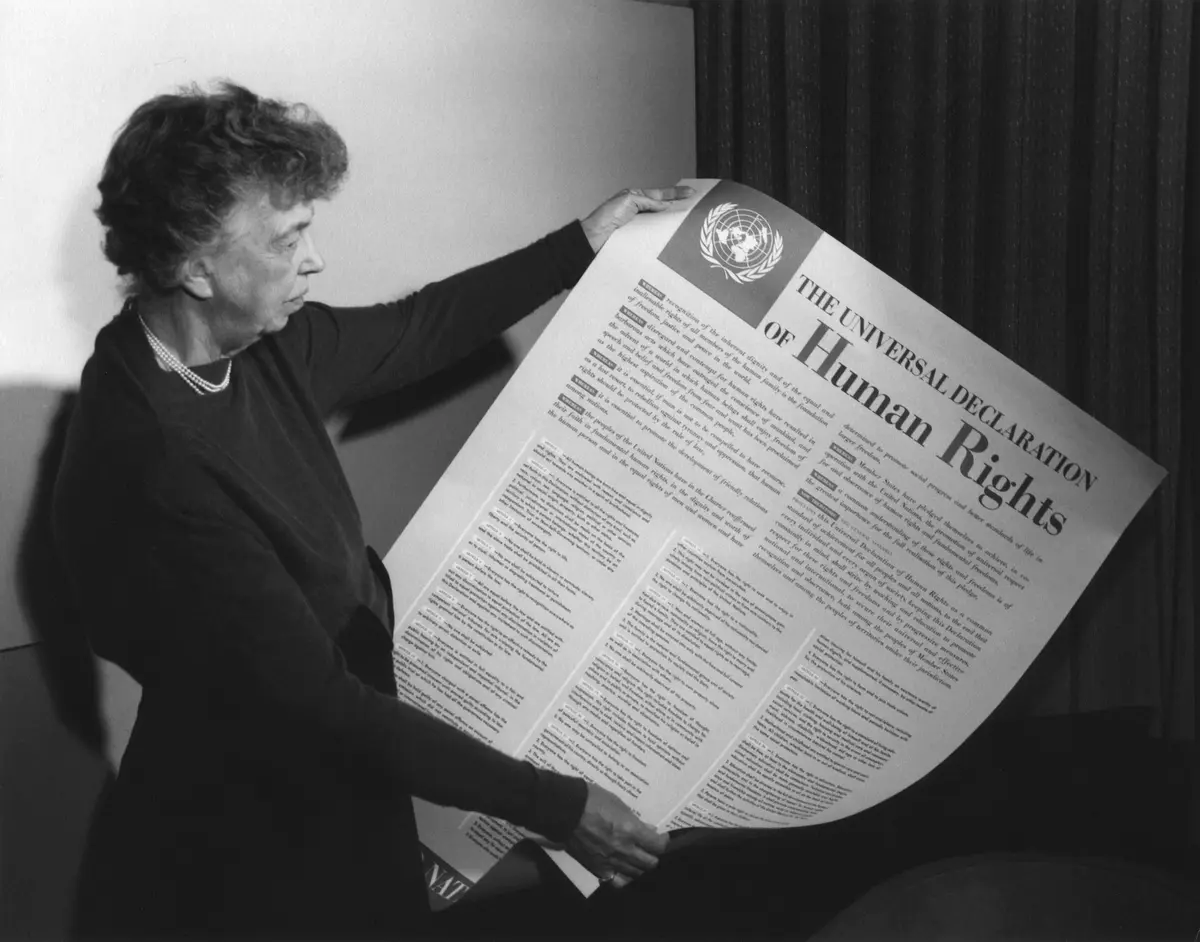
“On 10 December 1948, in Paris, the UN adopted the Universal Declaration of Human Rights, drafted under Eleanor Roosevelt: thirty articles of rights owed to every human being.”
Late on the evening of 10 December 1948, in the Palais de Chaillot in Paris, the General Assembly of the United Nations adopted the Universal Declaration of Human Rights. Forty-eight countries voted for it, none voted against, and eight abstained: the Soviet Union, Ukraine, Byelorussia, Poland, Czechoslovakia and Yugoslavia, together with Saudi Arabia and South Africa. For the first time the nations of the world agreed on one list of rights that belong to every person simply because they are human. A preamble and thirty articles open with 'All human beings are born free and equal in dignity and rights' and go on to the right to life, liberty and security, the bans on slavery and torture, equality before the law and a fair trial, freedom of movement, asylum, marriage and property, freedom of thought, religion, opinion and assembly, and a share in government. Then come social and economic rights: social security, work with fair pay, trade unions, rest, a decent standard of living, education and a part in cultural life.
The Declaration grew out of the Second World War. The Nazi genocide and the other crimes of the war had convinced the victors that the way a state treats its own people is the world's business, and Franklin Roosevelt's 'four freedoms' of 1941, freedom of speech and of worship, freedom from want and from fear, had come to stand for what the Allies were fighting for. The United Nations Charter of 1945 promised to promote 'fundamental human rights' but did not say what they were: a bill of rights was proposed at San Francisco, but there was no time to write one. So in 1946 the UN's Economic and Social Council set up a Commission on Human Rights. At its first meeting, on 27 January 1947, in part of the Sperry gyroscope factory at Lake Success near New York, the UN's temporary home, its eighteen members unanimously elected Eleanor Roosevelt, the president's widow, as chair, the Chinese philosopher and playwright P. C. Chang as vice-chair and the Lebanese philosopher Charles Malik as rapporteur. John Humphrey, a Canadian law professor who headed the UN Secretariat's human rights division, wrote the first outline of 48 articles, and the French jurist René Cassin reworked it into a declaration in June 1947.
Writing it took less than two years, while the Cold War was beginning around the drafters. Chang insisted that the text should reflect more than Western ideas and kept God and nature out of it; Malik argued from natural law; Hernán Santa Cruz of Chile fought for social and economic rights; and Hansa Mehta of India is credited with changing 'all men' to 'all human beings' in its first article. In Geneva in December 1947 the Commission divided the task into three parts, a declaration of principles, a binding covenant and the means to enforce it, and only the declaration was finished in time. The Commission approved its text at Lake Success on 18 June 1948 by 12 votes, with 4 abstentions; in Paris the Assembly's Third Committee, chaired by Malik, went through it article by article in 81 meetings and 168 proposed amendments and passed it on 6 December. In the final debate Eleanor Roosevelt said it might become the Magna Carta of all mankind. The Soviet bloc, which wanted the duties of the state written into almost every article, abstained but did not vote against.
The Declaration is not a treaty. It binds no government and has no court behind it, and its makers knew it: the Assembly's president, Herbert Evatt of Australia, called it a first step that obliged no state and provided no enforcement, and Roosevelt wrote to her aunt the day before the vote that it had no legal value but should carry moral weight. It was meant as the first part of an 'International Bill of Human Rights', and the two covenants the Commission could not finish in 1948, on civil and political rights and on economic, social and cultural rights, followed only in 1966. Yet the Declaration itself became the foundation of international human rights law: more than seventy human rights treaties refer to it, many national constitutions borrowed from it, courts cite it, and it has been translated into more than 500 languages. The day of its adoption, 10 December, is kept every year as Human Rights Day, and René Cassin received the Nobel Peace Prize in 1968.
It still matters because it is the common yardstick by which governments are judged, by one another, by courts and by their own citizens, and because the arguments of 1948 are still going on. Are these rights truly universal, or Western ideas in universal dress? Do freedom of speech and the right to food and work belong together, as the drafters held, or apart, as the two Cold War camps came to treat them, each praising the half that suited it? And what is a promise worth without a means to enforce it? The opening words and the date, 10 December 1948, have become the shorthand for an idea that was new in law if not in philosophy: that some things may not be done to anyone, anywhere, by any government.
What happened
- 1947
The UN Commission on Human Rights opens its first session at Lake Success. Its eighteen members unanimously elect Eleanor Roosevelt of the United States as chairman, P. C. Chang of China as vice-chairman and Charles Malik of Lebanon as rapporteur; John Humphrey, director of the Secretariat's human rights division, serves as the Commission's secretary.
Lake Success, New York: the former Sperry gyroscope plant, the UN's temporary headquarters, where the Commission on Human Rights first met and approved the draftThe first session closes. Members have argued whether to write a binding treaty with enforcement or a declaration of principles; the Commission asks its three officers, Roosevelt, Chang and Malik, to prepare with the Secretariat a preliminary draft of an international bill of human rights.
Lake Success, New York: the former Sperry gyroscope plant, the UN's temporary headquarters, where the Commission on Human Rights first met and approved the draftAfter some members of the Economic and Social Council ask for a broader group, Roosevelt widens the drafting group to eight countries: Australia, Chile, China, France, Lebanon, the Soviet Union, the United Kingdom and the United States. The Economic and Social Council notes it and sets the timetable: a draft to the Commission, comments from governments, a redraft, and the final text to the General Assembly in 1948.
The Drafting Committee meets for the first time at Lake Success. Before it lies the Secretariat's Draft Outline of an International Bill of Rights, prepared under John Humphrey: forty-eight articles of liberties, social rights and equality, with a documented survey of the world's constitutions and of drafts sent in by governments and private groups.
Lake Success, New York: the former Sperry gyroscope plant, the UN's temporary headquarters, where the Commission on Human Rights first met and approved the draftThe committee sets up a small working group of France, Lebanon, the United Kingdom and the chairman to rearrange the articles, and gives René Cassin the task of redrafting the declaration from the Secretariat's outline.
Lake Success, New York: the former Sperry gyroscope plant, the UN's temporary headquarters, where the Commission on Human Rights first met and approved the draftThe Drafting Committee holds its last meeting of the session at Lake Success. Its report to the Commission carries two texts: a draft declaration, Cassin's rework, and draft articles for a binding convention, because the members still disagree on which form the bill of rights should take.
Lake Success, New York: the former Sperry gyroscope plant, the UN's temporary headquarters, where the Commission on Human Rights first met and approved the draftThe Commission opens its second session in Geneva. It settles the shape of the work: an international bill of human rights in three parts, a declaration, a convention (later called a covenant) and measures of implementation, each given to its own working group. Many members accept a declaration only if it comes first and does not replace a treaty.
The Palais des Nations, Geneva: where the Commission's second session met in December 1947 and wrote the 'Geneva draft'The Geneva session ends. Its report with the draft articles of the declaration, known as the Geneva draft, goes to every member state in the first week of January, with replies due by 3 April 1948.
The Palais des Nations, Geneva: where the Commission's second session met in December 1947 and wrote the 'Geneva draft'- 1948
The Drafting Committee meets again at Lake Success to work in the governments' comments, the proposals of the Geneva conference on freedom of information and of the Commission on the Status of Women, and the American Declaration of the Rights and Duties of Man adopted at Bogotá that spring. By 21 May it has redrafted both the declaration and the covenant.
Lake Success, New York: the former Sperry gyroscope plant, the UN's temporary headquarters, where the Commission on Human Rights first met and approved the draftAt the last meeting of its third session at Lake Success, the Commission adopts the redrafted Declaration by 12 votes to none, with 4 abstentions. It has had no time for the covenant or for enforcement.
Lake Success, New York: the former Sperry gyroscope plant, the UN's temporary headquarters, where the Commission on Human Rights first met and approved the draftThe Economic and Social Council, meeting in Geneva, regrets that the covenant is unfinished but sends the draft Declaration to the General Assembly, without a vote.
The Palais des Nations, Geneva: where the Commission's second session met in December 1947 and wrote the 'Geneva draft'- 3:25 p.m.
President Vincent Auriol of France welcomes the third General Assembly to the Palais de Chaillot in Paris; at the opening meeting the delegates elect Herbert Evatt of Australia president of the session on the second ballot.
The Palais de Chaillot, Paris: where the third General Assembly met from September to December 1948 and adopted the Declaration on 10 December In the general debate the American Secretary of State, George Marshall, recalls that France gave the world the Declaration of the Rights of Man in 1789 and urges the Assembly to approve the new Declaration at this session, by an overwhelming majority, as a standard of conduct for all.
The Palais de Chaillot, Paris: where the third General Assembly met from September to December 1948 and adopted the Declaration on 10 DecemberThe Assembly refers the draft International Declaration of Human Rights to its Third Committee, on social, humanitarian and cultural questions.
The Palais de Chaillot, Paris: where the third General Assembly met from September to December 1948 and adopted the Declaration on 10 DecemberEleanor Roosevelt speaks at the Sorbonne on 'The Struggle for Human Rights' to an overflowing hall, calling the preservation of human freedom one of the great issues of the time and the Declaration the way to a lasting peace.
The Sorbonne, Paris: where Eleanor Roosevelt gave her speech 'The Struggle for Human Rights' on 28 September 1948The Third Committee, chaired by Charles Malik, starts its debate. Over 81 meetings until 7 December it goes through the text word by word; delegations table 168 formal amendments, and a sub-committee smooths the language of the whole.
The Palais de Chaillot, Paris: where the third General Assembly met from September to December 1948 and adopted the Declaration on 10 DecemberAt its 178th meeting the Third Committee adopts the Declaration as a whole by roll-call, 29 votes to none, with 7 abstentions.
The Palais de Chaillot, Paris: where the third General Assembly met from September to December 1948 and adopted the Declaration on 10 DecemberThe committee's report goes to the Assembly, and Roosevelt and Malik meet the press in Paris after the completion of the Declaration.
The Palais de Chaillot, Paris: where the third General Assembly met from September to December 1948 and adopted the Declaration on 10 December- 8:30 p.m.
Hours after the Assembly has adopted the Genocide Convention unanimously, its evening meeting opens the debate on the Declaration. Malik presents the committee's text; Roosevelt calls it a compromise but a good one, first of all a statement of basic principles to serve as a common standard for all nations, which might become the Magna Carta of all mankind, as important as the declarations of 1776 and 1789. The meeting runs past midnight.
The Palais de Chaillot, Paris: where the third General Assembly met from September to December 1948 and adopted the Declaration on 10 December - 9:00 p.m.
After two more meetings of speeches, the night meeting votes. The Soviet proposal to put the Declaration off to the next session falls, 45 votes to 6; the four Soviet amendments fall one by one; a British amendment passes that forbids any distinction by the status of a person's country, so the rights hold equally in colonies and trust territories. At Poland's request the Assembly votes on every recital and article, then adopts the whole by 48 votes to none, with 8 abstentions, before midnight. Evatt honours Roosevelt and Malik and calls it a first step, binding no one, but a declaration millions will turn to. The meeting rises at 12.10 a.m.
The Palais de Chaillot, Paris: where the third General Assembly met from September to December 1948 and adopted the Declaration on 10 December