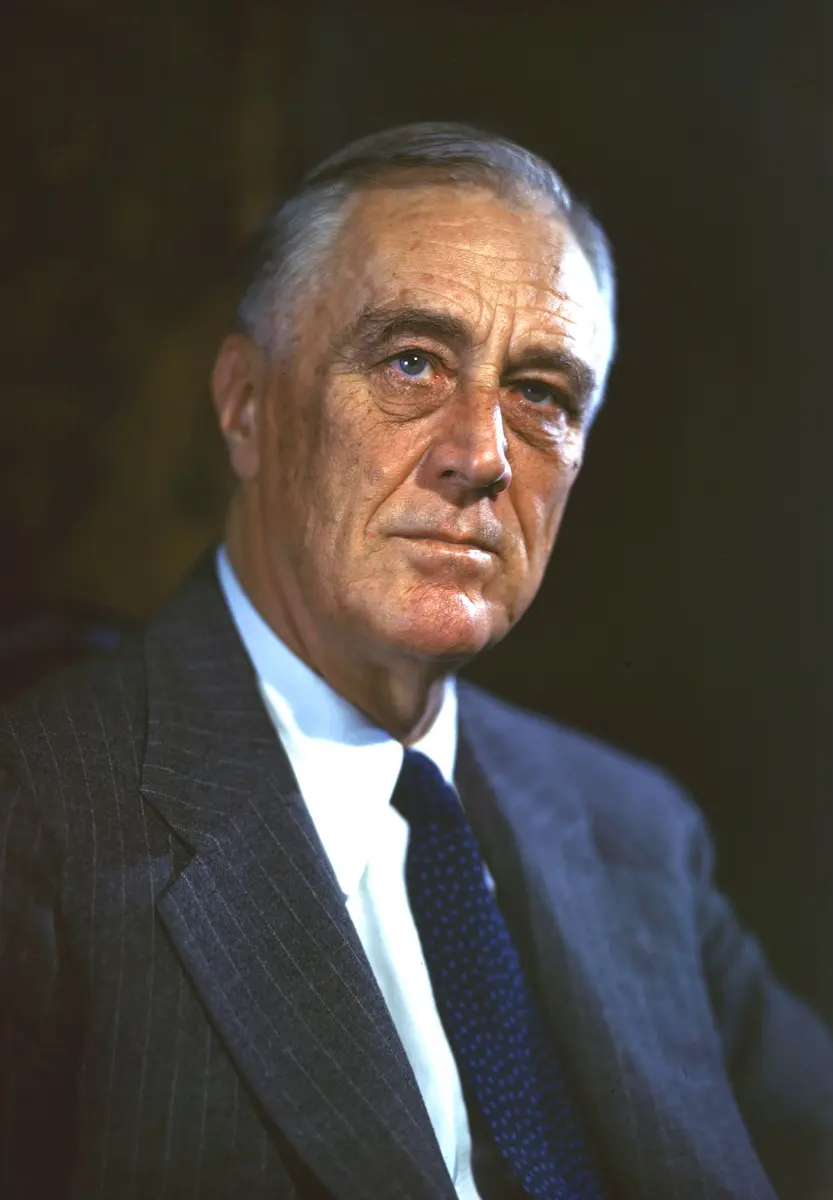
Franklin D. Roosevelt
“The president who led the United States through the Great Depression with his New Deal and through most of the Second World War, the only one elected four times.”
Franklin Delano Roosevelt was born on 30 January 1882 at Springwood, his family's estate above the Hudson River at Hyde Park, New York, the only child of Sara Delano and James Roosevelt, a wealthy landowner and widower twenty-six years her senior. Taught at home by tutors until he was fourteen, he went to Groton School and then to Harvard, where he finished his degree in three years and stayed on to run the student newspaper, the Crimson. In 1905 he married a distant cousin, Eleanor Roosevelt, whose uncle, President Theodore Roosevelt, gave the bride away; five of their six children survived. He studied law at Columbia without finishing, and in 1910, following the example of his admired cousin Theodore, entered politics as a Democrat by winning a state senate seat in a Republican district. Woodrow Wilson made him Assistant Secretary of the Navy in 1913, and in 1920 he ran for vice president on the Democratic ticket, which lost heavily.
In August 1921, at the family's summer home on Campobello Island in Canada, he fell ill and was found to have polio. He never walked on his own again. He spent years trying to recover, bought a run-down spa at Warm Springs, Georgia, in 1926 and turned it into a treatment centre for polio patients, and learned to seem to walk a few steps with steel leg braces, a cane and the arm of a son or an aide. He asked the press not to photograph him struggling to walk or being lifted from his car, and most Americans never saw how disabled he was. With the help of Eleanor and his adviser Louis Howe he came back: in 1928 he was elected governor of New York, and in July 1932, with the Great Depression at its worst, he flew to Chicago to accept the Democratic nomination and promise 'a new deal for the American people'. That November he beat Herbert Hoover by some seven million votes.
He took office on 4 March 1933, with banks closed across the country, telling Americans that 'the only thing we have to fear is fear itself'. He shut the banks for a few days, explained the rescue on the radio in the first of his 'fireside chats', and in the 'Hundred Days' that followed pushed through Congress a stream of laws for jobs, farmers, banks and industry, with new agencies such as the Civilian Conservation Corps and the Tennessee Valley Authority. In 1935 came the Works Progress Administration and the Social Security Act, which created old-age pensions and unemployment insurance. The New Deal did not end the Depression, and his 1937 plan to add up to six judges to a Supreme Court that had struck down his laws failed in Congress. But he won four elections, and his New Deal coalition kept the Democrats the majority party for a generation and gave the federal government a part in Americans' working lives that it has kept ever since.
As war spread in Europe and Asia, he moved a neutral and wary country towards helping Britain: he called America 'the arsenal of democracy', named four freedoms that all people should have, won the Lend-Lease Act in March 1941 and agreed the Atlantic Charter with Churchill that August. After Japan attacked Pearl Harbor he asked Congress on 8 December 1941 to declare war, calling the day of the attack 'a date which will live in infamy'. As commander in chief he put the defeat of Germany first, met Churchill and Stalin at Tehran and Yalta, and planned the United Nations. His war has dark pages too. In February 1942 he signed Executive Order 9066, under which about 120,000 people of Japanese ancestry, most of them American citizens, were forced from their homes on the West Coast and held in camps without charge; in 1988 the United States apologised and paid compensation. His government knew for much of the war that the Nazis were murdering Europe's Jews, but held that winning the war was the way to stop it, a choice many have criticised since.
By 1944 he was worn out: doctors found heart disease and dangerously high blood pressure, which the public was not told. He won a fourth term that November with Harry Truman as his running mate, came back exhausted from Yalta, and went to Warm Springs to rest. On 12 April 1945, while he sat for a portrait by the painter Elizabeth Shoumatoff, with Lucy Mercer Rutherfurd among the guests (his affair with her, discovered by Eleanor in 1918, had nearly ended his marriage), he complained of a terrible headache, collapsed and died of a cerebral haemorrhage that afternoon, aged 63, less than four weeks before Germany surrendered. Truman was sworn in the same day. Hundreds of thousands of people lined the tracks as a train carried his body to Washington and on to Hyde Park, where he was buried in the rose garden on 15 April. He remains the only president elected four times.
What happened
- 1882
Born at Springwood, his parents' estate at Hyde Park, New York, the only child of Sara Delano and James Roosevelt, who had a grown son from his first marriage.
Springwood, Hyde Park, New York: born here 30 January 1882, his home all his life, buried in its rose garden- 1896
After years of lessons at home with tutors, goes away at fourteen to Groton School in Massachusetts.
- 1900
Enters Harvard College; a few weeks later his father dies.
- 1904
Having taken his degree in three years, stays on at Harvard as president of the student newspaper, the Crimson.
- 1905
Marries his distant cousin Eleanor Roosevelt in New York City; her uncle, President Theodore Roosevelt, gives the bride away.
- 1907
Passes the bar examination, leaves Columbia Law School without a degree and joins the New York law firm of Carter, Ledyard and Milburn.
- 1910
Elected to the New York State Senate as a Democrat from Dutchess County, a Republican district; he takes his seat in 1911.
- 1913
President Woodrow Wilson makes him Assistant Secretary of the Navy, a post he holds through the First World War until 1920.
- 1920
Runs for vice president beside the Democratic candidate James M. Cox; Warren Harding's Republicans win in a landslide.
- 1921
On holiday at Campobello Island he falls ill, and his legs become paralysed; on 25 August Dr. Robert Lovett diagnoses polio.
Roosevelt Cottage, Campobello Island, New Brunswick: struck by polio here, August 1921- 1924
Visits Warm Springs, Georgia, for its mineral waters, and in his first public appearance since the illness nominates Al Smith for president at the Democratic convention.
The Little White House, Warm Springs, Georgia: died here 12 April 1945 - 1926
Buys the struggling Warm Springs resort for $200,000 and turns it into a treatment centre for polio patients.
The Little White House, Warm Springs, Georgia: died here 12 April 1945 - 1928
Elected governor of New York by about half a percentage point, while Al Smith loses the presidency to Herbert Hoover.
- 1932
Flies to the Democratic convention in Chicago to accept the nomination in person: 'I pledge you, I pledge myself, to a new deal for the American people.'
Defeats Hoover by some seven million votes and 472 electoral votes to 59.
- 1933
Inaugurated at the Capitol with banks closed across the country, he tells Americans that 'the only thing we have to fear is fear itself'.
United States Capitol, Washington: inaugurated 4 March 1933; the 'day of infamy' speech, 8 December 1941After closing every bank and rushing an emergency banking law through Congress, he explains on the radio, in his first fireside chat, why the reopened banks will be safe.
The White House, Washington: president 1933–1945The Hundred Days end: since 9 March Congress has passed his laws for banks, farmers, relief and industry and created the Civilian Conservation Corps and the Tennessee Valley Authority.
Visits camps of the Civilian Conservation Corps in Virginia and lunches with the young men of the Corps.
- 1935
Signs the Social Security Act, which creates old-age pensions and unemployment insurance.
- 1936
Re-elected in a landslide over Alf Landon, by 523 electoral votes to 8.
- 1937
Asks Congress to add a judge for every judge over seventy who will not retire, which would give the Supreme Court up to six new justices.
Defends the court plan in a fireside chat; within weeks the Court starts to uphold New Deal laws.
The Senate abandons the court plan, his worst defeat in Congress.
- 1940
Wins an unprecedented third term against Wendell Willkie, by 449 electoral votes to 82.
In a fireside chat he says the United States must be 'the arsenal of democracy'.
- 1941
In his State of the Union address he names four freedoms for all people: of speech, of worship, from want and from fear.
United States Capitol, Washington: inaugurated 4 March 1933; the 'day of infamy' speech, 8 December 1941Signs the Lend-Lease Act; by the war's end the United States has supplied some $50 billion of arms and goods to more than thirty countries.
Meets Churchill for two days on warships in Placentia Bay, Newfoundland; their Atlantic Charter of war aims is published on 14 August.
- 12:30 p.m.
The day after Japan's attack on Pearl Harbor, he asks a joint session of Congress to declare war: 7 December is 'a date which will live in infamy'.
United States Capitol, Washington: inaugurated 4 March 1933; the 'day of infamy' speech, 8 December 1941 - 4:00 p.m.
Signs the declaration of war on Japan, passed with a single vote against; three days later Germany and Italy declare war on the United States.
- 1942
Twenty-six nations, at war with the Axis, sign his Declaration by United Nations.
Signs Executive Order 9066; under it about 120,000 people of Japanese ancestry, most of them American citizens, are removed from the West Coast and held in camps without charge.
- 1943
At Casablanca he and Churchill agree to invade Sicily and Italy next and to demand the Axis powers' unconditional surrender.
Meets Stalin for the first time, with Churchill, at Tehran, where the invasion of France is fixed for 1944.
- 1944
A cardiologist, Dr. Howard Bruenn, finds that he has heart failure and very high blood pressure; his working day is cut to a few hours, and the public is not told.
Wins a fourth term against Thomas Dewey, by 432 electoral votes to 99, with Harry Truman as vice president.
- 1945
Sworn in for the fourth time in a short wartime ceremony at the White House.
The White House, Washington: president 1933–1945Meets Churchill and Stalin at Yalta in the Crimea, until 11 February, to settle the end of the war and the shape of Europe after it.
Back from Yalta, he reports to Congress; his delivery is halting and he strays from his text.
United States Capitol, Washington: inaugurated 4 March 1933; the 'day of infamy' speech, 8 December 1941Leaves Washington for the last time, to rest at his cottage in Warm Springs.
The Little White House, Warm Springs, Georgia: died here 12 April 1945Shortly after 1 p.m., while sitting for a portrait by Elizabeth Shoumatoff and signing papers, he complains of a terrible headache and slumps in his chair.
The Little White House, Warm Springs, Georgia: died here 12 April 1945- 3:35 p.m.
Dies of a cerebral haemorrhage at the Little White House, aged 63, without waking; Harry Truman is sworn in as president in Washington the same day.
The Little White House, Warm Springs, Georgia: died here 12 April 1945