Confucius
“China's most famous teacher, who never found a ruler willing to follow him, but whose sayings in the Analects, on ritual, family duty and rule by example, shaped East Asia for two thousand years.”
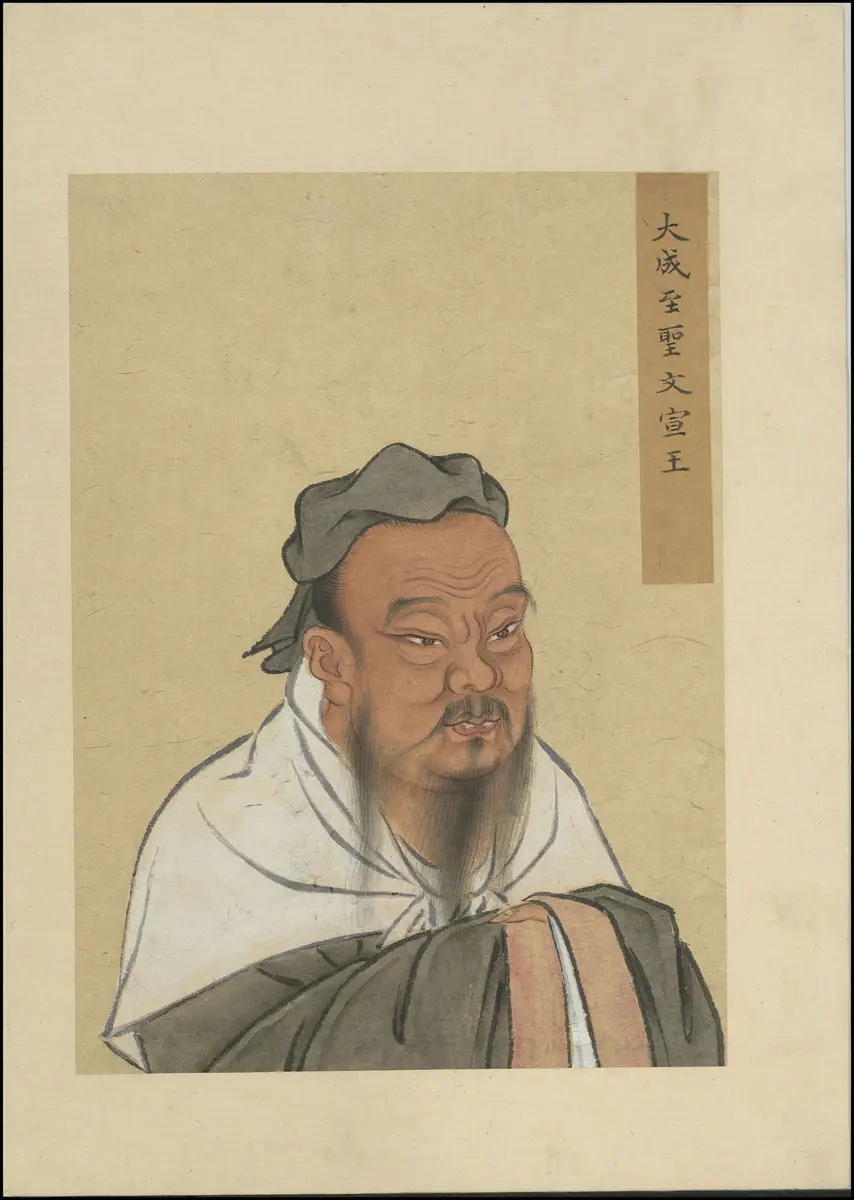
Confucius was a teacher and political thinker of ancient China, the most influential in the history of East Asia. The name is a Latin form, made by Jesuit missionaries, of Kong Fuzi, 'Master Kong'; his own name was Kong Qiu. By the traditional date he was born in 551 BCE at Zou, near Qufu in the small state of Lu, in today's Shandong province. It was late in the Spring and Autumn period: the kings of the Zhou dynasty had lost their power, and the regional states and their great families fought over what was left. His family claimed descent from nobles of the state of Song, but by his time they were plain shi, educated gentlemen one step above the common people. His father, an old soldier, died when he was about three, and he grew up poor with his mother. Because his station was low, as he said himself, he had to learn many humble skills, and his first jobs were keeping the granaries and the herds of the Ji, the most powerful family in Lu.
He rose in the service of Lu to minister of works and then minister of crime, and was valued above all as a diplomat. But the dukes of Lu were in the hands of three hereditary families, and when his plan to break their power failed in 498 BCE he had to leave. For some fourteen years he travelled with a few disciples through the states of Wei, Song, Chen and Cai to the border of Chu, looking for a ruler who would put his ideas to use. Twice he was nearly killed, and once he and his followers ran out of food. In 484 BCE Lu called him home. He never held office again, but the rulers consulted him as the 'elder of the state', and his circle of students grew. He outlived his only son and his favourite disciple, Yan Hui, and died in 479 BCE.
He called himself 'a transmitter and not a maker', and looked back to the founders of the Zhou, but he gave their old rites a new purpose. Ritual and music, he taught, train the feelings and teach people to put others before themselves. Respect and care within the family are the root of ren, humaneness, the highest virtue. A gentleman (junzi) is made by character and learning, not by birth, and a ruler governs best through his own example, which moves the people as the wind bends the grass. 'What you do not want done to yourself, do not do to others,' he said. He would teach anyone who brought a token gift, and made teaching a calling of its own. His followers collected his sayings and conversations in the Analects (Lunyu), a book that took its final form over the next three centuries.
Almost nothing about him was written down while he lived. His story comes from the Analects, from the Zuo commentary on the chronicle of Lu, and above all from the first biography, written by the historian Sima Qian around 100 BCE, nearly four centuries after his death. Sima Qian wove scattered anecdotes into one continuous life. The dates, the offices and many famous episodes, such as his meeting with Laozi, are tradition rather than proven fact.
Later followers, Mencius and Xunzi among them, carried his ideas through the Warring States. The First Emperor of Qin persecuted the scholars who taught them, but in 136 BCE the Han court made the Five Classics tied to his name the official learning of the state. A temple to him was built at Qufu in 478 BCE, a year after his death, and it grew, with his cemetery and his descendants' mansion, into one of China's great monuments. The Song scholar Zhu Xi (1130–1200) put the Analects at the heart of the 'Four Books', which, read through his commentaries, became the core of the civil service examinations until the early twentieth century, and temples to Confucius spread to Korea, Japan and Vietnam. Jesuit missionaries made him 'the philosopher of the Chinese' for Enlightenment Europe. In the twentieth century reformers attacked him as the symbol of an old and unequal order, and Mao's Cultural Revolution vilified him; today he is honoured again in China and across East Asia.
What happened
- 551 BCE
Born at Zou, near Qufu in the state of Lu, to Shuliang He, an old soldier, and his young wife Yan Zhengzai. Legend says his parents prayed for a son on Mount Ni, and that he was born in a cave of the hill.
Mount Ni (Nishan), about 24 km south-east of Qufu: where, by tradition, his parents prayed for a son and he was born, in a cave of the hill - 549 BCE
His father dies when he is about three, leaving the family poor; his mother brings him up.
- 532 BCE
A year after his marriage at nineteen to a woman of the Qiguan family, his son is born; the duke of Lu sends a gift of carp, and the boy is named Li, 'Carp'. About now he takes his first jobs, keeping the granaries and then the herds and fields of the Ji family.
- 518 BCE
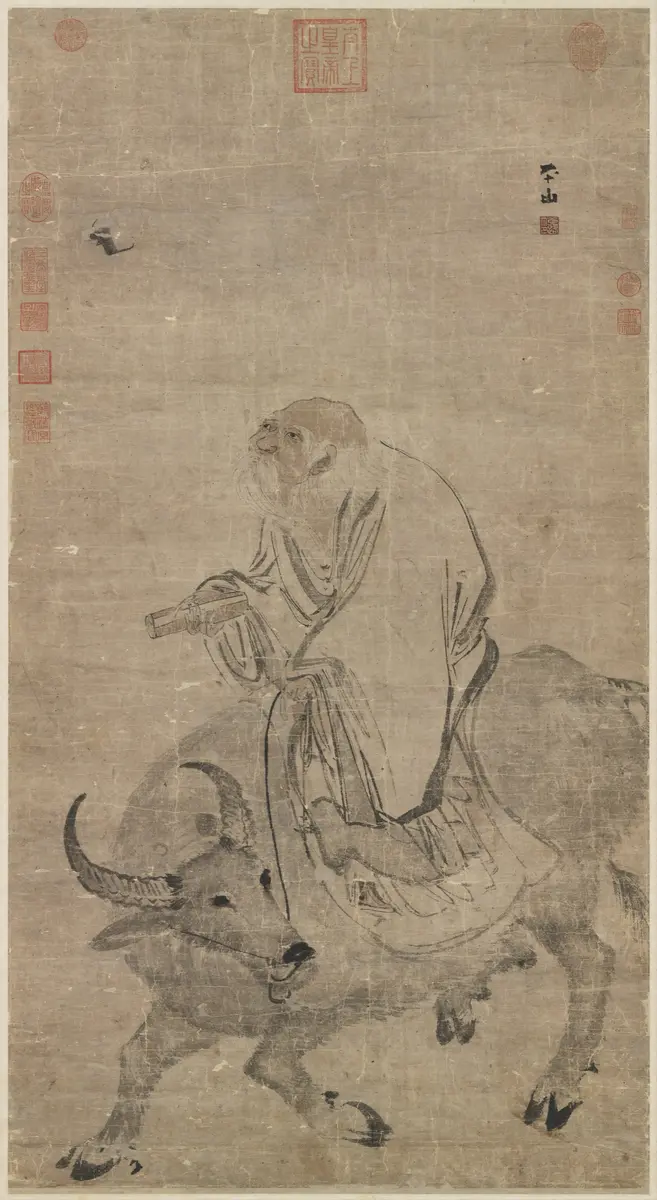
By a tradition Sima Qian records, he travels to the Zhou royal capital at Luoyang to study its rites and meets Laozi, keeper of the archives and later honoured as the first Daoist philosopher. Many historians think the meeting a legend.
- 517 BCE
Duke Zhao of Lu, beaten by the three great families, flees to the state of Qi, and Confucius follows. In Qi he hears the ancient Shao music and is so moved that for three months he does not know the taste of meat.
- 501 BCE
Back in Lu, he is made governor of the town of Zhongdu, his first post in the state's government.
- 500 BCE
Now minister of crime, he guides Duke Ding of Lu through a treaty meeting with the duke of Qi at Jiagu, and saves him from a plot to seize him.
- 498 BCE
He backs a plan to tear down the walls of the strongholds of the three families that hold the real power in Lu. Two are razed, but the third holds out, and the families turn against him.
- 497 BCE
He leaves Lu with a few disciples, Zilu, Zigong and Yan Hui among them, and goes first to the state of Wei: the start of fourteen years of travels in search of a ruler who will use him.
Puyang, near the site of Diqiu, capital of the state of Wei: his first refuge after leaving Lu in 497 BCE, and the state where he spent most of his fourteen years away - 493 BCE
After waiting four years for an audience, he is received by Duke Ling of Wei, who disappoints him and dies soon after. Confucius heads south.
Puyang, near the site of Diqiu, capital of the state of Wei: his first refuge after leaving Lu in 497 BCE, and the state where he spent most of his fourteen years away - 492 BCE
On the road he barely escapes death twice: in Song, where the officer Huan Tui tries to ambush him ('Heaven produced the virtue that is in me; what can Huan Tui do to me?'), and at Kuang, where a mob surrounds him. He reaches the state of Chen.
- 489 BCE
Leaving Chen, where war has broken out, for the state of Chu, he and his followers run out of food and grow too weak to stand. They get only as far as a border town of Chu before turning back.
Huaiyang, the old Wanqiu, capital of the state of Chen: where he spent three years, and from where he and his followers went hungry on the road to Chu - 484 BCE
Invited back by the duke of Lu, with a handsome gift, he returns home to Qufu. He takes no office, but the rulers consult him as the elder of the state, and he spends his last years teaching.
The Temple of Confucius, Qufu: begun in 478 BCE, a year after his death, and by tradition on the site of his house - 483 BCE
His son Li dies, before him.
- 481 BCE
His favourite disciple, Yan Hui, dies young. 'Heaven is destroying me!' Confucius cries, and weeps more than his disciples think proper.
A strange beast caught on a hunt is brought to him, and he knows it for a qilin, the creature of good omen. The Spring and Autumn Annals, the chronicle of Lu that tradition says he edited, ends with this event.
- 480 BCE
His disciple Zilu is killed defending his lord in a coup in Wei.
- 479 BCE
He dies in Lu on the 11th day of the fourth month, aged 73 by Chinese count, and is buried north of Qufu by the Si river. A year later a temple to him is built at Qufu.
The tomb of Confucius, in the Cemetery of Confucius north of Qufu, by the Si river: buried here in 479 BCE