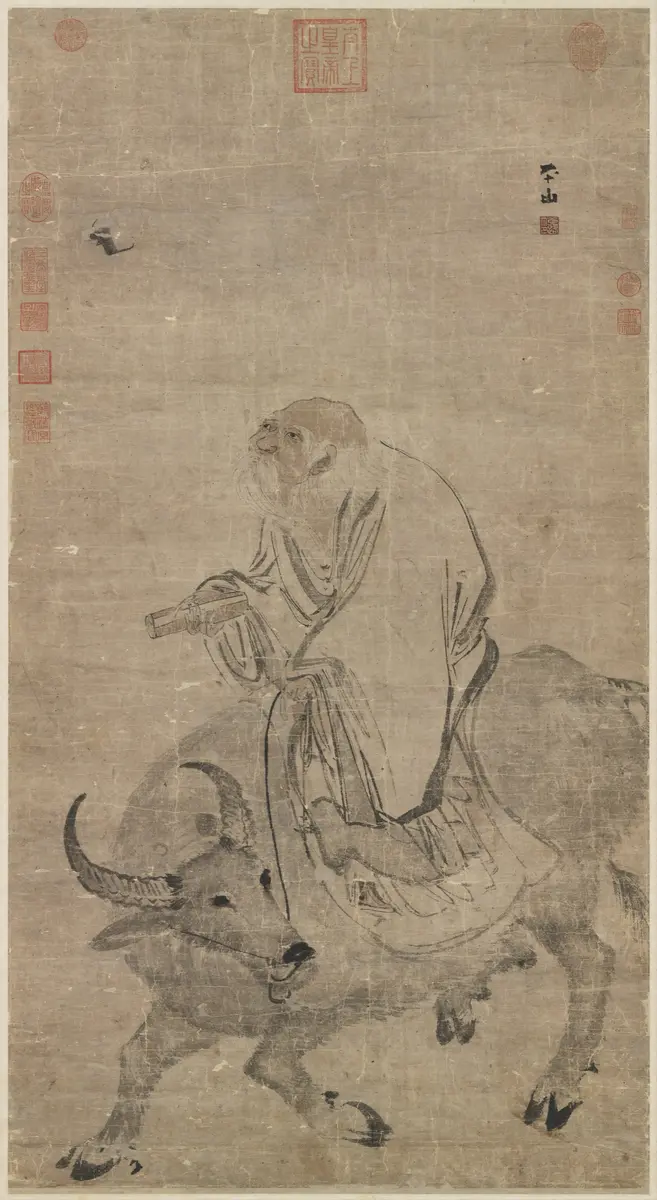
Laozi
“The legendary Old Master of the Daodejing, keeper of the Zhou archives who, the story says, taught Confucius, rode west through the pass and wrote his five thousand characters on the Way before vanishing.”
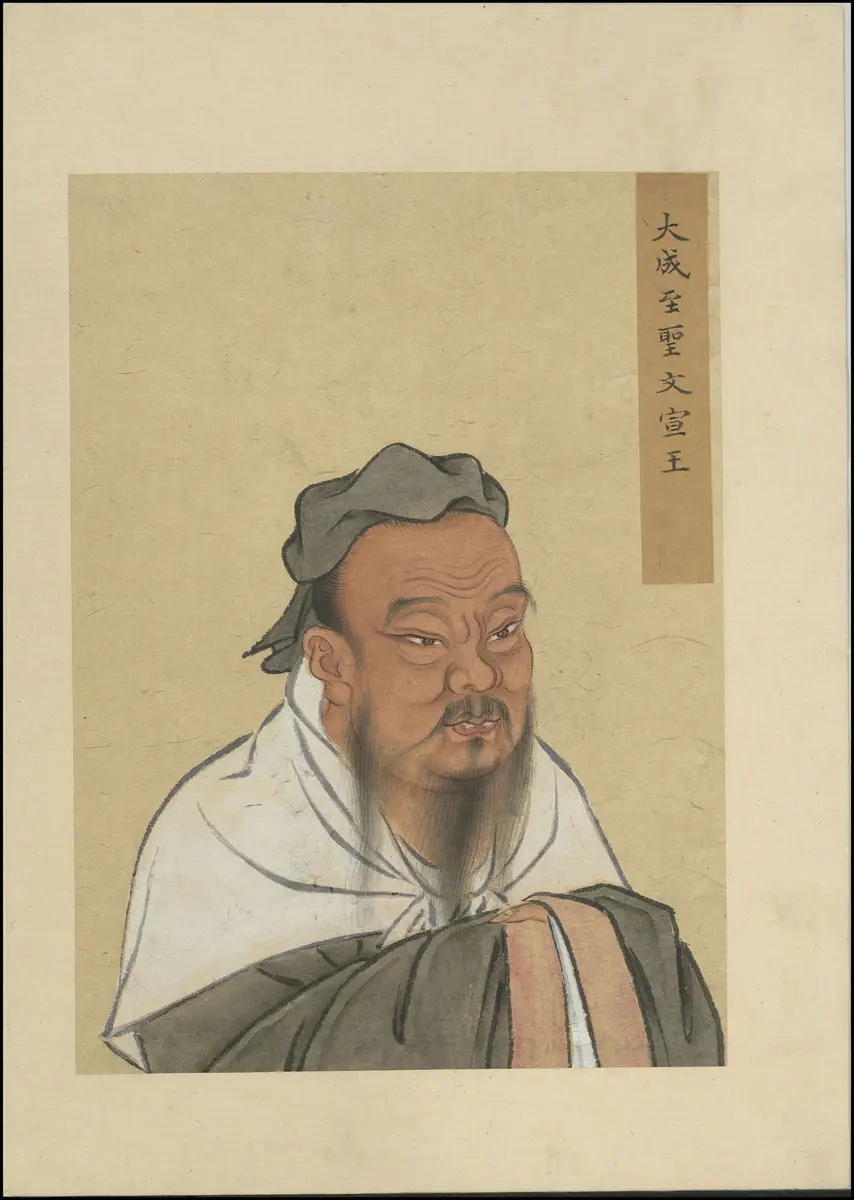
Laozi, the 'Old Master', is the sage to whom China credits the Daodejing, the short, riddling 'Classic of the Way and Virtue' that founded Daoism, and the oldest and least certain of the great teachers of the sixth century BCE. Everything told about his life comes from much later: the first biography is a few paragraphs by Sima Qian, the Han court historian, written about 100 BCE, some four hundred years after the time it describes, and Sima Qian himself admitted that he was stringing together stories that did not agree. Many scholars today think the man is a legend; others accept that a thinker called Lao Dan lived a little before Confucius and that his followers gave him the name of respect.
By Sima Qian's account he was born in a village in the state of Chu, at what is now Luyi in eastern Henan, with the family name Li and the given name Er. He served as a keeper of the archives at the court of the Zhou kings at Luoyang, and the young Confucius came to him to ask about the rites and went away saying he had met a dragon. When he saw that the Zhou were in decline he left, riding west; at the mountain pass on the frontier the keeper of the pass, Yin Xi, begged him to write his teachings down before he went. He wrote a book of some five thousand characters in two parts, on the Way and on virtue, and rode on, and nobody knows where he died. Later tradition fixed the pass as the Hangu Pass and placed the writing at Louguantai, in the hills south-west of Xi'an.
The book itself has a firmer history than its author. The oldest copies yet found are three bundles of bamboo slips from a tomb at Guodian in Hubei, sealed about 300 BCE, which carry about two fifths of the text; two silk copies from the Mawangdui tomb near Changsha, sealed in 168 BCE, carry the whole of it, with the 'virtue' half before the 'Way'. Most scholars now read it as an anthology of sayings that grew during the fourth century BCE and settled into its 81 short chapters under the Han. Its themes are the Dao, the nameless Way that underlies everything, the 'virtue' or power by which it works, naturalness, and wuwei, action without forcing: the soft overcomes the hard, the ruler who does least governs best, and 'governing a large country is like cooking a small fish'. Some seven hundred Chinese commentaries exist; the ones by Heshang Gong and by Wang Bi, a prodigy who died at twenty-three in 249 CE, carried the standard text for the next seventeen centuries.
In the second century CE Laozi became a god. The emperor Huan sent sacrifices to his birthplace in 165, an inscription there made him a cosmic being who had advised the sage-kings of old, and the Way of the Celestial Masters, the first organised Daoist church, worshipped him as Lord Lao, the Dao in person. The Tang emperors, whose family name was also Li, claimed him as their ancestor: in 666 Gaozong made him 'Supreme Emperor of the Mysterious Origin', and in 733 Xuanzong, who wrote his own commentary, ordered every household to keep a copy of the Daodejing and put it on the civil-service examinations. His birthday is still kept on the fifteenth day of the second lunar month, and the figure of the old man riding an ox out of the pass became one of the most painted scenes in Chinese art.
The West met him late. A Latin version made by Jesuit missionaries reached the Royal Society in London in 1788; Stanislas Julien printed the first full translation, into French, in 1842, and James Legge's English followed in 1891. More than two thousand translations have been counted since, which makes the Daodejing, after the Bible, probably the most translated book in the world. Whether or not the Old Master ever lived, his book did what he is said to have done at the pass: it left, and went everywhere.
What happened
- 600 BCE
Born, by Sima Qian's account, in the village of Quren in the district of Hu in the southern state of Chu, today's Luyi in eastern Henan, with the family name Li, the given name Er and the appellation Dan, 'long ears', a mark of long life. Tradition keeps his birthday on the fifteenth day of the second lunar month; the year is a convention, and some scholars think no such man lived.
Luyi: by Sima Qian's account his birthplace, the village of Quren in the district of Hu in Chu; the Laozi temple here, founded in 165 CE, became the Tang Taiqing Palace - 518 BCE
Keeper of the archives at the Zhou royal court at Luoyang, he is visited by the young Confucius, who asks him about the rites. By the story Sima Qian and the Zhuangzi tell, the old man rebukes his pride and ambition, and Confucius tells his disciples that he has seen a dragon. Historians call the meeting a legend; the traditional dates for it run from 518 to 501 BCE.
Luoyang: the Zhou royal capital where, the tradition says, he kept the archives and received Confucius - 501 BCE
Seeing the house of Zhou in decline, he leaves, riding west. At the pass on the frontier the gatekeeper Yin Xi asks him to write his teachings down before he goes, and he writes a book of some five thousand characters in two parts, on the Way and on virtue: the Daodejing. Then he rides on through the pass, and nobody knows where he went or where he died. Later tradition names the Hangu Pass and makes Louguantai the place of the writing.
The Hangu Pass at Lingbao: the frontier pass where, the story says, the gatekeeper Yin Xi asked him to write his book before he rode west