Helen Keller
“Deafblind from the age of 19 months, she learned language from Anne Sullivan at a water pump in 1887, graduated from Radcliffe in 1904 and became a world-famous author, socialist and campaigner for the blind.”
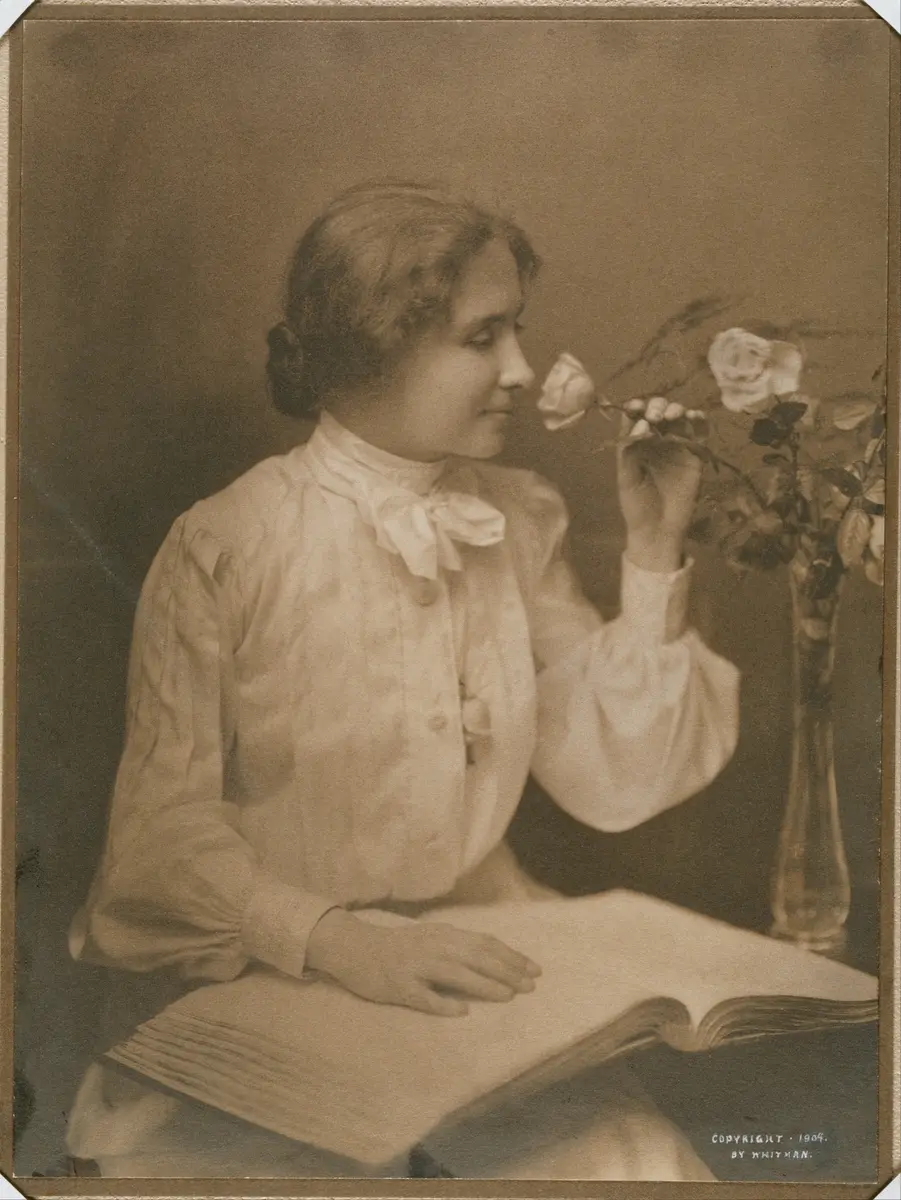
Helen Keller was an American author, lecturer and campaigner who lost her sight and hearing to an illness at nineteen months and became, with her teacher Anne Sullivan, the best-known example of what a deafblind person can learn. Sullivan reached her in 1887 by spelling words into her hand; Keller went on to read braille and raised type, to write, to speak aloud, to 'hear' others by touching their lips and throat, and in 1904 to graduate from Radcliffe College, the first deafblind person to earn a bachelor's degree. She wrote a dozen books, beginning with The Story of My Life (1903), worked for more than forty years for the American Foundation for the Blind, and met every American president from Grover Cleveland to John F. Kennedy. She was also, for much of her life, a political radical: a socialist, a suffragist, a pacifist and one of the founders of the American Civil Liberties Union.
She was born on 27 June 1880 at Ivy Green, her family's house in Tuscumbia, northern Alabama, the daughter of Arthur H. Keller, a former Confederate captain who edited the local newspaper, and his second wife, Kate Adams. In February 1882 an illness that doctors called 'acute congestion of the stomach and brain', perhaps scarlet fever or meningitis, left her blind and deaf. She grew up wild and frustrated, making herself understood with signs of her own. In 1886 her parents took her to an eye doctor in Baltimore, who sent them to Alexander Graham Bell in Washington, who sent them to Michael Anagnos, director of the Perkins Institution for the Blind in Boston. Anagnos chose his best former pupil, Anne Sullivan, twenty years old, the daughter of poor Irish immigrants, who had spent four years in a state poorhouse and still saw only partly. She arrived on 3 March 1887, moved with the child into the little garden house to win her obedience, and on 5 April, at the pump outside, spelled 'w-a-t-e-r' into one hand while water ran over the other. Keller understood that everything had a name, and by nightfall knew thirty words.
Her progress made her famous at eight. From 1888 she studied at Perkins in Boston, learned to speak with Sarah Fuller in 1890, and at eleven survived a painful charge of plagiarism over a short story, 'The Frost King', that turned out to echo a book read to her years before. Bell and Mark Twain became lifelong friends and defenders. After a school for the deaf in New York and a preparatory school in Cambridge, she entered Radcliffe, Harvard's college for women, in 1900, with Sullivan spelling every lecture and book into her hand, and graduated cum laude on 28 June 1904. While still a student she wrote The Story of My Life, edited by the Harvard scholar John Macy, who married Sullivan in 1905; it has been translated into some fifty languages.
Her politics were the side of her the public liked least. She joined the Socialist Party in 1909, convinced, as she said later, that much blindness came from industrial accidents, poverty and venereal disease rather than fate; she wrote 'How I Became a Socialist' in 1912, called herself an IWW, a member of the radical Industrial Workers of the World, and campaigned against America's entry into the First World War. She worked for women's suffrage and birth control, sent money to the NAACP, and in 1920 helped found the ACLU. Newspapers that had praised her mind now blamed her views on her disability. Like many progressives of her day she also held eugenic views: in 1915 she publicly backed a Chicago surgeon who let a severely disabled newborn die. To earn a living she lectured, played herself in a Hollywood film, Deliverance (1919), and toured the vaudeville stage from 1920 to 1924.
In 1924 she began her life's main work for the new American Foundation for the Blind, raising money, addressing legislatures and pressing for state commissions for the blind and for help for blind people in the Social Security Act of 1935. Sullivan died in 1936; her secretary Polly Thomson took her place, and from 1939 they lived at Arcan Ridge in Easton, Connecticut. She visited blinded soldiers in military hospitals in the Second World War, and from 1946 to 1957 travelled to thirty-five countries for the blind, as an unofficial American ambassador, from Japan, where she spoke at Hiroshima in 1948, to India, South Africa and Latin America. William Gibson's play The Miracle Worker (1959) fixed her childhood in the world's memory. Strokes ended her public life in 1961; in 1964 Lyndon Johnson gave her the Presidential Medal of Freedom. She died in her sleep at Arcan Ridge on 1 June 1968, and her ashes lie in Washington National Cathedral beside those of Sullivan and Thomson.
What happened
- 1880
Helen Adams Keller is born at Ivy Green in Tuscumbia, northern Alabama, in the small cottage beside the main house, the daughter of Captain Arthur H. Keller, a newspaper editor who had fought for the Confederacy, and his second wife Kate Adams.
Ivy Green, Tuscumbia, Alabama: the family house where she was born in 1880 and where Anne Sullivan taught her at the water pump in 1887- 1882
At nineteen months an illness the doctor calls 'acute congestion of the stomach and brain', perhaps scarlet fever or meningitis, leaves her blind and deaf; she grows up communicating with home signs, unruly and often in a rage.
Ivy Green, Tuscumbia, Alabama: the family house where she was born in 1880 and where Anne Sullivan taught her at the water pump in 1887- 1886
Her parents take her to an eye specialist in Baltimore, who sends them on to Alexander Graham Bell in Washington; Bell tells her father to write to Michael Anagnos, director of the Perkins Institution for the Blind in Boston, where Laura Bridgman had been taught fifty years before.
Anagnos answers Captain Keller's letter of 15 July: the child reminds him of Laura Bridgman, and he will gladly help find a competent teacher; he chooses his former pupil Anne Sullivan.
- 1887
Captain Keller offers Miss Sullivan her board, washing and twenty-five dollars a month, and promises to treat her as one of the family.
Ivy Green, Tuscumbia, Alabama: the family house where she was born in 1880 and where Anne Sullivan taught her at the water pump in 1887Anne Sullivan, twenty, arrives at Tuscumbia, the day Keller later called her 'soul's birthday', and begins at once to spell words into the child's hand, starting with 'd-o-l-l' for the doll the Perkins girls had sent. Within a week she wins permission to take Helen away from her indulgent family into the little garden house, where the two live alone for two weeks while she teaches her obedience.
Ivy Green, Tuscumbia, Alabama: the family house where she was born in 1880 and where Anne Sullivan taught her at the water pump in 1887At the pump outside, Sullivan spells 'w-a-t-e-r' into one hand as cool water gushes over the other, and Helen grasps that everything has a name; by nightfall she has learned thirty words, and by the end of August 625.
Ivy Green, Tuscumbia, Alabama: the family house where she was born in 1880 and where Anne Sullivan taught her at the water pump in 1887- 1888
After a few days in Washington, where they see Bell and call on President Cleveland, Helen, her mother and Sullivan reach the Perkins Institution in Boston, where she will study, on and off, for the next years.
- 1890
In the spring she asks to learn to speak; Sarah Fuller of the Horace Mann School for the Deaf in Boston gives her eleven lessons, feeling of lips and throat, after which Sullivan carries on. She is never satisfied with her voice, which strangers find hard to understand.
- 1891
She sends Anagnos a story, 'The Frost King', as a birthday present; it proves to echo a children's story read to her years before, she is questioned by a Perkins tribunal as a plagiarist, and by 1894 Anagnos breaks with her and her teacher.
- 1893
Bell takes her and Sullivan round the World's Fair in Chicago, describing its marvels of invention to her.
- 1894
She and Sullivan move to New York, where she studies speech and lip-reading at the Wright-Humason School for the Deaf.
- 1895
At the New York home of the writer Laurence Hutton she meets Mark Twain and William Dean Howells; Twain becomes a lifelong friend and admirer.
- 1896
Her father, Captain Arthur Keller, dies; that autumn she becomes a follower of the Swedenborgian church, and in October enters the Cambridge School for Young Ladies to prepare for Radcliffe.
- 1900
She enters Radcliffe College, Harvard's college for women, as a member of the class of 1904, with Sullivan spelling lectures and books into her hand.
Radcliffe College, Cambridge, Massachusetts (Fay House): her college from 1900 until she graduated in 1904- 1903
The Story of My Life comes out as a book, edited by John Macy after its serialisation in the Ladies' Home Journal and dedicated to Alexander Graham Bell; it is still in print and has been translated into some fifty languages.
- 1904
She graduates from Radcliffe cum laude, the first deafblind person to earn a bachelor of arts; she and Sullivan buy a farmhouse at Wrentham, Massachusetts.
Radcliffe College, Cambridge, Massachusetts (Fay House): her college from 1900 until she graduated in 1904- 1909
She and John Macy, now Sullivan's husband, join the Socialist Party of Massachusetts, and she becomes a suffragist.
- 1912
In the socialist New York Call she publishes 'How I Became a Socialist', mocking the Brooklyn Eagle, which had praised her mind until she came out for socialism and now put her views down to her blindness and deafness.
- 1913
She and Sullivan begin lecturing across the country, a career of more than fifty years, and she publishes Out of the Dark, her socialist essays.
- 1915
In The New Republic she defends a Chicago surgeon who let a severely disabled newborn die, proposing juries of doctors to decide such cases: a eugenic view shared by many progressives of the day.
- 1916
At Carnegie Hall in New York, for the Women's Peace Party, she gives 'Strike Against War', urging working people to refuse to fight; eleven days later the New York Tribune prints her interview 'Why I Became an IWW'.
Peter Fagan, a young socialist acting as her secretary, proposes and they take out a marriage licence in Boston; her mother forces her to renounce the engagement in public and takes her to Alabama.
- 1918
In Hollywood she films Deliverance, a silent feature about her life in which she plays herself; released in 1919, and from February 1920 she and Sullivan earn their living on the vaudeville stage.
- 1920
The American Civil Liberties Union, created a week earlier from the wartime Civil Liberties Bureau by Roger Baldwin and others to defend radicals' rights after the Palmer Raids, holds its first official meeting; Keller is one of its founders.
- 1924
She and Sullivan begin working for the new American Foundation for the Blind; for the next forty years she raises its money, lectures and lobbies legislatures for the blind.
- 1925
At the Lions Clubs' international convention she asks the Lions to become 'knights of the blind', and sight work becomes their main cause.
- 1926
In Washington she meets President Coolidge and Grace Coolidge, and reads Mrs Coolidge's lips with her hand for the press photographers.
- 1935
She lobbies successfully for Title X of the Social Security Act, which lets blind people receive state grants.
- 1936
Anne Sullivan Macy dies at their home in Forest Hills, New York; her ashes are placed in Washington Cathedral, which offers Keller the right to lie beside her. Polly Thomson, her secretary since 1914, takes Sullivan's place.
Washington National Cathedral, Washington, D.C.: her funeral, and her ashes beside Anne Sullivan's and Polly Thomson's- 1937
Keeping a promise to Sullivan, she tours Japan, Korea and Manchuria for the blind; she comes home with an Akita, the first of the breed in America.
- 1939
She sells the Forest Hills house and moves with Polly Thomson to Arcan Ridge, a house in the country at Easton, Connecticut.
Easton, Connecticut: Arcan Ridge, her home from 1939, where she died in 1968- 1943
She begins visiting blinded, deaf and maimed soldiers in military hospitals across the country, 'the crowning experience of my life'.
- 1946
For the American Foundation for Overseas Blind she makes her first world tour, to London, Paris, Italy, Greece and Scotland; in November a fire destroys Arcan Ridge and almost all she owns, and the house is rebuilt by 1947. In eleven years she visits 35 countries.
Easton, Connecticut: Arcan Ridge, her home from 1939, where she died in 1968- 1948
Touring Australia and New Zealand, she visits schools for the deaf and the blind in Sydney, where British Pathé films her.
Sent to Japan by General MacArthur as America's first goodwill ambassador, she speaks at Hiroshima and meets its mayor; the next day she writes that the ruined city 'exceeds in horror and anguish the accounts I have read'.
Hiroshima, Japan: where she spoke to the survivors on 13 October 1948, on her tour of Japan for the blind- 1955
After a five-month, 40,000-mile tour of Asia, including India and Japan, she receives an honorary doctorate from Harvard, the first woman so honoured; the film of her life, Helen Keller in Her Story, wins an Oscar the next spring.
- 1959
William Gibson's play The Miracle Worker, about her first weeks with Sullivan, opens on Broadway; it wins the Pulitzer Prize in 1960 and is filmed in 1962.
- 1960
Polly Thomson dies; a nurse, Winnie Corbally, stays on as Keller's companion.
- 1961
In Washington to receive the Lions Humanitarian Award, she calls on President Kennedy in the Oval Office, her last major public appearance.
A stroke, the first of several, ends her public life; she lives quietly at Arcan Ridge.
Easton, Connecticut: Arcan Ridge, her home from 1939, where she died in 1968- 1964
President Johnson awards her the Presidential Medal of Freedom, 'an example of courage to all mankind'; she is too frail to attend the ceremony.
- 1968
She dies in her sleep at Arcan Ridge, weeks before her 88th birthday. More than 1,200 people attend her funeral at Washington National Cathedral, where her ashes are placed beside those of Anne Sullivan and Polly Thomson.
Easton, Connecticut: Arcan Ridge, her home from 1939, where she died in 1968