Muhammad
“The Arab prophet who founded Islam: he proclaimed the Qur'an in Mecca from about 610, moved to Medina in 622, the first year of the Islamic calendar, and had united most of Arabia by his death in 632.”
Muhammad was the Arab prophet who founded Islam and proclaimed the Qur'an, which Muslims hold to be the word of God, revealed to him through the angel Gabriel from about 610 until his death. Born in Mecca, a trading town in western Arabia with an ancient sanctuary, the Kaaba, he became in twenty-two years both the religious and the political leader of most of Arabia. Within a generation of his death the community he founded had taken Syria, Egypt and Persia; today about 1.8 billion people, nearly a quarter of humanity, are Muslims, and the country with the most of them is Indonesia.
Almost everything told about his life comes from Islamic tradition written down a century and more after he died: above all the biography by Ibn Ishaq (died 767 or 768), known through later versions such as Ibn Hisham's, and the reports of his words and deeds, the hadith. The Qur'an itself names few people and gives no dates. A few outside sources confirm the outline: a Syriac chronicle of about 640 mentions 'the Arabs of Muhammad', and an Armenian history of about 660 calls him a merchant who preached to the Arabs. Historians see no compelling reason to doubt the basic framework of the traditional story, but its exact dates were worked out later by the biographers. Two leaves of the Qur'an in Birmingham, on parchment radiocarbon-dated to between 568 and 645, show that parts of the text were written down very close to his lifetime.
According to tradition he was born in 570 into the clan of Hashim of the Quraysh, the tribe that ruled Mecca. His father died before he was born and his mother when he was six; his grandfather and then his uncle Abu Talib raised him. He worked in the caravan trade, and at about twenty-five married Khadija, a wealthy widow whose goods he had taken to Syria; they stayed married, he with no other wife, until her death some twenty-five years later. At forty, during a retreat in a cave on Mount Hira above Mecca, he had the experience that Muslims see as the first revelation. He preached one God, a coming judgment and care for the poor, against the many gods whose idols stood in the Kaaba. That won him a small following and the enmity of Mecca's leading families; some of his followers took refuge in Christian Ethiopia, and when Khadija and Abu Talib died in about 619 his clan withdrew its protection.
In 622 he and his followers moved to the oasis town of Yathrib, which had invited him to settle its feuds and which became known as Medina, 'the town'. This emigration, the Hijra, became the start of the Islamic calendar, from which the caliph Umar began to count the years in 639. At Medina he was prophet and ruler at once: he built a house that was also the community's place of prayer, made an agreement that joined the believers and some of the town's Jewish tribes into one community, and turned the direction of prayer from Jerusalem to the Kaaba. War with Mecca followed: victory at Badr in 624, a defeat at Uhud in 625 and a failed siege of Medina, the Battle of the Trench, in 627. After each battle one of the three main Jewish tribes of Medina was removed: two were driven out, and the tradition says that the men of the third, the Qurayza, were executed. A truce in 628 opened the way to Mecca, which surrendered in 630; he declared an amnesty and, the tradition says, cleared the Kaaba of its idols. In 632 he led the Farewell Pilgrimage, the model for every later hajj, and on 8 June 632 he died at Medina, where he is buried under the Green Dome of the Prophet's Mosque.
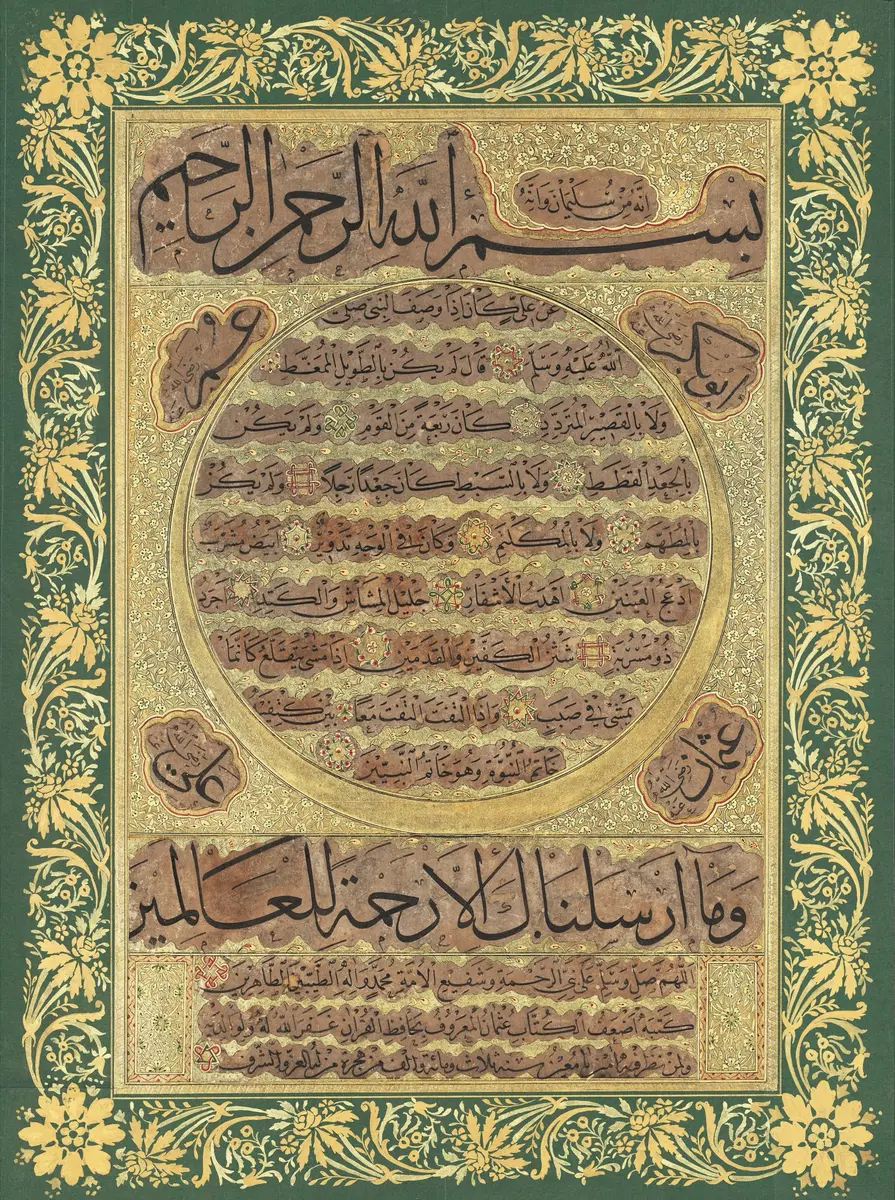
He left no arrangement for who should lead after him. His companion Abu Bakr became the first caliph, but many held that his cousin and son-in-law Ali was the rightful heir, and that dispute is the root of the division between Sunni and Shi'i Islam. Muslims honour him as the last of a line of prophets that includes Abraham, Moses and Jesus, and many reject any picture of him or of other prophets. This album therefore shows no image of him: it opens with his appearance described in words, a hilye by the Ottoman calligrapher Hafiz Osman, and follows him through the places of his life as the first photographers of Mecca and Medina saw them around 1880, through the earliest objects that name him, and on to pilgrims from the Indonesian islands, photographed at Mecca's port by a Dutch scholar in the same years.
What happened
- 570
Born in Mecca into the clan of Hashim of the Quraysh, the tribe that ruled the town and its sanctuary. His father has died before his birth. Tradition dates the birth to the year in which Abraha, the Christian ruler of South Arabia, marched on Mecca with an elephant and failed to take it.
The Kaaba, Mecca: the sanctuary of the town where he was born in 570, the direction of prayer from 624, cleared of its idols when Mecca surrendered in 630 - 576
His mother Amina dies when he is six; his grandfather Abd al-Muttalib takes him in, and after the grandfather's death two years later his uncle Abu Talib, head of the clan, raises him.
- 595
At about twenty-five he marries Khadija, a wealthy widow who had hired him to take her goods to Syria. They have at least two sons, who die young, and four daughters, among them Fatima.
- 610
At forty, during a retreat in a cave on Mount Hira above Mecca, he has the experience Muslims see as the first revelation: according to Islamic tradition the angel Gabriel teaches him the first verses of sura 96, 'Recite in the name of your Lord'. Khadija and her Christian cousin Waraqa reassure him.
The cave of Hira on Jabal al-Nour, above Mecca: where, according to Islamic tradition, the first revelation came to him in about 610 - 613
After about three years of speaking of the revelations only in private, he begins to preach in public. When his message turns against the gods of the Quraysh, Mecca's leading families turn against him and his followers.
- 615
About now some of his followers take refuge with the Christian king of Ethiopia, and the other clans of Mecca boycott his own clan, which still protects him.
- 619
Khadija and Abu Talib die. His uncle Abu Lahab, the new head of the clan, withdraws its protection; he looks for support in the town of al-Ta'if and is turned away.
- 620
According to Islamic tradition, about now he is carried in one night from Mecca to Jerusalem, prays there with Abraham, Moses, Jesus and the other prophets, and rises to heaven, where God sets the five daily prayers: the Night Journey, which Muslims commemorate at the Rock in Jerusalem.
- 622
Promised protection by people of Yathrib, his followers leave Mecca for the oasis; he follows last, with Abu Bakr. The tradition says he escaped a plot to kill him and hid in a cave on Mount Thawr. In the oasis, at Quba, the first mosque is founded. This emigration, the Hijra, becomes the first year of the Islamic calendar.
In Yathrib, now Medina, he builds a house that is also the place of prayer, and draws up a covenant that joins the believers from Mecca and Medina and some of the town's Jewish tribes into one community, the umma, under him as the messenger of God.
The Prophet's Mosque, Medina: his house and mosque from 622, and his tomb under the Green Dome since 632- 624
About eighteen months after the Hijra a revelation turns the direction of prayer from Jerusalem, as in Jewish practice, to the Kaaba in Mecca. Around the same time the Muslims of Medina begin raiding Meccan caravans.
In the middle of the month of Ramadan, about 300 Muslims surprised by a Meccan force of about 1,000 at the wells of Badr win a complete victory, which the Qur'an attributes to God's help; it is the only battle the Qur'an names.
Badr: the battlefield of his first victory over the Meccans, in 624- 625
The Meccans march on Medina and defeat the Muslims below Mount Uhud; he is wounded and his uncle Hamza is killed, but the Meccans do not take the town.
- 627
A Meccan army and its allies besiege Medina, which the Muslims have protected with a ditch, and give up: the Battle of the Trench. After each of the three battles with Mecca one of the three main Jewish tribes of Medina is removed; the first two were driven out, and according to the tradition the men of the third, the Qurayza, are now executed and the women and children enslaved.
- 628
He sets out with his followers to make the pilgrimage to Mecca and is stopped at al-Hudaybiyya, on the edge of the sacred territory. A treaty ends the fighting and allows the Muslims to make the pilgrimage the next year.
Two months later he leads his forces against the Jewish oasis of Khaybar, north of Medina. After a siege it submits; its people may stay if they send half their date harvest to Medina.
- 629
As the treaty allows, he and his followers make the pilgrimage to Mecca.
- 630
After allies of Mecca attack allies of his, he renounces the treaty and marches on Mecca with a large army. The town submits with little fighting; he declares an amnesty and, the tradition says, clears the Kaaba of its idols.
The Kaaba, Mecca: the sanctuary of the town where he was born in 570, the direction of prayer from 624, cleared of its idols when Mecca surrendered in 630He leads a campaign north to Tabuk on the Syrian border, and back in Medina receives delegations from tribes all over Arabia who declare their allegiance.
- 632
He leads the pilgrimage to Mecca himself, the Farewell Pilgrimage, whose rites, with the standing at Arafat, became the model for every later hajj; the tradition says he gave his last sermon on the plain of Arafat.
Mount Arafat, east of Mecca: the high point of the Farewell Pilgrimage of 632, and of every hajj sinceHe dies at Medina and is buried in his house beside the mosque, where his tomb now lies under the Green Dome. He has named no successor; Abu Bakr becomes the first caliph, and the quarrel over Ali's claim begins.
The Prophet's Mosque, Medina: his house and mosque from 622, and his tomb under the Green Dome since 632